What you'll learn in this topic:
- The difference between a strong acid and a weak acid in terms of ionisation.
- Why "strong" doesn't mean the same thing as "concentrated".
- How the pH scale links mathematically to the concentration of hydrogen ions.
You already know that acids form acidic solutions when dissolved in water. They do this by releasing hydrogen ions. The process of an acid molecule splitting apart to release these ions is called ionisation.
Ionisation
The process where a molecule splits apart in an aqueous solution to form ions. For acids, this means splitting to release hydrogen ions (H+\text{H}^+H+).
The difference between a strong acid and a weak acid comes down entirely to how much they ionise.
A strong acid is completely ionised in aqueous solution. This means that every single acid molecule that you put into the water splits apart to release a hydrogen ion. There are no intact acid molecules left.
Because the reaction goes to completion, we use a standard one-way arrow (→\to→) in the equation.
HCl(aq)→H+(aq)+Cl−(aq)
\text{HCl(aq)} \to \text{H}^+\text{(aq)} + \text{Cl}^-\text{(aq)}
HCl(aq)→H+(aq)+Cl−(aq)
You need to know three examples of strong acids for your exam:
- Hydrochloric acid (HCl\text{HCl}HCl)
- Nitric acid (HNO3\text{HNO}_3HNO3)
- Sulfuric acid (H2SO4\text{H}_2\text{SO}_4H2SO4)
A weak acid is only partially ionised in aqueous solution. When you dissolve a weak acid in water, only a tiny fraction of the molecules split apart. The vast majority of the acid molecules stay intact.
Because this is a reversible process that reaches an equilibrium, we must use the reversible reaction symbol (⇌\rightleftharpoons⇌) in the equation.
CH3COOH(aq)⇌H+(aq)+CH3COO−(aq)
\text{CH}_3\text{COOH(aq)} \rightleftharpoons \text{H}^+\text{(aq)} + \text{CH}_3\text{COO}^-\text{(aq)}
CH3COOH(aq)⇌H+(aq)+CH3COO−(aq)
You need to know three examples of weak acids:
- Ethanoic acid (found in vinegar)
- Citric acid (found in citrus fruits)
- Carbonic acid (found in fizzy drinks)

This is one of the most frequently tested ideas in GCSE Chemistry. You must be able to explain the difference between a "strong" acid and a "concentrated" acid. In everyday language, we often use these words to mean the same thing, but in chemistry, they describe entirely completely different properties!
Confusing 'strong' with 'concentrated'
Students often think a "strong" acid is simply an acid that has a lot of acid molecules crammed into a small amount of water. That is actually the definition of concentrated. Strength is about ionisation, not the amount of water.
Let's break down the definitions clearly:
- Strength (Strong vs Weak): Tells you about the degree of ionisation. A strong acid completely ionises, while a weak acid only partially ionises. This is a chemical property of the specific acid you are using.
- Concentration (Concentrated vs Dilute): Tells you about the amount of substance dissolved in a given volume of water. A concentrated solution has a lot of acid moles per cubic decimetre (mol dm−3\text{mol dm}^{-3}mol dm−3), while a dilute solution has very few. This is a physical mixture that you can change by just adding more water.
Mixing and matching strength and concentration
Because these properties are completely separate, you can have any combination of them!
- You can have a dilute strong acid: A tiny drop of pure hydrochloric acid in a massive swimming pool of water. It is fully ionised, but very spread out.
- You can have a concentrated weak acid: A bottle of pure ethanoic acid. There is very little water, but the acid molecules are mostly intact and un-ionised.
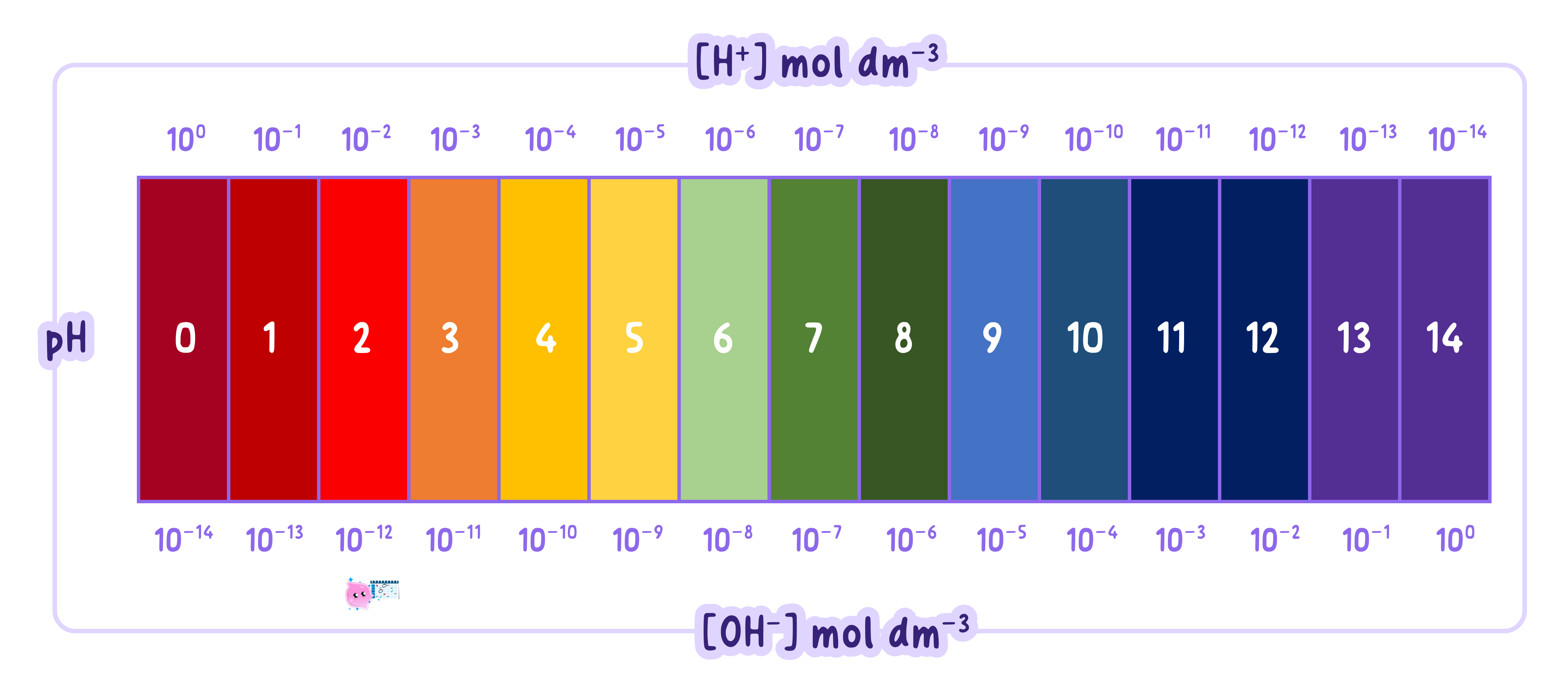
The pH of a solution is a measure of its hydrogen ion concentration.
For any given concentration of aqueous solutions, the stronger an acid is, the lower its pH will be. This makes sense: a strong acid ionises completely, releasing far more hydrogen ions into the water than a weak acid of the exact same concentration. More hydrogen ions mean a more acidic solution, which corresponds to a lower number on the pH scale.
But the pH scale is not a normal linear scale; it is a logarithmic scale. This means a small change in pH represents a massive change in the actual concentration of hydrogen ions.
The golden rule to remember is: As the pH decreases by one unit, the hydrogen ion concentration of the solution increases by a factor of 10.
Moving up and down the pH scale
- If pH goes down by 1, multiply the H+\text{H}^+H+ concentration by 10.
- If pH goes up by 1, divide the H+\text{H}^+H+ concentration by 10.
If the pH drops by more than one unit, you have to multiply by 10 for each step. Let's look at how to handle these order of magnitude calculations.
Calculating the change in hydrogen ion concentration
A student has a beaker of ethanoic acid with a pH of 5. They swap it for a beaker of hydrochloric acid with a pH of 2. By what factor has the hydrogen ion concentration increased?
- Find the difference in pH between the two solutions.
5−2=3
5 - 2 = 3
5−2=3
The pH has decreased by 3 units.
- Calculate the factor by multiplying by 10 for every single unit dropped.
Since the difference is 3 units, you multiply by 10 three times:
10×10×10=1000
10 \times 10 \times 10 = 1000
10×10×10=1000
Alternatively, you can write this as 10310^3103.
- State your final answer.
The hydrogen ion concentration has increased by a factor of 1000.
In the exam
- Read questions carefully to see if they are asking about the concentration of the acid (how much is dissolved) or the strength of the acid (how much it ionises).
- If asked to write an equation for a weak acid, you must use the reversible reaction symbol (⇌\rightleftharpoons⇌). Using a standard arrow will lose you a mark.
- Be prepared to name your three strong acids (hydrochloric, nitric, sulfuric) and your three weak acids (ethanoic, citric, carbonic).
- When calculating changes in H+\text{H}^+H+ concentration, never just multiply the pH difference by 10 (e.g. a drop of 3 pH units is a factor of 1000, not 30!).
Check yourself
- What is the definition of a strong acid?
- Why is ethanoic acid classified as a weak acid?
- Can a strong acid be described as dilute? Explain your answer.
- If an acidic solution changes from pH 6 to pH 4, by what factor has its hydrogen ion concentration increased?