Reversible reaction products can turn back into reactants
Reversible reaction
A reaction in which the products can react to form the original reactants again.
- The change from reactants to products is the forward reaction, and the change from products back to reactants is the reverse reaction.
- A reversible reaction is shown with the equilibrium sign, ⇌\rightleftharpoons⇌, instead of a single arrow.
- Heating ammonium chloride decomposes it into ammonia and hydrogen chloride:
NH4Cl(s)⇌NH3(g)+HCl(g)\text{NH}_4\text{Cl(s)} \rightleftharpoons \text{NH}_3\text{(g)} + \text{HCl(g)}NH4Cl(s)⇌NH3(g)+HCl(g)
- Near the cool top of the test tube, the two gases react again to form a white solid of ammonium chloride.
- Heating blue hydrated copper(II) sulfate drives off water and leaves white anhydrous copper(II) sulfate.
- Adding water to the white solid turns it blue again.
The copper(II) sulfate reaction is used as a test for water, because a liquid that turns white anhydrous copper(II) sulfate blue must contain water.
Changing conditions can reverse a reaction's direction
- Which direction a reversible reaction goes depends on the conditions, such as temperature, pressure and the amounts of substances present.
- For ammonium chloride, heating favours the forward reaction and cooling favours the reverse reaction.
- For copper(II) sulfate, heating removes water, while adding water reverses the change.
- When anhydrous copper(II) sulfate turns blue, the mixture gets hot, because the reverse reaction gives out the energy that heating put in.
- Most reactions, such as burning a fuel, cannot be reversed by changing the conditions.
A reversible reaction can go either way, and the conditions decide which direction happens.
Reversible reactions reach dynamic equilibrium in closed systems
Closed system
A container or apparatus from which no substances can escape and into which none can enter.
Dynamic equilibrium
The state of a reversible reaction in a closed system when the forward and reverse reactions happen at the same rate, so the amounts of all substances stay constant.
- At the start, only reactants are present, so the forward reaction is fast and the reverse reaction has not begun.
- As products build up, the reverse reaction speeds up, while the forward reaction slows as reactants are used up.
- Eventually the forward and reverse reactions happen at the same rate.
- From then on, the amounts of reactants and products stay constant.
- Equilibrium can be reached only in a closed system, because an escaping product could never react back.
- Heating calcium carbonate in an open container lets the carbon dioxide escape, so the reaction goes to completion instead.
- Do not say that the amounts of reactants and products are equal at equilibrium, because they stay constant but can be very different from each other.
- Do not say that the reactions stop at equilibrium, because both continue at the same rate.
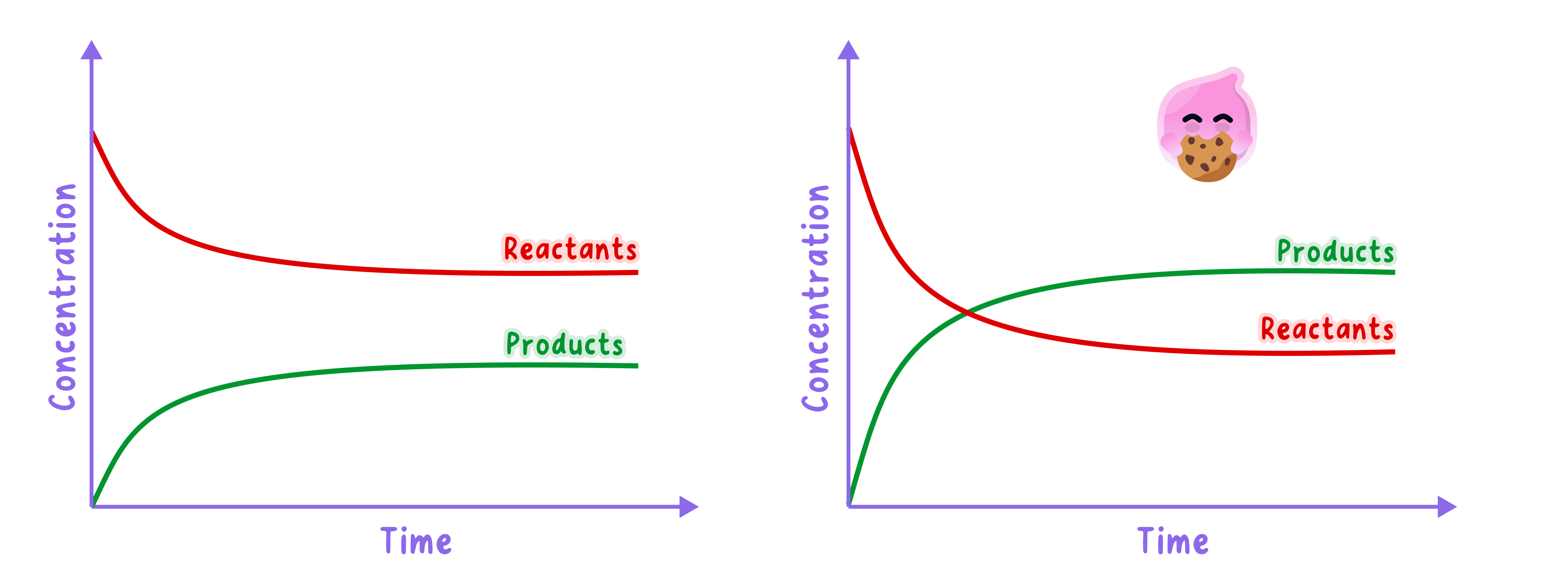
Both reactions continue at dynamic equilibrium
- The equilibrium is dynamic because particles keep reacting in both directions.
- No change can be seen, because each product particle formed is balanced by one reacting back.
- An equilibrium mixture can contain mostly products, mostly reactants or similar amounts of both.
- How far an equilibrium lies towards the products, and how that can be changed, is covered in the next topic.
When a question asks you to describe dynamic equilibrium, mention the closed system, the forward and reverse rates being equal and the amounts staying constant.
- What does the symbol ⇌\rightleftharpoons⇌ show in an equation?
- What happens when water is added to white anhydrous copper(II) sulfate?
- Why can dynamic equilibrium be reached only in a closed system?
- What is true about the rates of the forward and reverse reactions at dynamic equilibrium?
- Are the amounts of reactants and products equal at equilibrium?
