Question 30
FA student tested four solutions, A, B, C and D, with universal indicator. Figure shows the colour chart for universal indicator.
Figure: The colour chart for universal indicator and the pH values that each colour shows
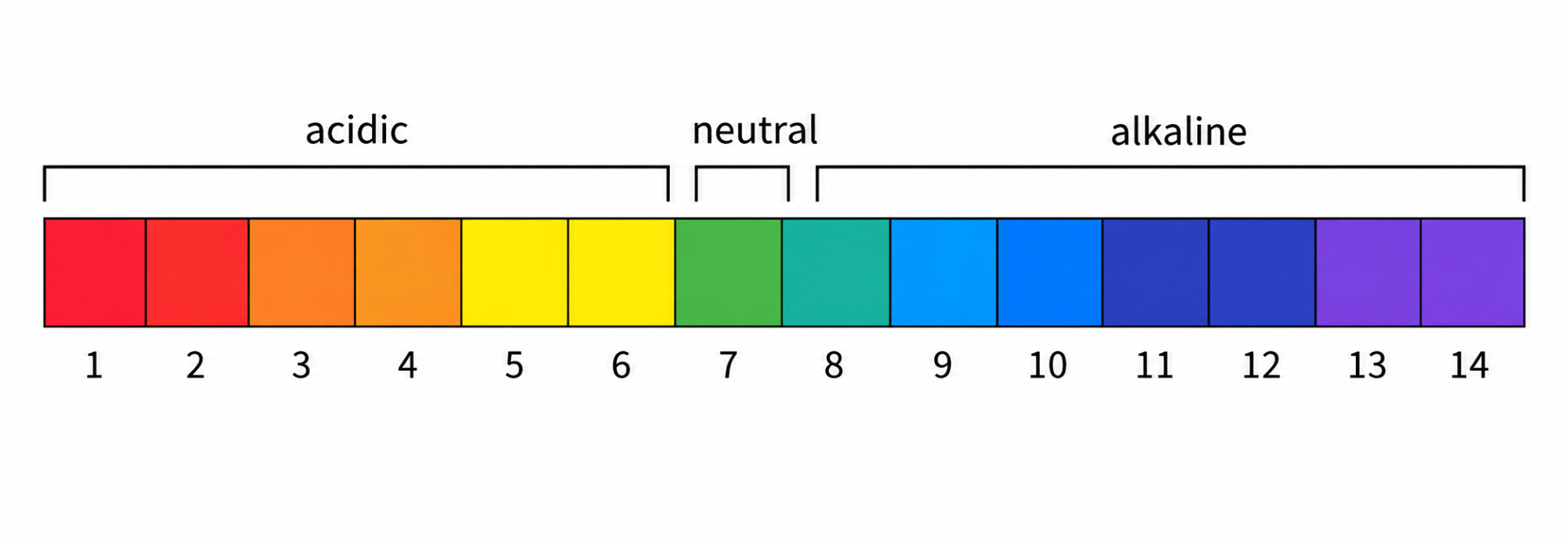
Table: The colour of universal indicator in each of the four solutions tested
| Solution | Colour of universal indicator |
|---|---|
| A | green |
| B | red |
| C | blue |
| D | yellow |
a.[1]
Use Figure and Table to give the pH of solution A.
b.[1]
Give the letter of the solution that is the most acidic.
c.[1]
Name the ion that is present in all acidic solutions.
d.[1]
Solution C is an alkali. Name the ion that is present in all aqueous solutions of alkalis.
e.[1]
Give one advantage of using a pH probe instead of universal indicator to measure the pH of solution D.
4.2 Reactions of acids Questions
88 exam-style questions on AQA GCSE Chemistry 4.2 Reactions of acids, covering 4.2.1a Reactions of acids with metals, 4.2.1b Redox in acid-metal reactions, 4.2.2 Neutralisation of acids and salt production, 4.2.3 Soluble salts, 4.2.4 The pH scale and neutralisation, 4.2.5a Titrations, 4.2.5b Calculating quantities in titrations, and 4.2.6 Strong and weak acids. Each one has a worked solution and a mark scheme showing where the marks go.