6.2.1 Crude oil and fractional distillation
Crude oil is a hydrocarbon mixture and a feedstock
Hydrocarbon
A compound containing carbon and hydrogen atoms only.
Feedstock
A raw material that an industrial process turns into other useful substances.
- Crude oil is a thick, dark mixture of many different hydrocarbons, pumped from rocks beneath the land and the seabed.
- Most of these hydrocarbons are alkanes, with chains ranging from one carbon atom to more than fifty.
- Crude oil is the main source of the hydrocarbons used as fuels, such as petrol, diesel and kerosene.
- It is also a feedstock for the petrochemical industry, which turns its hydrocarbons into new substances.
- Plastics, solvents, detergents, lubricants, dyes and many medicines are all made from crude oil hydrocarbons.
- Crude oil is of little use as it comes out of the ground, because each use needs hydrocarbons with a particular chain length.
Crude oil has to be separated into simpler mixtures before its hydrocarbons can be used as fuels or feedstocks.
Each fraction contains alkanes of similar chain length
Fraction
A mixture of hydrocarbons with similar numbers of carbon atoms and similar boiling points, collected together from crude oil by fractional distillation.
Alkane
A hydrocarbon in which all the bonds between carbon atoms are single covalent bonds.
- Fractional distillation separates crude oil into fractions with different boiling point ranges.
- Each fraction is still a mixture, containing hydrocarbons with similar numbers of carbon atoms and similar boiling points.
- The fractions are made up largely of alkanes, which form a homologous series.
- Each alkane has one more CH2\text{CH}_2CH2 unit than the one before, and all of them fit the general formula: CnH2n+2\text{C}_n\text{H}_{2n+2}CnH2n+2
- In the formula, nnn is the number of carbon atoms, so octane, with 888 carbon atoms, is C8H18\text{C}_8\text{H}_{18}C8H18.
- Alkanes contain only single bonds, so each carbon atom is bonded to as many hydrogen atoms as possible.
- Find the formula of the alkane with 121212 carbon atoms, then decide whether C10H20\text{C}_{10}\text{H}_{20}C10H20 is an alkane.
- Substitute n=12n = 12n=12: 2n+2=(2×12)+2=262n + 2 = (2 \times 12) + 2 = 262n+2=(2×12)+2=26, so the formula is C12H26\text{C}_{12}\text{H}_{26}C12H26.
- An alkane with 101010 carbon atoms needs (2×10)+2=22(2 \times 10) + 2 = 22(2×10)+2=22 hydrogen atoms.
- C10H20\text{C}_{10}\text{H}_{20}C10H20 has only 202020 hydrogen atoms, so it does not fit CnH2n+2\text{C}_n\text{H}_{2n+2}CnH2n+2 and is not an alkane.
In fractional distillation, vapours condense at different heights
Fractionating column
A vertical tube in which vapour repeatedly condenses and evaporates, improving the separation of liquids with different boiling points.
- Crude oil is heated to about 350 ∘C350\ ^{\circ}\text{C}350 ∘C in a furnace, so most of it boils and turns to vapour.
- The hot vapour is piped into the bottom of a tall fractionating column.
- The column has a temperature gradient, being hottest at the bottom and coolest at the top.
- The vapours rise up the column through holes in a series of trays, cooling as they go.
- Each hydrocarbon condenses to a liquid when it reaches a tray that is cooler than its boiling point, and the liquid is piped off.
- The smallest molecules never condense, so they leave the top of the column as refinery gases.
- The largest molecules do not boil at all, so they run out of the bottom as a thick residue called bitumen.
- From the top of the column down, the main fractions are refinery gases, petrol, naphtha, kerosene, diesel oil, fuel oil and bitumen.
- Refinery gases are bottled as liquefied petroleum gas, petrol and diesel fuel cars, and kerosene fuels aircraft.
- Naphtha is the main feedstock for making chemicals, fuel oil powers ships and bitumen surfaces roads.
Larger molecules have higher boiling points
Intermolecular force
An attraction between separate molecules.
Boiling point
The temperature at which a liquid changes to a gas at a stated pressure.
- Hydrocarbon molecules are held to each other by weak intermolecular forces.
- Longer molecules have more surface in contact with their neighbours, so the intermolecular forces between them are stronger.
- Stronger forces need more energy to overcome, so larger molecules have higher boiling points.
- Molecules with high boiling points condense in the hot lower part of the column, while small molecules with low boiling points rise to the cooler top.
- The covalent bonds inside the molecules do not break, so fractional distillation separates the hydrocarbons without changing them chemically.
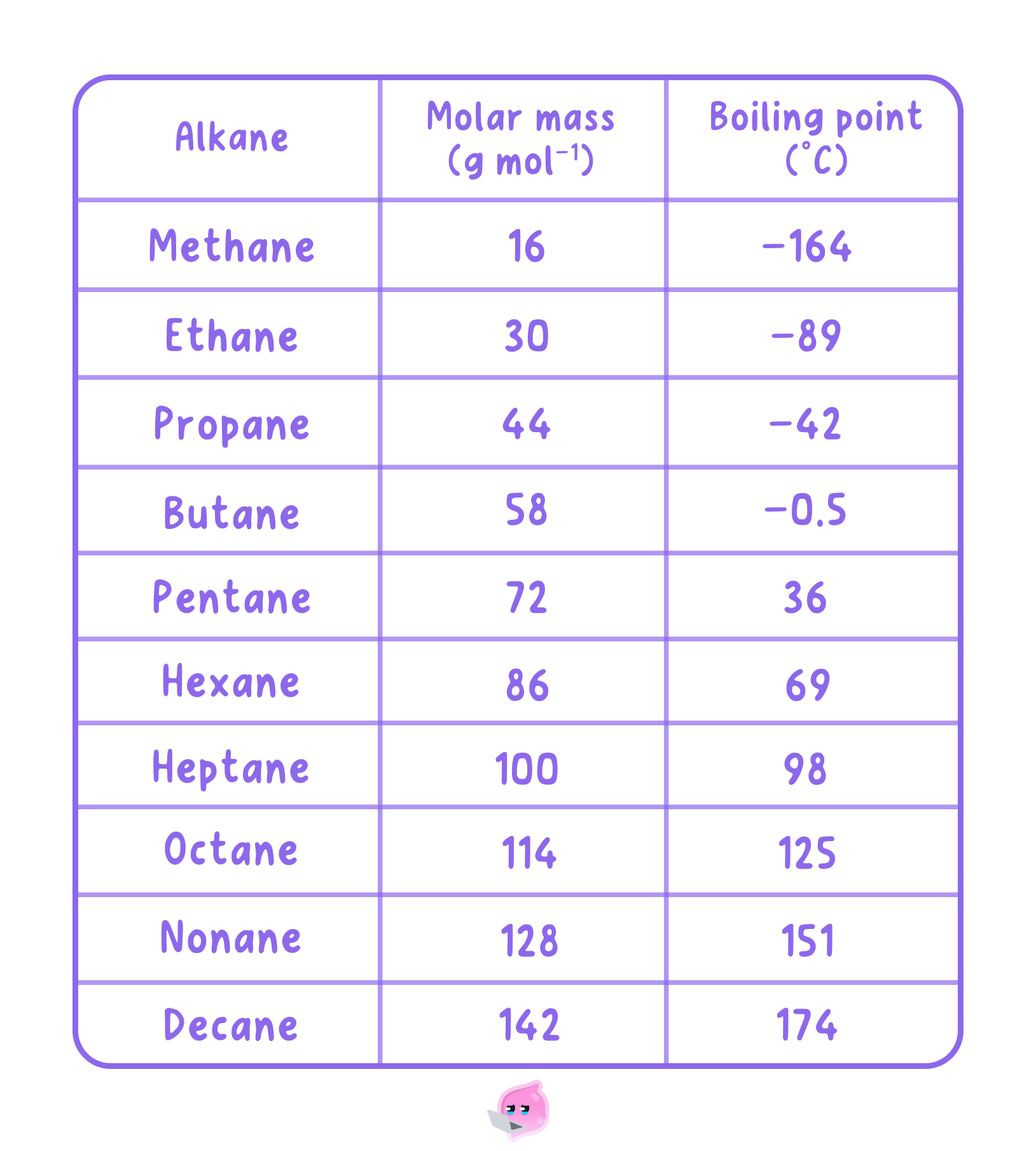
- Boiling point rises steadily with chain length, from −162 ∘C-162\ ^{\circ}\text{C}−162 ∘C for methane to 174 ∘C174\ ^{\circ}\text{C}174 ∘C for decane.
- When a question asks you to explain fractional distillation, link the steps in order: chain length, strength of intermolecular forces, boiling point and height in the column.
- Say that intermolecular forces are overcome, never that covalent bonds break.
- What is a fraction?
- What is the formula of the alkane with 777 carbon atoms?
- Where in the fractionating column do the fractions with the highest boiling points condense?
- Why do larger hydrocarbon molecules have higher boiling points?
- Name two types of product that the petrochemical industry makes from crude oil.
6.2.2 Cracking and dependence on hydrocarbons
Modern life depends on hydrocarbons for fuels and materials
Hydrocarbon
A compound containing carbon and hydrogen atoms only.
- Most crude oil is burned as fuel, because hydrocarbons release a lot of energy when they burn.
- Petrol and diesel power cars and lorries, kerosene powers aircraft and fuel oil powers ships.
- Natural gas, which is mostly the hydrocarbon methane, heats most UK homes and generates a large share of the country's electricity.
- The rest of the crude oil is a feedstock for making plastics, synthetic fibres, solvents, detergents, lubricants and medicines.
- Food packaging, polyester clothing, the bitumen in road surfaces and the plastic casing of a phone all come from hydrocarbons.
- Replacing hydrocarbons would mean changing how people travel, heat buildings and make almost every manufactured product.
A single bus journey uses diesel as the fuel, plastics in the seats, synthetic rubber in the tyres and bitumen in the road, all made from crude oil.
Crude oil is finite and forms far too slowly
Finite resource
A resource that is used up faster than it can be replaced, so supplies will eventually run out.
- Crude oil formed over millions of years from the remains of tiny sea plants and animals buried in mud.
- Heat and high pressure slowly changed these remains into crude oil, which became trapped in porous rock.
- People are using crude oil up in a tiny fraction of the time it took to form, so it is non-renewable.
- As the easily reached reserves run out, oil has to come from deeper or more remote places, which costs more and carries more risk.
- Burning crude oil destroys a feedstock that cannot be replaced, which is one reason to use alternatives such as biofuels, electric vehicles and recycled plastics.
Once a finite resource is used it is gone, so every litre of crude oil burned as fuel is a litre that can no longer be made into materials.
Fractional distillation makes too many long-chain hydrocarbons
- The amount of each fraction depends on the crude oil used, not on what customers want to buy.
- Crude oil usually contains more long-chain hydrocarbons, such as fuel oil, than the market needs.
- Long-chain hydrocarbons are viscous, hard to ignite and burn with smoky flames, so they make poor fuels for cars.
- Demand is highest for the short-chain fractions, such as petrol, which crude oil supplies in smaller amounts.
- Cracking converts the surplus long-chain molecules into shorter, more useful ones, so supply can match demand.
- A refinery makes 303030 tonnes of fuel oil from 100100100 tonnes of crude oil but can only sell 101010 tonnes, while it makes 101010 tonnes of petrol but could sell 252525 tonnes.
- Cracking the surplus fuel oil turns it into extra petrol and alkenes, which closes the gap.
Cracking breaks long-chain alkanes into shorter alkanes and alkenes
Cracking
The thermal decomposition of long-chain alkanes into shorter, more useful alkanes and alkenes, using heat and often a catalyst.
Catalyst
A substance that increases the rate of a reaction by providing an alternative pathway with a lower activation energy without being used up.
- Cracking uses heat to break long molecules apart, so it is a type of thermal decomposition.
- In catalytic cracking, the long-chain alkane is heated to vaporise it and the vapour is passed over a hot catalyst.
- The catalyst is usually a powdered zeolite or aluminium oxide at about 500 ∘C500\ ^{\circ}\text{C}500 ∘C.
- In steam cracking, the vapour is mixed with steam and heated above 800 ∘C800\ ^{\circ}\text{C}800 ∘C without a catalyst.
- The products are usually a mixture of shorter alkanes and alkenes, and there is always at least one alkene.
- Atoms are conserved, so the carbon and hydrogen atoms in the products add up to those in the starting alkane.
- Decane can crack into octane and ethene: C10H22→C8H18+C2H4\text{C}_{10}\text{H}_{22} \rightarrow \text{C}_8\text{H}_{18} + \text{C}_2\text{H}_4C10H22→C8H18+C2H4
Cracking liquid paraffin in the laboratory
- Aim: crack a long-chain alkane in the laboratory and show that an alkene forms.
- Apparatus: a hard-glass boiling tube with a bung and delivery tube, mineral wool, liquid paraffin, broken porcelain or aluminium oxide as the catalyst, a clamp and stand, a Bunsen burner, a trough of water, test tubes with bungs and bromine water.
Method
- Soak some mineral wool in liquid paraffin and push it to the closed end of the boiling tube.
- Put pieces of broken porcelain or aluminium oxide in the middle of the tube.
- Clamp the tube almost horizontally and connect the delivery tube so that it leads to an upturned test tube full of water.
- Heat the catalyst strongly, moving the flame to the mineral wool from time to time so that the paraffin vaporises and passes over the hot catalyst.
- Collect several tubes of gas, throwing away the first one because it is mostly air.
- Lift the delivery tube out of the water before you stop heating.
- Shake a tube of the gas with a few drops of bromine water and record the colour change.
Accuracy and safety
- Lifting the delivery tube out first stops cold water being sucked back into the hot tube, which could crack it.
- Bromine water turns from orange to colourless, which shows that the gas contains an alkene.
- Keep the collected gas away from flames, because it is flammable.
- Wear eye protection, and wear gloves when handling bromine water because it is harmful.
Cracking products are more useful than long-chain alkanes
Alkene
A hydrocarbon that contains a double covalent bond between two carbon atoms.
- The shorter alkanes are blended into petrol and other fuels that are in high demand.
- The alkenes contain a C=C\text{C}=\text{C}C=C double bond, which makes them more reactive than alkanes.
- Alkenes with one double bond have the general formula CnH2n\text{C}_n\text{H}_{2n}CnH2n, with two fewer hydrogen atoms than the alkane with the same number of carbon atoms.
- This reactivity makes alkenes a valuable feedstock for the petrochemical industry.
- Ethene and propene from cracking are joined into polymers such as poly(ethene) and poly(propene).
- Alkenes are also used to make other chemicals, such as ethanol from ethene.
- Hexadecane, C16H34\text{C}_{16}\text{H}_{34}C16H34, is cracked to give octane, C8H18\text{C}_8\text{H}_{18}C8H18, and one other product; find its formula and name its type of hydrocarbon.
- Subtract the carbon atoms: 16−8=816 - 8 = 816−8=8.
- Subtract the hydrogen atoms: 34−18=1634 - 18 = 1634−18=16.
- The other product is C8H16\text{C}_8\text{H}_{16}C8H16, which fits CnH2n\text{C}_n\text{H}_{2n}CnH2n, so it is an alkene.
- Give two ways in which modern life depends on hydrocarbons.
- Why is crude oil described as a finite resource?
- Why do oil refineries crack some of the fractions from crude oil?
- What conditions are used for catalytic cracking?
- What is the missing product in C12H26→C10H22+ ?\text{C}_{12}\text{H}_{26} \rightarrow \text{C}_{10}\text{H}_{22} + \ ?C12H26→C10H22+ ?
6.2.3 Functional groups and homologous series
Homologous series members share a functional group
Homologous series
A family of organic compounds with the same functional group and general formula, in which each member differs from the next by a CH2 unit.
Functional group
The atom or group of atoms in an organic molecule that is responsible for its characteristic reactions.
- Members of the same homologous series have the same functional group and the same general formula.
- Each member differs from the next by a CH2\text{CH}_2CH2 unit, so the chain grows by one carbon atom at a time.
- Their physical properties change gradually along the series, so boiling point rises as the chain gets longer.
- Their chemical properties are similar, because reactions happen at the functional group while the rest of the chain stays the same.
- Once you know how ethanol reacts, you can predict how butan-1-ol reacts, because both contain the −OH-\text{OH}−OH group.
- To identify the series a compound belongs to, find its functional group in the name or the displayed formula.
The reactions of an organic compound are set by the general reactions of its functional group, so one set of rules works for a whole series.

Alkanes have single bonds and names ending in -ane
Alkane
A hydrocarbon in which all the bonds between carbon atoms are single covalent bonds.
Displayed formula
A two-dimensional formula that shows every atom in a molecule and each bond between the atoms.
- Every carbon atom in an alkane forms four single bonds, so alkanes have the general formula CnH2n+2\text{C}_n\text{H}_{2n+2}CnH2n+2.
- The prefix of each name gives the number of carbon atoms: meth- is 111, eth- is 222, prop- is 333 and but- is 444.
- Methane, CH4\text{CH}_4CH4: H∣H−C−H∣H\begin{array}{ccccc}&&\mathrm{H}&&\\&&\vert&&\\\mathrm{H}&-&\mathrm{C}&-&\mathrm{H}\\&&\vert&&\\&&\mathrm{H}&&\end{array}H−H∣C∣H−H
- Ethane, C2H6\text{C}_2\text{H}_6C2H6: HH∣∣H−C−C−H∣∣HH\begin{array}{ccccccc}&&\mathrm{H}&&\mathrm{H}&&\\&&\vert&&\vert&&\\\mathrm{H}&-&\mathrm{C}&-&\mathrm{C}&-&\mathrm{H}\\&&\vert&&\vert&&\\&&\mathrm{H}&&\mathrm{H}&&\end{array}H−H∣C∣H−H∣C∣H−H
- Propane, C3H8\text{C}_3\text{H}_8C3H8: HHH∣∣∣H−C−C−C−H∣∣∣HHH\begin{array}{ccccccccc}&&\mathrm{H}&&\mathrm{H}&&\mathrm{H}&&\\&&\vert&&\vert&&\vert&&\\\mathrm{H}&-&\mathrm{C}&-&\mathrm{C}&-&\mathrm{C}&-&\mathrm{H}\\&&\vert&&\vert&&\vert&&\\&&\mathrm{H}&&\mathrm{H}&&\mathrm{H}&&\end{array}H−H∣C∣H−H∣C∣H−H∣C∣H−H
- Butane, C4H10\text{C}_4\text{H}_{10}C4H10: HHHH∣∣∣∣H−C−C−C−C−H∣∣∣∣HHHH\begin{array}{ccccccccccc}&&\mathrm{H}&&\mathrm{H}&&\mathrm{H}&&\mathrm{H}&&\\&&\vert&&\vert&&\vert&&\vert&&\\\mathrm{H}&-&\mathrm{C}&-&\mathrm{C}&-&\mathrm{C}&-&\mathrm{C}&-&\mathrm{H}\\&&\vert&&\vert&&\vert&&\vert&&\\&&\mathrm{H}&&\mathrm{H}&&\mathrm{H}&&\mathrm{H}&&\end{array}H−H∣C∣H−H∣C∣H−H∣C∣H−H∣C∣H−H
- Do not leave out any bond in a fully displayed formula, because every carbon atom must show four bonds and every hydrogen atom one.
- A shortened formula such as CH3CH3\text{CH}_3\text{CH}_3CH3CH3 hides the bonds, so it is not a displayed formula.
Alkenes contain a double bond between carbon atoms
Alkene
A hydrocarbon that contains a double covalent bond between two carbon atoms.
- Every alkene contains a double bond between two carbon atoms, C=C\text{C}=\text{C}C=C, as its functional group.
- Alkenes with one double bond have the general formula CnH2n\text{C}_n\text{H}_{2n}CnH2n, with two fewer hydrogen atoms than the alkane with the same chain length.
- A double bond needs two carbon atoms, so the first four members are ethene, propene, but-1-ene and pent-1-ene.
- Ethene, C2H4\text{C}_2\text{H}_4C2H4: HH∣∣C=C∣∣HH\begin{array}{ccc}\mathrm{H}&&\mathrm{H}\\\vert&&\vert\\\mathrm{C}&=&\mathrm{C}\\\vert&&\vert\\\mathrm{H}&&\mathrm{H}\end{array}H∣C∣H=H∣C∣H
- Propene, C3H6\text{C}_3\text{H}_6C3H6: HHH∣∣∣C=C−C−H∣∣HH\begin{array}{ccccccc}\mathrm{H}&&\mathrm{H}&&\mathrm{H}&&\\\vert&&\vert&&\vert&&\\\mathrm{C}&=&\mathrm{C}&-&\mathrm{C}&-&\mathrm{H}\\\vert&&&&\vert&&\\\mathrm{H}&&&&\mathrm{H}&&\end{array}H∣C∣H=H∣C−H∣C∣H−H
- But-1-ene, C4H8\text{C}_4\text{H}_8C4H8: HHHH∣∣∣∣C=C−C−C−H∣∣∣HHH\begin{array}{ccccccccc}\mathrm{H}&&\mathrm{H}&&\mathrm{H}&&\mathrm{H}&&\\\vert&&\vert&&\vert&&\vert&&\\\mathrm{C}&=&\mathrm{C}&-&\mathrm{C}&-&\mathrm{C}&-&\mathrm{H}\\\vert&&&&\vert&&\vert&&\\\mathrm{H}&&&&\mathrm{H}&&\mathrm{H}&&\end{array}H∣C∣H=H∣C−H∣C∣H−H∣C∣H−H
- Pent-1-ene, C5H10\text{C}_5\text{H}_{10}C5H10: HHHHH∣∣∣∣∣C=C−C−C−C−H∣∣∣∣HHHH\begin{array}{ccccccccccc}\mathrm{H}&&\mathrm{H}&&\mathrm{H}&&\mathrm{H}&&\mathrm{H}&&\\\vert&&\vert&&\vert&&\vert&&\vert&&\\\mathrm{C}&=&\mathrm{C}&-&\mathrm{C}&-&\mathrm{C}&-&\mathrm{C}&-&\mathrm{H}\\\vert&&&&\vert&&\vert&&\vert&&\\\mathrm{H}&&&&\mathrm{H}&&\mathrm{H}&&\mathrm{H}&&\end{array}H∣C∣H=H∣C−H∣C∣H−H∣C∣H−H∣C∣H−H
The number in but-1-ene and pent-1-ene shows that the double bond starts at carbon atom 111, at the end of the chain.
Alcohols contain the hydroxyl group and end in -ol
Alcohol
An organic compound containing the hydroxyl group, OH, bonded to a carbon atom.
- Every alcohol contains the hydroxyl group, −OH-\text{OH}−OH, bonded to a carbon atom, as its functional group.
- Alcohols with one −OH-\text{OH}−OH group have the general formula CnH2n+1OH\text{C}_n\text{H}_{2n+1}\text{OH}CnH2n+1OH.
- The -ol ending shows an alcohol, and the number before it shows which carbon atom carries the −OH-\text{OH}−OH group.
- Methanol, CH3OH\text{CH}_3\text{OH}CH3OH: H∣H−C−O−H∣H\begin{array}{ccccccc}&&\mathrm{H}&&&&\\&&\vert&&&&\\\mathrm{H}&-&\mathrm{C}&-&\mathrm{O}&-&\mathrm{H}\\&&\vert&&&&\\&&\mathrm{H}&&&&\end{array}H−H∣C∣H−O−H
- Ethanol, C2H5OH\text{C}_2\text{H}_5\text{OH}C2H5OH: HH∣∣H−C−C−O−H∣∣HH\begin{array}{ccccccccc}&&\mathrm{H}&&\mathrm{H}&&&&\\&&\vert&&\vert&&&&\\\mathrm{H}&-&\mathrm{C}&-&\mathrm{C}&-&\mathrm{O}&-&\mathrm{H}\\&&\vert&&\vert&&&&\\&&\mathrm{H}&&\mathrm{H}&&&&\end{array}H−H∣C∣H−H∣C∣H−O−H
- Propan-1-ol, C3H7OH\text{C}_3\text{H}_7\text{OH}C3H7OH: HHH∣∣∣H−C−C−C−O−H∣∣∣HHH\begin{array}{ccccccccccc}&&\mathrm{H}&&\mathrm{H}&&\mathrm{H}&&&&\\&&\vert&&\vert&&\vert&&&&\\\mathrm{H}&-&\mathrm{C}&-&\mathrm{C}&-&\mathrm{C}&-&\mathrm{O}&-&\mathrm{H}\\&&\vert&&\vert&&\vert&&&&\\&&\mathrm{H}&&\mathrm{H}&&\mathrm{H}&&&&\end{array}H−H∣C∣H−H∣C∣H−H∣C∣H−O−H
- Butan-1-ol, C4H9OH\text{C}_4\text{H}_9\text{OH}C4H9OH: HHHH∣∣∣∣H−C−C−C−C−O−H∣∣∣∣HHHH\begin{array}{ccccccccccccc}&&\mathrm{H}&&\mathrm{H}&&\mathrm{H}&&\mathrm{H}&&&&\\&&\vert&&\vert&&\vert&&\vert&&&&\\\mathrm{H}&-&\mathrm{C}&-&\mathrm{C}&-&\mathrm{C}&-&\mathrm{C}&-&\mathrm{O}&-&\mathrm{H}\\&&\vert&&\vert&&\vert&&\vert&&&&\\&&\mathrm{H}&&\mathrm{H}&&\mathrm{H}&&\mathrm{H}&&&&\end{array}H−H∣C∣H−H∣C∣H−H∣C∣H−H∣C∣H−O−H
- Do not call the −OH-\text{OH}−OH group a hydroxide, because it is covalently bonded to carbon and is not a hydroxide ion, OH−\text{OH}^{-}OH−.
- In a fully displayed formula, draw the bond between the oxygen and hydrogen atoms as well as the bond from carbon to oxygen.
Carboxylic acids contain the carboxyl group
Carboxylic acid
An organic compound containing the carboxyl group, COOH.
- Every carboxylic acid contains the carboxyl group, −COOH-\text{COOH}−COOH, as its functional group.
- In this group, one carbon atom has a double bond to one oxygen atom and a single bond to an −OH-\text{OH}−OH group.
- The carbon atom in −COOH-\text{COOH}−COOH counts in the name, so ethanoic acid has two carbon atoms in total.
- Methanoic acid, HCOOH\text{HCOOH}HCOOH: O∥H−C−O−H\begin{array}{ccccccc}&&\mathrm{O}&&&&\\&&\Vert&&&&\\\mathrm{H}&-&\mathrm{C}&-&\mathrm{O}&-&\mathrm{H}\end{array}H−O∥C−O−H
- Ethanoic acid, CH3COOH\text{CH}_3\text{COOH}CH3COOH: HO∣∥H−C−C−O−H∣H\begin{array}{ccccccccc}&&\mathrm{H}&&\mathrm{O}&&&&\\&&\vert&&\Vert&&&&\\\mathrm{H}&-&\mathrm{C}&-&\mathrm{C}&-&\mathrm{O}&-&\mathrm{H}\\&&\vert&&&&&&\\&&\mathrm{H}&&&&&&\end{array}H−H∣C∣H−O∥C−O−H
- Propanoic acid, C2H5COOH\text{C}_2\text{H}_5\text{COOH}C2H5COOH: HHO∣∣∥H−C−C−C−O−H∣∣HH\begin{array}{ccccccccccc}&&\mathrm{H}&&\mathrm{H}&&\mathrm{O}&&&&\\&&\vert&&\vert&&\Vert&&&&\\\mathrm{H}&-&\mathrm{C}&-&\mathrm{C}&-&\mathrm{C}&-&\mathrm{O}&-&\mathrm{H}\\&&\vert&&\vert&&&&&&\\&&\mathrm{H}&&\mathrm{H}&&&&&&\end{array}H−H∣C∣H−H∣C∣H−O∥C−O−H
- Butanoic acid, C3H7COOH\text{C}_3\text{H}_7\text{COOH}C3H7COOH: HHHO∣∣∣∥H−C−C−C−C−O−H∣∣∣HHH\begin{array}{ccccccccccccc}&&\mathrm{H}&&\mathrm{H}&&\mathrm{H}&&\mathrm{O}&&&&\\&&\vert&&\vert&&\vert&&\Vert&&&&\\\mathrm{H}&-&\mathrm{C}&-&\mathrm{C}&-&\mathrm{C}&-&\mathrm{C}&-&\mathrm{O}&-&\mathrm{H}\\&&\vert&&\vert&&\vert&&&&&&\\&&\mathrm{H}&&\mathrm{H}&&\mathrm{H}&&&&&&\end{array}H−H∣C∣H−H∣C∣H−H∣C∣H−O∥C−O−H
- When a question asks for a fully displayed formula, draw every atom and every bond, including each C−H\text{C}-\text{H}C−H and O−H\text{O}-\text{H}O−H bond.
- Then count the bonds: four on each carbon atom, two on each oxygen atom and one on each hydrogen atom.
- What do members of a homologous series have in common?
- Why do members of the same homologous series react in similar ways?
- Why is ethene the first member of the alkene series?
- Draw the fully displayed formula of propan-1-ol.
- How many carbon atoms are there in a molecule of butanoic acid?
6.2.4 Reactions of alkanes, alkenes and alcohols
Complete combustion of alkanes, alkenes and alcohols
Complete combustion
Burning in a plentiful supply of oxygen, so that all the carbon in a fuel forms carbon dioxide and all the hydrogen forms water.
- Alkanes contain only strong single bonds, so apart from combustion they are fairly unreactive.
- In complete combustion, every carbon atom ends up in carbon dioxide and every hydrogen atom ends up in water.
- The same two products form from any hydrocarbon or alcohol that burns in plenty of oxygen.
- For methane: CH4+2O2→CO2+2H2O\text{CH}_4 + 2\text{O}_2 \rightarrow \text{CO}_2 + 2\text{H}_2\text{O}CH4+2O2→CO2+2H2O
- For ethene: C2H4+3O2→2CO2+2H2O\text{C}_2\text{H}_4 + 3\text{O}_2 \rightarrow 2\text{CO}_2 + 2\text{H}_2\text{O}C2H4+3O2→2CO2+2H2O
- For ethanol: C2H5OH+3O2→2CO2+3H2O\text{C}_2\text{H}_5\text{OH} + 3\text{O}_2 \rightarrow 2\text{CO}_2 + 3\text{H}_2\text{O}C2H5OH+3O2→2CO2+3H2O
- To balance a combustion equation, balance carbon first, then hydrogen, and oxygen last.
- Write a balanced equation for the complete combustion of butane, C4H10\text{C}_4\text{H}_{10}C4H10.
- Balance carbon: 444 carbon atoms give 4CO24\text{CO}_24CO2.
- Balance hydrogen: 101010 hydrogen atoms give 5H2O5\text{H}_2\text{O}5H2O.
- Count the oxygen atoms in the products: (4×2)+5=13(4 \times 2) + 5 = 13(4×2)+5=13, which needs 612 O26\tfrac{1}{2}\,\text{O}_2621O2.
- Double everything to remove the half: 2C4H10+13O2→8CO2+10H2O2\text{C}_4\text{H}_{10} + 13\text{O}_2 \rightarrow 8\text{CO}_2 + 10\text{H}_2\text{O}2C4H10+13O2→8CO2+10H2O.
Alkenes react by addition across the double bond
Addition reaction
A reaction in which atoms join across a carbon to carbon double bond, so that two molecules combine to form a single product.
- The C=C\text{C}=\text{C}C=C double bond makes alkenes unsaturated and much more reactive than alkanes.
- In an addition reaction, one bond of the double bond breaks and a new atom joins each of the two carbon atoms.
- Two molecules join to make one product, which is saturated.
- With hydrogen and a nickel catalyst at about 150 ∘C150\ ^{\circ}\text{C}150 ∘C, an alkene forms the alkane with the same carbon chain: C2H4+H2→C2H6\text{C}_2\text{H}_4 + \text{H}_2 \rightarrow \text{C}_2\text{H}_6C2H4+H2→C2H6
- With bromine, an alkene forms a compound with a bromine atom on each carbon of the old double bond:
C2H4+Br2→C2H4Br2\text{C}_2\text{H}_4 + \text{Br}_2 \rightarrow \text{C}_2\text{H}_4\text{Br}_2C2H4+Br2→C2H4Br2
- The product from ethene is 1,2-dibromoethane: HH∣∣H−C−C−H∣∣BrBr\begin{array}{ccccccc}&&\mathrm{H}&&\mathrm{H}&&\\&&\vert&&\vert&&\\\mathrm{H}&-&\mathrm{C}&-&\mathrm{C}&-&\mathrm{H}\\&&\vert&&\vert&&\\&&\mathrm{Br}&&\mathrm{Br}&&\end{array}H−H∣C∣Br−H∣C∣Br−H
- Shaking an alkene with bromine water turns it from orange to colourless, while an alkane leaves it orange.
- Acidified potassium manganate(VII) also turns from purple to colourless with an alkene, but it reacts with alcohols too, so bromine water is the clearer test for a C=C\text{C}=\text{C}C=C bond.

- Do not describe the bromine water as going clear, because a clear solution can still be coloured; say it turns from orange to colourless.
- The bromine atoms in 1,2-dibromoethane are covalently bonded to carbon, so do not describe them as bromide ions.
Steam adds to alkenes to form alcohols
- Ethene reacts with steam at about 300 ∘C300\ ^{\circ}\text{C}300 ∘C and high pressure, with a phosphoric acid catalyst, to form ethanol:
C2H4+H2O→C2H5OH\text{C}_2\text{H}_4 + \text{H}_2\text{O} \rightarrow \text{C}_2\text{H}_5\text{OH}C2H4+H2O→C2H5OH
- A hydrogen atom joins one carbon of the double bond and the −OH-\text{OH}−OH group joins the other.
- For any alkene, keep the whole carbon chain and change only the double bond to a single bond.
- Then add the atoms from the other reactant, one to each carbon atom that was in the double bond.
- In general formulae, an alkene CnH2n\text{C}_n\text{H}_{2n}CnH2n gives CnH2n+2\text{C}_n\text{H}_{2n+2}CnH2n+2 with hydrogen, CnH2nBr2\text{C}_n\text{H}_{2n}\text{Br}_2CnH2nBr2 with bromine and CnH2n+1OH\text{C}_n\text{H}_{2n+1}\text{OH}CnH2n+1OH with steam.
- Propene with hydrogen gives propane, C3H8\text{C}_3\text{H}_8C3H8.
- Propene with steam gives propanol, C3H7OH\text{C}_3\text{H}_7\text{OH}C3H7OH.
- Predict the formula and structure of the product when but-1-ene, C4H8\text{C}_4\text{H}_8C4H8, reacts with bromine.
- Keep the four-carbon chain and change the C=C\text{C}=\text{C}C=C bond between carbon atoms 111 and 222 to a single bond.
- Add one bromine atom to carbon atom 111 and one to carbon atom 222.
- The product is 1,2-dibromobutane, C4H8Br2\text{C}_4\text{H}_8\text{Br}_2C4H8Br2: HHHH∣∣∣∣H−C−C−C−C−H∣∣∣∣BrBrHH\begin{array}{ccccccccccc}&&\mathrm{H}&&\mathrm{H}&&\mathrm{H}&&\mathrm{H}&&\\&&\vert&&\vert&&\vert&&\vert&&\\\mathrm{H}&-&\mathrm{C}&-&\mathrm{C}&-&\mathrm{C}&-&\mathrm{C}&-&\mathrm{H}\\&&\vert&&\vert&&\vert&&\vert&&\\&&\mathrm{Br}&&\mathrm{Br}&&\mathrm{H}&&\mathrm{H}&&\end{array}H−H∣C∣Br−H∣C∣Br−H∣C∣H−H∣C∣H−H
Alcohols burn and are oxidised to carboxylic acids
Carboxylic acid
An organic compound containing the carboxyl group, COOH.
- Alcohols burn in plenty of oxygen to form carbon dioxide and water, which is why ethanol is blended into UK petrol.
- For methanol: 2CH3OH+3O2→2CO2+4H2O2\text{CH}_3\text{OH} + 3\text{O}_2 \rightarrow 2\text{CO}_2 + 4\text{H}_2\text{O}2CH3OH+3O2→2CO2+4H2O
- Warming an alcohol with acidified potassium manganate(VII) oxidises it to a carboxylic acid.
- The solution changes from purple to colourless as the manganate(VII) reacts.
- The −CH2OH-\text{CH}_2\text{OH}−CH2OH end of the alcohol becomes −COOH-\text{COOH}−COOH, so the carbon chain keeps the same length.
- Ethanol is oxidised to ethanoic acid: HH∣∣H−C−C−O−H∣∣HH → HO∣∥H−C−C−O−H∣H\begin{array}{ccccccccc}&&\mathrm{H}&&\mathrm{H}&&&&\\&&\vert&&\vert&&&&\\\mathrm{H}&-&\mathrm{C}&-&\mathrm{C}&-&\mathrm{O}&-&\mathrm{H}\\&&\vert&&\vert&&&&\\&&\mathrm{H}&&\mathrm{H}&&&&\end{array} \;\rightarrow\; \begin{array}{ccccccccc}&&\mathrm{H}&&\mathrm{O}&&&&\\&&\vert&&\Vert&&&&\\\mathrm{H}&-&\mathrm{C}&-&\mathrm{C}&-&\mathrm{O}&-&\mathrm{H}\\&&\vert&&&&&&\\&&\mathrm{H}&&&&&&\end{array}H−H∣C∣H−H∣C∣H−O−H→H−H∣C∣H−O∥C−O−H
- Wine or beer left open to the air turns to vinegar, because bacteria oxidise its ethanol to ethanoic acid.
Do not change the number of carbon atoms when an alcohol is oxidised, because propan-1-ol gives propanoic acid, not ethanoic acid.
Predicting products from the functional group
- Start by finding the functional group: only single bonds for an alkane, C=C\text{C}=\text{C}C=C for an alkene or −OH-\text{OH}−OH for an alcohol.
- Then pick the reaction: combustion for all three, addition for an alkene and oxidation for an alcohol.
- Copy the carbon chain unchanged, then change only the atoms at the functional group.
- Pentan-1-ol, C5H11OH\text{C}_5\text{H}_{11}\text{OH}C5H11OH, is oxidised to pentanoic acid, C4H9COOH\text{C}_4\text{H}_9\text{COOH}C4H9COOH.
- Hex-1-ene, C6H12\text{C}_6\text{H}_{12}C6H12, adds hydrogen to form hexane, C6H14\text{C}_6\text{H}_{14}C6H14.
- Finish by checking that the product has the same number of carbon atoms as the starting compound, unless it has burned.
- When a question gives an unfamiliar alkene or alcohol, copy its carbon chain atom for atom before changing the functional group.
- Count the bonds on every carbon atom in your final structure to check that each has four.
- What are the products of the complete combustion of propane?
- What colour change shows that a compound contains a C=C\text{C}=\text{C}C=C double bond?
- What forms when ethene reacts with steam?
- What is the formula of the product when propene reacts with bromine?
- Which carboxylic acid forms when butan-1-ol is oxidised?
6.2.5 Addition polymerisation and repeat units
Addition polymerisation joins alkene monomers through double bonds
Addition polymerisation
A reaction in which many monomers containing a carbon to carbon double bond join together to form a polymer as the only product.
Monomer
A small molecule that can join with many other molecules to form a polymer.
- Addition polymerisation needs monomers with a C=C\text{C}=\text{C}C=C double bond, which is the functional group of the alkenes.
- At high pressure and with a catalyst, one bond in each double bond breaks.
- Each opened monomer then forms new single bonds to the monomers on either side of it.
- Thousands of monomers join in this way to make one very long polymer chain.
- The polymer is the only product, so every atom from the monomers ends up in the polymer.
- The polymer is named by putting the monomer's name in brackets after poly, so ethene forms poly(ethene).
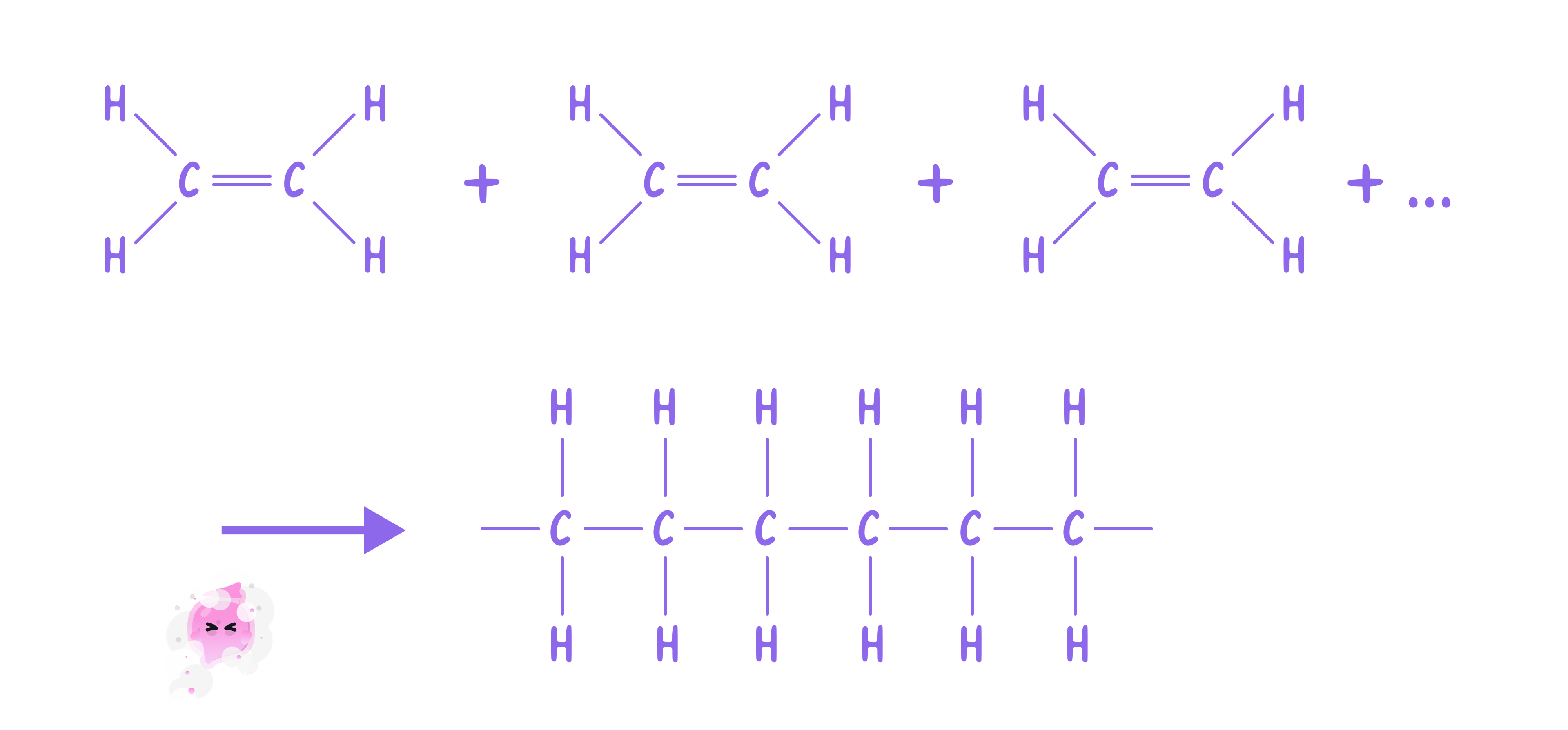
Addition polymerisation keeps every atom of the monomer and changes only the double bond, which becomes a single bond in the chain.
Repeating units have the monomer's atoms but single bonds
Repeating unit
The section of a polymer chain that is repeated over and over to make up the whole molecule.
- In poly(ethene), the unit that repeats contains two carbon atoms and four hydrogen atoms, like one ethene molecule.
- The double bond of the monomer becomes a single bond in the repeating unit.
- A bond sticks out from each end carbon atom through the brackets, to show that the unit joins to identical units on either side.
- The letter nnn after the brackets stands for a large number of repeating units.
- The equation for making poly(ethene) is:
n CH2=CH2→[CH2−CH2]nn\,\text{CH}_2{=}\text{CH}_2 \rightarrow \left[\text{CH}_2{-}\text{CH}_2\right]_nnCH2=CH2→[CH2−CH2]n
- In displayed formulae: n HH∣∣C=C∣∣HH → [HH∣∣−C−C−∣∣HH]nn\; \begin{array}{ccc}\mathrm{H}&&\mathrm{H}\\\vert&&\vert\\\mathrm{C}&=&\mathrm{C}\\\vert&&\vert\\\mathrm{H}&&\mathrm{H}\end{array} \;\rightarrow\; \left[ \begin{array}{ccccc}&\mathrm{H}&&\mathrm{H}&\\&\vert&&\vert&\\-&\mathrm{C}&-&\mathrm{C}&-\\&\vert&&\vert&\\&\mathrm{H}&&\mathrm{H}&\end{array} \right]_nnH∣C∣H=H∣C∣H→−H∣C∣H−H∣C∣H−n
- The repeating unit and the monomer have the same molecular formula, C2H4\text{C}_2\text{H}_4C2H4 for ethene.
Do not leave a C=C\text{C}=\text{C}C=C double bond inside the repeating unit, because the double bond is used up in making the chain.
Drawing a polymer from its monomer
- Draw the monomer with its two double-bonded carbon atoms side by side and the other groups above and below them.
- Change the double bond to a single bond.
- Add a bond sticking out from each of the two carbon atoms, then draw brackets across these bonds and write nnn after them.
- Keep every side group, such as CH3\text{CH}_3CH3 or Cl\text{Cl}Cl, on the same carbon atom as in the monomer.
- Chloroethene, CH2=CHCl\text{CH}_2{=}\text{CHCl}CH2=CHCl, forms poly(chloroethene), or PVC, which is used for window frames and pipes.
- Tetrafluoroethene, CF2=CF2\text{CF}_2{=}\text{CF}_2CF2=CF2, forms PTFE, the non-stick coating on frying pans.
- In displayed formulae: n FF∣∣C=C∣∣FF → [FF∣∣−C−C−∣∣FF]nn\; \begin{array}{ccc}\mathrm{F}&&\mathrm{F}\\\vert&&\vert\\\mathrm{C}&=&\mathrm{C}\\\vert&&\vert\\\mathrm{F}&&\mathrm{F}\end{array} \;\rightarrow\; \left[ \begin{array}{ccccc}&\mathrm{F}&&\mathrm{F}&\\&\vert&&\vert&\\-&\mathrm{C}&-&\mathrm{C}&-\\&\vert&&\vert&\\&\mathrm{F}&&\mathrm{F}&\end{array} \right]_nnF∣C∣F=F∣C∣F→−F∣C∣F−F∣C∣F−n
- Draw the repeating unit of the polymer made from propene, CH2=CHCH3\text{CH}_2{=}\text{CHCH}_3CH2=CHCH3.
- Draw propene with the CH3\text{CH}_3CH3 group on one of the double-bonded carbon atoms: HH∣∣C=C∣∣HCH3\begin{array}{ccc}\mathrm{H}&&\mathrm{H}\\\vert&&\vert\\\mathrm{C}&=&\mathrm{C}\\\vert&&\vert\\\mathrm{H}&&\mathrm{CH}_3\end{array}H∣C∣H=H∣C∣CH3
- Change the double bond to a single bond and add a bond out from each of the two carbon atoms.
- Put brackets around the unit and write nnn: [HH∣∣−C−C−∣∣HCH3]n\left[ \begin{array}{ccccc}&\mathrm{H}&&\mathrm{H}&\\&\vert&&\vert&\\-&\mathrm{C}&-&\mathrm{C}&-\\&\vert&&\vert&\\&\mathrm{H}&&\mathrm{CH}_3&\end{array} \right]_n−H∣C∣H−H∣C∣CH3−n
Finding the monomer from a polymer
- Find the repeating unit, which in a simple addition polymer has two carbon atoms in the main chain.
- Remove the two bonds that stick out through the brackets.
- Put a double bond between the two carbon atoms, keeping every other atom and group where it was.
- Name the monomer by removing poly and the brackets from the name of the polymer, so poly(propene) comes from propene.
- Poly(chloroethene) has the repeating unit [HH∣∣−C−C−∣∣HCl]n\left[ \begin{array}{ccccc}&\mathrm{H}&&\mathrm{H}&\\&\vert&&\vert&\\-&\mathrm{C}&-&\mathrm{C}&-\\&\vert&&\vert&\\&\mathrm{H}&&\mathrm{Cl}&\end{array} \right]_n−H∣C∣H−H∣C∣Cl−n, so its monomer is chloroethene: HH∣∣C=C∣∣HCl\begin{array}{ccc}\mathrm{H}&&\mathrm{H}\\\vert&&\vert\\\mathrm{C}&=&\mathrm{C}\\\vert&&\vert\\\mathrm{H}&&\mathrm{Cl}\end{array}H∣C∣H=H∣C∣Cl
- In a long section of chain, the pattern repeats every two carbon atoms, so a chain of six carbon atoms contains three repeating units.
- When a question asks for the repeating unit, show the single bond, every side group and a bond through each bracket, and write nnn.
- When it asks for the monomer, check that your answer has a C=C\text{C}=\text{C}C=C double bond and no bonds left sticking out.
- Which functional group must a monomer have to form an addition polymer?
- Why is the polymer the only product of addition polymerisation?
- What happens to the double bond during addition polymerisation?
- What is the repeating unit of poly(ethene)?
- Which monomer forms PTFE?
6.2.6 Naturally occurring polymers
Natural polymers are long chains of small monomers
Polymer
A substance made of very long molecules built from many repeating units joined by covalent bonds.
Monomer
A small molecule that can join with many other molecules to form a polymer.
- A natural polymer is made inside living things from many small monomer molecules joined by covalent bonds.
- The monomers join end to end into long chains, which can contain thousands of units.
- Natural polymers fall into three families according to their monomers.
- DNA is built from nucleotides.
- Starch and cellulose are built from sugars.
- Proteins are built from amino acids.
Like synthetic polymers, natural polymers are long chains of monomers, but living organisms make them.
DNA is a polymer made from four different nucleotides
Nucleotide
One of the four different monomers that join together in long chains to form DNA.
- DNA, or deoxyribonucleic acid, is found in the cells of every living organism and carries its genetic code.
- Its monomers are nucleotides, and there are four different types.
- Each nucleotide contains a sugar, a phosphate group and one of four bases.
- The bases are adenine, thymine, cytosine and guanine, so the four nucleotides are often labelled A, T, C and G after their four bases.
- A DNA molecule contains millions of nucleotides joined in two strands, which twist into a double helix.
- The order of the nucleotides along the chain stores the information for making proteins.
Do not say that DNA contains only four nucleotides, because it contains millions of nucleotides of four different types.
Starch, cellulose and glycogen are polymers of sugars
Glucose
A simple sugar made by plants in photosynthesis, which is the monomer of starch, cellulose and glycogen.
- Plants make the sugar glucose by photosynthesis.
- Plants join glucose molecules into long chains of starch, which stores energy in foods such as potatoes, rice and wheat.
- Glucose also forms cellulose, the tough polymer in plant cell walls.
- Cotton and paper are mostly cellulose, so a cotton T-shirt is made of a natural polymer.
- Animals store glucose as glycogen, a polymer found in the liver and muscles.
- Starch and cellulose are both made from glucose, but the glucose units are linked differently, which gives them very different properties.
Bread tastes sweeter the longer you chew it, because an enzyme in saliva breaks its starch back down into sugar.
Proteins are natural polymers built from amino acids
Amino acid
A small molecule that acts as a monomer, joining with others in chains to form proteins.
- Proteins are long chains of amino acids joined together.
- There are about 20 different amino acids in the proteins of living things.
- The order of the amino acids decides the shape of each protein and so the job it does.
- Enzymes are proteins that act as biological catalysts, such as amylase in saliva.
- Hair and nails are made of the protein keratin, and silk and wool are also proteins.
- The body digests proteins in food back into amino acids, then joins them in new orders to build its own proteins.
- When a question names a natural polymer, match it to its monomer: DNA to nucleotides, starch and cellulose to sugars, and proteins to amino acids.
- When it asks how many different monomers DNA is made from, the answer is four.
- What are the monomers of DNA called?
- How many different nucleotides make up DNA?
- Which sugar is the monomer of starch and cellulose?
- What type of monomer joins to make a protein?
- Name one natural polymer found in plants and one found in hair.
6.2.7 Chemical cells and fuel cells
Chemical cells work until their reactants run out
Chemical cell
A device in which a reaction between stored reactants produces a potential difference until those reactants are used up.
- Inside a cell, a chemical reaction pushes electrons around the external circuit, producing a potential difference.
- An everyday cell, such as an AA battery, contains a fixed amount of reactants sealed inside it.
- An alkaline AA cell reacts zinc with manganese(IV) oxide to give about 1.5 V1.5\,\text{V}1.5V.
- As the cell is used, its reactants are used up, and once one runs out the potential difference falls to zero and the cell is flat.
- A rechargeable cell can be recharged by passing a current through it, which reverses the reaction and remakes the reactants.
A TV remote stops working when its cells go flat, because the zinc or the manganese(IV) oxide inside them has been used up.
Fuel cells run while fuel and oxygen are supplied
Fuel cell
A cell that produces a potential difference from the reaction of a fuel with oxygen, both supplied continuously from outside the cell.
- Fuel and oxygen, usually from the air, are fed into a fuel cell continuously from outside.
- The products are removed as they form, so the cell does not run flat while the supply continues.
- In a hydrogen/oxygen fuel cell, hydrogen reacts with oxygen to form water: 2H2+O2→2H2O2\text{H}_2 + \text{O}_2 \rightarrow 2\text{H}_2\text{O}2H2+O2→2H2O
- This is the same overall reaction as burning hydrogen, but the energy is transferred directly as electrical energy rather than as heat in a flame.
- Fuel cells therefore waste less energy as heat, so they are more efficient than engines that burn fuel.
A chemical cell stores its reactants and runs out, while a fuel cell has its reactants supplied and runs for as long as the supply lasts.
Hydrogen fuel cells give off only water
- The only product is water, so no carbon dioxide is released at the point of use.
- They also release no nitrogen oxides or soot particles, which petrol and diesel engines give out.
- Fuel cells convert more of the energy in their fuel into electrical energy than a petrol or diesel engine does.
- They have no moving parts, so they are quiet and need less maintenance.
- A hydrogen car can be refuelled in a few minutes, much faster than most battery cars can be recharged.
- A hydrogen tank and fuel cell are lighter than batteries storing the same energy, which suits long journeys and heavy vehicles.
London has run hydrogen fuel cell buses on some routes, where the only exhaust is water vapour.
Hydrogen is hard to store and often fossil-based
- Hydrogen is a very flammable gas, so leaks can cause explosions.
- Hydrogen gas takes up a large volume, so it is stored in heavy high-pressure tanks.
- There are few refuelling stations, so hydrogen vehicles cannot yet travel everywhere.
- Most hydrogen is made from natural gas or other hydrocarbons, a process that releases carbon dioxide.
- Hydrogen can also be made by the electrolysis of water, but this needs a lot of electricity, which may come from burning fossil fuels.
- Only hydrogen made using renewable electricity, such as wind or solar power, gives a fuel cell very low carbon emissions overall.
- Fuel cells are expensive, partly because they use a platinum catalyst.
Do not call a hydrogen fuel cell pollution free, because making, compressing and transporting the hydrogen can all release carbon dioxide.
Weighing benefits and drawbacks when choosing a fuel cell
- Other fuel cells use fuels such as methanol, a liquid alcohol.
- Methanol is easier to store and carry than hydrogen, because it is a liquid at room temperature.
- Methanol contains carbon, so a methanol fuel cell releases carbon dioxide as well as water: 2CH3OH+3O2→2CO2+4H2O2\text{CH}_3\text{OH} + 3\text{O}_2 \rightarrow 2\text{CO}_2 + 4\text{H}_2\text{O}2CH3OH+3O2→2CO2+4H2O
- Methanol is toxic and flammable, so its cartridges must be sealed and handled safely.
- For a given use, compare the emissions, efficiency, fuel storage, cost and safety of each option.
- A hydrogen fuel cell suits a city bus that returns to one depot each night, where a single hydrogen supply can refuel the whole fleet.
- A methanol fuel cell suits a remote sensor or a camping power pack, where a small liquid cartridge is easier to carry than a gas cylinder.
- When a question asks you to evaluate a fuel cell for a use, give at least one advantage and one disadvantage that relate to that use.
- Finish with a conclusion that says whether the fuel cell is a good choice for that use and why.
- Why does a chemical cell stop producing a potential difference?
- What must be supplied to a fuel cell to keep it working?
- What is the overall equation for the reaction in a hydrogen/oxygen fuel cell?
- Give one advantage and one disadvantage of hydrogen fuel cell cars.
- Why does a methanol fuel cell release carbon dioxide?
6.2.8 Condensation polymerisation and how to make one
Condensation polymerisation releases a small molecule per link
Condensation polymerisation
A reaction in which monomers with two functional groups join to form a polymer, releasing a small molecule such as water each time a link forms.
Monomer
A small molecule that can join with many other molecules to form a polymer.
- Each monomer has two functional groups, one at each end of the molecule.
- The group at one end reacts with a monomer on one side and the group at the other end reacts with a monomer on the other side, so a chain grows.
- Most condensation polymers are made from two different monomers that join alternately.
- Each time two functional groups react, a new link forms and a small molecule, usually water, is released.
- Condensation polymerisation therefore gives two products, the polymer and the small molecule.
- Addition polymerisation, in contrast, uses monomers with a C=C\text{C}=\text{C}C=C double bond and makes the polymer as its only product.
Look for monomers with a reactive group at both ends, and expect a small molecule to be released each time a link forms.
A diol and dicarboxylic acid form a polyester
Diol
A molecule with two hydroxyl groups, OH, which can react at both ends to form a condensation polymer.
Dicarboxylic acid
A molecule with two carboxyl groups, COOH, which can react at both ends to form a condensation polymer.
- A diol has two hydroxyl groups, −OH-\text{OH}−OH, and a dicarboxylic acid has two carboxyl groups, −COOH-\text{COOH}−COOH.
- The −COOH-\text{COOH}−COOH group of the acid reacts with the −OH-\text{OH}−OH group of the diol to form an ester link, −COO−-\text{COO}-−COO−, and a water molecule.
- The water forms from the −OH-\text{OH}−OH of the acid group and the hydrogen atom of the alcohol group.
- Each monomer reacts at both ends, so the chain grows with acid and diol units alternating.
- Using a box and a circle for the carbon chains between the functional groups, the equation is: n HOOC−□−COOH+n HO−◯−OH→[−OC−□−COO−◯−O−]n+2n H2On\,\text{HOOC}{-}\square{-}\text{COOH} + n\,\text{HO}{-}\bigcirc{-}\text{OH} \rightarrow \left[{-}\text{OC}{-}\square{-}\text{COO}{-}\bigcirc{-}\text{O}{-}\right]_n + 2n\,\text{H}_2\text{O}nHOOC−□−COOH+nHO−◯−OH→[−OC−□−COO−◯−O−]n+2nH2O
- PET, made from ethane-1,2-diol and benzene-1,4-dicarboxylic acid, is the polyester used for drinks bottles and polyester clothing.
Do not write n H2On\,\text{H}_2\text{O}nH2O in the equation, because each repeating unit contains two ester links, so 2n2n2n water molecules form.
A diamine and dicarboxylic acid form a polyamide
Diamine
A molecule with two amine groups, NH2, which can react at both ends to form a polyamide.
- A diamine has an amine group, −NH2-\text{NH}_2−NH2, at each end of its molecule.
- The −COOH-\text{COOH}−COOH group reacts with the −NH2-\text{NH}_2−NH2 group to form an amide link, −CONH−-\text{CONH}-−CONH−, and a water molecule.
- The polymer formed is a polyamide, and nylon is the best-known example.
- Nylon-6,6 forms from hexane-1,6-diamine and hexanedioic acid, which each have six carbon atoms.
- Nylon is strong and hard-wearing, so it is used for ropes, fishing line and clothing.
- If the acid is replaced by an acid chloride such as hexanedioyl dichloride, with a −COCl-\text{COCl}−COCl group at each end, the small molecule released is hydrogen chloride, HCl\text{HCl}HCl.
- Proteins and DNA are also condensation polymers, made in living things from amino acids and nucleotides.
Do not assume the small molecule is always water, because monomers with −COCl-\text{COCl}−COCl groups release HCl\text{HCl}HCl instead.
Making nylon where two solutions meet
Immiscible
Describes two liquids that do not mix, so they settle into separate layers.
- One monomer, hexane-1,6-diamine, is dissolved in water.
- The other, hexanedioyl dichloride, is dissolved in an organic solvent such as cyclohexane, which does not mix with water.
- The two solutions are immiscible, so they form two layers, with the less dense cyclohexane solution on top.
- The monomers can only meet at the boundary between the layers, so a thin film of nylon forms there.
- As the film is pulled out, fresh monomers meet at the boundary and more nylon forms, so a continuous thread can be drawn out.
- The reaction releases hydrogen chloride, so the diamine solution often contains a little sodium hydroxide to neutralise it.
- Aim: make a thread of nylon from two monomers.
- Apparatus: a 50 cm350\,\text{cm}^350cm3 beaker, two 10 cm310\,\text{cm}^310cm3 measuring cylinders, a glass rod, tweezers, a solution of hexane-1,6-diamine in water, a solution of hexanedioyl dichloride in cyclohexane, a beaker of water for washing, gloves and a fume cupboard.
Method
- Working in a fume cupboard, pour about 5 cm35\,\text{cm}^35cm3 of the hexane-1,6-diamine solution into the small beaker.
- Slowly pour about 5 cm35\,\text{cm}^35cm3 of the hexanedioyl dichloride solution down a glass rod on top, so that the two layers do not mix.
- Use tweezers to grip the film of nylon that forms at the boundary between the layers.
- Lift the film out slowly to form a thread.
- Wind the thread onto a glass rod, turning it steadily so that fresh nylon keeps forming at the boundary.
- Wash the nylon thoroughly in the beaker of water before touching it.
Accuracy and safety
- Pouring the second solution down a glass rod keeps the layers separate, so the nylon forms only at the boundary.
- The nylon is coated in unreacted chemicals until it has been washed.
- Wear gloves and eye protection, because the acid chloride is corrosive.
- Keep cyclohexane away from flames, because it is highly flammable.
- What is released each time a link forms in condensation polymerisation?
- Which two types of monomer react to form a polyester?
- What is the name of the link formed between a diamine and a dicarboxylic acid?
- Where does nylon form when it is made from two layers of solution?
- Which small molecule forms when nylon is made from hexanedioyl dichloride?
