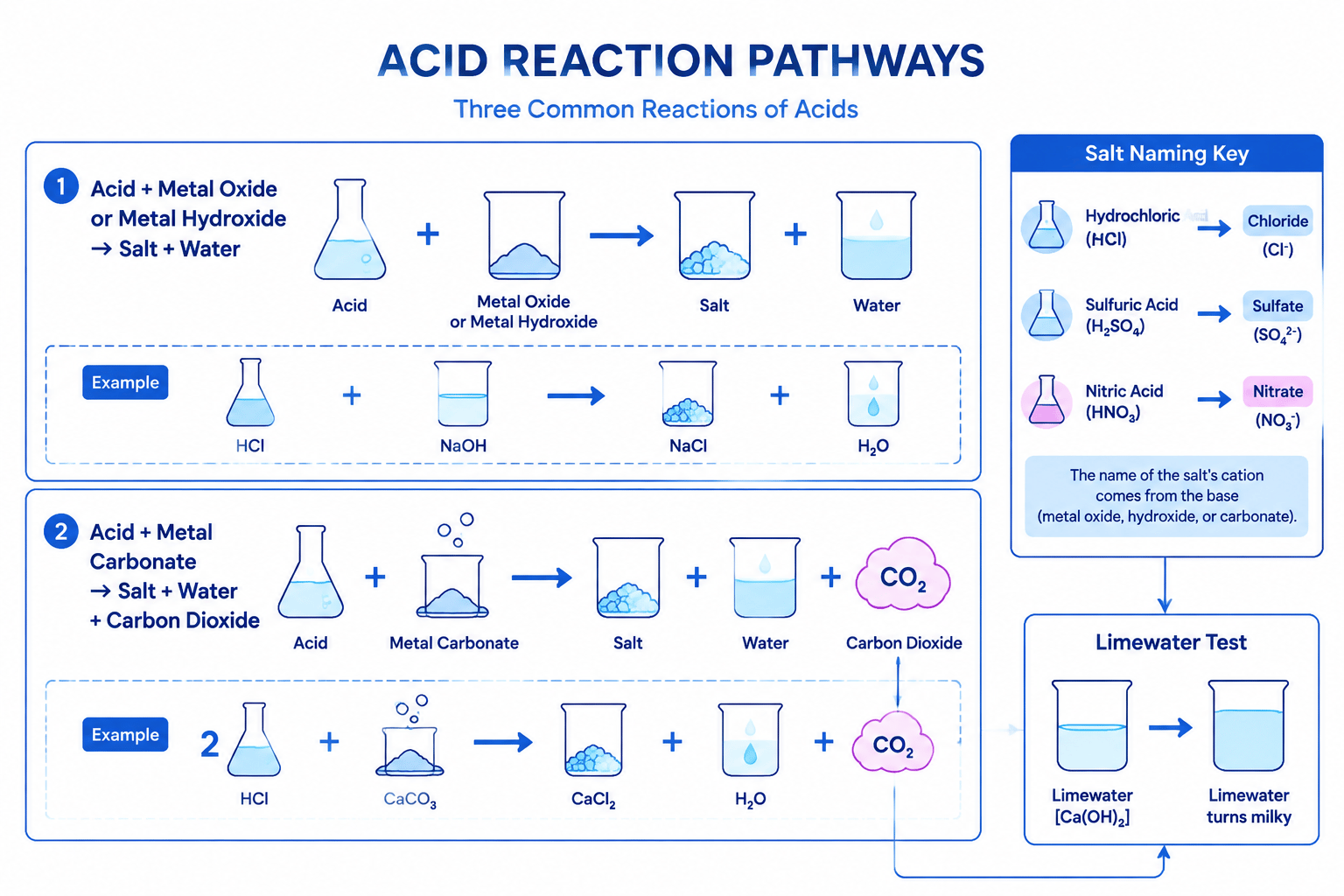
Welcome to the core of acid chemistry! When acids react with certain substances, they lose their acidity and become neutral. This process is called neutralisation, and it is a reaction you will see over and over again in chemistry.
What you'll learn:
- The general word equations for neutralising acids.
- How to easily predict the name of the salt produced in a reaction.
- How to use the charges of common ions to write perfect chemical formulas for salts.
All acids contain hydrogen ions (H+\text{H}^{+}H+). During a neutralisation reaction, these hydrogen ions are replaced by metal ions. This chemical swap creates a brand new, neutral compound called a salt.
Because different substances can neutralise acids, there are a few general equations you need to learn. First, let's look at bases and alkalis.
Base
A base is any substance that can neutralise an acid to form a salt and water. Common examples include metal oxides (like copper oxide) and metal hydroxides (like zinc hydroxide).
Alkali
An alkali is simply a base that dissolves in water. Soluble metal hydroxides, like sodium hydroxide, are alkalis.
Confusing bases and alkalis
Remember the rule: all alkalis are bases, but not all bases are alkalis. An insoluble powder like copper oxide will happily neutralise an acid, but because it doesn't dissolve in water, it is a base, not an alkali.
When an acid reacts with a base or an alkali, the products are always the same:
Acid + Base →\to→ Salt + Water
Acid + Alkali →\to→ Salt + Water
Metal carbonates (like calcium carbonate or sodium carbonate) can also neutralise acids. However, because they contain the carbonate ion (CO32−\text{CO}_3^{2-}CO32−), they break down to release a gas alongside the usual salt and water.
Acid + Metal Carbonate →\to→ Salt + Water + Carbon Dioxide
Spotting the fizz
If you ever add an acid to a metal carbonate in a test tube, you will immediately see fizzing (effervescence). Those bubbles are the carbon dioxide gas escaping! Whenever you see "carbonate" in a question, let it trigger a reminder: don't forget the carbon dioxide!
Whenever you carry out one of these reactions, a specific salt is produced. The name of the salt always comes in two parts, much like your first and last name.
- The First Name always comes from the metal in the base, alkali, or carbonate.
- The Last Name always comes from the specific acid you used.
You need to memorise the surnames given by the three core laboratory acids:
- Hydrochloric acid always produces chlorides.
- Nitric acid always produces nitrates.
- Sulfuric acid always produces sulfates.
For example, if you react zinc oxide with hydrochloric acid, the salt produced will be zinc chloride.

Naming rules
To predict the products of a neutralisation reaction, take the metal's name from the base/carbonate and combine it with the salt name of the acid.
Once you know the name of a salt, you often have to write its chemical formula. Salts are ionic compounds made up of positive metal ions and negative non-metal ions.
For the salt to be stable, the total positive charge must exactly cancel out the total negative charge. To do this, you need to know the charges of some common ions:
- Group 1 metals: form 1+1+1+ ions (e.g., Na+\text{Na}^{+}Na+, K+\text{K}^{+}K+)
- Group 2 metals: form 2+2+2+ ions (e.g., Mg2+\text{Mg}^{2+}Mg2+, Ca2+\text{Ca}^{2+}Ca2+)
- Aluminium: forms a 3+3+3+ ion (Al3+\text{Al}^{3+}Al3+)
- Chloride: Cl−\text{Cl}^{-}Cl− (from hydrochloric acid)
- Nitrate: NO3−\text{NO}_3^{-}NO3− (from nitric acid)
- Sulfate: SO42−\text{SO}_4^{2-}SO42− (from sulfuric acid)
Deducing the formula of magnesium nitrate
- Identify the ions and their charges. Magnesium is in Group 2, so it forms a Mg2+\text{Mg}^{2+}Mg2+ ion. Nitric acid produces nitrate ions, which have the formula NO3−\text{NO}_3^{-}NO3−.
- Compare the charges. We have a 2+2+2+ charge and a 1−1-1− charge. They do not cancel out yet, so the formula isn't just a 1-to-1 ratio.
- Balance the charges. To cancel out the 2+2+2+ charge from one magnesium ion, we need exactly two nitrate ions (since two 1−1-1− charges give a total of 2−2-2−).
- Write the final formula. Because nitrate is a "complex ion" (an ion made of more than one element), we must put it in brackets before adding the small 222 outside. The correct formula is Mg(NO3)2\text{Mg(NO}_3)_2Mg(NO3)2.
You now have all the tools you need to predict the products of any neutralisation reaction and write out full, balanced chemical equations for them. Let's look at one final example from start to finish.
Writing a balanced symbol equation
Write the balanced symbol equation for the reaction between solid copper(II) oxide and dilute sulfuric acid.
- Write the word equation. Using our naming rules, the metal is copper and the acid is sulfuric acid. Therefore, the salt is copper sulfate. Since copper oxide is a base, the other product is just water.
Copper oxide + Sulfuric acid →\to→ Copper sulfate + Water
- Work out the formulas of the reactants. The numeral (II) in copper(II) oxide tells us the copper ion is Cu2+\text{Cu}^{2+}Cu2+. Oxide is always O2−\text{O}^{2-}O2−. Because 2+2+2+ and 2−2-2− balance perfectly, copper(II) oxide is simply CuO\text{CuO}CuO. You should memorise that sulfuric acid is H2SO4\text{H}_2\text{SO}_4H2SO4.
- Deduce the formula of the products. For the salt, we pair Cu2+\text{Cu}^{2+}Cu2+ with the sulfate ion SO42−\text{SO}_4^{2-}SO42−. Again, 2+2+2+ and 2−2-2− cancel perfectly, making the salt CuSO4\text{CuSO}_4CuSO4. Water is always H2O\text{H}_2\text{O}H2O.
- Assemble the equation and add state symbols. Copper(II) oxide is a solid powder (s). The acid is an aqueous solution (aq). The newly formed salt dissolves in the mixture, so it is also aqueous (aq), and water is a liquid (l).
`
CuO(s)+H2SO4(aq)→CuSO4(aq)+H2O(l)
\text{CuO(s)} + \text{H}_2\text{SO}_4\text{(aq)} \to \text{CuSO}_4\text{(aq)} + \text{H}_2\text{O(l)}
CuO(s)+H2SO4(aq)→CuSO4(aq)+H2O(l)
`
5. Check the balancing. Count the atoms on both sides. There is 1 Cu, 1 S, 5 O, and 2 H on the left, and exactly the same on the right. The equation is already perfectly balanced!
In the exam
- Read the question carefully: If a question asks you to "Name the salt produced", write the words (e.g., sodium chloride). Do not write the chemical formula unless explicitly asked, as a tiny mistake in the formula will cost you the mark!
- Learn the acid formulas: You must know the formulas for hydrochloric (HCl\text{HCl}HCl), sulfuric (H2SO4\text{H}_2\text{SO}_4H2SO4), and nitric (HNO3\text{HNO}_3HNO3) acids off by heart. They will rarely be given to you.
- Check for carbonates: Before you finish an equation, quickly glance at the reactants. If one of them has "carbonate" in the name, double-check that you have written CO2\text{CO}_2CO2 on the product side.
Check yourself
- What are the three products formed when nitric acid reacts with calcium carbonate?
- What is the name of the salt produced when zinc oxide reacts with hydrochloric acid?
- Using the charges of the ions, what is the chemical formula for aluminium sulfate?