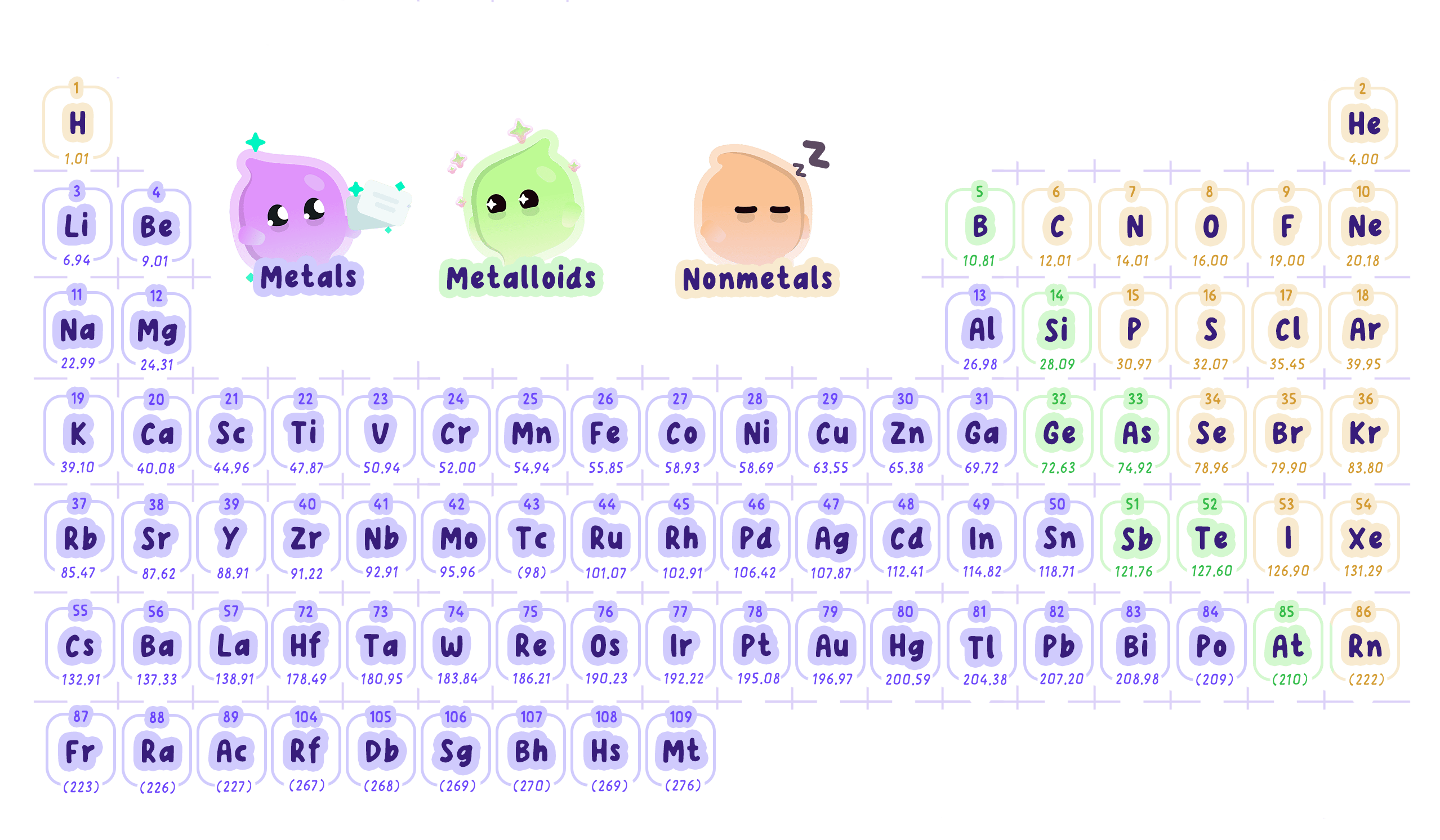
- How GCSE Chemistry defines metals and non-metals using the ions they form.
- Where metals and non-metals are found in the periodic table.
- How typical physical and chemical properties differ.
- How atomic number and electron arrangement explain an element’s reactions.
Before you classify elements as metals or non-metals, you need a few key building blocks.
Element
An element is a substance made from only one type of atom. For example, magnesium is an element because it contains only magnesium atoms.
An atom is the smallest particle of an element that can still be recognised as that element. At GCSE, you can picture an atom as having a central nucleus containing positive protons, with negative electrons arranged in shells around it.
Atomic number
The atomic number of an element is the number of protons in the nucleus of one atom of that element. In a neutral atom, the number of electrons is the same as the number of protons.
The electrons in the outer shell are especially important because they control how the atom reacts.
Ion
An ion is a charged particle formed when an atom, or group of atoms, gains or loses electrons. A positive ion forms when electrons are lost. A negative ion forms when electrons are gained.
Positive ions form by losing electrons
Electrons are negative. So if an atom loses negative electrons, it is left with more protons than electrons overall, making it a positive ion.
Predicting the ion formed by magnesium
Magnesium has atomic number 12. Predict the ion it forms.
- Atomic number 12 means a neutral magnesium atom has 12 protons and 12 electrons.
- Its electron arrangement is 2,8,2, so it has two electrons in its outer shell.
- Magnesium can lose those two outer-shell electrons, leaving 12 protons but only 10 electrons.
- Because it has two more positive protons than negative electrons, the ion has a 2+ charge: magnesium forms Mg²⁺.
Positive ion does not mean gaining positives
Atoms do not usually gain or lose protons in ordinary chemical reactions. A positive ion forms because the atom loses electrons, not because it gains protons.
In this part of the periodic table topic, the key definition is based on the ions elements form.
Metal and non-metal
A metal is an element that reacts to form positive ions. A non-metal is an element that does not form positive ions.
This definition is more useful than just saying “metals are shiny” because it links directly to chemical reactions and electron arrangement.
For example, sodium is a metal because sodium atoms lose one electron to form Na⁺ ions. Chlorine is a non-metal because chlorine atoms do not form positive ions; they often gain one electron to form Cl⁻ ions or share electrons in covalent bonding.
The periodic table arranges elements in order of increasing atomic number. A vertical column is called a group, and a horizontal row is called a period.
Most elements are metals. They are found mainly on the left and towards the bottom of the periodic table. Non-metals are found mainly towards the right and top.

The central block contains the transition metals, such as iron and copper. These are all metals and often have typical metallic properties such as good electrical conductivity and high melting points.
Hydrogen is the awkward exception
Hydrogen sits above Group 1 because it has one electron in its outer shell, but it is a non-metal gas, not a Group 1 metal.
Classifying from position in the periodic table
An element is in Period 3, Group 1. Another element is in Period 3, Group 7. Classify each as a metal or non-metal.
- The Period 3, Group 1 element is on the left-hand side of the periodic table, where metals are found.
- Group 1 elements have one electron in their outer shell, so this element can lose one electron to form a positive ion. It is a metal.
- The Period 3, Group 7 element is near the top right of the periodic table, where non-metals are found.
- Group 7 elements have seven electrons in their outer shell, so they do not normally form positive ions. This element is a non-metal.
Physical property
A physical property is a feature you can observe or measure without changing the substance into a different substance. Examples include melting point, electrical conductivity and whether a substance is brittle or malleable.
Typical metals are:
- good conductors of electricity and thermal energy
- shiny when freshly cut or polished
- strong and often have high melting points
- malleable, meaning they can be hammered or bent into shape
- ductile, meaning they can be drawn into wires
Typical non-metals are:
- poor conductors of electricity and thermal energy
- dull-looking, if they are solids
- often brittle when solid
- often gases or low-melting-point solids at room temperature
These are typical patterns, not perfect rules. For example, graphite is a form of carbon, which is a non-metal, but graphite conducts electricity.
Judging using only one property
Do not classify an element using just one physical property. Some non-metals have unusual properties, and some metals have exceptions. Use position in the periodic table and ion formation as stronger evidence.
Using properties to identify a metal
A solid element conducts electricity, can be bent into shape, and reacts with chlorine to form a compound containing positive ions of that element. Decide whether it is a metal or non-metal.
- Conducting electricity suggests metallic behaviour, because metals usually contain charged particles that can move.
- Being bent into shape shows it is malleable, which is another typical metal property.
- Forming positive ions is the key chemical evidence. By the GCSE definition, an element that reacts to form positive ions is a metal.
Chemical property
A chemical property describes how a substance reacts and what new substances it can form.
The most important chemical difference is about electrons:
- Metals tend to lose electrons and form positive ions.
- Non-metals do not form positive ions. Many non-metals gain electrons to form negative ions, or share electrons in covalent bonds.
- A covalent bond is a pair of electrons shared between atoms.
For example, magnesium is a metal. It reacts with oxygen to form magnesium oxide:
2Mg(s) + O₂(g) → 2MgO(s)
In magnesium oxide, magnesium forms Mg²⁺ ions and oxygen forms O²⁻ ions.
Sodium also reacts with chlorine to form sodium chloride:
2Na(s) + Cl₂(g) → 2NaCl(s)
Sodium forms Na⁺ ions, while chlorine forms Cl⁻ ions.
A quick charge check
If an atom loses one electron, it forms a 1+ ion. If it loses two electrons, it forms a 2+ ion. Losing negative electrons makes the ion more positive.
The periodic table is not just a list: its layout reflects electron arrangement.
For many GCSE examples:
- Group 1 elements have one electron in their outer shell.
- Group 2 elements have two electrons in their outer shell.
- Group 7 elements have seven electrons in their outer shell.
- Group 0 elements have full outer shells and are mostly unreactive.
This is why elements in the same group often react in similar ways: they have the same number of electrons in their outer shell.

Atomic number links to reactions
Atomic number tells you the number of electrons in a neutral atom. The electron arrangement tells you the number of outer-shell electrons. The outer-shell electrons control how the element reacts.
Using atomic number to compare sodium and chlorine
Use atomic numbers to explain why sodium is a metal but chlorine is a non-metal.
- Sodium has atomic number 11, so a neutral sodium atom has 11 electrons. Its electron arrangement is 2,8,1.
- Sodium has one electron in its outer shell, so it can lose that electron to form Na⁺. This matches the definition of a metal.
- Chlorine has atomic number 17, so a neutral chlorine atom has 17 electrons. Its electron arrangement is 2,8,7.
- Chlorine has seven electrons in its outer shell, so it tends to gain or share electrons rather than form positive ions. This matches the definition of a non-metal.
Metals are usually on the left-hand side because these elements often have one, two or three electrons in their outer shell. They can form positive ions by losing those electrons.
Non-metals are usually on the right-hand side because their outer shells are closer to being full. They do not usually form positive ions; instead, they often gain electrons or share electrons.
As atomic number increases across a period, the number of protons and electrons increases. This changes the electron arrangement, which changes the element’s reactions. That is why the periodic table is so powerful: position, atomic structure and chemical behaviour all connect.
| Feature | Metals | Non-metals |
|---|
| Main position | Left and lower parts of periodic table | Top right of periodic table |
| Ion formation | Form positive ions | Do not form positive ions |
| Electron behaviour | Tend to lose electrons | Tend to gain or share electrons |
| Physical properties | Usually conduct, malleable, high melting points | Usually poor conductors, brittle if solid, often lower melting points |
| Examples | Sodium, magnesium, iron, copper | Oxygen, chlorine, carbon, neon |
In the exam
- If asked to define a metal, say it is an element that reacts to form positive ions.
- If asked to explain the difference between metals and non-metals, link properties to outer-shell electrons, not just appearance.
- Use periodic table position carefully: metals are mostly left and lower down; non-metals are mostly top right.
- For ion questions, remember that losing electrons forms positive ions, while gaining electrons forms negative ions.
Check yourself
- Why does losing electrons make an ion positive?
- Where are most metals found in the periodic table?
- An element has atomic number 13 and electron arrangement 2,8,3. Would you expect it to be a metal or non-metal?