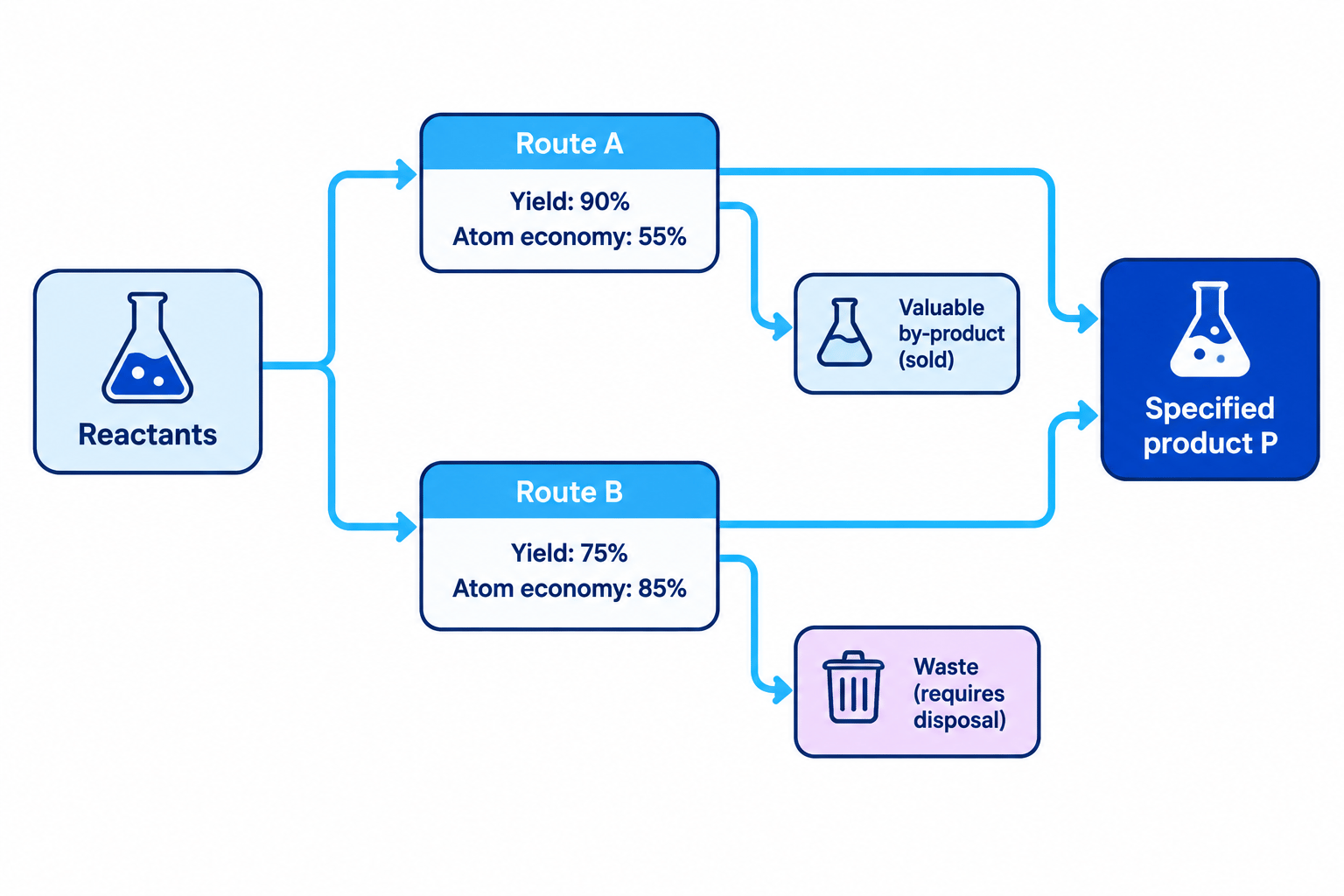
A reaction pathway is the route chosen to make a product
Definition
Reaction pathway
A sequence of one or more reactions used to convert starting materials into a specified product.
Definition
Specified product
The desired product named in the question as the substance that the process must produce.
- There is often more than one reaction pathway that makes the same specified product.
- Industry compares the routes and picks the one that makes the specified product most efficiently.
Key Idea
No single factor decides the best pathway; the choice weighs several against one another.
Yield and atom economy shape the choice
Definition
Atom economy
The percentage of the total mass of reactants that becomes the desired product.
- A high percentage yield is preferred because it makes more product from each batch of reactants.
- A high atom economy is preferred because less of the reactant mass is wasted as by-products.
Example
A route with a high yield but a low atom economy still throws away a lot of material, so both figures have to be judged together.
By-products, rate and equilibrium also count
Definition
By-product
A substance formed alongside the desired product in a chemical process.
Definition
Equilibrium position
The relative amounts of reactants and products present when a reversible reaction reaches equilibrium in a closed system.
- A useful by-product that can be sold improves the economics of a pathway.
- A faster rate of reaction makes more product in the same time.
- In a reversible reaction, the equilibrium position limits how much product can form.
Exam technique
- In an evaluate question, give both a strength and a weakness of each pathway before you reach a decision.
- Support your final choice with the specific figures given, such as the yields or atom economies quoted.
Weighing up the whole pathway
- The cost and availability of the raw materials affect whether a route is practical.
- The energy needed and the environmental impact of any waste also weigh on the decision.
- The best pathway is the one that balances all of these against a good yield and a high atom economy.
Self review
- What is meant by a reaction pathway?
- Give four factors used to compare different reaction pathways.
- Why can a useful by-product make a pathway more attractive?
- Why is no single factor enough to choose the best pathway?