Question 2
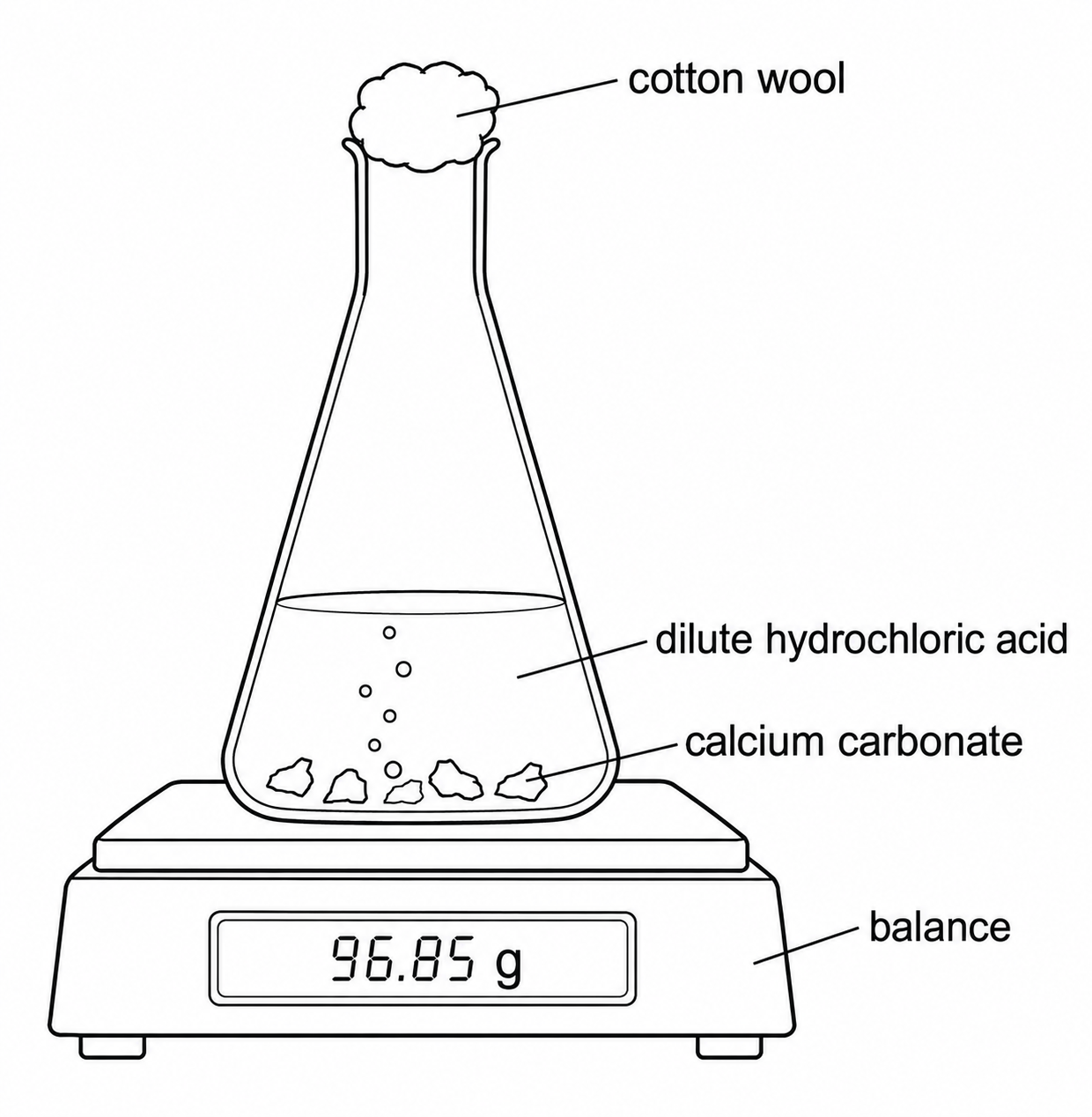
FA student added small pieces of calcium carbonate to dilute hydrochloric acid in a conical flask. The flask was standing on a balance. Figure shows the apparatus.
Figure: The apparatus used to measure the change in mass when calcium carbonate reacts with dilute hydrochloric acid
The equation for the reaction is:
CaCO3+2HCl→CaCl2+H2O+CO2\text{CaCO}_3 + 2\text{HCl} \rightarrow \text{CaCl}_2 + \text{H}_2\text{O} + \text{CO}_2CaCO3+2HCl→CaCl2+H2O+CO2
a.[2]
The balance reading decreases during the reaction. Explain why.
b.[2]
The student repeats the experiment with a rubber stopper sealing the neck of the flask. Predict what happens to the balance reading, and give a reason for your prediction.
3.1 Chemical measurements, conservation of mass and the quantitative interpretation of chemical equations Questions
40 exam-style questions on AQA GCSE Chemistry 3.1 Chemical measurements, conservation of mass and the quantitative interpretation of chemical equations, covering 3.1.1 Conservation of mass and balanced chemical equations, 3.1.2 Relative formula mass, 3.1.3 Mass changes when a reactant or product is a gas, and 3.1.4 Chemical measurements. Each one has a worked solution and a mark scheme showing where the marks go.