Question 8
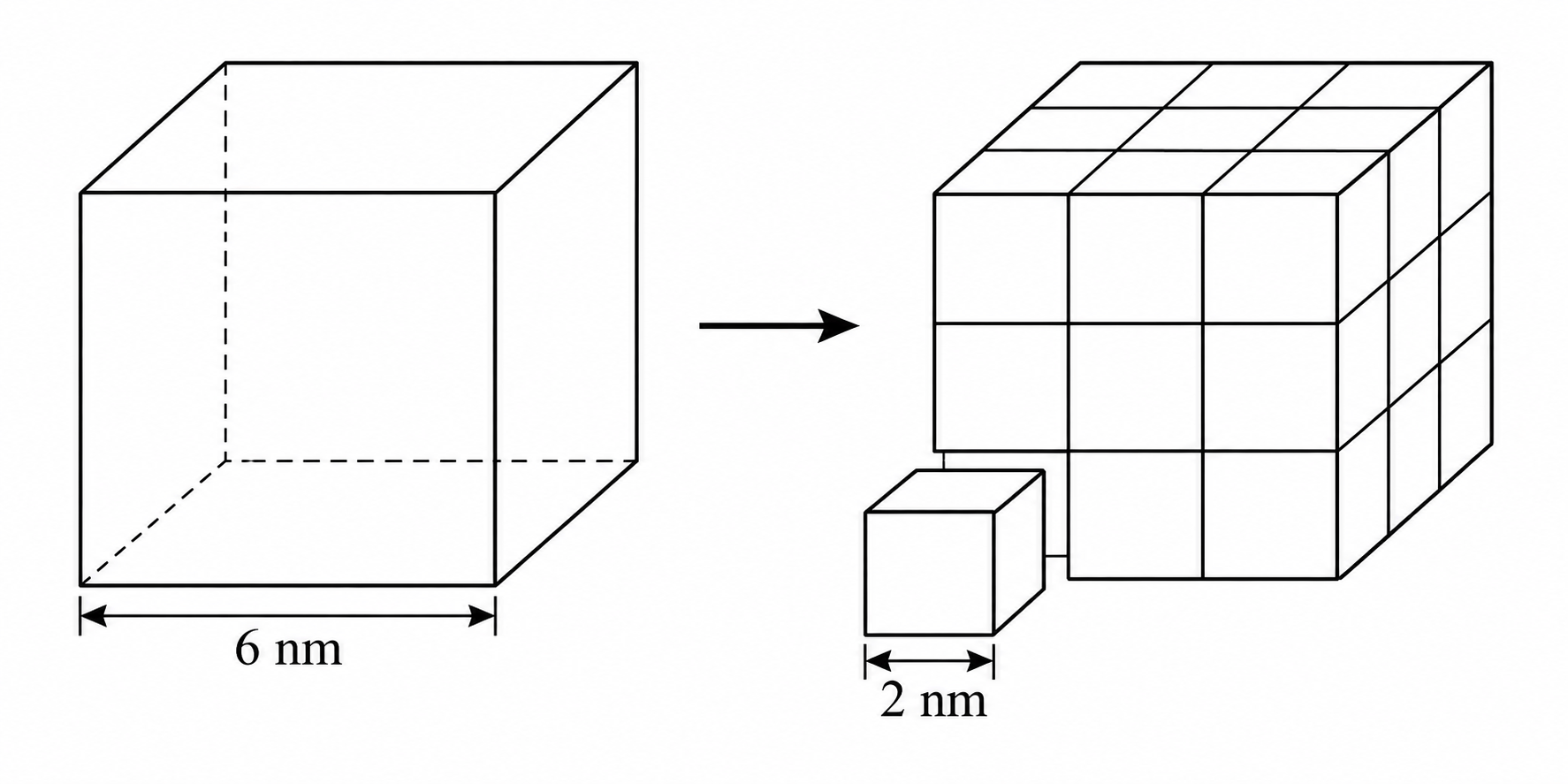
HThe figure shows a cube of a solid with sides of length 6 nm6\ \text{nm}6 nm, and the same cube after it has been cut into smaller cubes with sides of length 2 nm2\ \text{nm}2 nm.
Figure: A cube of a solid with sides of length 6 nm, and the same cube cut into smaller cubes with sides of length 2 nm
a.[1]
Calculate the number of smaller cubes produced.
b.[2]
Calculate the total surface area of all of the smaller cubes.
c.[1]
The surface area of the original cube is 216 nm2216\ \text{nm}^2216 nm2.
Calculate how many times larger the total surface area of the smaller cubes is than the surface area of the original cube.
2.4 Bulk and surface properties of matter including nanoparticles Questions
40 exam-style questions on AQA GCSE Chemistry 2.4 Bulk and surface properties of matter including nanoparticles, covering 2.4.1 Sizes of particles and their properties and 2.4.2 Uses of nanoparticles. Each one has a worked solution and a mark scheme showing where the marks go.