Size, age and ownership: the situation the owner is in
- Two businesses selling the same product on the same street can hold opposite aims, because an aim is a response to the circumstances the owner is actually in.
- Size and age: a business in its first year aims at survival, because it has no reputation and little cash behind it, while an established firm with regular customers can aim at profit or growth.
- The start-up counts covering its costs each month as success, while the established firm can spend on a second site knowing that one bad year will not close it.
- Ownership: a private limited company that has sold shares to outside investors faces pressure to produce a return for them, so profit moves to the top of its list.
- A sole trader answers to nobody, so can choose a smaller income and a four-day week without justifying that decision to anyone.
- What the owner personally wants: someone who left a job to be their own boss puts independence first, while someone who set up purely to make money aims at the largest profit possible.
- Offered a contract that would double sales but mean hiring ten staff, the first owner turns it down to keep control and the second takes it, so two identical firms end up completely different sizes.
Example
- A plumber who left an employer to work for himself aims to earn enough to cover his mortgage and choose his own hours.
- A bakery in Leeds owned by three shareholders aims to open a second shop within two years.
- Both firms make a profit, and only one of them treats standing still as failure.
The market and the economy: pressure from outside the business
- A fast-changing market: a firm selling a new kind of product aims at market share before profit, because a customer signed up now is one a rival cannot win later.
- That can mean setting a price low enough to take customers quickly and accepting a thin margin for a year or two, which a firm chasing immediate profit would never do.
- A stable market: a hardware shop serving the same village year after year aims at steady profit, because there is little share left to win and the cost of expanding would not be repaid.
- Competition: strong rivals push a business towards either winning share or being noticeably different, since matching a large rival on price alone is a fight a small firm loses.
- Aldi and Lidl chase share with low prices and a narrow range, while Innocent aims instead at customers willing to pay more than supermarket own-brand for its branding.
- The state of the economy: in a downturn customers cut their spending, so even a firm still making a profit switches its aim to survival and protecting cash.
- If the Bank of England raises the base rate, loan repayments rise, so a firm planning a second site drops the plan and aims to hold on to the site it has.
Note
- The lists themselves, financial aims such as profit and market share and non-financial aims such as independence, belong to the two previous guides.
- Here the marks come from explaining why one business picks one of them and another business picks a different one.
Why the same business changes its aims over time
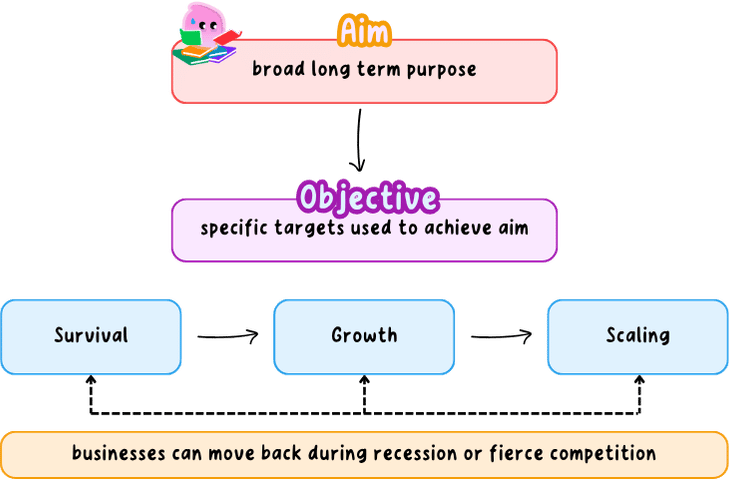
- An aim is a snapshot of a business's situation rather than a fixed feature of it, because the circumstances that produced the aim keep moving.
- Survival in year one usually becomes growth by year three, once repeat customers make the monthly income predictable and a bank is willing to lend against it.
- The change runs the other way too, since a recession, a new rival or the loss of one large customer can turn a growing firm back into one aiming only to stay open.
- Wilko had traded since 1930 and ran around 400 shops, but as trade worsened its aim moved from growth to survival, and by October 2023 every shop had closed with around 12,500 jobs lost.
Exam technique
- Read the source for the firm's size, age, ownership and market before you name an aim, because the application mark depends on matching the aim to that firm.
- Write the reason as a chain: the firm is six months old, so it has no reserves to fall back on, so survival has to come before growth.
- A question asking why two businesses hold different aims wants a comparison, so put both sides in the same sentence instead of describing each firm on its own.
- If the case mentions a downturn, a rate rise or a new competitor, say what that does to the aim, since the shift is the point being tested.
Self review
- Give two reasons a start-up and an established firm set different aims.
- Why might a sole trader aim at something other than the largest possible profit?
- How does a fast-changing market change what a firm aims at, and why?
- What happens to a profitable firm's aims during a recession?
- Name one event that could move a growing business back towards survival.
