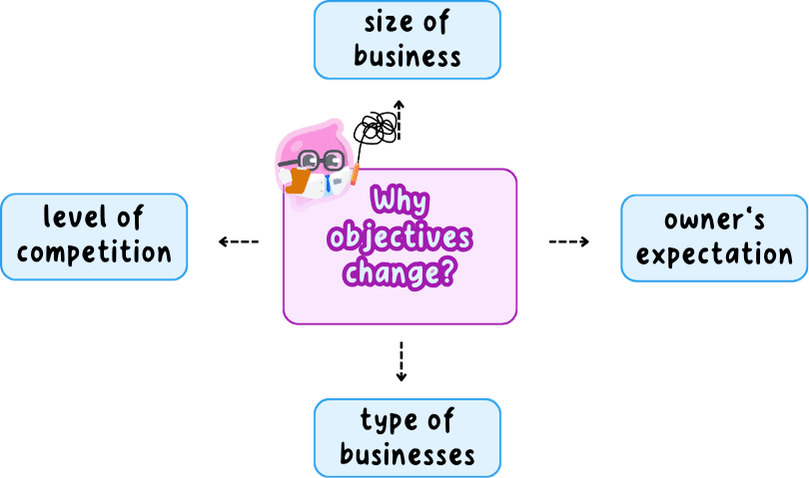
Aims are not fixed: they shift as the business develops
- The aims written down at start-up describe what mattered to the owner in that first month, so they are reviewed as the business, its market and its owner all move on.
- One pattern repeats across most firms, with a different aim dominating at each stage.
| Stage of the business | Aim that dominates | What it drives day to day |
|---|---|---|
| First year or two | Survival | Low prices, cash kept for bills |
| Established, regular custom | Growth | Second site, wider range, online |
| Mature, market largely won | Profit or market share | Protecting margins and share |
Referring to the above table:
- Survival dominates early because cash is thin and one quiet month can leave the owner unable to pay rent, so a low profit is accepted in exchange for staying open.
- Once regular custom is established the survival aim is met, so the owner reinvests profit in a second van, a second unit or an online shop, which is a growth aim.
- Later, with the customer base largely won, the aim turns to profit for the owner or to market share taken from rivals, because there is less new ground left to take.
- The sequence runs backwards as easily as forwards, and Wilko had traded since 1930 with around 400 shops before it entered administration in August 2023, which shows that age and size do not protect an aim.
Example
- Ben Francis founded Gymshark in Birmingham in 2012, screen-printing gym clothing in a garage.
- At that point the aim was to cover the cost of fabric and printing and keep trading.
- Selling online through fitness influencers brought in enough orders to make survival safe, and the aim moved on to growth into a global brand.
Outside the business: market conditions, technology and the law
- Market conditions change when new rivals arrive, when demand shifts to something else, or when a product the firm relied on stops selling.
- Aldi and Lidl compete on price with a narrower range, so a nearby grocer loses its price-sensitive shoppers, revenue falls, and an aim of opening a second branch is replaced by an aim of holding on to the customers it still has.
- A firm that takes most of its income from one product is hit hardest, because when that product stops selling the growth aim becomes a survival aim within a single trading year.
- Technology changes aims by making an old objective pointless and putting a new one in its place, most often a new way of selling or a cheaper way of producing.
- An objective of opening three more shops becomes an objective of taking a third of sales online, because a website reaches the whole country for a monthly fee while a high-street unit costs several thousand pounds a year in rent.
- Blockbuster rented DVDs from shops and did not move its aims fast enough once streaming arrived, and its UK business entered administration in 2013 while Netflix took the customers.
- Legislation changes aims by forcing spending and management time onto compliance, which pushes the objectives the owner would rather pursue further back.
- A rise in the National Living Wage lifts the wage bill of a café with eight staff, so the £12,000 saved towards a second site pays wages instead and the expansion objective slips by a year.
- Tighter environmental or consumer law works the same way, since new packaging or new record-keeping has to be paid for before any growth target is funded.
Inside the business: performance and internal reasons
- Performance against an objective sets the next one, because a target hit early and a target missed badly point the aim in opposite directions.
- Hitting an objective early shows there is more demand than expected, so the business raises its sights and sets a more ambitious target.
- Missing one badly forces the opposite, and a growth objective drops back to survival until trading steadies.
- Internal reasons start with the owner, whose own priorities change when they want more time away from the business or decide to sell up.
- Taking on investors brings in people who expect a return and push for profit or growth, and new managers arrive with plans of their own.
Exam technique
- Name the trigger from the source booklet, say which aim it makes unworkable, then name the aim that replaces it.
- The link most often dropped is the middle one, because answers describe the change and then jump to a new aim without saying why the old one failed.
- Finish with the spending decision the new aim forces, such as postponing a second unit, since that is where the analysis is credited.
- When the question says explain, one trigger carried the whole way through scores better than three triggers listed.
Self review
- Which aim dominates in a business's first year or two, and why?
- Give one change in market conditions that turns a growth aim into a survival aim.
- How can a change in technology make an existing objective irrelevant?
- How does hitting an objective early, or missing one badly, change the objective a business sets next?
- Give one internal reason, coming from the owner or from new investors, that changes a business's aims.
