1.5.1a Business stakeholders and their objectives
What a stakeholder is: any group with a stake in what the business does
Stakeholder: any individual or group with an interest in a business and how it performs, and who is affected by the decisions it takes.
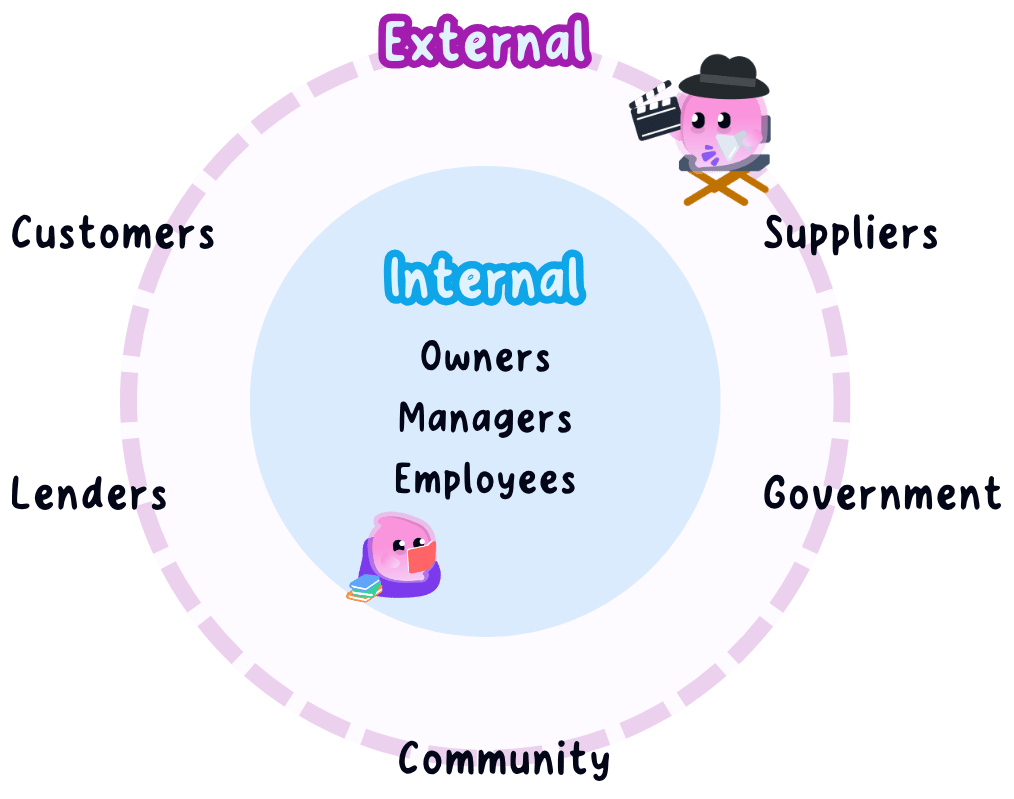
Internal and external stakeholders: internal stakeholders own the business or work inside it, while external stakeholders deal with it from outside.
- Having an interest means a decision by the business changes something that group cares about, such as its wages, its prices, its profit or the traffic on its street.
- Edexcel names eight stakeholder groups, and they divide into two sets by where each group sits.
- Internal: shareholders, employees and managers, who put money, labour or decisions into the business itself.
- External: customers, suppliers, the local community, pressure groups and the government, who meet the business as buyers, sellers, neighbours, campaigners or regulators.
- Every business has stakeholders whether it plans for them or not, from a market stall with one wholesaler and thirty regulars to Tesco with millions of shareholders and shoppers.
The internal stakeholders: what owners, staff and managers want
- An internal stakeholder's objective follows from what they put into the business and what they stand to lose.
- Shareholders (owners): a return on the money they invested, taken as a share of the profit and as a rising share value, plus a say through their vote in how the business is run, because they carry the loss if it fails.
- Employees: secure jobs, fair pay, safe working conditions and training that leads to promotion, because one employer supplies their whole household income.
- Managers: the business to hit its sales and cost targets, since their salary, bonus and job depend on those figures, along with the budget and the staff needed to reach them.
- Owners and managers are the same people in a sole trader, but in a large company the owners hire managers to run it, so the two objectives are held by two different sets of people.
- Wilko traded from 1930 and ran around 400 shops before entering administration in August 2023.
- Its employees wanted secure jobs and steady pay, and around 12,500 of them lost that when every shop closed by October 2023.
- Its owners wanted a return on the capital tied up in the chain, and were left with a business worth nothing.
- The managers' objective, hitting the sales targets that kept the shops trading, was the one that would have protected both groups.
The external stakeholders: what customers, suppliers, neighbours, campaigners and the state want
- An external stakeholder's objective follows from the one relationship it has with the business.
- Customers: good quality at a fair price, a choice of products, and service they can rely on such as accurate delivery dates and an easy refund, because it is their own money being spent.
- Suppliers: regular repeat orders and payment in full on the agreed date, because their own cash flow has to cover their wages and rent whether the customer pays or not.
- The local community: jobs for local people and money spent in local shops, with as little noise, heavy traffic and pollution as possible, because residents live beside the site every day.
- Pressure groups: a change in how the business behaves on one specific issue, such as plastic packaging, animal welfare or the pay and conditions of the workers who make its products.
- The government: businesses that pay their corporation tax and VAT to HMRC, obey employment and consumer law, employ people and add to the growth of the economy.
- Greggs shows how far apart these can sit: its customers want a hot roll for a low price, its suppliers want that order repeated every week, and the council wants the shop to control litter on the high street.
- How each of these groups affects the business, and how the business affects them, is the next guide.
- Where two groups want opposite things, the guide after that deals with the conflict.
One person can sit in more than one group
- Stakeholder groups are roles, not separate people, so the same person can hold two or three of them at once.
- A woman who works at the Tesco store, owns Tesco shares through a pension and lives on the road behind it is a stakeholder three times over.
- Her objectives do not all agree: as an employee she wants a pay rise, as a shareholder she wants profit protected so dividends keep coming, and as a resident she wants the night deliveries stopped.
- So identify the role someone is acting in before you state their objective, because the answer changes depending on which hat they are wearing.
- A question that names a group wants that group's objective, so write about payment dates for suppliers, not about profit.
- Add the reason after the objective, because "suppliers want paying on time so they can cover their own wage bill" earns more than "suppliers want money".
- Every shareholder is a stakeholder, but not every stakeholder is a shareholder, so never swap the two words.
- Use the stakeholders named in the source booklet, such as the residents near that firm's depot, since application marks are gated on that context.
- Define a stakeholder in one sentence.
- Which three of the eight groups are internal stakeholders?
- State two objectives of employees and say why they hold them.
- What does a supplier want from a business, and why does the timing of payment matter to it?
- Give one example of a person who belongs to more than one stakeholder group.
1.5.1b How stakeholders and businesses affect each other
How business activity affects stakeholders: follow one decision outwards
- A business decision never stops at the firm's own accounts, because every choice it makes moves money, work or surroundings for people outside it.
- Take a food manufacturer that closes its factory in one town and moves production to a larger site 80 miles away, then trace where that decision lands.
- Employees: 200 staff lose their jobs, so household income drops to whatever redundancy pay and benefits provide, and anyone who cannot find similar pay locally has to retrain or move.
- Customers: the larger site makes each unit more cheaply, so shop prices can be held down, although supply may be patchy for a few weeks while the new lines are set up.
- Suppliers: the haulier and the packaging firm next to the old factory lose their contracts, so their revenue falls and they may have to cut their own staff.
- The local community: 200 wage packets stop being spent in nearby shops and cafes, so takings there fall, while the new town gains that trade along with extra lorry traffic on its roads.
- Shareholders: running costs fall, so profit rises, so dividends and the share price can climb, which is the reason the board approved the move.
- The government: it collects less income tax and National Insurance from the workers who lost their jobs and pays more out in benefits, while gaining tax revenue in the town that gained the site.
- Each of those is a chain rather than a label, because the decision changes something specific for the group and the group is then forced to act differently.
- Wilko had traded from 1930 and ran around 400 UK shops before it entered administration in August 2023.
- Every shop had closed by October 2023 and around 12,500 people lost their jobs.
- Suppliers lost a customer that had ordered from them for decades, so their own sales fell in the same quarter.
- High streets were left with large empty units, which cuts the number of shoppers passing the businesses on either side.
How stakeholders impact business activity: every group holds a lever
- Stakeholders are not only on the receiving end, because each group controls something the business needs and can withhold it.
- Customers: they can stop buying and spend at a rival instead, which is the most direct pressure of all, since revenue falls the same week rather than after a meeting.
- Employees: they can leave, work with less care, or refuse to accept a change to shifts and pay, so output drops and the business pays again to recruit and train replacements.
- Shareholders: they can vote against the directors at the annual general meeting or sell their shares, and heavy selling pushes the share price down.
- Suppliers: they can withdraw the 30 days' credit, raise their prices or stop supplying altogether, which drains cash and can halt production within days.
- The local community: it can object to a planning application, which can delay or block a new store, car park or extension for months.
- Pressure groups: they campaign publicly over issues such as packaging or pay, and the damage to reputation costs sales even where the business has broken no law.
- The government: it can change the law or the tax the business pays, and HMRC collects what is owed whether the owners agree with it or not.
- Managers usually act before a lever is pulled, because keeping customers and staff costs far less than winning them back once they have gone.
- Greggs sells cheap hot food in high volume on UK high streets, so any shift in what its customers buy shows up in sales figures quickly.
- Enough shoppers wanting a meat-free option made a vegan sausage roll worth adding to the menu.
- No customer voted or wrote to head office, they simply chose what to buy at the counter each morning.
- The lever here was ordinary spending, and it worked because Greggs depends on repeat trade from the same shoppers.
The size of a stakeholder's influence: how easily could the business replace them?
- How hard a group can push comes down to one test, which is how easily the business could manage without it.
- A supplier that is the only source of a part has real power, because refusing to supply halts production and the buyer has nowhere else to turn, so it can raise its price and still keep the order.
- A supplier that is one of twenty firms selling the same cardboard boxes has almost none, because the buyer can switch within a week and still pay £2 a box.
- The test works the same way for people, since an engineer trained over five years is hard to replace and can press for a rise, while one shopper leaving Tesco for Aldi changes nothing until thousands do the same.
- The government is the exception, because a business cannot replace it or trade around it, so its laws and taxes bind a market stall and a supermarket chain alike.
- Check which direction the question wants, because "affected by business activity" needs the business acting on the group and "impact on business activity" needs the group acting on the business.
- Build three links every time: the decision, what it changes for the named group, and what that group then does about it.
- Use the stakeholder named in the extract rather than listing every group you can remember, since application marks are gated on the given business.
- On a longer question, judge whether that group's influence is large or small here by asking how easily the business could replace it.
- Give two ways that closing a factory affects government finances.
- Which stakeholder lever acts on a business fastest, and why?
- How can the local community delay a new store?
- What decides whether a supplier has real power over a business?
- Name one action shareholders can take if they disagree with the directors.
1.5.1c Conflicts between stakeholder groups
Why conflict is built in: one pot of money, several claims on it
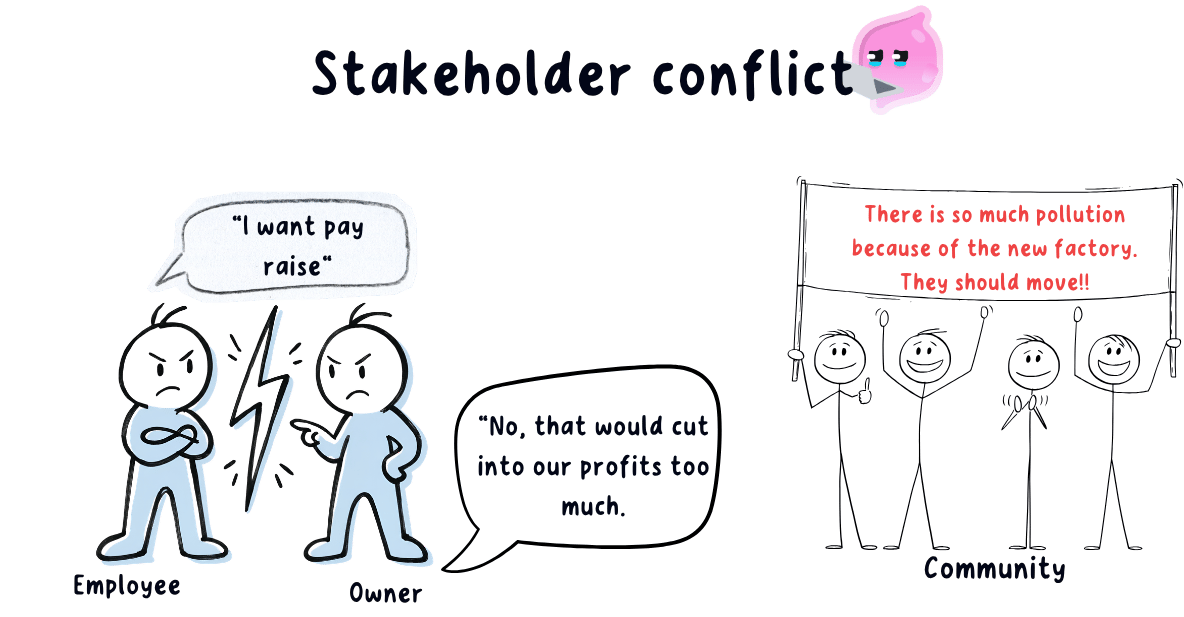
Stakeholder conflict: when giving one stakeholder group what it wants makes it harder to give another group what it wants.
- A business has one pot of money coming in from sales, and every stakeholder group has a claim on part of it.
- Money paid out in higher wages is money that is not paid out as profit, so satisfying employees costs the shareholders and satisfying the shareholders costs the employees.
The clashes that come up most, and the mechanism behind each
- Shareholders against employees: both claims land on the same wage bill.
- Shareholders want costs cut so profit and dividends rise, while employees want higher pay and secure jobs, so a 5% rise on a £200,000 wage bill takes £10,000 straight out of profit.
- Shareholders against customers: the price is the point where the money changes hands.
- Adding 50p to a £5 item raises profit on every sale, but customers get less for their money and some switch to a cheaper rival, so the extra profit is never guaranteed.
- The business against the local community: expansion buys sales and costs goodwill.
- Opening a larger site or trading until 11pm brings extra sales for the owners, but residents get more traffic, noise and litter, so objections can delay or block planning permission.
- Managers against shareholders: the argument is about timing rather than the amount.
- Managers often want profit reinvested in equipment and new branches that pay off in several years, while shareholders may want that same profit paid out as a dividend now.
- Suppliers against the business: both sides are protecting their own cash flow.
- The business wants a lower price and 60 days to pay, the supplier wants a higher price and payment in 30 days, and every extra day of credit the buyer gains is a day the supplier waits for cash.
- Pressure groups against the business: a greener method almost always costs more per unit.
- A campaign for recycled packaging or sustainably sourced materials raises the cost of making each item, so meeting it cuts profit unless customers will pay more for it.
- Greggs sells cheap hot food in high volume, so each item earns only a small amount of profit.
- A rise in shop wages there has to be paid for either by a higher price for customers or by a smaller profit for the owners.
- Its vegan sausage roll worked the other way, because it answered customers who wanted a meat-free option and brought in new sales the owners gained from as well.
Where interests overlap: decisions that pay two groups at once
- Conflict is not always settled by picking a side, because some decisions pay two groups at the same time.
- Paying shop staff above the going rate raises the wage bill, but it cuts staff turnover, so the business spends less on recruiting and training replacements.
- Experienced staff also serve customers faster and make fewer mistakes, so repeat custom and sales rise and the shareholders end up better off from the decision the employees wanted.
- Name both groups, say what each one wants, then show why the same pound or the same decision cannot satisfy both.
- Check for an overlap before you assume a trade-off, because a decision such as better pay can raise sales as well as costs, and that point separates a top answer from a list.
- When the question says justify or evaluate, finish by saying which group should come first for this business and why, using its size, its cash position or its market.
- Do not write that a business can keep everyone happy, and do not claim every conflict can be fully resolved.
- Why does paying employees more usually reduce profit?
- State the conflict between shareholders and customers over the price charged.
- Why might managers and shareholders disagree about what to do with a year's profit?
- Give one decision that benefits employees and shareholders at the same time, and explain the link.
- Name two things that decide which stakeholder group a business should put first.
1.5.2a Types of technology used by business
E-commerce: selling online through your own site or a marketplace
E-commerce marketplace: a site such as Amazon, eBay or Etsy where many separate businesses list their products, and the site supplies the shopfront, the search and the checkout in return for a cut of each sale.
- E-commerce: selling goods and services over the internet, either through a website the business runs itself or through a marketplace.
- In practice the business lists each product with photographs, a price and a delivery option, takes the order and the money online, then packs the goods and posts them.
- Benefit: one online shop can sell to the whole country without renting a unit anywhere, which is how ASOS sells clothing to shoppers across the UK through its website and app.
- Drawback: delivery, packaging and returns all cost money, and a customer who sends half an order back still has to be refunded in full.
- Every other online seller is now a rival too, because a shopper can compare your price with theirs in seconds without leaving the sofa.
Social media: your posts and other people's recommendations
- Social media: apps and sites where a business runs a page, posts content, replies to comments and collects public reviews.
- A business posts new products and offers, answers questions sent as messages, and pays influencers to show the product to their own followers.
- Benefit: a post costs almost nothing to publish yet can reach tens of thousands of people, and every customer who shares it or tags a friend spreads the message for free.
- Drawback: complaints are public and travel fast, so one angry review sits under the post where every future customer can read it.
- Keeping the accounts going also takes time, because a page that has not posted for six months looks like a business that has closed down.
- Gymshark was started in 2012 by Ben Francis, who screen-printed gym clothing in a garage in Birmingham.
- It grew by getting its clothing onto fitness influencers who wore it in their own posts and videos.
- Those posts reached followers who already trusted the influencer, so the recommendation carried more weight than an advert the business wrote about itself.
- The trade-off is control, because once the clothing is in someone else's video the business no longer decides what is said about it.
Digital communication: email, messaging, video calls and the website
- Digital communication: sending information electronically, by email, instant messaging, video call or the business's own website.
- The same tools run in three directions: to customers as order confirmations and delivery updates, to staff as rotas and team video calls, and to suppliers as orders and stock queries.
- Benefit: messages arrive instantly, cost almost nothing to send and leave a written record you can check if an order is later disputed.
- It also makes remote working possible, since a manager can approve a supplier's order from home rather than waiting until Monday.
- Drawback: staff can be overwhelmed by the sheer number of messages, and writing carries no tone of voice, so a short reply meant to be efficient can read as rude.
Payment systems: how the money actually reaches the business
Electronic payment system: any method that moves money from the customer to the business without cash, including chip and PIN, contactless cards, mobile wallets and online checkouts.
Transaction fee: the charge the card or checkout provider takes out of every sale, usually a small percentage of the amount plus a few pence.
- In person: a chip and PIN terminal, contactless for smaller amounts, mobile wallets held against the reader, or a card reader that plugs into a phone so a market stall can take cards.
- Online: a checkout page that takes card details, or payment inside an app, such as paying Deliveroo before the food is cooked or paying Tesco for a click and collect order before you drive over.
- Benefit: queues move faster, no sale is lost because a customer is carrying no cash, and the day's takings are recorded automatically instead of being counted by hand.
- Drawback: the provider takes a fee out of every single transaction, so on a £2.50 coffee the business keeps a little less than the price on the board.
- A payment system that goes down stops trading completely, because a shop that takes almost no cash has no other way of being paid.
- A state or identify question wants the type of technology plus one example, such as social media, for example a paid Instagram post.
- Keep the four types apart, because answers often turn every point into e-commerce when the business in the source is actually using digital communication or a payment system.
- Match the technology to the business you are given, since a market stall needs a card reader and a national clothing brand needs a marketplace listing.
- Save the effects on sales, costs and the marketing mix for the impact questions, as the marks here are for identifying the technology and saying how the firm uses it.
- Name the four types of technology in this topic.
- What is an e-commerce marketplace, and name one.
- Give one benefit and one drawback of a business using social media.
- Besides customers, who else does a business use digital communication with?
- Why does taking a card payment leave the business with less than the price charged?
1.5.2b How technology influences business activity
Sales: a national market, and a national set of rivals
- Technology lifts sales through five mechanisms, and each one needs its chain stating rather than naming.
- Reach: selling online replaces a catchment of a few miles with a national or international market, so the number of people who could buy rises without the business renting a second shop.
- Opening hours: the site takes an order at two in the morning when the shop is locked, so sales that closing time would have killed are still made.
- Cheap reach: one social media post reaches thousands of followers at no cost per view, so a small firm speaks to an audience it could never afford to buy in print.
- Customer data: the checkout records what each shopper bought, so the business can recommend related items and raise the average order value.
- Faster payment: saved card details and contactless cut the number of shoppers who abandon a full basket at the last step, so more visits end in a sale.
- The same reach works in reverse, because a customer can compare your price with twenty other sellers in seconds, so a shop once protected by being the only one in town loses trade to a cheaper rival two hundred miles away.
- A business with no online presence now loses sales by default, because a customer who searches and does not find it simply buys from whichever seller does appear.
- Gymshark was started in 2012 by Ben Francis screen-printing gym clothing in a Birmingham garage, and sold nationally through fitness influencers rather than through shops.
- Blockbuster rented DVDs from high-street shops and entered administration in the UK in 2013, once Netflix let the same customers stream at home instead.
- The technology that carried one firm's sales up is the technology that took the other's away.
Costs: what technology takes away and what it adds
- Technology cuts four costs in particular.
- Rent: an online seller trades from a spare room or a cheap unit rather than a high-street site, so the biggest overhead in retailing disappears.
- Wages: self-service checkouts, online ordering and automatic email replies mean fewer people on tills and phones, as at PureGym where sites open 24 hours with no staffed reception.
- Stock: the till updates the stock record as each item sells, so the owner reorders on real figures and throws away less unsold stock.
- Promotion: an email or social media campaign costs a fraction of print or television advertising, so a budget of a few hundred pounds still buys a wide audience.
- Technology also adds costs, and this is the half most answers leave out.
- Buying in: the equipment, the website and the software licences are paid for before a single extra sale arrives, which drains cash from a young business.
- Training and upkeep: staff must be taught to use the system and it then has to be maintained and updated, so the spending does not stop at the purchase price.
- Fulfilment: postage, packaging and free returns eat into every order, and the payment provider takes a fee on each transaction the business takes online.
- Breakdown: when the site or the card terminal fails the business cannot take money at all, so a fault costs a day of trade on top of the repair bill.
- Technology usually swaps variable costs for fixed ones.
- A machine or a £40 monthly subscription is paid for whether trade is strong or weak, while the hours of a part-time assistant can be cut in a quiet week.
- That makes technology a bigger risk for a business with unpredictable sales, because the cost stays put when the revenue falls.
The marketing mix: one shift in each of the four Ps
- Product: a business can now sell a purely digital product such as a streaming subscription, or bolt a digital feature such as an app onto a physical one.
- Price: easy comparison drags prices down because the cheaper seller is one click away, though customer data also lets a firm send an offer to one shopper instead of cutting the price for everybody.
- Promotion: social media posts, influencers and email lists have taken the place of the print and television advertising a small firm could never afford.
- Place: the website becomes the shop, and click and collect at Tesco and Sainsbury's joins the two by letting a customer order online and pick the goods up in store.
- Adopting technology is no longer a free choice for most businesses, because once rivals offer card payment, next-day delivery and an app, customers treat all three as the minimum and go elsewhere when they are missing.
- Choose one of the three areas, then build the chain: name the technology, say what it changes, and finish on sales revenue, a cost or a named P.
- Do not describe the technology itself, because "social media lets a business post pictures" earns nothing without the effect on the firm.
- On any question about costs, give one cost technology removes and one it adds, since the marks sit in that comparison.
- Apply it to the business in the source booklet, because a market stall and a national retailer gain very different amounts from the same website.
- Give two mechanisms by which selling online raises sales.
- Name one cost technology removes and two costs it adds.
- Why does technology tend to swap variable costs for fixed costs, and why does that raise risk?
- State one effect of technology on price and one on place.
- Why can a business lose sales to technology even when its product has not changed?
1.5.3a Principles of consumer law
Why the law sets a floor: legislation as a minimum standard
Consumer law: the rules that set the minimum standards a business must meet when it sells goods and services to the public.
- Legislation sets a standard every business selling in the UK has to reach whether or not it would choose to, and for consumer sales that framework is the Consumer Rights Act 2015.
- A buyer only finds out that a product is faulty after paying for it and carrying it home, so the harm lands before the market has any chance to punish a bad seller.
- A common floor also stops firms competing by cutting corners, because no rival can undercut an honest seller by shipping unsafe goods and staying quiet about it.
Quality: satisfactory, fit for purpose and as described
Satisfactory quality: the standard a reasonable person would expect of goods at that price, taking account of safety, finish and durability.
- Three promises about quality are built into every sale, and a business cannot write them out of its own terms and conditions.
- Satisfactory quality: a kettle that leaks from the seam after a fortnight fails, because no reasonable buyer would accept it at any price.
- Fit for purpose: walking boots sold for hill walking that let water in fail, because they do not do the job they were sold to do even though nothing is visibly broken.
- As described: a jumper advertised as wool that turns out to be acrylic fails, because it does not match the description, however warm and well made it is.
Consumer rights: a repair, a replacement or a refund
- If goods fall short on any of the three promises, the customer is entitled to a remedy from the shop that sold them, not from the factory that made them.
- Repair: the seller puts the fault right and returns the same item, which is usually the cheapest route for the business.
- Replacement: the seller hands over another one of the same product and absorbs the cost of the faulty unit.
- Refund: the seller gives the money back, so the sale is reversed and the revenue disappears from the accounts.
- Services carry a parallel promise: a haircut, a repair or a boiler fitting must be done with reasonable care and skill and charged at a reasonable price.
- The cost that legislation adds to a business in general is dealt with in guide 1.5.3c.
- What follows from meeting or failing these obligations is dealt with in guide 1.5.3d.
What consumer law changes in how a business operates
- Meeting these promises is not a document in a drawer, because it changes five everyday jobs, each of which costs money or time.
- Checking what comes in: stock is inspected or a supplier is tied to a quality standard, so faults are caught before they reach a customer.
- Describing honestly: adverts, labels and online listings have to be checked against the actual product, which means somebody is paid to sign them off.
- Training staff: sales and customer service staff learn what to claim about a product and how to settle a complaint, which is paid time away from selling.
- Keeping records: receipts, order histories and proof of purchase are stored so a genuine claim can be settled quickly rather than argued over.
- Budgeting for returns: money is set aside for refunds and replacements, so cash is tied up against returns that may never be claimed.
- The law works for the seller as well: shoppers order clothing from ASOS without trying it on because they know a faulty or misdescribed item can go back, so consumer law lifts sales at the same time as it constrains the business.
- Answer from the firm's side, because the marks sit on what the business must change, not on reciting the law.
- Use the exact wording, since "the goods were rubbish" scores nothing while "not of satisfactory quality" is the examiner's language.
- Edexcel does not want statute detail, so do not spend words on sections, time limits or court cases.
- Finish the chain: the firm checks stock, so fewer faulty items reach customers, so it pays fewer refunds and keeps the repeat custom its profit depends on.
- Name the three promises the law makes about the quality of goods.
- Which of the three does a jumper sold as wool but made of acrylic break?
- Give the three remedies a customer can be offered when goods fall short.
- What standard must a service be carried out to?
- Give two changes a business has to make to how it operates to meet consumer law.
1.5.3b Principles of employment law
Recruitment and pay: who you may hire and what you must pay them
- Employment law sets the minimum standards a business must meet when it hires, pays and manages the people who work for it, and a small firm gets no exemption from them.
- Recruitment: jobs must be open to everyone who could do them, selection must rest on ability to do the job, and the person hired must be given a written contract setting out pay, hours, holiday and notice.
- You word the advert so it does not shut out a group who could do the work, such as asking for a young and energetic person when age has nothing to do with the task.
- You interview every candidate against the same criteria and keep a written record of why the successful one was chosen, so the decision can be shown to rest on ability if it is later challenged.
- Pay: workers must be paid at least the legal minimum for their age, paid on the agreed date, given a payslip showing what has been deducted, and men and women must receive equal pay for equal work.
- The National Minimum Wage is set by the government and rises from time to time, so the rate is not something an owner negotiates separately with each worker.
- This puts a floor under the wage bill that the business cannot go below whatever its profits, so a firm having a bad year still pays the full rate to every member of staff.
- Equal pay means the same rate for the same work, so paying a female warehouse picker less than a male picker doing an identical job breaks the law even if she agreed to the lower rate.
- Greggs competes on low prices and high volume from shops on high streets and retail parks.
- Its shop staff must be paid at least the legal minimum like anyone else's, so when that minimum rises the wage bill rises across every shop at once.
- Because customers come to Greggs for cheap hot food, passing the whole increase on in prices risks losing the volume the model depends on.
Discrimination: treating someone worse because of who they are
Discrimination: treating a worker or job applicant less favourably because of a characteristic protected by law rather than because of their ability to do the job.
Reasonable adjustment: a change an employer must make so a disabled worker is not put at a disadvantage, such as a ramp, an adapted chair or altered hours.
- Under the Equality Act 2010 a business must not treat someone worse because of a protected characteristic such as age, sex, race, disability, religion or belief, sexual orientation, pregnancy or marriage.
- The rule covers hiring, pay, promotion, training and dismissal, so passing a worker over for promotion because she has told you she is pregnant is unlawful even though her pay is untouched.
- Reasonable adjustments go further than equal treatment, because a disabled worker needs the workplace changed rather than simply left alone, and the cost of that change falls on the employer.
Health and safety: a safe place, safe equipment and trained people
- The business must provide a safe workplace, equipment that is safe to use, and training in the hazards of the job before a worker is left to do it alone.
- Protective equipment such as gloves, goggles or non-slip shoes must be supplied free where the job needs it, and accidents must be recorded, with the serious ones reported to the authorities.
- In practice this means a written risk assessment for each task, a maintenance schedule for machinery, and paid staff hours spent on training rather than on producing output.
- A bakery in Leeds would assess hot ovens, the slicing machine and wet floors, then fit a guard to the slicer and lay non-slip matting, which costs money before a single extra loaf is sold.
- Consumer law, which protects the people buying from the business rather than working for it, is covered in guide 1.5.3a.
- The cost of meeting legislation is guide 1.5.3c, and what follows from complying or failing to comply is guide 1.5.3d.
What employment law means for the business
- Meeting these duties raises costs, because wages sit at or above the legal floor, training takes paid hours, guards and protective equipment have to be bought, and someone has to keep the contracts, payslips and accident records up to date.
- That spending buys something back, since staff who are paid properly and kept safe leave less often, so the business recruits and retrains fewer replacements and loses fewer days to injury.
- A reputation as a fair employer widens the pool of people willing to apply, which matters most to a small firm competing for staff against larger employers on the same high street.
- Name the area precisely, such as discrimination or health and safety, because writing that the business must follow the law earns nothing.
- Carry the chain through: the law requires something, so the business must change what it does, so its costs or its staffing move in a stated direction.
- You are never asked for the wording of an act, so time spent on legal detail is time not spent on the effect on the firm, which is where the marks sit.
- When the question says explain or analyse, apply the point to the business in the source booklet, since a bakery worries about slicers and hot ovens while an office worries about screens and long hours.
- Name the four areas of employment law you need to know.
- Define discrimination.
- What must a business give a new employee in writing, and what does it set out?
- Give one thing a business must do to meet its health and safety duties.
- Explain one way in which following employment law can save a business money.
1.5.3c The cost impact of legislation
Where the money goes: the direct costs of complying
Legislation: laws passed by government that a business must obey, including consumer law and employment law.
Compliance: doing what the law requires, together with the spending and the time it takes to do it.
- Consumer law and employment law both force a business to spend before it earns a penny more, and that spending lands in five places.
- Wage costs: paying the legal minimum lifts the wage bill, and it lifts it most in a business employing many low-paid staff, such as a café or a corner shop.
- Equipment and premises: guards on machinery, protective clothing, fire extinguishers and adjustments such as a ramp or an accessible toilet for disabled workers all have to be bought, then maintained and replaced.
- Training: an hour spent teaching staff safe lifting or how to handle a customer returning a faulty item is an hour not spent producing or selling, so it costs output even when no outside trainer is paid.
- Administration: writing risk assessments, issuing written contracts, running payslips and keeping pay records take hours, and a small firm often pays an accountant or an adviser £60 an hour to do them properly.
- Returns and refunds: consumer law means faulty goods come back, so the owner must budget for refunds, replacements and stock that cannot be sold again.
- Greggs sells cheap hot food in high volume, so a large share of its costs is the pay of shop staff on hourly rates.
- A rise in the legal minimum wage therefore adds to its wage bill in every shop at once, not in one place only.
- An independent bakery in Leeds with four staff faces the same rise as a much smaller cash sum, but has far fewer customers to spread it across.
Why the same law costs a small business proportionally more
- Compliance costs barely change with the size of the firm, which is why an identical rule squeezes a sole trader harder than a national chain.
- The paperwork is the same length: a risk assessment takes roughly the same hours to write whether the workplace has 6 staff or 600, so the cost per employee is far higher in the small firm.
- The equipment is the same price: a fire alarm system, a first aid kit and a set of machine guards cost much the same in a small unit as in a large one, but are spread over far fewer sales.
- The people doing it differ: a large firm employs an HR manager and a safety officer whose job this is, while a sole trader does the records in the evening after trading and loses that time from the business.
- What consumer law and employment law actually require is covered in guides 1.5.3a and 1.5.3b.
- The fines and the damage to reputation that follow breaking them belong to guide 1.5.3d.
How a business pays for it: four responses, each with a consequence
- Once costs rise the money has to come from somewhere, and an owner has four choices.
- Raise prices: passing the cost on protects the profit per unit, but in a price-sensitive market shoppers switch to Aldi or Lidl and sales volume falls.
- Absorb it: holding the price keeps those customers, but the lower profit leaves less cash to reinvest in stock, equipment or a second site.
- Cut costs elsewhere: trimming staff hours or stopping overtime pays for the rise, but a shop with fewer staff on the floor serves customers more slowly and can lose repeat trade.
- Invest in equipment: self-service tills or a faster oven cut the labour hours needed, but the machinery has to be paid for up front, which a small firm may manage only with a loan and interest on top.
Set against the cost: spending that prevents a larger bill
- Some compliance spending is cheaper than the accident it prevents, because an injury halts production, removes a trained worker for weeks and pushes up the premium on the firm's insurance.
- Clear contracts and tidy pay records also cut the hours lost to disputes, since an employer who can produce a signed contract settles an argument in minutes rather than months.
- Seen that way the spending buys certainty, because a business that meets the law knows what its costs will be instead of gambling on nothing going wrong.
- Name the cost precisely, because "the wage bill rises" and "machine guards must be bought" earn marks where "legislation costs money" earns none.
- Carry each cost through to an effect, such as a thinner profit, less cash for growth or a higher price that loses customers.
- If figures are given, multiply them out, for example a 50p rise across 8 staff working 25 hours a week, then say what that weekly total means for the owner.
- Size the impact against the firm in the case study, since the same rule takes a larger share of a small firm's revenue than of a chain's.
- Name four separate areas where obeying the law costs a business money.
- Define compliance.
- A café pays 8 staff for 25 hours a week each and the legal minimum wage rises by 50p an hour, so by how much does the weekly wage bill rise?
- Why does the same health and safety rule cost a small firm proportionally more than a large one?
- Give one compliance cost that prevents a larger cost later.
1.5.3d Consequences of meeting legal obligations
Meeting your obligations: what the business gets back
- What consumer and employment law actually require is covered in 1.5.3a and 1.5.3b, and what obeying it costs in 1.5.3c, so this guide takes the obligations as given and traces what follows from them.
- Meeting them pays the business back in four ways that show up in the figures, not just in feeling like the right thing to do.
- Customer trust: a shop that honours refunds and returns without an argument is one people buy from more readily and come back to, so repeat sales rise and less has to be spent finding new customers.
- Staff who stay: workers paid at least the National Living Wage, treated fairly and kept safe leave less often, which cuts the cost of advertising, interviewing and training replacements and keeps experienced people who serve customers faster.
- Fewer accidents: guarded machinery and proper training mean fewer lost working days and lower insurance premiums, so output holds up in a week when someone would otherwise have been off.
- Easier to win contracts: larger customers check a supplier's record before they sign, so a clean one gets a small firm onto the approved list and a poor one keeps it off.
- Those gains build slowly while the costs land at once, because higher wages, safety equipment, training time and the hours spent on paperwork all reduce profit in the current year.
- Greggs sells cheap hot food in high volume from shops on high streets and retail parks, so its food safety and staff safety duties apply in every shop, every day.
- Meeting them keeps every branch open and the queues moving, which is what a low-price, high-volume model depends on.
- One serious failure in one shop would be shared online and judged against the whole chain, so compliance protects sales in branches that did nothing wrong.
Not meeting them: the cash costs first, then the ones that last
- Breaking consumer or employment law sets off five consequences, and they arrive roughly in this order.
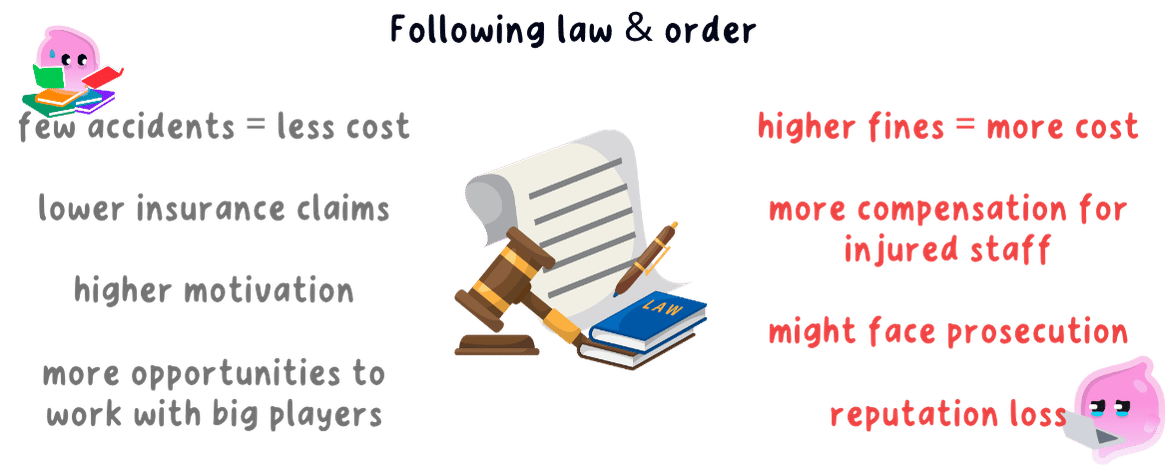
- Fines and prosecution: a penalty has to be paid out of cash the business may not be holding, so it goes further into its overdraft or delays paying suppliers, which then tighten its credit terms.
- Compensation and legal fees: a customer refused a refund on faulty goods or an employee dismissed unfairly can claim, and the firm pays its own solicitor whether it wins or loses.
- Being stopped from trading: a kitchen ordered shut or a licence withdrawn takes revenue to zero while rent, loan repayments and wages carry on being owed.
- Damaged reputation: one review, photograph or local news story spreads online within hours and keeps appearing in searches, so sales stay below where they were long after the case is closed.
- Staff leaving and refusing to apply: word gets round quickly in a local labour market, so the best workers go first and the firm is left recruiting from a smaller pool, which pushes wages up or service quality down.
- The reputational damage usually costs more than the fine and lasts far longer, because a fine is a single figure paid once while lost customers reduce revenue every week for years afterwards.
- Stopping your answer at "the business would be fined" is a Level 1 point and earns little.
- A business can budget for a fine, but it cannot budget for customers quietly deciding to shop somewhere else.
- For a small firm with little cash, being ordered to stop trading for a fortnight can end the business before any fine is collected.
Judging it: is complying worth the cost for a small business?
- Meeting legal obligations is compulsory; the real choice is whether to go beyond the minimum, such as paying more, improving conditions further or offering more generous customer policies.
- Going further is more likely to repay its cost when reputation is visible to customers, skilled staff are hard to replace, or the business competes on trust rather than the lowest price.
- Overall, every business should meet the law properly; spending beyond the minimum should depend on whether the likely gains in loyalty, retention and reputation exceed the extra cost for that business.
- Trace each consequence to costs, sales or profit rather than stopping at the legal event itself.
- On the non-compliance side, consider lasting effects such as reputation and staff retention as well as fines or compensation.
- Use the business context when judging whether going beyond the legal minimum is likely to repay its extra cost.
- Give two benefits of meeting legal obligations and say what each does to costs or sales.
- Why does keeping staff longer save a business money?
- Name three costs a business faces if it breaks consumer or employment law.
- Why does damaged reputation usually cost more than the fine itself?
- Give two things that decide whether a small business should go beyond the legal minimum.
1.5.4 The economy and business
Unemployment and consumer income: what customers can afford to spend
- Unemployment: when it rises, fewer people are earning wages, so total spending across the economy falls.
- Businesses selling non-essentials are hit hardest, because a household under pressure cancels the restaurant meal and the new trainers long before it stops buying bread and electricity.
- Recruitment gets easier at the same time: with more people looking for work, a vacancy attracts more applicants, so a post is filled faster, the owner can pick from a stronger field of candidates and wage rates are easier to hold down.
- Changing levels of consumer income: when incomes rise, households have more left once the essentials are paid for, so spending shifts towards better quality and dearer products and premium sellers gain.
- Falling income works the other way: when incomes drop, or rise more slowly than prices, the same households trade down to cheaper brands and put off replacing anything that still works, so a discounter's sales hold up while a premium seller's orders fall away.
- Rising household bills leave a family with about £40 a week less to spend on the weekly shop.
- They move their groceries to Aldi or Lidl, which compete on price with a narrower product range, and they put off replacing the vacuum cleaner.
- The one change wins Aldi and Lidl customers while costing a premium seller such as Dyson sales, so the effect depends entirely on where the business sits in the market.
Inflation, interest rates and taxation: what the business and its customers have to pay
Inflation: the rate at which the average price of goods and services rises over time.
Interest rate: the price of borrowing money, or the reward for saving it, shown as a percentage.
- Inflation: rising prices push up what the business pays for stock, energy and wages, so its costs climb before its sales do.
- It can raise its own prices to cover the increase, but then risks losing customers to a rival who has held theirs.
- It can absorb the extra cost instead, which protects sales volume but leaves a smaller profit on every unit sold.
- Demand tends to fall either way, because customers whose wages buy less feel worse off and cut back even where the business has held its price.
- Changes in interest rates: the Bank of England sets the base rate, and a rise makes borrowing dearer right across the economy.
- Customers with mortgages have less left at the end of the month, so sales fall even for a business that has never borrowed a penny.
- A rise also makes an owner think twice about borrowing to expand, while a cut does the reverse and makes a second branch cheaper to finance.
- Government taxation: a higher tax on business profits, collected by HMRC, leaves less for the owner to reinvest in equipment or take out of the business.
- A change in VAT changes the price on the shelf, so the business either passes it on and risks losing sales or holds its price and accepts a thinner margin.
Changes in exchange rates: the same movement helps one business and harms another
Exchange rate: the price of one currency in terms of another, such as how many euros one pound buys.
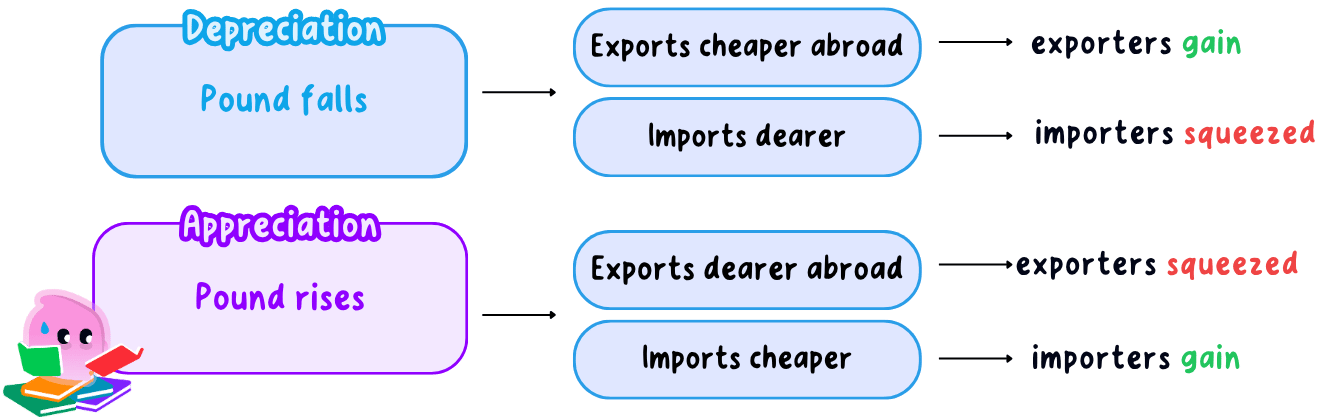
- A strong pound buys more foreign currency, so goods bought from abroad become cheaper in pounds.
- A business importing its materials or stock gains, because each delivery costs fewer pounds, which widens its margin or funds a price cut to win customers.
- An exporter loses from that same move, because its goods now look dearer to foreign buyers and orders from abroad fall away.
- A weak pound does the reverse, making imported materials dearer to buy while UK exports become cheaper for foreign customers and easier to sell.
- A movement in the pound is therefore never simply good or bad news, and an answer only earns the mark once it says whether the business being discussed is an importer or an exporter.
The six factors at a glance
The table sets out each change, what it does to a business, and who tends to gain or lose from it.
| Change in the economy | Effect on the business | Who tends to gain or lose |
|---|---|---|
| Unemployment rises | Spending falls, hiring easier | Luxury sellers lose, budget gains |
| Consumer incomes rise | Spending shifts towards better quality | Premium sellers gain, discounters lose |
| Inflation rises | Stock, energy and wage costs rise | Firms on thin margins are hit hardest |
| Interest rates rise | Borrowing costs more, sales fall | Borrowers lose, others cope |
| Taxation rises | Less profit kept, sales fall | All firms, hardest on low-margin ones |
| The pound strengthens | Imports cheaper, exports dearer | Importers gain, exporters lose |
| The pound weakens | Imports dearer, exports cheaper | Exporters gain, importers lose |
- Work from the right-hand column first, because almost every change creates a winner and a loser at the same moment rather than being simply good or bad news for business as a whole.
- Read the row that matches what the business in front of you actually does, since an importer and an exporter read the same movement in the pound in opposite directions, and remember that these changes rarely arrive one at a time, so explain how two rows can squeeze the same firm together.
The factors arrive together, and a prepared business is hit less hard
- These six factors interact rather than arriving one at a time, because inflation tends to bring an interest rate rise with it, which squeezes a borrower just as its costs are already climbing.
- A business that plans for that, by holding a cash reserve or agreeing prices with suppliers in advance, keeps trading through the squeeze while one that has done neither runs short of cash.
- Build a chain for each factor: name the change, state its effect on customer spending or on the firm's costs, then the impact on sales or profit.
- Name who gains as well as who loses, because a weak pound helps a UK exporter at the same moment it raises a UK importer's costs.
- Check the business in the source booklet for three things: whether it sells essentials or luxuries, whether it has borrowed, and whether it trades abroad.
- When the question says justify or evaluate, finish by judging which single factor matters most to that firm instead of listing all six evenly.
- Why does rising unemployment hit a business selling non-essentials hardest?
- Give one benefit of higher unemployment for a business that is recruiting.
- What happens to a discounter's sales and a premium seller's sales when consumer incomes fall?
- State the two choices a business faces when inflation pushes up its costs.
- Does a strong pound help an importer or an exporter?
1.5.5 External influences
The change is fixed, the response is a choice: technology
External influence: a change that happens outside the business, which the business cannot control and can only respond to.
- An external influence starts outside the firm, so no owner can prevent it and the only decision left is what to do about it.
- Marks in the exam sit on that decision and its consequences, not on describing the change a second time.
- A change in technology, taught in guide 1.5.2, leaves a business three responses, and each carries a different cost.
- Adopt it: launch e-commerce or buy the new equipment, which needs money up front, perhaps £4,000 for a website plus the training to run it, but protects sales that would otherwise go to an online rival.
- Adapt the offer around it: keep the shop and add click and collect alongside it, as Tesco and Sainsbury's do, so online orders still bring shoppers through the door.
- Do nothing and compete on what technology cannot copy: personal service and expert advice cost nothing extra now, which makes this the cheapest response today and the riskiest one later.
- Blockbuster rented DVDs from high-street shops and carried on doing so while Netflix moved the same customers to streaming.
- Paying rent on shops and holding stock made no sense against a service that needed neither.
- The UK Blockbuster business entered administration in 2013, so the cost of not responding arrived all at once rather than in instalments.
Responses to new legislation: deciding who carries the cost
- New legislation, such as a rise in the National Living Wage or tighter safety rules, adds a cost the business must pay, so the real question is who ends up carrying it.
- Comply and absorb the cost: profit per unit falls, but the price on the shelf stays the same, so no customers are lost over it.
- Comply and pass the cost on: raising prices recovers the money, yet price-sensitive shoppers may move to a rival who chose to absorb it instead.
- Change how the business works: buying equipment that cuts the labour hours needed, or retraining staff to work more accurately, spreads the higher wage rate over more output, though the equipment has to be paid for first.
- Not complying is not a fourth response, because it delays the payment rather than avoiding it.
- Fines, compensation to customers or employees and the loss of repeat trade usually cost more than complying would have done.
- Write about how the firm complies, not about whether it complies.
Responses to the economic climate: downturn, recovery and a weaker pound
- The economy, taught in guide 1.5.4, moves in both directions, so a business needs a plan for falling demand and a plan for the recovery that follows.
- In a downturn: cut costs, delay expansion and keep more cash back, so wages and suppliers can still be paid through a long spell of weak sales.
- Change the offer, not only the price: a cheaper range, smaller pack sizes and short promotions hold customers who would otherwise switch to Aldi or Lidl.
- When conditions improve: expand, recruit and widen the range, and borrow while interest rates are low, because repayments on the same loan cost less.
- When a weaker pound raises import costs: find a UK supplier, buy in bulk for a discount, or raise prices and accept that some customers will buy less.
- A cheaper range protects sales volume but pulls the average selling price down, so the firm gives up profit per unit to keep customers who will spend more again once incomes recover.
Judging a response: moving fast against moving carefully
- Responding early can protect customers and market position, but it risks spending before the change is proven; responding late saves cash at first but may leave rivals with customers that are expensive to win back.
- The right timing depends on how permanent the change looks, how directly it affects the business, how quickly competitors are moving and what the business can afford.
- Overall, financial strength gives a business more choice over its response, while a cash-limited firm may be forced towards the cheapest short-term option even when it is not the strongest long-term response.
- Start with the action the business could take, then explain what it costs and what it protects.
- Match the response to the influence and use the business in the source booklet rather than a generic solution.
- For a judgement, consider timing and affordability and state whether this business can realistically pay for the response you recommend.
- What makes an influence external?
- Give the three responses a business can make to a change in technology.
- A new law raises wage costs: give two different ways a business can deal with the extra cost.
- Name two responses to a downturn and one response to a weaker pound.
- Why does responding early to an external change carry a risk?
