Motivation: the effort that goes beyond the minimum
Definition
Motivation: the desire someone has to do their job well, which shows in the effort they put in beyond the minimum the job requires.
Productivity: output per worker in a given time, such as the number of orders one packer completes in an hour.
- A manager can require an employee to turn up on time and follow the rules, but no contract can require them to care about the work.
- Motivation is what closes that gap, because a motivated worker chooses to do the extra check, the extra tidy and the extra customer that nobody has told them to do.
- Two people on the same wage, doing the same job after the same training, can produce very different amounts of work, and the difference is usually motivation rather than ability.
What a motivated workforce gives the business
Motivation shows up in multiple effects a business can assess.
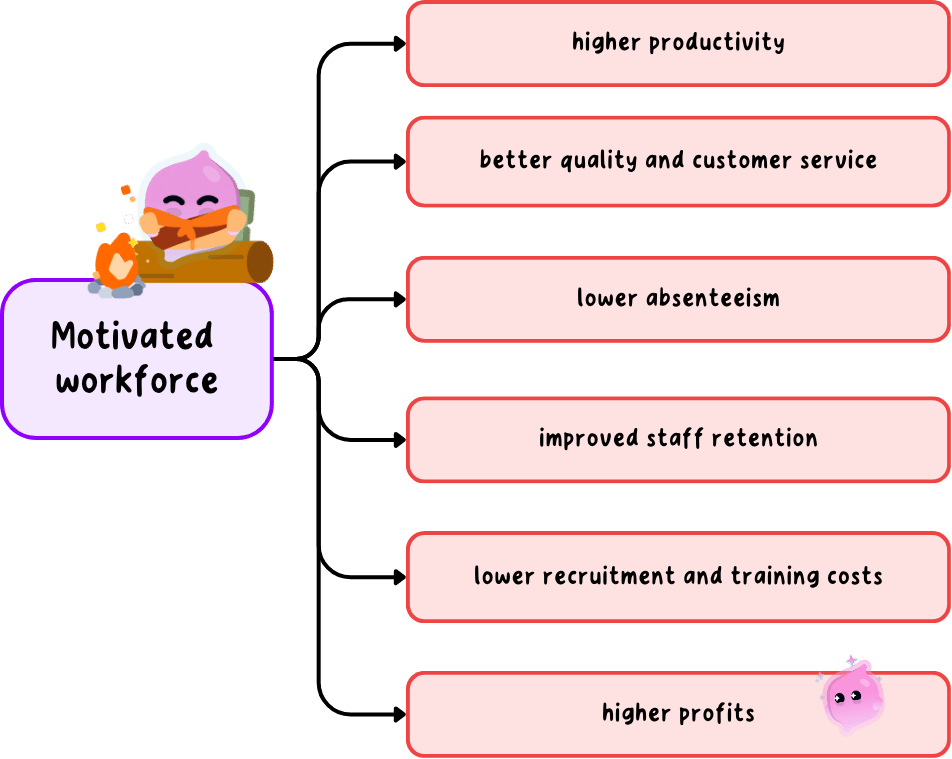
- Higher productivity: motivated staff work faster and waste less time between tasks, so output per worker rises and the same rent, machinery and management are spread over more units, which cuts the cost of producing each one.
- Better quality: someone who cares about the work checks it before it leaves their hands, so there are fewer faults, fewer returns to refund and less material thrown away as waste.
- Better customer service: staff who want to be there greet people, answer questions properly and sort problems out, which brings repeat custom and good online reviews that pull in new customers at no extra cost.
- Lower absenteeism: motivated staff take fewer unnecessary days off, so the business does not pay overtime or agency fees for cover and does not lose a day of output every time someone stays at home.
- More ideas: the people closest to the work can see where time and material are wasted, and they suggest improvements when they believe their views count for something.
Example
- Greggs sells cheap hot food in high volume, so a shop earns its profit on the number of customers served rather than on a high price per item.
- At the lunchtime rush, a server who keeps the queue moving and gets each order right adds directly to the takings of that hour.
- A slow, distracted server on exactly the same wage loses sales the moment the queue is long enough for people to walk out.
- The wage cost is identical either way, which is why the effort of the person on the till changes the profit of the shop.
Retaining staff and attracting new ones
- A demotivated workforce runs all of that backwards, with low output, poor quality, complaints, high absence and, in the end, people walking out and a recruitment bill the business never planned for.
- Higher retention: motivated staff stay, so the business avoids the cost of advertising a vacancy, interviewing and training a replacement, and keeps experience that a new starter takes months to build.
- Attracting employees: a business known for treating its staff well receives more applications for each vacancy, so it can pick a stronger candidate and fill the post before the gap starts costing output.
- A reputation for miserable staff does the reverse, because word travels through reviews and former employees, so posts stay open for longer and the staff who remain cover the extra work and become demotivated themselves.
Common Mistake
- Keep labour turnover, the proportion of staff who leave in a year, separate from absenteeism, which is staff being off work while still employed.
- A rising figure for either points to a motivation problem, but they cost the business in different ways.
- Writing that motivation increases profit, with nothing in between, is an assertion rather than analysis.
Why motivation is a financial issue and not only a people issue
- Motivation reaches profit from both directions at once, because more output and better quality lift revenue while lower absence and lower turnover cut costs, and profit is what is left when costs come out of revenue.
- That is why two shops with the same stock, the same prices and the same wage bill can finish the year with very different profits.
- Pay is only one of the things that decides how motivated people are.
- How people are managed: whether a manager listens, gives credit for good work and treats everyone consistently.
- What the work itself is like: whether the job carries some variety and some control over how it is done, or is one task repeated for eight hours.
- Whether there is anywhere to go: someone who can see a route to a better job tries harder than someone who knows next year will look exactly like this one.
- Businesses draw on two sets of tools, financial methods and non-financial methods, which the next two guides take in turn.
Exam technique
- Use a precise measurable effect such as productivity, absenteeism or labour turnover, then trace it through to costs or revenue.
- Apply the chain to the business in the source booklet and develop the most relevant effects rather than listing many benefits.
- For a judgement, weigh what the motivation method costs against the output and retention it is likely to produce.
Self review
- Define motivation in one sentence.
- Give three effects of a motivated workforce that a business can measure.
- Explain the chain from higher motivation to a lower cost per unit.
- Why does high labour turnover cost a business money even when a replacement is found quickly?
- Name two things other than pay that affect how motivated someone is.
