Globalisation: national economies growing into one connected market
Definition
Globalisation: the process by which national economies become more connected through trade, investment and technology, so businesses buy, sell and produce across borders.
- Globalisation matters to a UK business because it changes who its suppliers are, who its customers are and who its rivals are, often all at once.
- Three developments drove it: container shipping cut the cost of moving goods, the internet let a firm sell and manage abroad without an office there, and many governments agreed to trade more freely with each other.
- The result is that a bakery in Leeds can buy Italian flour, a Birmingham clothing brand can take an order from Australia overnight, and both can be undercut by a producer they have never heard of.
Imports and exports: cheaper supplies for one firm, tougher rivals for another
- Imports are goods and services bought from abroad, and they reach a UK business down two very different routes.
- Buying from overseas: a UK firm can source materials more cheaply, so a metal bracket bought abroad at £4 instead of £7 from a UK supplier cuts the cost of every unit it makes and leaves room to cut its own price.
- Competition from overseas: the same open border brings finished foreign goods onto UK shelves, so a UK manufacturer paying UK wages is undercut on price inside its own home market.
- Exports are sales to customers in other countries, which turns a market of one country into a market of many and lifts potential sales without the firm changing its product.
- Exporting also spreads risk, because a firm selling into several countries is less exposed if UK consumer spending falls, although shipping, paperwork and a moving exchange rate all eat into the extra revenue first.
Example
- A furniture workshop in Leeds buys imported timber and imported fittings, cutting the material cost of every wardrobe it builds.
- The same trade route brings finished imported wardrobes into UK shops at a price the workshop cannot match.
- Globalisation helped that business as a buyer and hurt it as a seller in the same year.
- Dyson shows one escape route, selling on design and engineering at a premium price so a cheaper imported vacuum is not a straight substitute.
Changing location and multinationals: production moves to where it pays
Definition
Multinational: a business that runs operations, such as factories, offices or shops, in more than one country.
- Globalisation lets a business put each stage of production wherever it pays best, and UK firms move abroad for two main reasons.
- Lower costs: wages, land and energy are cheaper in some countries, so moving assembly there cuts the cost of making each unit and protects profit when rivals cut prices.
- Closer to the market: producing inside a large overseas market shortens delivery times and cuts the cost of shipping finished goods to the customers who actually buy them.
- Neither move is free, because a factory thousands of miles away adds weeks of transport time, makes faults harder to spot early, and can damage the firm's reputation at home when UK jobs go with it.
- Multinationals coming the other way bring investment and jobs to the UK and widen the choice shoppers have, since Netflix reached UK households with a streaming service no rental chain could match.
- They also take sales from local rivals and send profits back to a parent company abroad, and streaming is part of why the UK Blockbuster business entered administration in 2013.
Note
For GCSE Edexcel, use this as an overview. The specification focus is imports, exports, changing business locations and multinationals.
Note
- Tariffs and other barriers to trade are covered in the next guide, and how firms compete internationally comes after that.
- Exchange rates were covered in Theme 1, and they move the price of an import or an export without either business changing anything it does.
Judging globalisation: whether it is good depends on which UK business you mean
Globalisation does not push all UK businesses the same way, and the table sets each change against the firm it helps and the firm it harms.
| Change | UK business that gains | UK business that loses |
|---|---|---|
| Cheaper imported materials | Furniture maker buying timber | UK timber supplier |
| Imported goods in UK shops | Importer and retailer | UK factory competing on price |
| Export markets open up | Online seller with spare capacity | Local hairdresser, no reach abroad |
| Production moved abroad | Owners, through lower unit costs | UK workers whose jobs go |
| Multinational opens in the UK | Shoppers and new employees | Small local rival |
- The balance depends on whether the business imports, exports or produces abroad, and whether it can differentiate itself from overseas rivals.
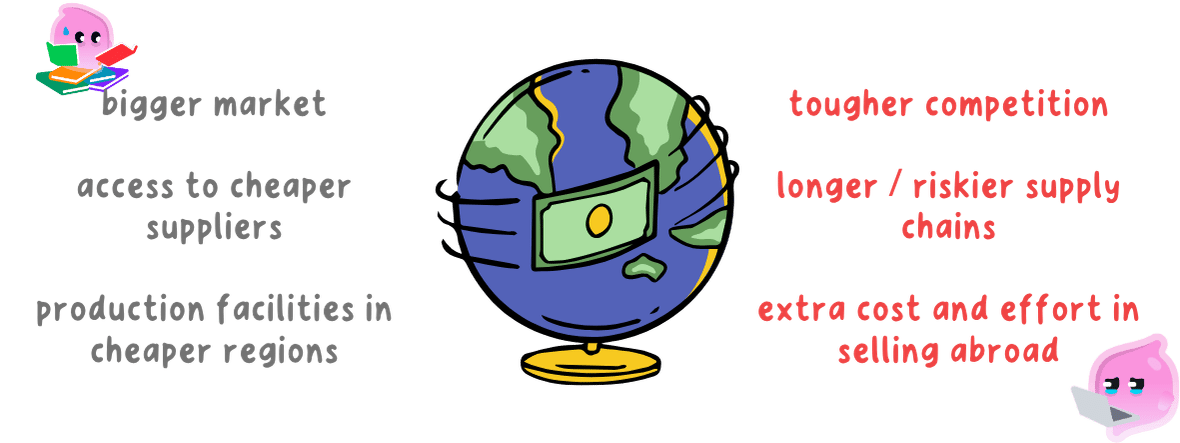
- Overall, globalisation offers larger markets and lower-cost sourcing, but those gains matter only if the business can manage the extra competition and complexity.
Exam technique
- Identify whether the business is importing, exporting or producing abroad before judging the effect.
- Trace one impact through to costs, sales or profit using the source-booklet business.
- For a judgement, weigh one opportunity against one threat and decide which matters more for that firm.
Self review
- Define globalisation.
- Give the two ways imports affect a UK business.
- State two reasons a UK firm might move production to another country.
- Give one benefit and one drawback of a multinational opening in the UK.
- Which kind of UK business gains least from globalisation, and why?
