Unemployment and consumer income: what customers can afford to spend
- Unemployment: when it rises, fewer people are earning wages, so total spending across the economy falls.
- Businesses selling non-essentials are hit hardest, because a household under pressure cancels the restaurant meal and the new trainers long before it stops buying bread and electricity.
- Recruitment gets easier at the same time: with more people looking for work, a vacancy attracts more applicants, so a post is filled faster, the owner can pick from a stronger field of candidates and wage rates are easier to hold down.
- Changing levels of consumer income: when incomes rise, households have more left once the essentials are paid for, so spending shifts towards better quality and dearer products and premium sellers gain.
- Falling income works the other way: when incomes drop, or rise more slowly than prices, the same households trade down to cheaper brands and put off replacing anything that still works, so a discounter's sales hold up while a premium seller's orders fall away.
Example
- Rising household bills leave a family with about £40 a week less to spend on the weekly shop.
- They move their groceries to Aldi or Lidl, which compete on price with a narrower product range, and they put off replacing the vacuum cleaner.
- The one change wins Aldi and Lidl customers while costing a premium seller such as Dyson sales, so the effect depends entirely on where the business sits in the market.
Inflation, interest rates and taxation: what the business and its customers have to pay
Definition
Inflation: the rate at which the average price of goods and services rises over time.
Interest rate: the price of borrowing money, or the reward for saving it, shown as a percentage.
- Inflation: rising prices push up what the business pays for stock, energy and wages, so its costs climb before its sales do.
- It can raise its own prices to cover the increase, but then risks losing customers to a rival who has held theirs.
- It can absorb the extra cost instead, which protects sales volume but leaves a smaller profit on every unit sold.
- Demand tends to fall either way, because customers whose wages buy less feel worse off and cut back even where the business has held its price.
- Changes in interest rates: the Bank of England sets the base rate, and a rise makes borrowing dearer right across the economy.
- Customers with mortgages have less left at the end of the month, so sales fall even for a business that has never borrowed a penny.
- A rise also makes an owner think twice about borrowing to expand, while a cut does the reverse and makes a second branch cheaper to finance.
- Government taxation: a higher tax on business profits, collected by HMRC, leaves less for the owner to reinvest in equipment or take out of the business.
- A change in VAT changes the price on the shelf, so the business either passes it on and risks losing sales or holds its price and accepts a thinner margin.
Changes in exchange rates: the same movement helps one business and harms another
Definition
Exchange rate: the price of one currency in terms of another, such as how many euros one pound buys.
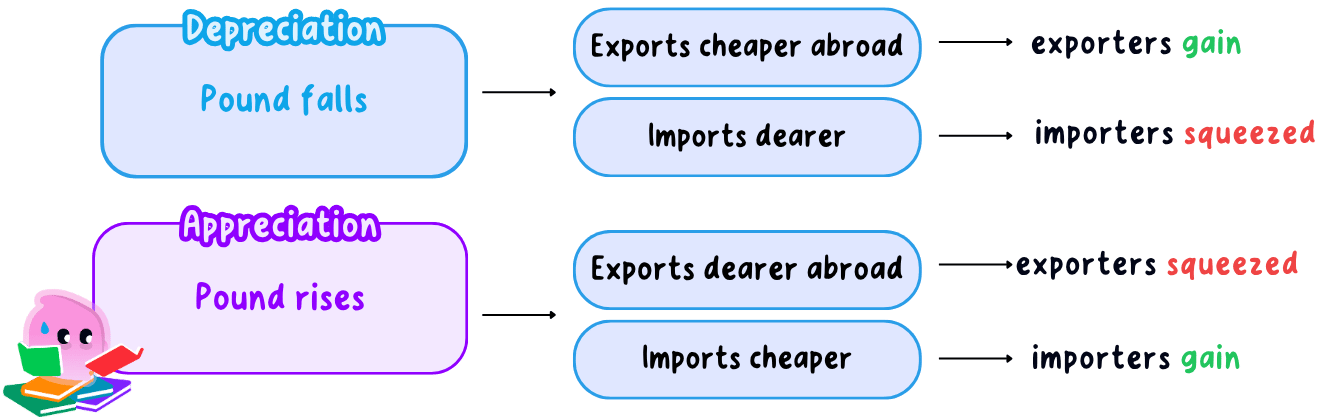
- A strong pound buys more foreign currency, so goods bought from abroad become cheaper in pounds.
- A business importing its materials or stock gains, because each delivery costs fewer pounds, which widens its margin or funds a price cut to win customers.
- An exporter loses from that same move, because its goods now look dearer to foreign buyers and orders from abroad fall away.
- A weak pound does the reverse, making imported materials dearer to buy while UK exports become cheaper for foreign customers and easier to sell.
- A movement in the pound is therefore never simply good or bad news, and an answer only earns the mark once it says whether the business being discussed is an importer or an exporter.
The six factors at a glance
The table sets out each change, what it does to a business, and who tends to gain or lose from it.
| Change in the economy | Effect on the business | Who tends to gain or lose |
|---|---|---|
| Unemployment rises | Spending falls, hiring easier | Luxury sellers lose, budget gains |
| Consumer incomes rise | Spending shifts towards better quality | Premium sellers gain, discounters lose |
| Inflation rises | Stock, energy and wage costs rise | Firms on thin margins are hit hardest |
| Interest rates rise | Borrowing costs more, sales fall | Borrowers lose, others cope |
| Taxation rises | Less profit kept, sales fall | All firms, hardest on low-margin ones |
| The pound strengthens | Imports cheaper, exports dearer | Importers gain, exporters lose |
| The pound weakens | Imports dearer, exports cheaper | Exporters gain, importers lose |
- Work from the right-hand column first, because almost every change creates a winner and a loser at the same moment rather than being simply good or bad news for business as a whole.
- Read the row that matches what the business in front of you actually does, since an importer and an exporter read the same movement in the pound in opposite directions, and remember that these changes rarely arrive one at a time, so explain how two rows can squeeze the same firm together.
The factors arrive together, and a prepared business is hit less hard
- These six factors interact rather than arriving one at a time, because inflation tends to bring an interest rate rise with it, which squeezes a borrower just as its costs are already climbing.
- A business that plans for that, by holding a cash reserve or agreeing prices with suppliers in advance, keeps trading through the squeeze while one that has done neither runs short of cash.
Exam technique
- Build a chain for each factor: name the change, state its effect on customer spending or on the firm's costs, then the impact on sales or profit.
- Name who gains as well as who loses, because a weak pound helps a UK exporter at the same moment it raises a UK importer's costs.
- Check the business in the source booklet for three things: whether it sells essentials or luxuries, whether it has borrowed, and whether it trades abroad.
- When the question says justify or evaluate, finish by judging which single factor matters most to that firm instead of listing all six evenly.
Self review
- Why does rising unemployment hit a business selling non-essentials hardest?
- Give one benefit of higher unemployment for a business that is recruiting.
- What happens to a discounter's sales and a premium seller's sales when consumer incomes fall?
- State the two choices a business faces when inflation pushes up its costs.
- Does a strong pound help an importer or an exporter?
