Where the money goes: the direct costs of complying
Definition
Legislation: laws passed by government that a business must obey, including consumer law and employment law.
Compliance: doing what the law requires, together with the spending and the time it takes to do it.
- Consumer law and employment law both force a business to spend before it earns a penny more, and that spending lands in five places.
- Wage costs: paying the legal minimum lifts the wage bill, and it lifts it most in a business employing many low-paid staff, such as a café or a corner shop.
- Equipment and premises: guards on machinery, protective clothing, fire extinguishers and adjustments such as a ramp or an accessible toilet for disabled workers all have to be bought, then maintained and replaced.
- Training: an hour spent teaching staff safe lifting or how to handle a customer returning a faulty item is an hour not spent producing or selling, so it costs output even when no outside trainer is paid.
- Administration: writing risk assessments, issuing written contracts, running payslips and keeping pay records take hours, and a small firm often pays an accountant or an adviser £60 an hour to do them properly.
- Returns and refunds: consumer law means faulty goods come back, so the owner must budget for refunds, replacements and stock that cannot be sold again.
Example
- Greggs sells cheap hot food in high volume, so a large share of its costs is the pay of shop staff on hourly rates.
- A rise in the legal minimum wage therefore adds to its wage bill in every shop at once, not in one place only.
- An independent bakery in Leeds with four staff faces the same rise as a much smaller cash sum, but has far fewer customers to spread it across.
Why the same law costs a small business proportionally more
- Compliance costs barely change with the size of the firm, which is why an identical rule squeezes a sole trader harder than a national chain.
- The paperwork is the same length: a risk assessment takes roughly the same hours to write whether the workplace has 6 staff or 600, so the cost per employee is far higher in the small firm.
- The equipment is the same price: a fire alarm system, a first aid kit and a set of machine guards cost much the same in a small unit as in a large one, but are spread over far fewer sales.
- The people doing it differ: a large firm employs an HR manager and a safety officer whose job this is, while a sole trader does the records in the evening after trading and loses that time from the business.
Note
- What consumer law and employment law actually require is covered in guides 1.5.3a and 1.5.3b.
- The fines and the damage to reputation that follow breaking them belong to guide 1.5.3d.
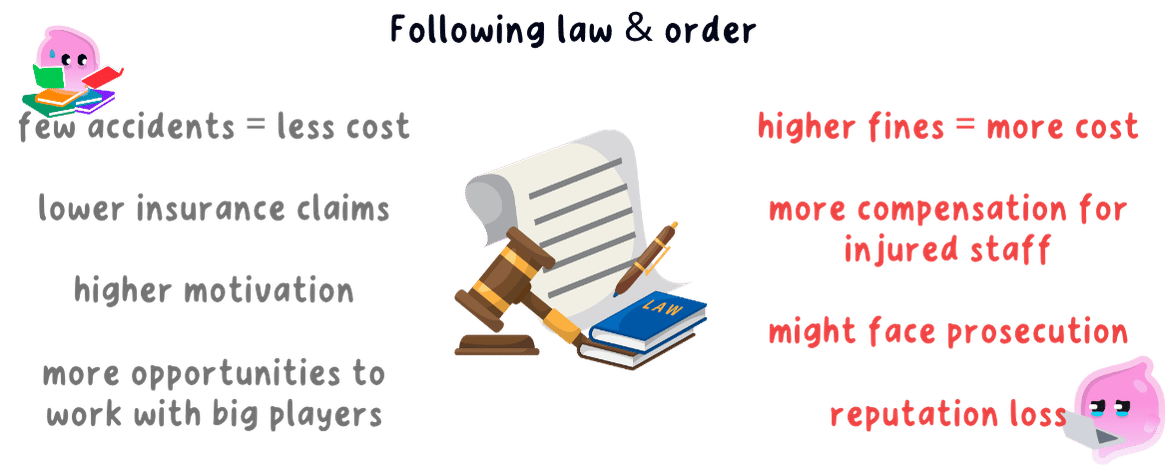
How a business pays for it: four responses, each with a consequence
- Once costs rise the money has to come from somewhere, and an owner has four choices.
- Raise prices: passing the cost on protects the profit per unit, but in a price-sensitive market shoppers switch to Aldi or Lidl and sales volume falls.
- Absorb it: holding the price keeps those customers, but the lower profit leaves less cash to reinvest in stock, equipment or a second site.
- Cut costs elsewhere: trimming staff hours or stopping overtime pays for the rise, but a shop with fewer staff on the floor serves customers more slowly and can lose repeat trade.
- Invest in equipment: self-service tills or a faster oven cut the labour hours needed, but the machinery has to be paid for up front, which a small firm may manage only with a loan and interest on top.
Set against the cost: spending that prevents a larger bill
- Some compliance spending is cheaper than the accident it prevents, because an injury halts production, removes a trained worker for weeks and pushes up the premium on the firm's insurance.
- Clear contracts and tidy pay records also cut the hours lost to disputes, since an employer who can produce a signed contract settles an argument in minutes rather than months.
- Seen that way the spending buys certainty, because a business that meets the law knows what its costs will be instead of gambling on nothing going wrong.
Exam technique
- Name the cost precisely, because "the wage bill rises" and "machine guards must be bought" earn marks where "legislation costs money" earns none.
- Carry each cost through to an effect, such as a thinner profit, less cash for growth or a higher price that loses customers.
- If figures are given, multiply them out, for example a 50p rise across 8 staff working 25 hours a week, then say what that weekly total means for the owner.
- Size the impact against the firm in the case study, since the same rule takes a larger share of a small firm's revenue than of a chain's.
Self review
- Name four separate areas where obeying the law costs a business money.
- Define compliance.
- A café pays 8 staff for 25 hours a week each and the legal minimum wage rises by 50p an hour, so by how much does the weekly wage bill rise?
- Why does the same health and safety rule cost a small firm proportionally more than a large one?
- Give one compliance cost that prevents a larger cost later.
