1.3.1a Financial aims and objectives
Aims and objectives: the goal and the measurable step towards it
Business aim: the broad, long-term goal the owners are working towards, written in words rather than numbers.
Business objective: a specific, measurable target, with a figure and a deadline, that moves the business towards its aim.
- A business aim is the direction of travel, such as 'grow the business', 'be the best-known bakery in Leeds' or 'earn a living from the stall'.
- A business objective turns that direction into something countable, such as 'increase sales by 10 per cent by next March' or 'open a second shop by December 2027'.
- The measurable part needs three pieces: what is being counted, how much it must change, and the date it will be checked.
- Because an objective carries a number and a date, the owner can check progress halfway through and change the price or the advertising spend before the year is lost, which a vague aim never allows.
- Non-financial aims such as personal satisfaction, independence and social objectives are covered in the next guide, 1.3.1b.
- Why two businesses in the same market choose different aims is covered in 1.3.1c.
The five financial aims a start-up chooses between
Market share: the proportion of all the sales made in a market that one business wins, usually written as a percentage.
- Survival: keeping the business trading, with enough cash to pay suppliers, rent and wages, through the first year.
- Profit: the money left from revenue once every cost of running the business has been paid.
- Sales: raising the number of units sold, or the revenue those sales bring in.
- Market share: the slice of the market the business holds, which only moves if the firm grows faster or slower than its rivals.
- Financial security: a steady, dependable income that covers the owner's bills every month.
- Aldi and Lidl compete on price and carry a narrower product range than Tesco and Sainsbury's.
- Low prices pull shoppers away from the wider-range supermarkets, so Aldi and Lidl take a larger share of grocery spending.
- The narrow range is what makes those prices affordable to run, because fewer product lines mean lower stockholding and simpler shops.
- The aim being served here is market share, and every individual sale earns less than the same item would at a higher price.
Financial aims pull against each other
- The five aims compete for the same money and the same price decision, so a business that pushes hard on one usually gives up part of another.
- Chasing market share by cutting prices wins customers from rivals, but each unit now earns less, so total profit can fall even though more units are leaving the shelves.
- Chasing profit early carries the opposite cost, because holding the price high protects the money made on each sale but sends price-sensitive shoppers to a cheaper rival, so sales and share both slip.
- Aiming at financial security means turning down the risky expansion that would have lifted sales, so the owner swaps possible growth for a wage they can rely on.
- Check whether the question asks for an aim or an objective, because a target with no figure and no deadline will not be credited as an objective.
- Name the aim, then say why this business chose it, using its age, its cash position or its rivals as they appear in the source booklet.
- On a justify or evaluate question, say what the firm gives up by choosing that aim, since the trade-off is where the higher marks sit.
- Replace 'to make money' with something countable such as 'to make £30,000 profit in year two', because the vague version scores nothing.
- What is the difference between a business aim and a business objective?
- Rewrite the aim 'grow the business' as a measurable objective.
- Define market share.
- Why does survival usually come before profit for a start-up?
- Explain why cutting prices to win market share can reduce profit.
1.3.1b Non-financial aims and objectives
Aims and objectives that are not measured in money
Non-financial objective: a goal an owner sets for the business that is not measured in money, such as being your own boss or helping a community.
Social objective: a goal to benefit a community or the environment, for example fair treatment of suppliers and staff or reducing waste.
- Some of what an owner wants from a business cannot be read off a bank statement, and Edexcel names five such aims: social objectives, personal satisfaction, challenge, independence and control.
- These carry most weight in sole traders and small start-ups, because the owner sets the direction alone and answers to nobody else.
The five non-financial aims and why an owner holds one
- Each aim describes something the owner wants from the business that a higher income on its own would not deliver.
- Social objectives: using the business to leave a community or the environment better off, held by an owner who wants fair treatment of suppliers and staff, or less waste, to be part of how the firm trades.
- Personal satisfaction: spending the working week on something the owner enjoys or believes in, held because work that pays more but bores them is worth less to them than the work itself.
- Challenge: proving to themselves that they can build something that works, often held after years in a career elsewhere where somebody else made the decisions and took the credit.
- Independence: being your own boss, held by an owner who wants to choose their own hours, customers and direction rather than be told what to do.
- Control: making every decision without needing the approval of an employer or an investor, held because a business shared with a backer means sharing the choices about products, prices and growth.
- Independence and control overlap but are not the same, since independence is about who you work for and control is about who has the final say on a decision.
- Ben Francis founded Gymshark in 2012 by screen-printing gym clothing in a garage in Birmingham.
- Starting that small gave him the challenge of finding out whether the idea worked and full control over the designs and the brand.
- Julian Dunkerton built Superdry from a market stall in Cheltenham, again beginning on a scale he could run his own way.
- Neither aim appears anywhere in the accounts, yet both explain why the owner started up instead of taking a salaried job.
How a non-financial aim changes real decisions
- A social objective shows up in ordinary buying decisions, and each of the three below costs the business money.
- Paying more than the cheapest price: a coffee shop may pay a supplier £4.20 a kilogram because it knows the growers are paid fairly, when a wholesaler offers the same weight at £3.10.
- Refusing a cheaper material: a clothing brand may turn down a synthetic fabric costing half as much because it will not break down once the garment is thrown away.
- Keeping production in the UK: a furniture maker may keep its workshop in Leeds and pay the National Living Wage rather than move assembly to a country where labour is cheaper.
- Every one of those choices raises the cost per unit, so the owner must accept a thinner profit or charge a higher price, and a higher price loses the customers who buy on price alone.
- An owner who values control makes a different sacrifice, by turning down money that would have paid for growth.
- Levi Roots accepted a £50,000 investment on Dragons' Den in 2007 and got Reggae Reggae Sauce onto Sainsbury's shelves, whereas an owner who refused that deal would keep every decision but stay at the scale their own profits allow.
- Refusing outside money protects the owner's say over the business, so growth is funded only from retained profit, which means a rival with a backer can open in the next town first and take those customers.
- A non-financial aim is never free, because it appears in the accounts either as a higher cost or as growth the business chose not to take.
- The business still has to earn enough to survive, since an owner who runs out of cash loses the independence, the control and the social work all at once.
- That is why a firm with a social objective usually tells customers the reason for its higher price, so that enough of them are willing to pay it.
Financial and non-financial aims run side by side
- Most owners hold both kinds of aim at once, so a baker can want the craft to stay enjoyable and still need the till to cover £1,200 of rent each month.
- Survival sits underneath every non-financial aim, because a business that has closed helps no community and gives its former owner no independence at all.
- Non-financial aims are also harder to track, since there is no figure like revenue to check, so the owner measures them by whether the work still feels worth doing and whether the promised benefit is visible.
- Name the aim the case actually gives you, such as a wish to be your own boss, rather than listing all five.
- Carry it through to a decision: the owner wants control, so refuses outside investment, so growth is funded only from profit and stays slow.
- When the question says explain or evaluate, say what the aim costs the business in money, because that is where the developed marks sit.
- Do not write that a business with a social objective ignores profit, since it still has to cover its costs to keep going.
- Name the five non-financial aims on the specification.
- Define a social objective.
- Give one buying decision a social objective might change, and say why it raises costs.
- Why might an owner who values control turn down an offer of investment?
- Explain the difference between independence and control.
1.3.1c Why aims and objectives differ
Size, age and ownership: the situation the owner is in
- Two businesses selling the same product on the same street can hold opposite aims, because an aim is a response to the circumstances the owner is actually in.
- Size and age: a business in its first year aims at survival, because it has no reputation and little cash behind it, while an established firm with regular customers can aim at profit or growth.
- The start-up counts covering its costs each month as success, while the established firm can spend on a second site knowing that one bad year will not close it.
- Ownership: a private limited company that has sold shares to outside investors faces pressure to produce a return for them, so profit moves to the top of its list.
- A sole trader answers to nobody, so can choose a smaller income and a four-day week without justifying that decision to anyone.
- What the owner personally wants: someone who left a job to be their own boss puts independence first, while someone who set up purely to make money aims at the largest profit possible.
- Offered a contract that would double sales but mean hiring ten staff, the first owner turns it down to keep control and the second takes it, so two identical firms end up completely different sizes.
- A plumber who left an employer to work for himself aims to earn enough to cover his mortgage and choose his own hours.
- A bakery in Leeds owned by three shareholders aims to open a second shop within two years.
- Both firms make a profit, and only one of them treats standing still as failure.
The market and the economy: pressure from outside the business
- A fast-changing market: a firm selling a new kind of product aims at market share before profit, because a customer signed up now is one a rival cannot win later.
- That can mean setting a price low enough to take customers quickly and accepting a thin margin for a year or two, which a firm chasing immediate profit would never do.
- A stable market: a hardware shop serving the same village year after year aims at steady profit, because there is little share left to win and the cost of expanding would not be repaid.
- Competition: strong rivals push a business towards either winning share or being noticeably different, since matching a large rival on price alone is a fight a small firm loses.
- Aldi and Lidl chase share with low prices and a narrow range, while Innocent aims instead at customers willing to pay more than supermarket own-brand for its branding.
- The state of the economy: in a downturn customers cut their spending, so even a firm still making a profit switches its aim to survival and protecting cash.
- If the Bank of England raises the base rate, loan repayments rise, so a firm planning a second site drops the plan and aims to hold on to the site it has.
- The lists themselves, financial aims such as profit and market share and non-financial aims such as independence, belong to the two previous guides.
- Here the marks come from explaining why one business picks one of them and another business picks a different one.
Why the same business changes its aims over time
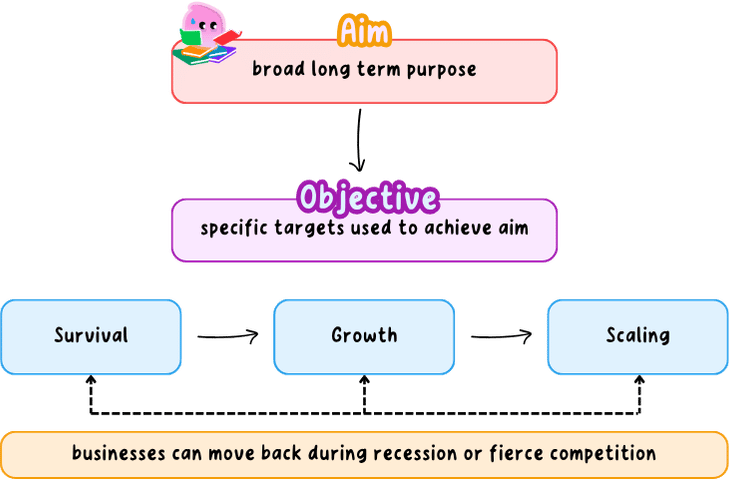
- An aim is a snapshot of a business's situation rather than a fixed feature of it, because the circumstances that produced the aim keep moving.
- Survival in year one usually becomes growth by year three, once repeat customers make the monthly income predictable and a bank is willing to lend against it.
- The change runs the other way too, since a recession, a new rival or the loss of one large customer can turn a growing firm back into one aiming only to stay open.
- Wilko had traded since 1930 and ran around 400 shops, but as trade worsened its aim moved from growth to survival, and by October 2023 every shop had closed with around 12,500 jobs lost.
- Read the source for the firm's size, age, ownership and market before you name an aim, because the application mark depends on matching the aim to that firm.
- Write the reason as a chain: the firm is six months old, so it has no reserves to fall back on, so survival has to come before growth.
- A question asking why two businesses hold different aims wants a comparison, so put both sides in the same sentence instead of describing each firm on its own.
- If the case mentions a downturn, a rate rise or a new competitor, say what that does to the aim, since the shift is the point being tested.
- Give two reasons a start-up and an established firm set different aims.
- Why might a sole trader aim at something other than the largest possible profit?
- How does a fast-changing market change what a firm aims at, and why?
- What happens to a profitable firm's aims during a recession?
- Name one event that could move a growing business back towards survival.
1.3.2a Revenue, costs and profit calculations
Revenue: price multiplied by the quantity sold
Revenue: the money a business takes from customers for the goods and services it sells in a given period, before any costs are deducted.
- The figure moves whenever either the price or the number sold changes.
- A market stall sells printed T-shirts at £12 each and sells 250 in a month.
- That £3,000 is every pound the owner took over the counter that month, and it is the ceiling on what the stall can possibly keep once the bills are paid.
- Revenue is not profit, because the £3,000 still has to pay the pitch rent, the blank shirts and the ink.
- Watch the wording in a question, since revenue, sales revenue and turnover all name the same figure.
- Greggs works on low prices and high volume, so a large revenue figure there says nothing until the cost of every sausage roll and every shop has been taken off.
Fixed, variable and total costs: does one more shirt change it?
Fixed costs: costs that do not change when output changes, such as rent, insurance and business rates.
Variable costs: costs that rise and fall directly with output, such as raw materials and packaging.
- Costs split into two kinds, and the split matters because only one of them moves when output moves.
- Fixed costs: the stall pays £400 a month for its pitch and £50 for insurance, so its fixed costs are £450 a month.
- Variable costs: each shirt costs £5 in blanks and ink, so 250 shirts cost:
- The £450 is owed whether the owner sells 250 shirts or none at all, so even a wash-out month still takes £450 out of the bank account.
- The £1,250 would halve if the owner printed half as many shirts, because every single shirt carries its own £5 of materials.
- That £1,700 is the whole cost of running the stall for the month, and it is the figure the £3,000 of revenue has to beat.
- To sort any cost, ask whether printing one more shirt makes it rise: if it does the cost is variable, and if it does not the cost is fixed.
Profit and loss: revenue minus total costs
profit=revenue−total costs \text{profit} = \text{revenue} - \text{total costs} profit=revenue−total costs- A negative answer is a loss rather than a profit.
- For the busy month the stall makes:
- That £1,300 is the owner's reward for the risk taken, and it can be drawn as income or put back into more stock and a better pitch.
- A quiet month shows how fast the same stall slips the other way, because bad weather leaves it selling only 60 shirts.
- Revenue drops to:
- Variable costs drop with it to:
- Total costs are still:
- The rent and the insurance did not shrink when the sales did.
- This is a loss of £30 for the month.
- The £450 of fixed costs had to be paid even though 190 fewer shirts sold, so a quiet month hurts twice over: revenue collapses with demand while the fixed bills sit still, leaving the owner to find that £30 out of savings.
Interest: what borrowed money costs the business
Interest: the charge a lender adds for borrowing money, expressed as a percentage of the amount borrowed and found from the difference between the total repayment and the amount borrowed.
- The exam hands over the total repayment and the amount borrowed and asks for the interest as a percentage, and formulae are not provided in the paper so this one has to be recalled.
- The stall owner borrows £5,000 for a year to buy a heat press and repays £5,300 in total, so in cash terms the loan costs:
- The press really costs £5,300 rather than the £5,000 on the price tag.
- The formula turns that £300 into a rate:
- That 6 per cent is the price of borrowing, and it is a cost the business has to cover out of its profit, so the £300 would cut the £1,300 profit of a busy month to £1,000.
- The interest is owed whether trading is good or bad, so like the £450 of rent and insurance it still arrives in a wash-out month, and quoting the charge as a rate rather than as £300 lets the owner hold one lender's 6 per cent against another's 9 per cent and take the cheaper offer.
- Write the formula, substitute the figures, then give the answer with a £ sign, because the method marks survive an arithmetic slip.
- Multiply the variable cost per unit by the actual output before adding fixed costs, since the £5 given is the cost of one shirt and not the month's total.
- Show a negative result as a minus figure or label it a loss, because £30 written on its own reads as a profit.
- End every calculation with one sentence on what the number means for the owner, as that is where the interpretation mark sits.
- Give the formula for revenue.
- Fixed costs are £450 and variable costs are £300, so what are total costs?
- Which type of cost still has to be paid in a month when nothing at all is sold?
- Why does a fall in sales push a business towards a loss?
- A business borrows £8,000 and repays £8,640 in total over the year.
- Calculate the interest on that loan as a percentage.
1.3.2b Break even and margin of safety
Break-even output: the formula to recall and the contribution inside it
Contribution per unit: the amount a single sale leaves towards the fixed costs once its own variable cost has been paid.
Break-even output: the level of output at which total revenue equals total costs, so the business makes neither a profit nor a loss.
- Work through one business the whole way: it sells a product for £9, the variable cost of making one is £4, its fixed costs are £4,500 a month and it currently sells 1,200 units a month.
- First find the contribution per unit:
- Each unit sold leaves £5 towards the fixed costs, and once the £4,500 is fully covered every further £5 is profit.
- Then find the break-even output:
- The business must take £8,100 in sales revenue before it covers all its costs, which is the figure to compare against a monthly sales target.
- Below 900 units the £5 contributions have not yet filled the £4,500 hole, so the business makes a loss, and at exactly 900 units it makes neither profit nor loss.
- Above 900 units the fixed costs are already paid, so every extra unit adds its whole £5 straight to profit.
- Greggs sells cheap hot food at low prices, so the contribution on one sausage roll is small, which means a shop has to sell a very large number of items each day before its rent and staff costs are covered.
Margin of safety: the cushion between current sales and a loss
Margin of safety: the gap between actual or budgeted sales and break-even output, showing how far sales can fall before the business starts making a loss.
- A question may give a forecast or budgeted level of sales rather than an achieved one, and the method is the same either way.
- Sales could fall by 300 units, a quarter of current sales, before the business starts losing money, and that cushion is what the owner is really buying with every extra sale.
- The same contribution figure gives the monthly profit:
- That £1,500 is simply the 300 units of margin multiplied by their £5 contribution, so the margin of safety and the monthly profit are the same fact told two ways.
What moves the break-even point, and the margin with it
- Three changes shift the break-even output, and each one drags the margin of safety along with it.
- Fixed costs rise to £5,000
- The margin of safety falls from 300 units to 200.
- The price rises to £10
- Contribution becomes £6, so:
- The fixed costs are covered 150 units sooner.
- The variable cost per unit rises: contribution shrinks, so break-even output rises and the margin of safety narrows.
- A margin of only 200 units leaves the business one quiet month from a loss, so an owner facing a rent rise has to choose between raising the price, cutting the variable cost or accepting the extra risk.
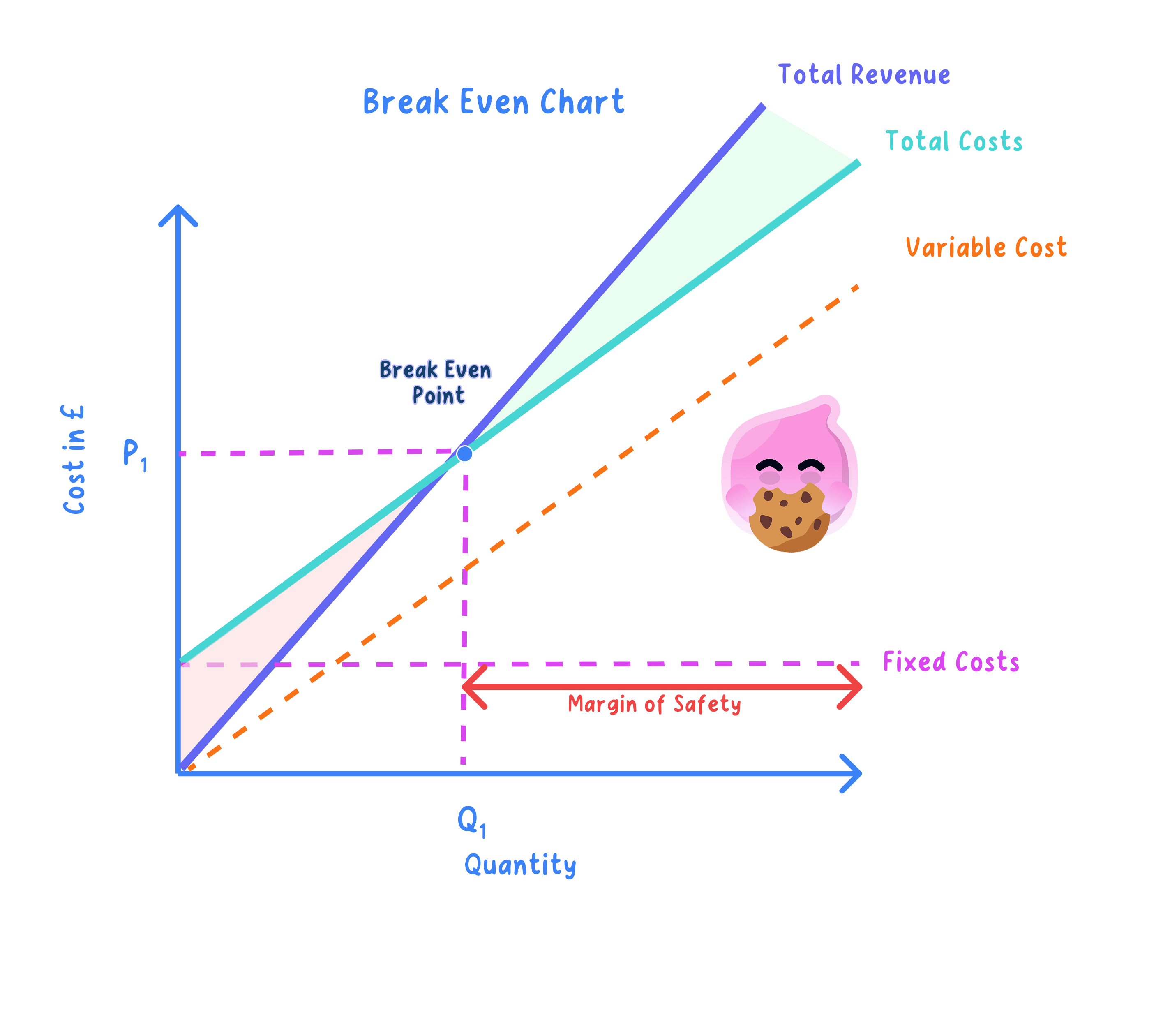
Both figures can also be read off a break-even chart, which is covered in 1.3.2c.
The limits of break-even
- Break-even assumes every unit made is sold, and all of it at the same price, which breaks down as soon as stock is left over or discounted in a sale.
- It assumes costs stay fixed at every level of output, yet a business that doubles output may need a second machine or overtime pay, which moves the break-even point again.
- The figures are forecasts that may be wrong, so break-even is a guide to a decision, not a guarantee.
- No formula sheet is given, so you have to recall all three: the break even point in units is fixed cost divided by sales price minus variable cost, the break-even point in revenue is break-even output multiplied by the selling price, and margin of safety is actual output minus break-even output.
- Do the subtraction on the bottom before you divide, because dividing the fixed costs by the selling price is the most common way marks are lost here.
- Break-even output and margin of safety are answered in units, while the break-even point in revenue is answered in pounds, so label each answer with the unit the question asked for.
- Show each step, then add one sentence saying what the number means for the business in the source booklet.
- State the formula for the break even point in units.
- Fixed costs are £3,000 and contribution per unit is £6, so what is the break-even output?
- Those same fixed costs of £3,000 go with a selling price of £10 and a variable cost per unit of £4, so what is the break-even point in revenue?
- A business breaks even at 900 units and sells 1,200, so what is its margin of safety?
- Why does a rise in the variable cost per unit push the break-even output up?
- Give one assumption that limits how far a break-even figure can be trusted.
1.3.2c Interpretation of break even diagrams
Drawing the chart: three lines on one pair of axes
Break-even chart: a graph plotting fixed costs, total costs and total revenue against output, so the break-even level of output and the size of any profit or loss can be read straight off the diagram.
- The horizontal axis measures output in units and the vertical axis measures money in £, so every point on the chart pairs a level of output with an amount of money.
- Three lines sit on those axes, and each has a shape you have to get right.
- Fixed costs: a horizontal line, because rent, insurance and salaries are the same whether the business makes nothing or 2,000 units.
- Total costs: a line that meets the vertical axis level with fixed costs and then slopes upwards, because the variable cost of each extra unit is added on top of the fixed costs.
- Total revenue: a line from the origin that slopes up more steeply than total cost while the product is profitable, because at zero output there is nothing sold and no money coming in.
- Draw them in that order, since the total cost line has to start level with the fixed cost line and can never fall below it.
- The most common error is drawing the total cost line flat, which just repeats the fixed cost line under a new label.
- Total cost must slope up, because every extra unit made adds its variable cost.
- The revenue line starts at the origin, not level with fixed costs, because a business with no sales takes no money.
- Profit is the vertical gap between total revenue and total cost, never the gap between revenue and the fixed cost line.
Reading the chart: break-even output, profit, loss and the margin of safety
- The two sloping lines cross at one output only, and reading down from that crossing to the horizontal axis gives the break even level of output.
- Take a market stall selling phone cases at £9 with a variable cost of £4 each and fixed costs of £4,500, where the lines cross at 900 cases.
- Check the crossing both ways: 900×£9=£8,100900 \times \pounds 9 = \pounds 8{,}100900×£9=£8,100 and £4,500+(900×£4)=£8,100\pounds 4{,}500 + (900 \times \pounds 4) = \pounds 8{,}100£4,500+(900×£4)=£8,100.
- Because the two figures match at £8,100, the stallholder covers every cost at 900 cases and takes nothing home, so case 901 is the first one that adds profit.
- To the left of the crossing the total cost line sits above the revenue line and the vertical gap between them is the loss, so at 600 cases revenue of £5,400 against costs of £6,900 leaves a loss of £1,500.
- To the right the revenue line is on top and the same vertical gap is the profit, so at 1,300 cases revenue of £11,700 against costs of £9,700 gives a profit of £2,000.
- The margin of safety is the horizontal distance from break-even output back to actual output, so selling 1,300 cases gives 400 cases of cushion before the stall drops into loss.
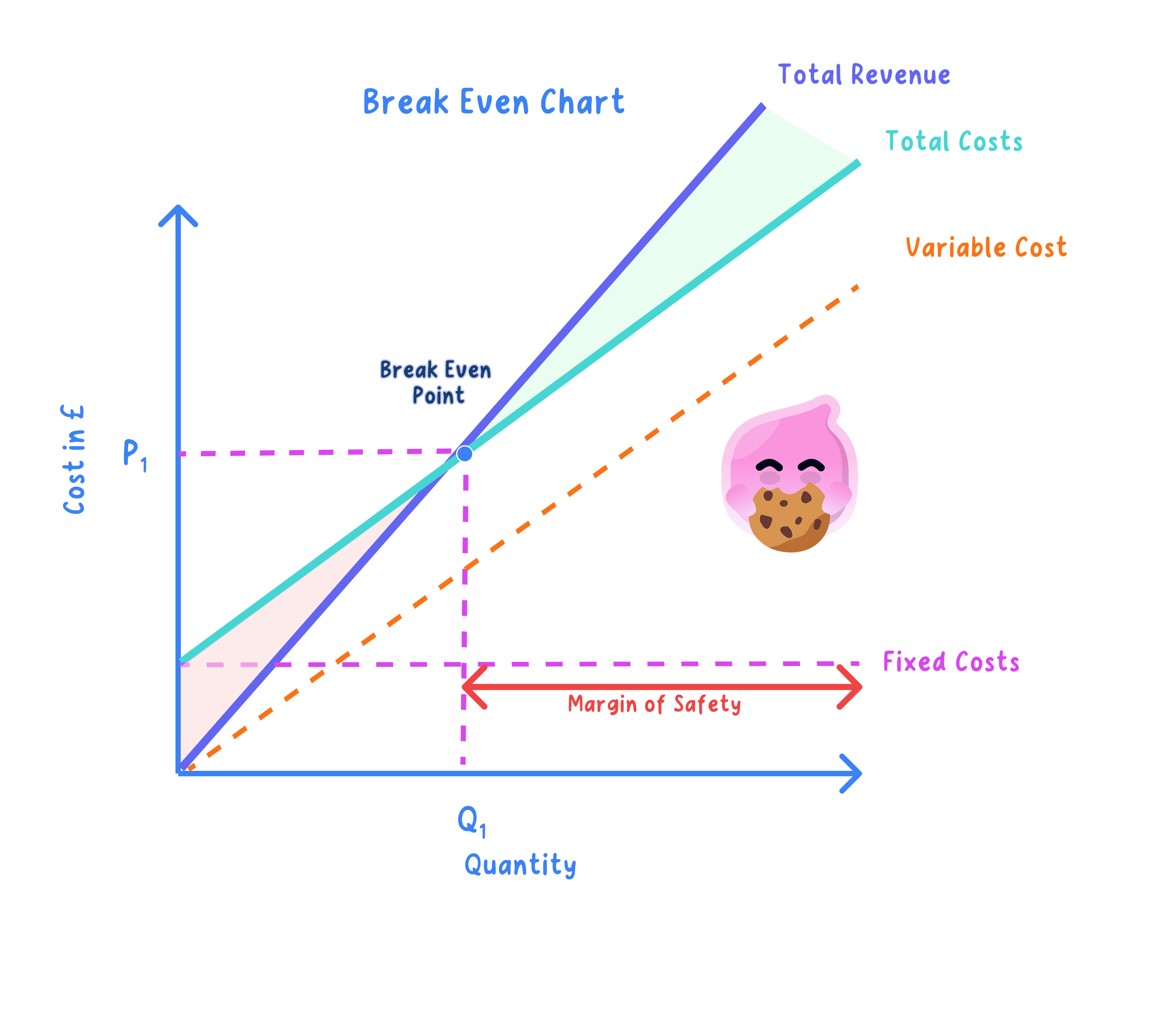
- Greggs sells cheap hot food, so each sausage roll adds only a small amount to the revenue line.
- A shallow revenue line takes longer to climb up to the total cost line, so break-even output for a shop is counted in thousands of items rather than hundreds.
- Past that output the gap between the two lines widens with every extra item sold, which is why high volume matters so much to a low-price business.
- A quiet week that pushes sales back towards the crossing point wipes out the margin of safety fast.
The impact of changes in revenue and costs: which line moves
- The chart earns its keep when a figure changes, because you can see which line moves and which way the crossing point slides before you work out a single number.
- Fixed costs rise: the fixed cost line and the total cost line both shift up in parallel, the lines cross further to the right, so break-even output rises and the margin of safety falls.
- Variable cost per unit rises: the total cost line starts from the same point on the vertical axis but becomes steeper, so the crossing moves right and break-even output rises.
- Selling price rises: the revenue line becomes steeper and meets the cost line sooner, so break-even output falls and the margin of safety grows.
- Selling price falls, perhaps through a discount: the revenue line flattens, the crossing moves right and break-even output rises.
- Carry the shift through to the business: an extra £900 of rent lifts the stall's fixed costs to £5,400, which pushes break-even output to 1,080 cases.
- That means 180 more cases must be sold before any profit appears, and at an output of 1,300 the margin of safety shrinks from 400 cases to 220, so the owner is trading much closer to a loss than before.
- Label both axes and all three lines, because a correctly shaped diagram scores nothing if the marker cannot tell which line is which.
- To read break-even output, drop a dotted line from the crossing point to the output axis and write the answer in units.
- When a question changes a price or a cost, redraw only the line that moves, mark the new crossing point and state whether break-even output has risen or fallen.
- Finish by saying what the new figure means for the business, such as how many more units it must sell each week to stay out of loss.
- Why is the fixed cost line horizontal?
- Where does the total cost line meet the vertical axis, and why is it not at the origin?
- A stall has fixed costs of £4,500, a price of £9 and a variable cost of £4 per case: what is the loss at an output of 600 cases?
- Which line moves, and in which direction, when the variable cost per unit rises?
- What happens to the margin of safety when fixed costs rise and output stays the same?
1.3.3a The importance of cash to a business
What cash pays for: suppliers, overheads and employees
Cash: the money a business can spend immediately, held in its till and its bank account.
Overheads: the running costs of the business that do not change with how much it sells, such as rent, energy, insurance and business rates.
- Cash is the only thing that settles a bill, because a supplier, a landlord or an employee cannot be paid with a sale that has not yet turned into money.
- Three payments fall due whether or not the money has arrived.
- Suppliers: stock and materials are usually delivered on credit, so a missed payment means the supplier refuses the next delivery, the shelves empty and sales stop.
- Overheads: rent, energy, insurance and business rates are billed on fixed dates whatever the takings were that week, and unpaid rent can cost the business its lease on the premises.
- Employees: wages must be paid in full and on time, staff who are not paid leave for another employer, and a shop with nobody behind the counter cannot trade at all.
- A bakery in Leeds owes £2,400 of rent on the first of the month and around £3,000 of wages every four weeks, and neither date moves when a wet week cuts takings by a third.
- Miss one payment and the damage spreads to the others, because no stock means no sales, no sales means no cash, and no cash means no wages the following month.
- Cash and profit are not the same measure: profit is revenue minus costs over a period, while cash is the money sitting in the account on a given day.
- The full comparison belongs to the next guide, 1.3.3b.
- Forecasting cash month by month is covered in 1.3.3c and 1.3.3d.
Insolvency: failing on the day the bill lands
Insolvency: when a business cannot pay its debts as they fall due, which usually forces it to stop trading.
- A business is insolvent once it cannot pay its debts as they fall due, and the people it owes can then take it to court, force it to close and have its assets sold to recover what they are owed.
- The test is about timing, not about being unprofitable.
- A firm with orders on the books and a profit on paper still fails if the cash is not in the account on the day the invoice has to be paid.
- Suppliers usually feel it first, because they notice a missed payment within days and can switch the business to cash up front or stop supplying it.
- That is why a cash shortage deepens instead of correcting itself: deliveries stop, so there is less to sell, so less money comes in to pay the next bill.
- Wilko had traded on UK high streets since 1930 and ran around 400 shops.
- It could not pay its suppliers, so it lost the deliveries its shops depended on.
- It entered administration in August 2023 and every shop had closed by October 2023, with around 12,500 jobs lost.
- More than 90 years of trading ended with a shortage of cash rather than a shortage of customers.
Why cash runs short in a business that is trading well
- A full order book does not guarantee cash, because four gaps drain the bank account faster than sales refill it.
- Customers on credit: a trade customer who pays 60 days after delivery leaves the business paying for materials and wages now and collecting the money two months later.
- Money tied up in stock: cash spent on goods sitting unsold in a stockroom has already left the account and only comes back when the item is sold.
- Large one-off bills: a VAT bill from HMRC or a £12,000 replacement oven can take out a month's cash in a single payment.
- Seasonal trade: a garden centre buys stock and pays staff through the winter, weeks before the spring rush brings any money in.
- Each gap is a matter of timing rather than a loss, so the fix is planning when money moves in and out, not simply selling more.
- Name which payment is at risk, because "it needs cash" earns nothing on its own.
- Carry the chain through: the supplier is unpaid, so deliveries stop, so the shop has nothing to sell, so revenue falls further.
- Use insolvency precisely, meaning it cannot pay debts as they fall due, and avoid saying the business made a loss unless the source says so.
- If a case study business is profitable but cannot pay a bill, diagnose a timing problem with cash rather than calling the business unsuccessful.
- Define overheads and give two examples.
- What happens to sales if a business cannot pay its suppliers?
- What does it mean for a business to be insolvent?
- Why can a profitable business still be forced to close?
- Give two reasons a healthy business might run short of cash.
1.3.3b The difference between cash and profit
Cash and profit: a performance over a period and a position on one day
Profit: revenue minus total costs, measured over a period of time such as a month or a year.
Cash: the money a business actually holds in its bank account and its till at this moment.
- Profit is worked out by taking every cost of the period away from the revenue earned in that period, so it is a figure you calculate rather than one you can count.
- Cash is the balance sitting in the account today, which a bank statement will show you to the penny.
- Profit is a measure of performance and cash is a measure of position, so profit tells the owner whether trading is worthwhile while cash tells the owner whether Friday's wages can be paid.
- The two are recorded at different moments, which is why a business can report a healthy profit for the month and still have nothing in the bank.
Why the two figures pull apart: four timing mechanisms
- Profit is recorded when a sale is made or a cost is incurred, while cash moves only when money changes hands, and four everyday situations separate those two dates.
- Credit sales: a sale counts as revenue when the goods leave the premises, but the cash may not arrive for 30 or 60 days, so the profit is recorded well before the money is received.
- Credit purchases: a business can receive stock now and pay for it later, so the cash leaves after the cost has already been counted, which flatters the bank balance for a few weeks.
- Stock: money spent on unsold stock has gone out of the bank but is not yet a cost against profit, because it counts as a cost only once the item is sold.
- Large one-off payments: buying a van or paying a tax bill to HMRC takes cash out without being a normal running cost of that month, so cash drops much further than profit does.
- Tracking these timing gaps month by month is the job of a cash-flow forecast.
- Net cash flow and the opening and closing balances are covered in the guides on cash-flow forecasts.
Profitable with an empty bank account: the case that catches owners out
- A firm sells £20,000 of goods in a month that cost it £14,000, so it has made £6,000 of profit.
- Its customers pay 60 days later, but it must pay its own suppliers and its staff this month.
- The firm therefore has £6,000 of profit and no cash, and if the rent falls due it cannot pay.
- An unpaid landlord or supplier can demand payment or refuse to supply again, which means a business whose trading is genuinely profitable can be forced to stop before the £20,000 ever reaches its account.
- Greggs sells cheap hot food over the counter on the high street, so the customer pays at the moment the sausage roll is handed over.
- Revenue and cash arrive together, which keeps the profit figure and the bank balance close to each other.
- A bakery that instead supplies offices and cafes and invoices them at the end of the month earns the same revenue but waits weeks for the money.
- Same product and same profit, but a very different cash position, because what changes is who pays and when.
The reverse case: plenty of cash while making a loss
- The gap runs the other way too: money from a new loan or from selling a piece of equipment lands in the bank without being revenue, so a business can hold plenty of cash while making a loss.
- A healthy bank balance is not proof of a healthy business, because that money arrives once while the losses repeat every month.
- A business narrows the gap by collecting from customers sooner, paying suppliers later, holding less stock or arranging an overdraft, which is covered in 1.3.4a.
- Answer a cash and profit question by naming the timing gap, not by repeating the two definitions.
- Build the chain: the sale is made in March, the cash arrives in May, the wages fall due in April, so the business is short in April.
- If the case study mentions credit customers, a large stock order or a new vehicle, that is the examiner pointing at the cash gap.
- Never write that a profitable business must have money in the bank, because that one line gives away the mark the question is testing.
- State one difference between what profit measures and what cash measures.
- A firm sells £20,000 of goods in a month that cost it £14,000, so what profit has it made?
- Why does a credit sale raise profit before it raises cash?
- Why does money spent on unsold stock reduce cash but not profit?
- Why can a business hold plenty of cash while it is making a loss?
1.3.3c Cash-flow forecasts: inflows and outflows
What a cash-flow forecast is: spotting a shortfall before it arrives
- A cash-flow forecast is a month-by-month estimate of the money a business expects to come in and the money it expects to go out, set out with one column for each month.
- Its job is to show a shortfall before it happens, so the owner can arrange an overdraft or delay a payment while there is still time to do either.
Cash inflows: money arriving in the bank account
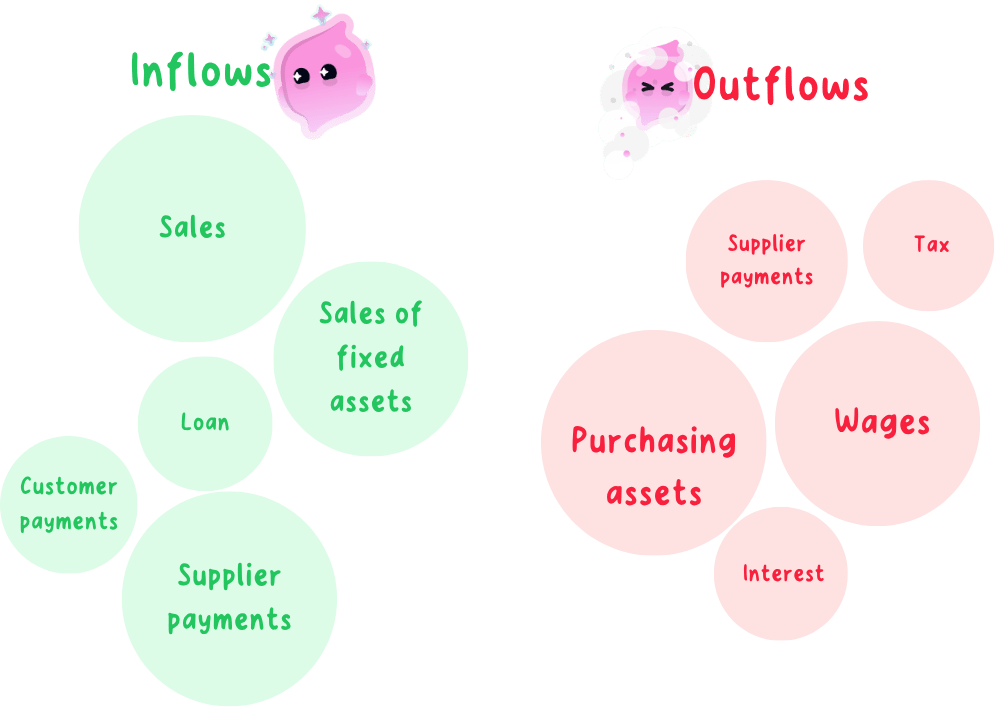
Cash inflow: money that actually arrives in the business's bank account in a given month, whether from customers, a lender, the owner or a grant.
- Six inflows cover almost every figure a forecast asks you to enter.
- Cash sales: money taken at the till or through the website on the day the customer buys.
- Payments from credit customers: cash from sales made earlier, arriving when the invoice is settled, often 30 days later.
- Owner's capital: savings the owner pays into the business, usually a one-off sum at the start or when more money is needed.
- A bank loan being received: the whole sum lands in the account in one month, and the repayments become outflows in later months.
- Selling an asset: cash raised by selling a van, an oven or a machine the business no longer uses.
- Grants: money from a council or government scheme that does not have to be repaid.
- An inflow is money arriving in the bank, so Greggs records the cash the moment a sausage roll is sold at the till, while a bakery invoicing an office caterer on 30-day terms has made the sale but has no inflow until the customer actually pays.
Cash outflows: money leaving the bank account
Cash outflow: money that actually leaves the business's bank account in a given month, such as payments for stock, wages, rent or tax.
- Every outflow is entered in the month the money genuinely leaves the account, not the month the order was placed.
- Buying stock or raw materials: flour, packaging or goods for resale, usually the largest and most regular payment a small firm makes.
- Wages: paid weekly or monthly, and due whether trade that month was strong or weak.
- Rent, energy and other overheads: payments for the premises, electricity, insurance and phone line that fall on fixed dates.
- Loan repayments and tax: a set repayment to the bank each month, plus VAT and corporation tax paid to HMRC on their due dates.
- Buying equipment: a one-off payment for an oven, a till system or a van that hits one month hard.
A worked month: totalling March for a bakery in Leeds
The two tables below set out the figures a bakery in Leeds expects for March, with everything coming in shown first and everything going out shown second.
| Cash inflows (March) | Amount (£) |
|---|---|
| Cash sales | 5,400 |
| Payments from credit customers | 2,300 |
| Grant | 500 |
| Total cash inflows | 8,200 |
| Cash outflows (March) | Amount (£) |
|---|---|
| Stock | 3,100 |
| Wages | 2,400 |
| Rent | 900 |
| Energy | 350 |
| Loan repayment | 700 |
| Total cash outflows | 7,450 |
- The figures that get compared are the two totals at the foot of each table: £8,200 came in against £7,450 going out.
- More cash came in than went out that month, so the bakery ended March with a larger bank balance than it started with and did not need to borrow.
- Stock at £3,100 is the largest single outflow, so a supplier who charges less for flour frees far more cash than trimming the £350 energy bill ever could.
- A forecast is only an estimate, so one credit customer paying in April instead of March, or a supplier raising a price, pushes the real figures away from the plan.
- The next guide turns these two totals into net cash flow and a running opening and closing balance.
- Sort every figure into inflow or outflow before you add anything up, because one item in the wrong row spoils both totals.
- A bank loan is an inflow in the month it arrives, and the monthly repayment is a separate outflow in later months.
- Put a credit sale in the month the customer pays, not the month the order was taken.
- Label your two answers "total inflows" and "total outflows" so the method still earns credit if one figure is misread.
- What is a cash-flow forecast and what is it used to spot?
- Give three cash inflows other than cash sales.
- Why is a sale made on credit not an inflow in the month of the sale?
- Cash sales of £5,400, credit customer payments of £2,300 and a grant of £500: what are total inflows?
- Name two cash outflows that fall due on fixed dates every month.
1.3.3d Cash-flow forecasts: net cash flow and balances
Net cash flow: what one month adds to or takes from the cash held
Net cash flow: the difference between all the cash coming into a business in a month and all the cash going out of it.
- The first formula measures a single month's movement: net cash flow=total cash inflows−total cash outflows\text{net cash flow} = \text{total cash inflows} - \text{total cash outflows}net cash flow=total cash inflows−total cash outflows.
- A positive net cash flow means more cash arrived than left, so the business ends the month holding more cash than it started with.
- A negative net cash flow means more cash left than arrived, so the cash held falls by exactly that amount.
Opening and closing balances: how one month feeds the next
Opening balance: the cash a business holds at the start of a month, before any of that month's inflows or outflows.
Closing balance: the cash a business holds at the end of that month, once the net cash flow has been added to the opening balance.
- The second formula turns the movement into a position: closing balance=opening balance+net cash flow\text{closing balance} = \text{opening balance} + \text{net cash flow}closing balance=opening balance+net cash flow.
- The third rule carries the forecast along: this month's closing balance becomes next month's opening balance, so a weak month drags down every month that follows it.
A worked forecast: three months for a shop
The forecast below sets out three months for the shop, showing each month's total inflows and outflows, the net cash flow they produce, and the opening and closing balances that follow from it.
| January (£) | February (£) | March (£) | |
|---|---|---|---|
| Total cash inflows | 6,000 | 5,500 | 9,000 |
| Total cash outflows | 6,800 | 6,300 | 6,500 |
| Net cash flow | -800 | -800 | 2,500 |
| Opening balance | 1,200 | 400 | -400 |
| Closing balance | 400 | -400 | 2,100 |
- Read the table down a column to follow one month from its inflows through to its closing balance, and read across a row to follow a single line, such as net cash flow, as it changes over the three months.
- The closing balance of one month becomes the opening balance of the next, which is why the £400 at the foot of the January column reappears at the top of the February column.
Reading the forecast: what the owner should do about it
- January's net cash flow is negative, yet the £1,200 opening balance absorbs the £800 gap and the month still ends £400 in credit, so a negative month on its own is not a crisis.
- February is the month that matters, because a closing balance of −£400 means the shop is forecast to be overdrawn and cannot pay all its bills without help.
- Because the forecast showed the shortfall weeks in advance, the owner can act in January instead of discovering the problem when a payment bounces.
- Arrange an overdraft: agreeing one with the bank before the money is needed is easier than asking once the account is already empty.
- Move the timings: chasing customers to pay sooner pulls cash in earlier, and negotiating longer to pay a supplier pushes an outflow later.
- Delay spending: putting off buying equipment until March shifts an outflow into the month when £2,500 of cash comes back in.
- March recovers to a closing balance of £2,100, so the shop has a timing gap rather than a failing business, and short-term finance is the sensible answer rather than closing.
- A forecast whose closing balance falls every month with no recovery is a different signal, of the kind that ends businesses, as with Wilko, which had traded since 1930 before entering administration in August 2023.
- Show the subtraction and the addition as separate lines, because method marks are given for the working even when the final figure is wrong.
- Keep the minus sign or use brackets, since −£400 and £400 are marked as different answers.
- Never leave a figure bare, so follow February's −£400 with the point that the shop cannot pay its bills that month.
- When asked what the owner should do, name an action tied to a month, such as arranging an overdraft before February starts.
- Write out the formula for net cash flow.
- A month opens with £900 and has a net cash flow of −£1,300, so what is the closing balance?
- Which figure becomes the next month's opening balance?
- How can a month have a negative net cash flow but still a positive closing balance?
- What does a negative closing balance warn the owner to arrange?
1.3.4a Short-term sources of finance
Short-term finance: covering a timing gap, not buying equipment
- Short-term finance covers a timing gap of weeks or months, such as the negative closing balance a cash-flow forecast shows for February, when money leaves the business before the money coming in arrives.
- The gap closes by itself once customers pay or trade picks up, so the borrowing is cleared inside the year rather than sitting on the books.
- It is the wrong tool for an oven, a van or a second shop, because those are long-term needs met by the long-term sources in 1.3.4b, and Edexcel names exactly two short-term sources: an overdraft and trade credit.
Overdraft: borrowing on your own account, only on the days you dip into it
Overdraft: an arrangement letting a business spend more than it has in its bank account, up to an agreed limit.
- The bank agrees a limit, say £3,000, and charges interest only on the amount actually overdrawn and only for the days it is overdrawn, which gives an overdraft two advantages over a loan.
- Flexibility: dipping £400 below zero for six days costs interest on £400 for six days rather than on a whole borrowed sum for a whole year, so the business borrows only what it needs on the day.
- Speed: an overdraft is arranged with the bank in days and then sits unused until it is needed, which suits a shortfall that appears at short notice.
- Three drawbacks make it unsuitable for anything longer than a short dip.
- High interest: the rate is well above the rate on a bank loan, so a business that stays overdrawn month after month loses profit to interest it could have avoided.
- Repayable on demand: the bank can reduce or withdraw the limit at short notice, which can leave the owner unable to pay wages in the same week the decision lands.
- Charges for going over: exceeding the agreed limit brings fees and refused payments, so a supplier's direct debit bounces and the firm's reputation for paying suffers.
Trade credit: taking the stock now and paying the supplier in 30 days
Trade credit: an agreement to receive goods from a supplier now and pay for them later, commonly 30 days after delivery.
- The supplier delivers the goods and issues an invoice, commonly on 30-day terms, and that delay does two things for a small business.
- It costs nothing: trade credit is normally interest free, so a £2,000 stock order settled on day 30 costs the same £2,000 it would have cost on the day it arrived.
- It funds itself: the business sells the stock before paying for it, so the customers' cash settles the supplier's bill and the owner needs less money of their own tied up in stock.
- Three drawbacks limit how far a small business can lean on it.
- It may not be offered: a new business with no trading record is often refused credit, because the supplier has no evidence the bill will be paid, so a start-up pays cash up front for its first orders.
- Late payment costs supply: missing the date damages the relationship, and the supplier can shorten the credit period, put the account on hold or stop delivering, which halts trading altogether.
- The discount is lost: many suppliers cut the price for payment inside a few days, so taking the full 30 days quietly raises the cost of every order.
Which one suits a small business: it depends on what caused the gap
- The two are not rivals for the same job, because each covers a shortfall the other cannot reach.
- Where the shortfall comes from buying stock, trade credit is the better first choice, because it is free and the goods are often sold before the invoice falls due, so the sale itself pays the supplier and no interest is ever charged.
- Where wages, rent or a tax bill fall due before customers pay, no supplier is involved and trade credit cannot touch it, so an overdraft is the only one of the two that covers the gap.
- Levi Roots won £50,000 on Dragons' Den in 2007 and his Reggae Reggae Sauce was stocked by Sainsbury's, and any small producer supplying a chain must make and deliver stock weeks before the payment arrives, which is the wage-bill gap an overdraft exists to carry.
- So judge it on three things: how large and how long the gap is, what the overdraft interest would cost set against credit that is free, and whether suppliers will offer a business with no trading record any credit at all.
- Name the source, then say what it does to the cash position, then say what that lets the owner do, because the marks sit in the chain and not in the label.
- Read the case for what caused the shortfall: stock points to trade credit, wages or rent point to an overdraft.
- When the question says justify or evaluate, weigh the interest cost of an overdraft against the risk that a new firm is refused trade credit, then commit to one recommendation.
- Never recommend an overdraft or trade credit for premises or machinery, because those are long-term needs and the source would be repayable long before the asset had paid for itself.
- Define trade credit and give the length of a typical credit period.
- On what amount and for how long does a bank charge interest on an overdraft?
- State two drawbacks of an overdraft.
- Why might a supplier refuse trade credit to a business in its first month?
- A shop must pay £1,200 of wages on Friday but its customers pay next week, so which of the two sources fits and why?
1.3.4b Long-term sources of finance
Internal sources: your own money and profit you have already made
Retained profit: profit from earlier years kept inside the business and reinvested, instead of being taken out by the owners.
- Personal savings: money the owner puts in from their own bank account, which is how most UK start-ups get going before any outside backer will take a risk on them.
- Advantage and drawback: savings cost no interest and give away no share of the business, but the sum is capped by what the owner has managed to put aside, and it is their own money that disappears if the firm fails.
- In practice: Ben Francis began Gymshark in 2012 by screen-printing in a garage rather than renting a factory, because savings set a hard ceiling on how big the first step can be.
- Retained profit: profit kept back from previous trading years and spent on the business, such as a bakery using £20,000 of past profit to fit out a second shop.
- Advantage and drawback: it carries no interest and needs nobody's permission, but a business in its first year has no past profit to draw on, and every pound reinvested is a pound the owner has not taken home.
- Internal sources cost nothing in interest but are capped by what the owner has saved or earned, while external sources can raise far larger sums in exchange for interest or a share of ownership.
External sources: larger sums, paid for in interest or in ownership
Share capital: money a limited company raises by selling shares, each share being a piece of ownership that carries a vote and a claim on profit.
Venture capital: a large investment from a specialist investor into a risky but fast-growing business, in return for a stake in it.
- Loans: a fixed sum borrowed from a bank and repaid in regular instalments with interest over an agreed period, such as £30,000 over five years to buy a delivery van.
- Advantage and drawback: the owner keeps every share of the business and can budget for a known monthly instalment, but interest makes the total repaid larger than the sum borrowed and the instalment still falls due in a month with no sales.
- Watch the security: a bank may also demand security such as the owner's home, so a business that fails can cost the owner an asset that was never part of the firm.
- Share capital: money raised by selling shares, which is open only to a company registered at Companies House and never to a sole trader.
- Advantage and drawback: share capital never has to be repaid and carries no interest, so the cash stays in the business, but ownership, future profit and votes are shared, and enough new shareholders can outvote the founder.
- Venture capital: one investor puts in a large sum where a bank would refuse, betting that a fast-growing firm will be worth far more later.
- Advantage and drawback: the business gets a sum no bank would risk, plus the investor's experience and contacts, but it hands over a large stake and a say in decisions, and that investor expects to sell the stake at a profit within a few years.
- In practice: Levi Roots turned the £50,000 he won on Dragons' Den in 2007 into Reggae Reggae Sauce stocked by Sainsbury's, because the investor's contacts opened doors that the cash alone would not have opened.
- Crowd funding: many people each pledge a small amount through an online platform, so 2,000 pledges of £25 raise £50,000 without any single backer risking much.
- Advantage and drawback: a campaign raises money and tests demand at the same time, but if the target is missed the pledges are usually returned and nothing is raised, while the idea sits in public where a rival can copy it.
The six sources side by side
Read the table one row at a time, so that you see for each source where the money comes from, what it gives the business and what it costs in return.
| Source | Internal or external | Main advantage | Main drawback |
|---|---|---|---|
| Personal savings | Internal | No interest, control kept | Small sum, owner's cash at risk |
| Retained profit | Internal | No interest, control kept | Only after profitable trading |
| Loan | External | Control kept, budgeted repayments | Interest owed, repayments fixed |
| Share capital | External | Does not have to be repaid | Ownership and control shared |
| Venture capital | External | Large sum, expertise, contacts | Stake and a say handed over |
| Crowd funding | External | Raises cash, tests demand | Target may be missed, idea public |
- The two internal rows charge nothing at all, but notice their ceiling: they are capped by what the owner has already saved or what the business has already earned, so they can run out long before the plan is funded.
- Every external row charges either interest or a share of ownership, so the real question is not which source is best but which of those two prices the owner would rather pay.
- Compare the drawback column rather than the advantage column when you choose, because the advantages read much alike while the drawbacks are what actually rule a source out for a particular business.
Judging which source suits a start-up and which suits an established business
- A start-up has no trading record and no past profit, so a bank will usually refuse a loan or demand the owner's home as security, which leaves personal savings, crowd funding or venture capital as the realistic options.
- An established business with several years of accounts can show a lender steady sales, so it can borrow more cheaply or fund growth from retained profit, and it rarely needs to sell a stake at all.
- Which source wins depends on how much money is needed, whether the owner will give up control, whether there is a trading record a lender will accept, and whether the business can afford fixed repayments in a bad month.
- For a small start-up needing a few thousand pounds, savings topped up by crowd funding is usually the stronger choice, because unproven sales cannot safely carry monthly repayments, while a firm with reliable revenue and a large plan should take the loan or the share issue and keep the growth it can now pay for.
- Label the source internal or external before you judge it, because that classification is the first thing an examiner looks for.
- Never offer share capital to a sole trader or a partnership, since only a company can sell shares.
- Use the figures in the case: a £4,000 need points to savings, while a £250,000 expansion does not.
- When the question says justify or evaluate, land the judgement on control against cash: who ends up owning the business, and can it meet the repayments.
- Which two of the six long-term sources are internal?
- Why can a sole trader not raise share capital?
- Give one advantage and one drawback of venture capital.
- What happens to the pledges if a crowd funding campaign misses its target?
- Why is retained profit no help to a business in its first year?
