Job, batch and flow: three ways of organising production
Definition
Job production: making one item at a time, built to that customer's own requirements.
Batch production: making identical items in groups, with the machinery reset between one group and the next.
Flow production: making identical items continuously on a production line.
- Which process fits depends on how many identical units the business needs and how far one order differs from the next.
- Job: one worker or team sees the product through from start to finish, so it suits one-off orders such as a made-to-measure suit, a hand-painted shop sign or a wedding cake.
- Batch: work moves through the workshop in groups, and the equipment is cleaned and reset before the next group starts, which suits a bakery in Leeds alternating between white loaves, wholemeal and rolls through the day.
- Flow: the product moves along a line while each stage adds one operation, which suits Greggs supplying cheap hot food to high streets and retail parks in the volumes its low prices depend on.
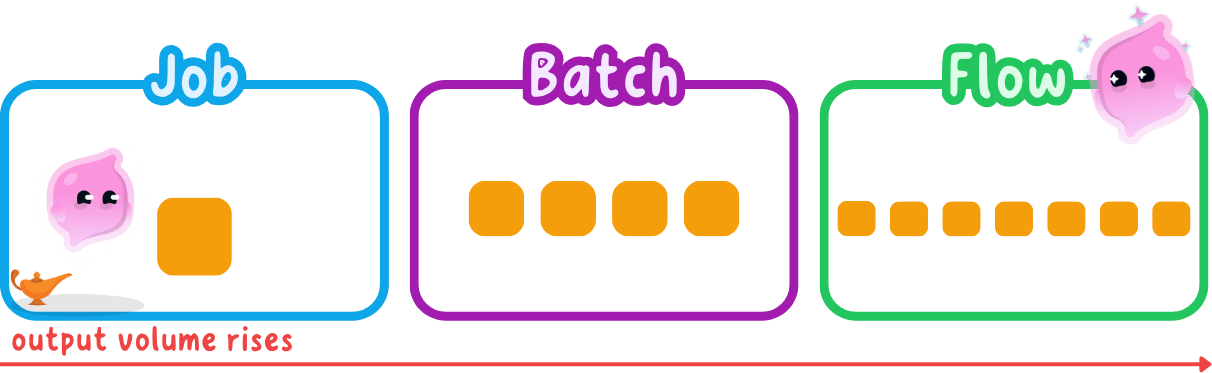
- Cost per unit falls across the table because the set-up cost, the machine time and the supervision are spread over far more units, and materials can be bought in bulk at a lower price.
- Matching the process to the level of demand is what keeps productivity up, because neither workers nor machines sit idle waiting for the next order, and the lower unit cost that follows lets the business either undercut rivals on price or keep the difference as profit.
| Job | Batch | Flow | |
|---|---|---|---|
| Output volume | One unit per order | Tens or hundreds per run | Thousands, continuously |
| Customisation | Made to customer's design | Fixed per batch, varies | None, fully standardised |
| Cost per unit | Highest | Lower than job | Lowest |
| Flexibility | Very high | Moderate | Very low |
Advantages: what each process gives the business
- Job production delivers exactly what was ordered and lets quality be checked on the single item in front of you, so the business can charge a premium price for work a mass producer cannot match.
- Batch production keeps some variety on offer while cutting cost per unit below job production, because materials are bought in bulk and each machine is used far more fully across the day.
- Flow production gives the lowest cost per unit and very high output, since the line can run around the clock and machinery does work that would otherwise need paid labour.
Drawbacks: what each process costs the business
- Job production is slow and labour-intensive and depends on skilled workers who are scarce and expensive to hire, so cost per unit is the highest of the three and a large order takes weeks.
- Batch production loses time and money at every changeover while machines are cleaned and reset, and part-finished goods build up as stock that ties up cash and needs storing.
- Flow production is very expensive to set up and inflexible once built, so changing the product means costly retooling, and a single breakdown stops the entire line rather than one workstation.
- Repetitive work on a line can demotivate staff, which raises absence and labour turnover, so the business carries the cost of recruiting and training replacements.
Note
- How automation and computer-aided design change what each process can do belongs to the next guide, on the impact of technology on production.
- Here, treat the process itself as your answer and technology as a separate factor.
Judging which process a business should use
- There is no best process, only the one that fits four features of the business and its market.
- The size and predictability of demand: flow only repays its set-up cost when orders are large and steady, while demand that arrives in bursts leaves an expensive line standing still.
- Whether customers want something individual: a buyer commissioning a one-off will not accept standard output, so job or batch is the only way to keep that customer.
- How much capital the business has: a start-up with a few thousand pounds of savings cannot buy a production line, so its real choice is between job and batch.
- The price the market will pay: a premium price covers the high unit cost of job production, but a market where shoppers compare prices on every purchase pushes the business towards flow.
- Read down the table again and the trade-off is the whole judgement: cost per unit falls as you move from job to flow, but flexibility falls with it, so a business is really choosing between being cheap and being adaptable.
- For most small UK firms serving varied local demand, batch production is the stronger choice, because it captures part of the cost saving without locking the owner into one standard product that may not sell, whereas a business with proven national demand and the capital to invest should take the flow route and compete on price.
Exam technique
- When the question says explain, name the process and carry the chain through to cost per unit, output or the customer, because a bare name earns nothing.
- Use the product and the level of demand described in the source booklet rather than a car plant you have memorised, since application marks are gated on that context.
- When the question says justify or evaluate, weigh cost per unit against flexibility and then commit to one process.
- The point most often dropped is the decision itself, because the answer describes all three processes and never says which one this business should use.
Self review
- Define batch production.
- Which process has the highest cost per unit, and why?
- Give one drawback of flow production other than its set-up cost.
- Why does a bakery lose time when it switches from white loaves to wholemeal?
- Name two things that decide which production process a business should choose.
