Reading an organisational chart: who reports to whom
- An organisational chart is drawn as a pyramid: a single box at the top for the owner or managing director, a wider row of department managers below it, and under each manager the row of staff that manager is responsible for, with a line joining every box to the box above that it reports to.
- Hierarchy and levels: the layers of authority from top to bottom, one level for each horizontal row of boxes on the chart.
- Chain of command: the line down which instructions pass from the top to the bottom, so a long chain puts more layers between the decision and the person carrying it out.
- Span of control: the number of people a manager is directly responsible for, wide when many report to one manager and narrow when only a few do.
- Tall structure: many layers, narrow spans of control and a long chain of command.
- Flat structure: few layers, wide spans of control and a short chain of command.
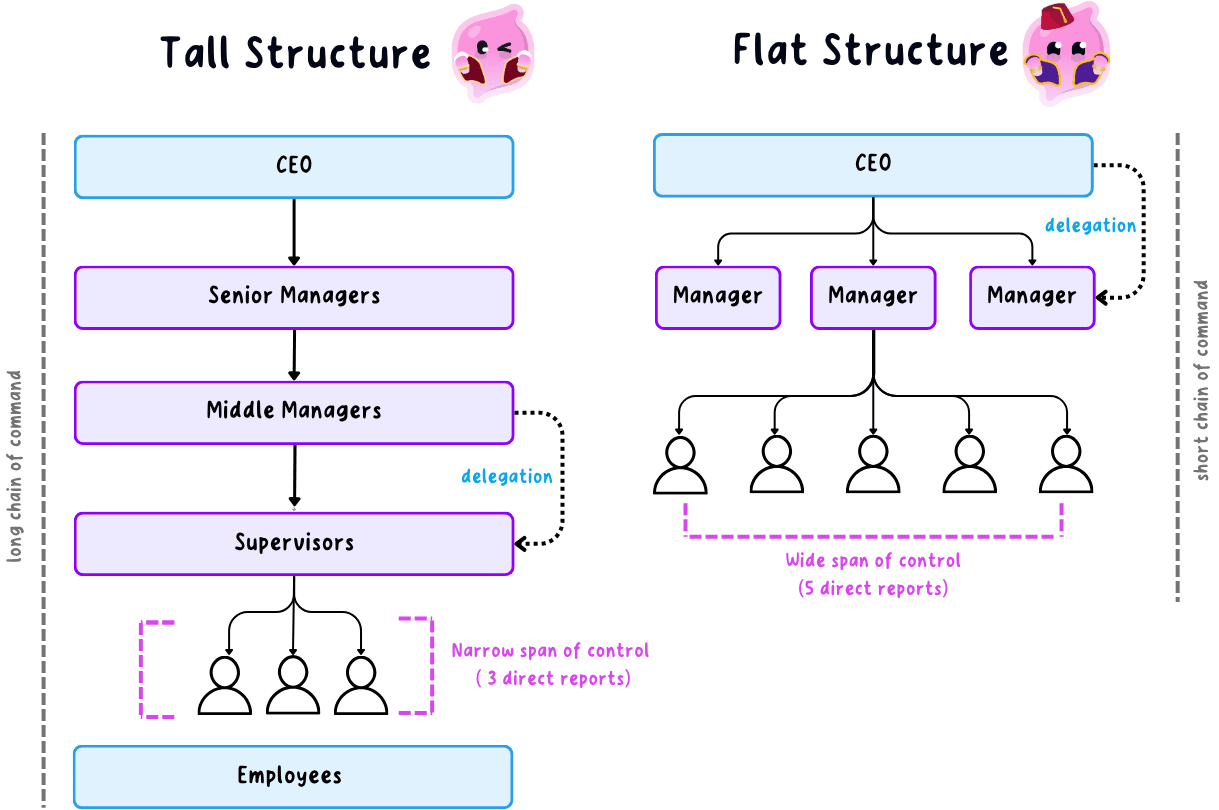
Note
The diagram uses the term tall structure. For GCSE Edexcel, focus on hierarchical and flat structures; a tall structure is a hierarchical structure with more management levels and a longer chain of command.
- Centralised decision making: decisions taken at the top of the business and passed down the chain to be carried out.
- Decentralised decision making: decisions delegated to managers or staff further down the hierarchy.
Tall or flat: what each shape does to the business
The table sets the two shapes side by side on the five features an exam question tests most often.
| Feature | Tall structure | Flat structure |
|---|---|---|
| Number of layers | Many | Few |
| Span of control | Narrow | Wide |
| Speed of communication | Slow | Fast |
| Cost of managers | High | Low |
| Staff responsibility | Limited | Greater |
- The rows move together rather than separately, because taking out a layer leaves the remaining managers holding the staff that layer used to supervise, so every gain in speed and cost is bought with a wider span.
- A tall structure gains control: each extra layer is another rung on the promotion ladder for an ambitious employee, and a supervisor watching six people can spot a mistake the day it is made.
- A tall structure loses time: every instruction stops at each layer on the way down, so a change agreed by a director on Monday may still not have reached the till by the following week, and staff at the bottom feel remote from choices they had no part in.
- A flat structure gains pace and commitment: an idea from the shop floor reaches the owner in one step, and staff given real responsibility usually work harder at decisions they helped make themselves.
- A flat structure loses supervision and promotion: a manager responsible for twenty staff cannot coach each one, and an employee with no next rung to climb to often leaves for a business that has one.
Common Mistake
- Tall does not mean big, because a large business can run a flat structure and a small one can stack up several supervisor layers.
- Judge the shape by counting rows of boxes down the chart, never by counting employees.
- Span of control counts people sideways, not layers downwards, so a manager with three levels beneath them may still have a narrow span.
Centralised or decentralised: where the decision is taken
- Centralising gains consistency and tight control, because every branch follows one procedure and one head-office team sets the price, which is how Aldi holds a narrow product range at the same low prices in every store.
- Centralising loses local speed, because a store that spots a problem has to wait for head office to agree a change, and staff who are never asked come to feel untrusted and stop passing ideas up.
- Decentralising gains quicker local decisions and uses knowledge head office does not have, so a supermarket branch manager can build rotas around the shopping patterns of that town rather than a national average.
- Decentralising loses consistency, because two branches may settle the same complaint differently, and it works only with capable, trained staff since one weak manager given real authority can damage the brand across a whole town.
Judging which structure suits a business
- A small business in a fast-moving market is more likely to benefit from a flat, decentralised structure, while a larger or more stable business may accept more hierarchy and central control to keep standards consistent.
- Staff skill and trust set the limit: wide spans and decentralised decisions work better with experienced employees, while new or high-risk work may need closer supervision.
- Overall, choose the structure that fits what the business competes on, balancing consistency and control against speed, local knowledge and employee responsibility.
Exam technique
- Keep levels of hierarchy, chain of command and span of control separate, then develop the effect of the structure on this business.
- Use the staff experience, size and pace of change in the source booklet when deciding whether close control or faster delegated decisions matter more.
- For a judgement, name the factor that decides it and commit to one structure rather than listing both.
Self review
- Define span of control.
- State three features of a tall structure.
- One supervisor watches six people and another manager is responsible for twenty, so which of them has the wider span of control?
- Give one drawback of centralised decision making.
- Name two things that decide whether a flat structure suits a business.
