1.4.1a Limited liability
Liability: whether the law sees the business as separate from its owner
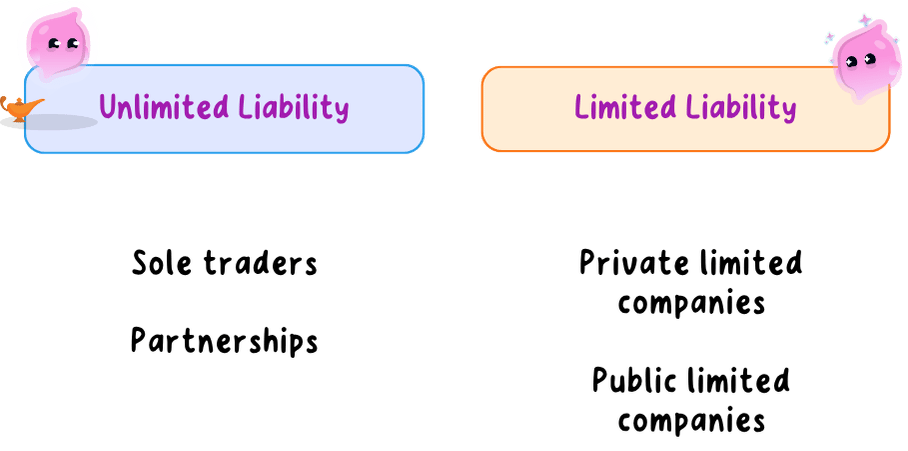
Unlimited liability: the owner is personally responsible for all the debts of the business, with no upper limit on the amount.
Limited liability: the owner can lose only the money they have put into the business, because the business owes its debts itself.
- Liability answers one question: if the business cannot pay what it owes to a bank, a supplier or HMRC, whose money settles the bill?
- The answer turns on whether the law treats the business as a separate thing from the person who owns it.
- With unlimited liability the owner and the business are the same legal thing, so the debts of the business are simply the owner's own debts.
- With limited liability the business is a separate legal body, so it owes the money itself and a creditor sues the company rather than the person behind it.
- Sole traders and ordinary partnerships carry unlimited liability, while private limited companies carry limited liability.
- The ownership types themselves, with their full advantages and disadvantages, are covered in the next guide, 1.4.1b.
- Here you need them only as the labels that tell you which kind of liability applies.
Unlimited liability: the owner's own money stands behind the debts
- Because there is no legal wall between the two, a supplier chasing an unpaid £8,000 invoice can claim against the owner in person once the business has run out of money.
- Personal possessions can then be sold to settle business debts.
- A car, a savings account and, in the worst case, the family home are all within reach of the people the business owes.
- The loss is not capped by the amount invested, so what is at risk is everything the owner owns rather than the sum they chose to put in.
- Two friends run a sandwich shop in Leeds as an ordinary partnership and each put in £6,000 of savings.
- The shop closes owing £24,000 to its bank and its wholesaler.
- Each partner can be pursued for the whole £24,000 rather than half of it, because unlimited liability does not divide the debt neatly between them.
- Their £6,000 stakes set no ceiling, so one of them may end up selling a car and emptying an ISA long after the shutters came down.
Limited liability: the loss stops at what you put in
- The company owes its own debts, so the most an owner can lose is the money they paid in for their shares.
- A home, a car and personal savings sit outside the business, so they cannot be taken to pay its creditors.
- Private limited companies carry this protection, which is why owners planning to borrow heavily or buy expensive equipment tend to want that structure.
- A capped downside changes what an owner is willing to try, because failure now costs the £50,000 invested instead of the roof over the family.
- James Dyson worked through over 5,000 prototypes before he had a bagless vacuum cleaner worth selling, and a run of failures on that scale is only survivable when each one costs money put into the business rather than the owner's house.
- Limited liability does not mean the owner walks away with nothing lost.
- If the company fails the shares become worthless, so the whole investment is gone.
- The protection is that the loss stops there and cannot spread to money the owner never put in.
The price of protection: what limited liability costs the owner
- Limited liability is not free, because a company has to be registered and reported on in ways a sole trader avoids.
- The company registers with Companies House and files accounts every year, which brings paperwork and an accountant's fee the owner has to pay whether the business made a profit or not.
- Those accounts are public, so a rival, a supplier or a customer can look up figures that a sole trader keeps to themselves.
- Banks often ask the owner of a small company to sign a personal guarantee before lending, which makes that person personally responsible for repaying the loan if the company cannot.
- A bank loan is usually the largest debt a small firm carries, so a guarantee removes the protection exactly where it mattered most.
- Questions ask for the implications for the owner, so name the possession at risk instead of writing that the owner is responsible for debts.
- Carry the chain through: the shop owes £24,000, the owner has unlimited liability, therefore savings and the car can be sold, therefore the failure follows the owner after the business has closed.
- Say that the shareholder still loses the money invested, because answers claiming limited liability means losing nothing are marked down.
- On a longer question, set the protection against the public accounts and the personal guarantee a bank may demand, since that balance is where the judgement mark sits.
- Define unlimited liability.
- Which two types of business named in this guide have unlimited liability?
- An owner pays £4,000 for shares in a private limited company that later fails owing £90,000, so what is the most they can lose?
- Give two costs a business accepts in return for limited liability.
- Why does a personal guarantee weaken the protection limited liability gives?
1.4.1b Types of business ownership for start-ups
Sole trader: one owner keeps everything and carries everything
- A sole trader is a business owned and run by one person who is not legally separate from the firm, and both sides of the structure follow from that single ownership.
- All the profit and all the control: the owner keeps every pound the business makes and can cut a price, drop a product or open on a Sunday the same afternoon, without asking a partner or a board.
- Unlimited liability: business debts can be settled out of the owner's personal savings, car or home, as guide 1.4.1a sets out.
- Every skill and every hour sits with one person: the owner sells, prices, orders stock and files the tax return, and with nobody to cover illness or a holiday the takings stop when the owner does.
Partnership: two or more owners share the money, the work and the risk
- A partnership is a business owned by two or more people who share its capital, its decisions and its profits, usually on terms fixed in a written partnership agreement.
- Shared workload and different skills: one partner can keep the books and chase invoices while another sells, so the firm covers jobs a sole trader would have to learn from scratch or pay for.
- More capital and shared risk: three partners putting in £8,000 each start with £24,000 rather than one person's savings, a loss falls across them all rather than on one owner, and the business keeps running when one partner is ill.
- The profit is split: sharing has a price, and the first part of it is that a profit of £60,000 divided equally between three partners leaves each of them with £20,000, less than a sole trader earning £30,000 alone.
- Unlimited liability, and each partner is bound by the others: in an ordinary partnership the partners' personal assets are exposed, and a contract one partner signs binds the rest, so a deal you never agreed to can reach your savings.
- Slower decisions and the risk of disagreement: no partner can act alone on a big decision, so a price cut waits for agreement, and partners who fall out over strategy or over how much each one works can stall the business or break it up.
Private limited company: shares held privately and owners protected
Shareholder: a person who owns part of a company by holding one or more of its shares, and who gets a vote on big decisions.
Dividend: a share of a company's profit paid out to its shareholders rather than kept in the business.
- A private limited company (Ltd) is a business whose shares are held privately by the founders, their family or investors they have invited in, and which the law treats as a body separate from its owners.
- Limited liability: a shareholder can lose the money they put in but not their personal assets, because the company owes the debts rather than the people behind it, as guide 1.4.1a explains in full.
- Share finance and a more established look: it can raise money by selling new shares, which a sole trader or partnership cannot do at all, and because suppliers and larger customers can look it up at Companies House a first trade credit account or a bigger contract is easier to win.
- The profit is shared out: that protection is paid for, starting with the earnings themselves, because profit not kept in the business goes out as dividends to every shareholder instead of belonging to one owner.
- More paperwork and less privacy: the company must be registered and must file accounts at Companies House every year, which usually means paying an accountant and letting a competitor read what the business earns.
- Control is diluted: every new shareholder brought in for their money also brings a vote, so a founder who has sold most of the shares can be outvoted on a decision in their own business.
- Gymshark began in 2012 with Ben Francis screen-printing gym clothing in a garage in Birmingham.
- At that size the money at risk is a printer and a few boxes of stock, so company paperwork and an accountant's bill would buy protection the owner barely needs.
- Once a business holds thousands of pounds of stock, signs supplier contracts and employs staff, the debts it could run up grow past what one owner could personally settle.
- Ownership is not a permanent choice, so a sole trader who grows commonly becomes a private limited company later, and saying so is a strong answer to a question about changing structure.
The three types side by side
The features that separate the three structures are gathered here so they can be compared row by row.
| Sole trader | Partnership | Private limited company | |
|---|---|---|---|
| Owners | One | Two or more | Shareholders, often founders |
| Liability | Unlimited | Unlimited | Limited |
| Who keeps the profit | The owner | Shared between partners | Shared between shareholders |
| Setting up | Quick and cheap | Quick and cheap | More paperwork and cost |
| Accounts | Private | Private | Filed and publicly visible |
| Control | Complete | Shared | Shared, and diluted by new shareholders |
| Raising finance | Hardest | Easier than a sole trader | Easiest of the three |
- The row that changes most for an owner is liability, because it alone decides whether a business that fails costs the money put in or the home the owner lives in.
- The advantages also run in opposite directions, since the structure that is quickest and cheapest to set up is the one that leaves the owner's own possessions exposed, and no column is stronger in every row, which is why the choice has to be argued for a particular business rather than settled in general.
Choosing between them: what the decision actually turns on
- No structure is best in general, so judge a particular start-up against three questions.
- How much the owner has to lose: a dog-walking round with £300 of kit risks little, while a café with a £45,000 fit-out and a five-year lease could leave an owner personally owing more than they earn in a decade, which is when limited liability earns its cost.
- How much money the idea needs up front: an idea that must buy equipment before it earns anything needs outside money, and an investor who will not lend will still buy shares, which only a company can sell.
- How much control and administration the owner wants: keeping every decision and skipping annual filing points to a sole trader, while accepting other shareholders' votes and a yearly set of published accounts is the price of protection and share finance.
- So a low-risk service built on one person's skill is best left as a sole trader, a business that needs a second skill set and a second cheque book fits a partnership, and any start-up borrowing heavily or signing contracts larger than the owner's savings should be a private limited company from the start, because the extra cost is small next to the debts it could face.
- An advantage only scores when you carry it through, so "the owner keeps all the profit" becomes "the owner keeps all the profit, so every extra sale funds the second van sooner".
- Sole trader counts owners, not workers, so a sole trader with six employees is still a sole trader.
- Never write that an Ltd sells shares on the stock market, because private shares are sold only to people the existing owners invite.
- When the question says justify or evaluate which ownership type a firm should choose, pick one and support it with the size of the debts and the finance the idea needs, since the judgement mark sits there.
- How many people own a sole trader business, and can it employ staff?
- Give two advantages a partnership has over a sole trader.
- Three partners share profit of £60,000 equally, so how much does each receive?
- Why can a private limited company raise money in a way a sole trader cannot?
- State two disadvantages of running a start-up as a private limited company.
1.4.1c Franchising
What a franchise is: paying to trade under someone else's brand
Franchise: an arrangement in which one business sells another the right to trade under its brand name and to copy its business model.
Franchisor: the business that owns the brand and the model and sells the right to use them.
Franchisee: the person who buys that right and runs their own outlet under the brand.
- The franchisor owns the name, the products and the whole system for running the business, and sells other people the right to copy it in one town or one site for a fixed number of years.
- The franchisee puts up the money, signs the agreement, employs the staff and keeps whatever profit is left once the franchisor has been paid.
- Initial fee: a one-off payment of several thousand pounds to join, handed over before the outlet has sold a single item.
- Royalties: an ongoing payment taken every month the outlet trades, usually set as a percentage of sales revenue rather than of profit.
- Tied supplies: most agreements make the franchisee buy stock, ingredients and equipment from the franchisor, which keeps every outlet identical but removes the chance to shop around for a cheaper supplier.
Advantages for the franchisee: buying a business that already works
- An established brand does the selling for you, because shoppers already know what Greggs sells and roughly what it charges before they walk in, while an unknown sandwich shop has to earn that trust one customer at a time.
- The model is proven, since the prices, the layout and the supply chain have been tested in hundreds of outlets, so the failure rate is lower than for an untried idea run on guesswork.
- Training and ongoing support come with the fee, so someone who has never run a business is shown how to order stock, control waste and manage staff instead of learning by making expensive mistakes.
- National advertising is paid for centrally out of everyone's royalties, so one small outlet gets television and social media coverage it could never afford on its own turnover.
- A bank lends more readily to a franchisee, because the manager can see trading figures from existing outlets and treats a tested formula as lower risk, which means the start-up loan is easier to get and the business can open sooner.
Disadvantages for the franchisee: what the safety net costs
- The fee and the royalties leave the business whether trade is good or bad, so in a quiet January the franchisee still hands over a slice of every sale and can be left with a loss on the month.
- Freedom is close to nil, because the products, the prices, the shop layout, the uniform and the suppliers are all set centrally, so a franchisee who finds a cheaper local baker or spots a gap for a new line usually cannot act on it.
- The outlet's reputation is not its own, since poor hygiene or rude service at another franchisee two counties away is reported as the brand failing and cuts trade at every branch, including a well-run one.
- The agreement lasts a fixed term and can be ended for breaking the rules or simply not renewed, so years spent building local custom can finish with the franchisee holding a lease but no brand to trade under.
- A franchisee is not an employee of the franchisor, so the losses, the wages and the rent are theirs to carry.
- Royalties are normally charged on sales, not on profit, so they are owed in full in a month when the outlet makes nothing.
- However long the franchisee trades, the brand stays the franchisor's property and cannot be sold on freely.
The other side of the deal: why a franchisor sells the rights
- Franchising lets the franchisor open outlets fast without buying premises or hiring managers, because the franchisee provides the capital and the daily effort while the fees and royalties come back as income.
- The risk runs the other way, because the franchisor hands its name to someone it does not employ, so one filthy kitchen or one rude counter can damage a brand built over decades.
Judging a franchise: whether it is a good route into business
- How strong the brand really is: a name recognised across the UK genuinely brings customers in on day one, while a young franchise with fifteen outlets sells a logo nobody has heard of, so the fee buys very little.
- The fees against likely sales: a percentage of revenue is comfortable in a busy town-centre unit but painful on a quiet retail park, so the franchisee should test the payments against realistic local takings rather than the franchisor's best-performing branch.
- How much freedom the owner wants: a person with their own recipes and design ideas will chafe against a rulebook, whereas someone who wants a tested system and a manual is buying exactly what they lack.
- Whether the capital exists: the joining fee, the fit-out and the opening stock are all paid before a customer walks in, so an owner with £5,000 of savings may be choosing between a franchise deposit and an independent business they can actually afford to open.
- On balance, a franchise is the better route for a first-time owner with enough capital and no distinctive product of their own, because the lower failure rate and the ready-made customers are worth more than the lost independence, while an owner with a strong idea and thin savings keeps more of the profit and all of the control by starting alone.
- Keep the roles straight, because the franchisor sells the rights and collects the royalties while the franchisee pays and runs the outlet.
- Answer from the franchisee's side unless the question names the franchisor.
- Chain every point: the brand is known, so customers come sooner, so revenue arrives earlier, so the owner can repay the start-up loan faster.
- When the question says justify or evaluate, weigh the fees against the lower risk and commit to an answer, since the judgement mark is for deciding rather than for listing.
- What is the difference between a franchisor and a franchisee?
- Name the two payments a franchisee makes to the franchisor and say which one is ongoing.
- Give two advantages for a franchisee and explain the mechanism behind one of them.
- Why can the behaviour of another franchisee affect sales at your own outlet?
- Give one benefit and one risk of franchising for the franchisor.
1.4.2a Factors influencing business location
Proximity to market, labour, materials and competitors: four pulls on one site
Proximity: how close a business is to something it depends on, such as its customers, its workers or its suppliers.
Footfall: the number of people passing a site, which for a shop or a café is the main source of possible customers.
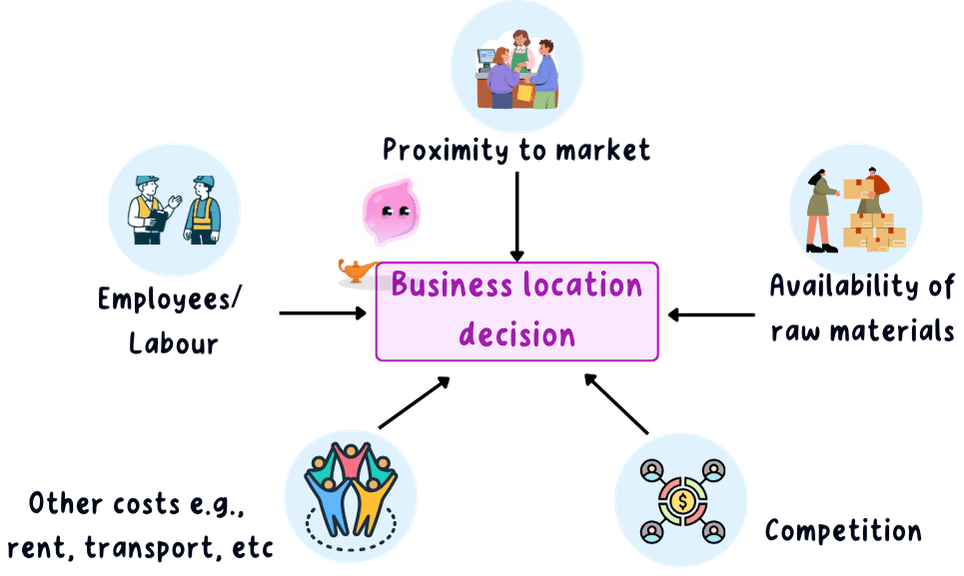
- A business can only occupy one site at a time, so four pulls compete for the decision and they rarely point to the same street.
- Proximity to the market: being near customers matters most where the customers travel to the business, such as a café, a hairdresser or a corner shop.
- Passing trade is then the main source of sales, so the same shop takes more money on a busy street than on a quiet side road without spending a penny more on advertising.
- Proximity to labour: the site has to be somewhere the right staff already live and can travel to by car or on public transport.
- This decides the choice where specific skills are needed or where wages are a large share of costs, because a firm that cannot fill its shifts locally has to raise pay to pull workers in from further away.
- Proximity to materials: being near suppliers cuts the cost and the time of bringing inputs in.
- It matters most where materials are heavy, bulky or perishable, such as a bakery in Leeds taking a daily flour delivery, since transport costs climb with every mile and fresh stock loses value in transit.
- Proximity to competitors: a business sometimes locates away from its rivals so that it does not split the same customers with them.
- Sometimes it locates deliberately near them, because a street known for restaurants or a road known for car dealerships pulls in more customers for everyone on it, and the bigger crowd outweighs having to share it.
- Greggs puts shops on high streets and in retail parks, where people are already walking past on the way to work or to the shops.
- Cheap hot food sold in high volume only works if enough people pass the door every hour.
- A quieter site would cut the rent bill, but it would cut the passing trade the whole model runs on.
Nature of the business activity: what the firm does decides which pull wins
- The nature of the business activity settles which of the four factors dominates, so there is no single best location for every firm.
- A manufacturer: weighs materials and space, so an industrial unit near a motorway junction beats a town-centre shop it could not get a lorry into.
- A retailer: weighs footfall above everything, because a shop nobody walks past takes no money however low the rent is.
- An online business: weighs delivery links and the cost of storage, and does not weigh footfall at all, since no customer ever visits the unit.
How the internet and e-commerce widen the choice of where a business can trade from is covered in the next guide, 1.4.2b.
Cost of the site: the constraint running through every factor
- Cost cuts across all four pulls, because the best located sites are the ones landlords can charge the most rent for.
- A start-up short of cash often takes a cheaper site off the main street and spends the difference on promotion instead.
- That swaps passing trade for a smaller rent bill, which the business has to cover whether it sells anything or not, so the choice only pays off if the promotion brings in customers who would otherwise have walked past a rival.
Judging which factor matters most: it depends on the type of business
- No factor wins in every case, so decide which matters most by asking who travels to whom.
- Where the customer travels to the business, as at a café or a hairdresser, proximity to the market decides it, because footfall is the only source of sales and no saving on rent replaces the customers a quiet site never delivers.
- Where the business travels or ships to the customer, proximity to the market barely counts, and cheap space near good road links counts for more.
- It also depends on the rent the firm can afford, on whether its customers come to it or it goes to them, and on how much of its selling is done online.
- Overall, proximity to the market is the deciding factor for a small retailer or service business, while for a manufacturer or an online seller the cost of space and access to materials outweigh it.
- Name the factor, say why it matters to that firm, then say what it does to the firm's sales or its costs.
- A memorised list of four factors with no ranking stays in the bottom level when the question says justify or evaluate.
- Use the detail in the source booklet, such as what the firm sells and where its customers are, to choose the factor you argue for.
- Land the judgement in comparative form: footfall matters more than rent here, because the café depends on passing trade.
- Which type of business gains most from being close to its market, and why?
- Give one reason a business might choose to locate close to its competitors.
- Which two location factors matter most to a manufacturer?
- Why does footfall not matter to an online seller?
- Name two things that decide which location factor is the most important for a firm.
1.4.2b Impact of the internet on location
E-commerce and location: the customer no longer travels to you
E-commerce: buying and selling goods and services online instead of through a physical shop.
- E-commerce weakens the pull of being near the market, because the customer now reaches the business through a website instead of walking through a door.
- A firm can sell to the whole country from an industrial estate unit at £600 a month instead of a high-street shop at £3,000, and the same budget then buys several times the floor space.
- Selling online also widens the market, because a business in a small town can reach buyers across the UK, and abroad, without opening a second site.
- Potential sales rise while premises costs stay flat, since no extra rent, business rates or shop staff are needed to serve those extra customers.
- Gymshark was founded in 2012 by Ben Francis in Birmingham, screen-printing gym clothing in a garage.
- It sold online through fitness influencers rather than from a shop, so it reached customers nationally without renting a single high-street unit.
- A market stall would have limited it to the people who walked past that stall, and the website carried no such limit.
What an online business needs from a site instead of footfall
- Location still decides an online seller's costs, but the site is judged on three things rather than on passing trade.
- Storage space: stock has to sit somewhere, and a warehouse gives far more square metres per pound of rent than a shop does.
- Road links: couriers collect every day, so a unit near a motorway junction gets parcels into the delivery network sooner and shortens the delivery time the business can promise.
- Reliable broadband: orders, payments and stock records all run through the website, so a slow or unreliable connection stops the business trading altogether.
- Being close to a delivery network now matters more than being close to shoppers, which is why warehouses sit beside motorways while shops sit in town centres.
- ASOS sells clothing online rather than through high-street shops, so it never pays for a prime retail site.
- Amazon judges a site by how quickly parcels can leave it, so a warehouse with good road access beats a unit on a busy shopping street.
- The rent saved goes into stock, packing staff and cheaper delivery, which is the part the online customer actually notices.
The internet also widens competition and adds new costs
- The internet widens your market and every rival's market at the same moment, so your local customers are now within reach of sellers based anywhere.
- A local shop no longer has a captive local market, because a customer standing in the aisle can check the same product on eBay or Etsy before deciding to buy.
- Trading online carries its own costs, since the website, the packaging, the delivery and the returns all come out of the margin the shop used to keep.
- Returns bite hardest in clothing, where one customer may order three sizes and send two back, so the business pays postage twice and earns revenue on a single item.
- The internet changes which location factors matter, not whether location matters at all.
- Rent, road links and delivery costs still shape the decision, they simply outrank footfall once the selling happens online.
- How technology affects place and the rest of the marketing mix belongs to the marketing mix guides, not to this one.
Where footfall still decides, and why many firms now do both
Click and collect: ordering online and collecting the goods from a shop or collection point instead of paying for delivery.
- E-commerce only removes the need for footfall where the product can be boxed and posted.
- A hairdresser, a dentist, a gym and a restaurant each deliver the service in person, so the customer still has to travel and passing trade still decides the site.
- Many businesses now run both channels, with a shop for browsing and trying on and a website for ordering, which is why Tesco offers click and collect.
- The store then earns its rent twice, as a place to shop and as a collection point that saves the cost of sending a courier to every door.
- Start a location answer by deciding whether the business posts a product or delivers a service in person, because that settles whether the internet helps it at all.
- Build the chain in full: selling online removes the need for footfall, so the firm takes a cheaper unit, so fixed costs fall, so it can undercut a high-street rival.
- Name the cost on the other side, since delivery, packaging and returns eat into the rent saving and a one-sided answer stalls in the middle level.
- When the question says justify or evaluate, tie the judgement to the firm in the source booklet, because a barber and an online clothing seller land on opposite answers.
- Define e-commerce.
- Give two things an online seller needs from its premises that a high-street shop does not.
- Explain one reason the internet raises competition for a small local shop.
- Name two costs a business takes on when it starts selling online.
- Why does the internet not change the location decision for a hairdresser?
1.4.3a What the marketing mix is
The marketing mix: four decisions taken as one set
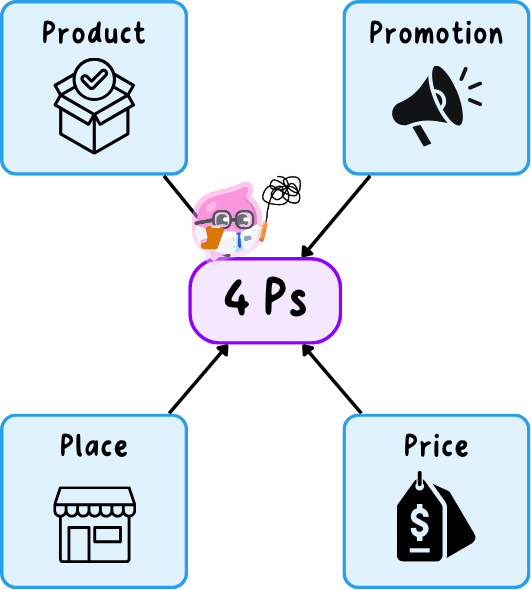
Marketing mix: the combination of product, price, promotion and place a business uses to sell a product to its chosen customers.
- The marketing mix is the set of four decisions a business makes about how it sells: what the product is, what it costs the customer, how customers hear about it and where they can buy it.
- Every business has a mix even if nobody sat down and planned one, because a market stall that sells one item at one price in one location has still made all four decisions.
- The four are chosen together rather than one at a time, since a customer sees a single offer and judges the whole of it before deciding whether to buy.
- Treat the mix as a recipe with four ingredients rather than four separate dishes.
- One ingredient badly wrong spoils the meal however good the other three are, which is why a business that fixes only its promotion often sees no rise in sales.
- Different customers want different recipes, so the same four ingredients are blended in different proportions for different target markets.
What each element decides and why it matters
- Each element answers a different question, and all four have to be answered before a product reaches a buyer.
- Product: the decision about what is actually sold, covering what it does, its quality, its features and how it looks.
- It matters most, because a product that does not meet the customer need cannot be rescued by the other three: cutting the price or advertising harder only tells more people about something they still do not want.
- The product also sets the limits for the rest of the mix, since a hard-wearing, well-designed item supports a higher price than a basic one.
- Price: the decision about what the customer is charged.
- It decides whether customers buy at all, because a shopper choosing between two similar coats normally takes the cheaper one unless something else justifies the gap.
- It also decides how much is left on each sale once costs are paid, so a price set too low can pull in customers and still leave the business losing money on every unit.
- Promotion: the decision about how customers are told the product exists and are persuaded to buy it.
- A product nobody knows about does not sell however good it is, so promotion is what turns a strong product into actual revenue.
- Promotion also signals what kind of product this is, so the message has to match the quality being offered and the price being charged.
- Place: the decision about where and how the customer can buy it, such as a shop, the firm's own website or a marketplace like Amazon or Etsy.
- A customer who cannot buy it conveniently buys something else instead, so awkward availability hands the sale to a rival that is easier to reach.
- Place has to suit the customer being targeted, since a shopper on a lunch break wants somewhere they already walk past while a gift buyer may want to see the item before paying.
- Greggs sells cheap hot food, a product built for a fast, low-cost lunch.
- Prices are low and the shops sit on high streets and retail parks where people already pass by, so the price and the place both suit a lunchtime customer in a hurry.
- The vegan sausage roll it launched fits the same mix: a cheap hot item, in the same shops, aimed at the same customer with one more need met.
- All four elements point at one group of buyers, which is what makes the mix work rather than any single clever decision.
Why all four have to point the same way
- Every element sends a signal about who the product is for, so the mix only works when the four signals agree.
- Dyson sells bagless vacuum cleaners on design and engineering at a premium price, so its promotion talks about the technology inside the machine rather than about a bargain.
- Selling the same machine cheaply from a market stall would undercut that message, because customers would read the low price and the makeshift place as evidence of low quality and stop believing the premium claim.
- The reasoning runs in a chain: a strong product justifies a high price, a high price needs promotion that signals quality, and that promotion needs a place that matches, which means one element out of line weakens the other three and the business loses sales it had already paid to win.
- How a business then balances the mix against its competitors and changing customer needs is covered in the next guide.
- Name all four elements exactly as product, price, promotion and place, because a mix answer that misses one drops the knowledge mark straight away.
- For each element, say what it decides and then what that does to sales, costs or the firm's image, since the mark sits in the effect and not in the label.
- On a question asking which element matters most, argue it through the others: promotion cannot fix a product customers do not want, so product usually comes first.
- Keep pricing strategies, promotion methods and distribution channels out of a Theme 1 answer, because those belong to the Theme 2 questions on making marketing decisions.
- What is the marketing mix?
- Name the four elements of the marketing mix.
- Why can strong promotion not rescue a product that customers do not want?
- Which element decides how much is left on each sale after costs are paid?
- Give one reason a premium product should not be sold cheaply from a market stall.
1.4.3b Balancing the marketing mix
How the four elements work together: move one and the rest must follow
- Raising the price is never a single decision, because the product, the promotion and the place all have to justify the higher figure or sales fall.
- Product: the ingredients, materials or service have to improve visibly, so the customer can see what the extra money is buying.
- Promotion: the message has to move from cheapness to quality, otherwise the business is still advertising itself as the budget option at a premium price.
- Place: selling through a discount shelf contradicts the new price, so the product moves to outlets that match it.
- If any one of those three stays as it was, the customer sees an unchanged product costing more, buys from a rival instead, and revenue falls even though every sale now earns more.
- Moving from a rented shop to selling online is a place decision, and it drags the other three with it.
- Promotion has to buy attention through search results and social media, because there are no passing shoppers to see a window display.
- Price can come down, since the business no longer pays shop rent of perhaps £1,500 a month, which lets it undercut high-street rivals and still cover its costs.
- Gymshark was founded in 2012 by Ben Francis in Birmingham, screen-printing gym clothing in a garage.
- With no shop, place was online from the start, so promotion had to run through fitness influencers rather than a high-street location.
- Paying no shop rent kept costs down, which is what made competitive prices on a made-at-home product possible.
- Each element was chosen to fit the others, not settled on its own.
Balancing the mix against the competitive environment
Competitive environment: the number and strength of the rival businesses selling to the same customers, and the ways those rivals choose to compete.
- Where many rivals sell something similar, such as takeaway pizza in one town centre, a price cut is copied within days, so the discount buys no lasting advantage and only shrinks the profit on every sale.
- Weight therefore shifts onto what a rival cannot copy overnight: a product feature, a name customers recognise from years of promotion, or a place more convenient than theirs.
- A business with no close rival, such as the only garage in a village, has more freedom on price, because a customer who objects to it faces a long drive to the alternative.
- When a rival moves, rebalance rather than mirror: Tesco and Sainsbury's answer Aldi and Lidl through a wider range and click and collect, instead of trying to beat a narrow-range discounter on price alone.
The impact of changing consumer needs on the mix
- What customers want does not stand still, and three shifts in particular pull the mix in a new direction.
- Convenience: shoppers who expect to order from a phone push a business into online ordering and delivery, a place decision that then needs promotion on the apps and sites those customers already use.
- Tighter household budgets: when incomes are squeezed, demand moves to smaller pack sizes and budget ranges, which are product and price decisions taken together rather than separately.
- Environmental concern: customers wanting less plastic force a change in packaging, and that change only pays for itself if promotion tells them it has happened.
- The Greggs vegan sausage roll shows the full chain: a product change answering a shift in diet, backed by heavy promotion, sold at the same low price through the same high-street shops.
Judging which element matters most for a small business with a limited budget
- With only a few thousand pounds to spend, a small business cannot strengthen all four at once, and the usual answer is product, because it is the only element the customer still has after the sale and it earns repeat custom that costs nothing to run.
- Against that, a product nobody has heard of sells nothing, which is why a market-stall trader with £500 normally gains more from promotion and a busy pitch than from a better recipe.
- Which element wins depends on four things: the market it competes in, what its own customers actually value, what its rivals are already strong at, and how much money it has to spend.
- On balance, the element worth backing is the one rivals are weakest at, because money spent matching a strength the market already offers changes nothing a customer would notice, and a firm on a tight budget cannot afford an unnoticed change.
- Name the element you would change first, then show in one sentence what it forces the business to change next.
- Answers stall at Level 1 by listing all four elements, so pick one and carry the chain through to sales, costs or profit.
- Use the competitive environment given in the source booklet, because how many rivals there are and how they compete decides which element is worth funding.
- When the question says justify or evaluate, finish by saying which element matters most for that business and why, since the judgement mark sits there.
- If a business raises its price, which other two elements must change, and why?
- Define the competitive environment.
- Why does cutting price rarely give lasting advantage in a market with many similar rivals?
- Name one changing consumer need and the element it changes first.
- Give two things that decide which element a small business should spend on.
1.4.3c Impact of technology on the marketing mix
E-commerce: the website takes over the job of the shop
E-commerce: buying and selling goods and services online instead of in a physical shop.
- Selling online moves all four elements of the mix, and it moves place furthest of all.
- Place: the market becomes national rather than local, and there is no rent on a high street unit, so a business can trade from cheap warehouse space and still take orders from Cornwall to Aberdeen.
- Price: a shopper compares the same item across a dozen sellers in seconds, which drags prices towards the cheapest and squeezes the profit made on each sale.
- Product: the range on offer can be far wider than a shop could hold, because stock sits on racking in a warehouse rather than on shelves a customer walks past.
- Promotion: the sale can be closed at the moment the advert is seen, because a link takes the customer straight to the checkout instead of asking them to travel into town.
- That price squeeze is survivable because a website costs less to run than a shop with rent, staff and lighting, so the business can accept a lower price and still cover its costs.
- ASOS sells clothing online rather than through high street shops, so its place decision is a website and a delivery service.
- Etsy gives a one-person craft business the same national reach without it having to build a website of its own.
- In both cases the seller trades rent for postage, and the customer gains a choice that no local shop could stock.
Digital communication: promotion is where the change lands hardest
Digital communication: reaching customers through email, social media, websites, apps and messaging rather than through print, post or television.
- Digital communication reaches every element as well, and here it is promotion that changes furthest.
- Promotion: one post or email reaches thousands of people for a fraction of the cost of a newspaper advert, and it can be aimed at the people most likely to buy rather than at everyone.
- Product: reviews and comments arrive within days and in volume, so a fault or a missing feature can be put right in the next batch instead of after a year of falling sales.
- Price: a discount code can be sent to a chosen group at a chosen time, such as a midweek offer to bring in customers on the quietest days, without cutting the price for everybody.
- Place: click and collect and delivery tracking tie the online and physical sides together, so a customer orders on a phone and picks the order up in person.
- Digital promotion is also measurable, since the business can see which post produced sales that day and move the money to whatever is working.
- Gymshark started with screen-printing in a Birmingham garage and grew by selling online through fitness influencers.
- The influencer post is promotion and the website is place, so one decision carried two elements of the mix at once.
- Tesco click and collect runs the other way round, using shops it already owns as collection points for orders placed online.
What technology costs the business in return
- Technology moves the mix, but it does not move it for free, and five things come back the other way.
- Set-up and running costs: the website has to be built, hosted and kept secure, and every order carries picking, packing, postage and the cost of taking returns back.
- Wider competition: once the market is national the business no longer competes with two local shops but with every seller a search engine lists, including Amazon and eBay.
- Complaints in public: a poor review sits under the product for every future buyer to read and spreads within hours, where an unhappy shopper in a shop once told only a few friends.
- Keeping up to date: a site that loads slowly or an app that crashes loses the sale to a rival, so the spending on technology never finishes.
- Not every product suits it: a customer buying boots or a sofa still wants to try them, so for those firms the website supports the shop rather than replacing it.
- Name the technology, name the element of the mix it changes, then say what happens to the firm's sales or its costs.
- "They could use social media" scores nothing alone, so carry it through: the post reaches the target market cheaply, so more people see the product, so sales rise without a large advertising budget.
- If the question says marketing mix, write about more than promotion, because place, price and product all move too.
- Use the business in the source booklet, since the application marks are tied to that context and not to a memorised example.
- Define e-commerce.
- Which element of the mix does e-commerce change the most, and why?
- Give two ways digital communication changes promotion.
- Why can selling online push a business's prices down?
- Name two costs or risks a business takes on when it starts selling online.
1.4.4a The role and importance of a business plan
What a business plan is, and what writing one does to your thinking
Business plan: a written document setting out what a business will do and how it will do it, prepared before trading starts.
Forecast: an estimate of a future figure, such as sales or cash, made before the event rather than recorded after it.
- A business plan is written in advance, so every figure in it is a prediction about a business that does not yet trade.
- Writing the plan changes how the owner thinks, because it turns loose guesses into figures that have to sit next to each other on the same page.
- A plan that will not add up on paper is unlikely to work in practice, and discovering that costs a few evenings rather than the owner's savings, a signed lease and a year of work.
- The plan also forces the owner to answer questions in an order that exposes gaps, since a price cannot be set until the target market is known and finance cannot be arranged until the costs are estimated.
- An owner planning a coffee stall starts with "I will sell a lot of coffee at the market", which no plan will accept.
- The plan makes that a price of £2.50 a cup and a number of cups a day, so 80 cups over four days becomes £800 of forecast weekly revenue.
- That sits against £250 stall rent plus the cost of beans, cups and wages, and the gap between the two is the owner's income.
- If honest research points to 40 cups a day instead, the figures stop working, and the owner learns it before paying the first month's rent.
The plan identifies multiple things
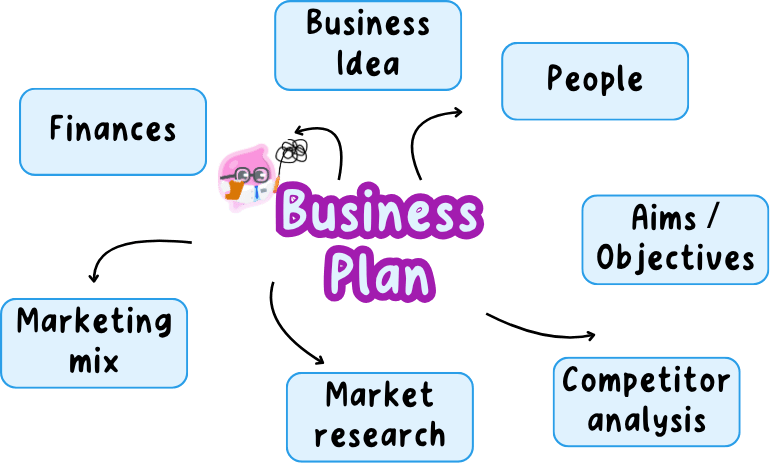
- Edexcel names eight things a business plan identifies, and each one exists to answer a question the reader would otherwise have to ask.
- The business idea: what the business will sell and how it differs from what is already available, answering why a customer would buy this rather than the thing that exists.
- Business aims and objectives: the targets the owner is working towards, such as survival through year one or a set level of sales, answering what would count as this business succeeding.
- Target market and market research: who the customers are and the survey, sales data or competitor evidence behind that claim, answering whether the demand is real or only hoped for.
- Forecast revenue, cost and profit: the sales income expected, the cost of earning it and what is left over, answering whether the idea makes money at the price the owner has chosen.
- Cash-flow forecast: the month-by-month timing of money coming in and going out, answering whether there will be enough in the bank account in month three to pay the bills.
- Sources of finance: how much start-up money is needed and where each pound comes from, answering how much of the risk the owner is carrying personally and how much a lender is being asked to carry.
- Location: where the business will trade, such as a high-street unit, a market stall or online only, answering whether customers can reach it at a rent the forecast can absorb.
- The marketing mix: the planned product, price, place and promotion decisions, answering how customers will hear about the business and be persuaded to buy.
- Each of these eight has its own guide elsewhere in Theme 1, where the detail and any calculations belong.
- Here you need only what each section contains and why it earns its place in the document.
Who reads the plan: the owner and the lender
- The plan has two readers, and the same document does a different job for each.
- The owner uses it to run the business and to check it, by setting each month's actual sales and costs against the forecast and acting on any gap.
- A bank or investor uses it to decide whether to lend, reading the cash-flow forecast and the sources of finance sections hardest because those show whether repayments can be met.
- A lender is risking its own money, so weak evidence means either no loan or a loan at a higher interest rate, which raises the costs the forecast then has to cover.
- Two purposes follow from all of this: a plan helps the owner minimise risk and helps the business obtain finance.
- Both are developed in the next guide, 1.4.4b.
A plan is a living document, not a one-off
- Because every figure in the plan is a forecast, real trading almost always produces different numbers, and the plan is revised to match them rather than filed away.
- Gymshark started in 2012 with Ben Francis screen-printing gym clothing in a garage in Birmingham and selling online through fitness influencers, and a plan written on that basis would need rewriting many times as the location, the costs and the customer base changed.
- Edexcel does not ask you to draw up a full business plan, so no marks come from reciting a template; they come from what a section contains and why its reader wants it.
- Answer in three parts: name the section, say in a phrase what is in it, then say what it tells the reader, such as the cash-flow forecast showing the timing of money in and out so the bank can see whether month three is affordable.
- Use the word forecast for every figure in a plan, because writing that the plan shows the profit the business made turns an estimate into a record and loses the mark.
- Where a question names a firm, choose the sections that matter to that firm, such as location for a shop and the marketing mix for an online seller.
- What is a business plan, and at what point is it written?
- Which section gives a reader evidence that demand for the idea actually exists?
- Give one question the cash-flow forecast answers that the forecast of profit does not.
- Name the two readers of a business plan and say what each uses it for.
- Why is a business plan revised rather than written once and kept?
1.4.4b The purpose of planning business activity
Minimising risk: testing the idea on paper before the money is spent
Risk: the chance that a business decision loses money, for example that sales come in far below the level the owner expected.
- Planning cuts risk because the idea is tested on paper first, where a wrong assumption costs nothing to correct, and four parts of the plan do that work.
- Revenue and cost forecasts: setting expected sales against expected fixed and variable costs shows whether the idea can make a profit at all, before a single pound goes on stock.
- The cash-flow forecast: it shows the month the balance turns negative, so an overdraft can be arranged in advance instead of in a panic during the week the rent is due.
- Market research inside the plan: asking 200 people in the area whether they would buy tests that customers exist, which cuts the chance of filling a shop with stock nobody wants.
- Objectives with figures and dates: a target of £4,000 of sales a month gives something to measure actual takings against, so a shortfall shows up in month two while it is still fixable.
- A bakery in Leeds whose plan shows January takings falling to £2,100 against rent of £900 a month knows in October that an overdraft will be needed, and a lender approached calmly in October is far more likely to agree than one approached in January.
- Planning reduces risk, it does not remove it.
- Every figure in a plan is a forecast, and a forecast is a considered guess about a market that has not happened yet.
- What changes is that the owner is surprised by fewer things, and has already decided what to do when a surprise comes.
Obtaining finance: the plan is the evidence a lender asks for
- A bank or an investor parts with money only if it believes the money is coming back, and the business plan is the evidence behind that belief.
- A lender reads the plan for three things.
- How much is needed and what for: £15,000 for a second-hand oven, a shop refit and three months of stock can be checked, while £15,000 to get started cannot.
- When it can be repaid: the cash-flow forecast shows the monthly surplus the repayments would come out of, so the lender can judge whether £400 a month is realistic.
- Whether the owner understands the market: the research and competitor sections show whether they know who buys, at what price and against whom, which decides whether they are trusted with the money.
- Without a plan a lender has only an idea and a request for money, so most will refuse, and that falls hardest on a start-up because it has no trading record to offer instead.
- Levi Roots took Reggae Reggae Sauce to Dragons' Den in 2007 and left with £50,000 of investment.
- The sauce was then stocked by Sainsbury's.
- An investor is buying a share of future profits, so what has to convince is the route to those profits, and that route is what a plan sets out.
Judging how much a business plan is really worth
- A plan can reduce risk and help a start-up obtain finance, but its forecasts may be wrong or over-optimistic because they are based on estimates rather than actual trading results.
- Its value therefore depends on honest assumptions and regular updates as real sales, costs and market changes replace the original forecasts.
- Overall, a current plan is useful evidence for decisions and finance, while following an outdated plan rigidly can make the business keep spending on assumptions it already knows are wrong.
- Keep the two purposes separate: minimising risk and obtaining finance.
- For risk, show how a forecast lets the owner spot a problem and act before it happens; for finance, explain what evidence reassures the lender or investor.
- For a judgement, consider how reliable and up to date the forecasts are rather than treating the plan as automatically accurate.
- Name the two purposes of a business plan in this specification.
- How does a cash-flow forecast inside a plan reduce risk?
- What does a lender want the plan to prove before agreeing to a loan?
- Why does planning reduce risk rather than remove it?
- Give one reason a plan can mislead the owner who wrote it.
