2.3.1a The purpose of business operations
Business operations: turning inputs into the thing the customer pays for
Business operations: everything a business does to turn its inputs into the goods or services it sells, and to get them to the customer.
- Operations is the doing part of a business, and every operation has the same three stages whatever is being sold.
- Inputs: the raw materials, staff time, machinery, energy and premises the business puts in.
- What the business does to them: the baking, assembling, cutting, cooking or advising that changes those inputs into something usable.
- Outputs: the finished good or the completed service the customer receives and pays for.
- Greggs turns flour, fat, meat and bakers' time into hot food sold from shops on high streets and retail parks.
- The baking and the hot counter are what a customer will hand over money for, when a sack of flour is not.
- Greggs sells at low prices in high volume, so its operations have to hold the cost of making each item down or that price stops working.
The two purposes Edexcel names: to produce goods and to provide services
- To produce goods means making a physical product to the right specification, in the right quantity and on time, and each of those three fails in its own way.
- Wrong specification: the item does not do what was promised, so it comes back as a return and the business pays for the materials and labour twice.
- Wrong quantity: make too few and customers are turned away, make too many and cash sits in stock that may never sell.
- Late: the customer buys from a rival who had it ready, so the sale is lost and the marketing spent winning that customer is wasted.
- To provide services means delivering the service consistently every time, because a service is produced and consumed at the same moment.
- A service cannot be stored in a warehouse or inspected before the customer gets it the way a good can, so the checking has to be built into staff training and the process itself instead of happening at the end.
- Do not write as though operations only happens in factories, because a gym, a bank and a barber all run an operations function.
- A poor haircut has already been delivered by the time the customer notices, so it cannot be pulled off the shelf and replaced.
- That is why a service failure usually costs a refund plus a customer who never books again, while a faulty good can at least be swapped.
Quality and cost: doing it right, and doing it cheaply enough to make money
- Managing quality is a purpose of operations because the product has to do what the customer expected it to do when they paid.
- Poor quality costs the business twice over, since it refunds revenue it had already counted and then pays again for the materials and labour of a replacement.
- Being efficient means getting the same output from fewer inputs, which pulls down the cost of producing each unit.
- Quality control and quality assurance, the two systems used to manage quality, are covered in the guide on managing quality.
- How much stock to hold, and how suppliers are chosen, are covered in the guide on working with suppliers.
Why operations decides the price you can charge and whether customers come back
The same purposes are met in completely different ways depending on what is being sold.
| Local bakery | Car factory | Hairdresser | |
|---|---|---|---|
| Output | Goods, made fresh daily | Goods, made in huge volume | A service, nothing to store |
| Main inputs | Flour, ovens, bakers | Steel, robots, assembly staff | Stylist time, scissors, a chair |
| Operations priority | Freshness and daily timing | Low cost per car | The same result every visit |
| Cost of getting it wrong | Unsold stock thrown away | The whole line stops | The customer never returns |
- The priority row is the one that moves, so there is no single best way to organise operations, only the way that fits the product, and an exam answer has to fit the business in front of it.
- Operations set the cost of producing each unit, which sets the lowest price the business can charge and still make money, which in turn decides how it competes.
- Aldi and Lidl carry a narrower range so each line is bought and handled in bulk and sold cheaply, while Dyson spends heavily on engineering and charges a premium for the result.
- Operations also decide whether the order arrives when it was promised, which decides whether the customer comes back, and repeat customers cost far less to serve than the new ones marketing has to buy.
- Name the actual inputs and outputs of the business in the source booklet, because application marks are gated on that context rather than on "raw materials" in general.
- Say whether the business sells a good or a service before you write about quality, since a service cannot be checked before the customer receives it.
- When the command word is explain or analyse, carry the chain through: the operations problem, the effect on cost or on the customer, then the effect on profit.
- The link most often dropped is the last one, where an answer names a late delivery but never says the sale went to a rival.
- What are business operations?
- Name the three stages every operation has, and give one input and one output for a pizza takeaway.
- Give two ways producing goods can go wrong, and the consequence of each.
- Why can a service not be checked for quality before the customer receives it?
- Explain how the cost of producing each unit affects the price a business can charge.
2.3.1b Production processes
Job, batch and flow: three ways of organising production
Job production: making one item at a time, built to that customer's own requirements.
Batch production: making identical items in groups, with the machinery reset between one group and the next.
Flow production: making identical items continuously on a production line.
- Which process fits depends on how many identical units the business needs and how far one order differs from the next.
- Job: one worker or team sees the product through from start to finish, so it suits one-off orders such as a made-to-measure suit, a hand-painted shop sign or a wedding cake.
- Batch: work moves through the workshop in groups, and the equipment is cleaned and reset before the next group starts, which suits a bakery in Leeds alternating between white loaves, wholemeal and rolls through the day.
- Flow: the product moves along a line while each stage adds one operation, which suits Greggs supplying cheap hot food to high streets and retail parks in the volumes its low prices depend on.
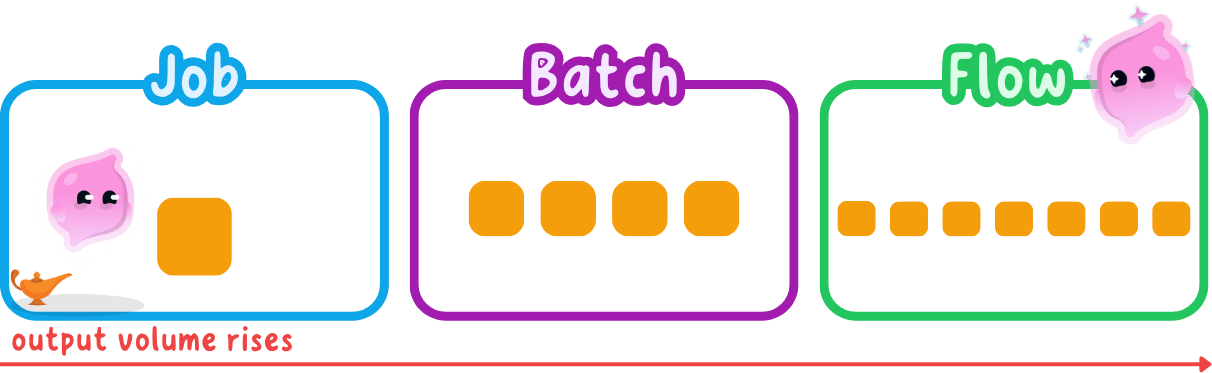
- Cost per unit falls across the table because the set-up cost, the machine time and the supervision are spread over far more units, and materials can be bought in bulk at a lower price.
- Matching the process to the level of demand is what keeps productivity up, because neither workers nor machines sit idle waiting for the next order, and the lower unit cost that follows lets the business either undercut rivals on price or keep the difference as profit.
| Job | Batch | Flow | |
|---|---|---|---|
| Output volume | One unit per order | Tens or hundreds per run | Thousands, continuously |
| Customisation | Made to customer's design | Fixed per batch, varies | None, fully standardised |
| Cost per unit | Highest | Lower than job | Lowest |
| Flexibility | Very high | Moderate | Very low |
Advantages: what each process gives the business
- Job production delivers exactly what was ordered and lets quality be checked on the single item in front of you, so the business can charge a premium price for work a mass producer cannot match.
- Batch production keeps some variety on offer while cutting cost per unit below job production, because materials are bought in bulk and each machine is used far more fully across the day.
- Flow production gives the lowest cost per unit and very high output, since the line can run around the clock and machinery does work that would otherwise need paid labour.
Drawbacks: what each process costs the business
- Job production is slow and labour-intensive and depends on skilled workers who are scarce and expensive to hire, so cost per unit is the highest of the three and a large order takes weeks.
- Batch production loses time and money at every changeover while machines are cleaned and reset, and part-finished goods build up as stock that ties up cash and needs storing.
- Flow production is very expensive to set up and inflexible once built, so changing the product means costly retooling, and a single breakdown stops the entire line rather than one workstation.
- Repetitive work on a line can demotivate staff, which raises absence and labour turnover, so the business carries the cost of recruiting and training replacements.
- How automation and computer-aided design change what each process can do belongs to the next guide, on the impact of technology on production.
- Here, treat the process itself as your answer and technology as a separate factor.
Judging which process a business should use
- There is no best process, only the one that fits four features of the business and its market.
- The size and predictability of demand: flow only repays its set-up cost when orders are large and steady, while demand that arrives in bursts leaves an expensive line standing still.
- Whether customers want something individual: a buyer commissioning a one-off will not accept standard output, so job or batch is the only way to keep that customer.
- How much capital the business has: a start-up with a few thousand pounds of savings cannot buy a production line, so its real choice is between job and batch.
- The price the market will pay: a premium price covers the high unit cost of job production, but a market where shoppers compare prices on every purchase pushes the business towards flow.
- Read down the table again and the trade-off is the whole judgement: cost per unit falls as you move from job to flow, but flexibility falls with it, so a business is really choosing between being cheap and being adaptable.
- For most small UK firms serving varied local demand, batch production is the stronger choice, because it captures part of the cost saving without locking the owner into one standard product that may not sell, whereas a business with proven national demand and the capital to invest should take the flow route and compete on price.
- When the question says explain, name the process and carry the chain through to cost per unit, output or the customer, because a bare name earns nothing.
- Use the product and the level of demand described in the source booklet rather than a car plant you have memorised, since application marks are gated on that context.
- When the question says justify or evaluate, weigh cost per unit against flexibility and then commit to one process.
- The point most often dropped is the decision itself, because the answer describes all three processes and never says which one this business should use.
- Define batch production.
- Which process has the highest cost per unit, and why?
- Give one drawback of flow production other than its set-up cost.
- Why does a bakery lose time when it switches from white loaves to wholemeal?
- Name two things that decide which production process a business should choose.
2.3.1c Impacts of technology on production
The technologies that change how a product is made
Automation: using machines to carry out a task with little or no human input.
Productivity: the output produced from each unit of input, such as the number of units made per worker per hour.
- Automation and robotics on the line: programmable machines do the repetitive jobs of welding, filling, sealing and stacking, with a few staff supervising rather than operating them.
- Computer-aided design (CAD): the product is drawn and tested on screen, so a change to a shape or a measurement is tried on the computer before anything is cut.
- Dyson built over 5,000 prototypes of the bagless vacuum, and every physical prototype costs materials and weeks of time, which is exactly what testing a design on screen removes.
- Computer-aided manufacture (CAM): the finished CAD file drives the cutting or moulding machine directly, so the design reaches the factory floor without being redrawn or measured out by hand.
- Automatic stock control: barcodes and till systems record every item sold or used and place a reorder with the supplier once the level drops to a set point, so nobody counts the shelves.
- How job, batch and flow production differ is covered in the guide on production processes.
- Stock control in depth, including JIT and JIC, belongs to the guide on working with suppliers.
Productivity and quality: more units per hour, and the fault that repeats
- A machine works faster than a person, carries on through breaks and can run overnight, so more units come off the line every hour.
- The rent, the supervisors and the machines themselves now cover a much larger output, so the cost of producing each unit falls and the business can either cut its price or keep the price and earn more on each sale.
- A machine repeats the same movement to the same measurement every time, so fewer units come out faulty, fewer are sent back by customers and less material is thrown away.
- Consistency cuts both ways, because an error in the programme or a worn cutting tool is repeated identically on every unit, so a whole batch can be wrong before anyone inspects it.
- Greggs sells cheap hot food in high volume on high streets and retail parks, so each sausage roll has to be made for pennies.
- A business in that position needs the same item produced the same way thousands of times a day, which machinery delivers and hand-finishing cannot.
- The trade-off is that a change to the recipe or the pack size has to be programmed into the equipment rather than simply explained to a baker.
Cost, flexibility and staff: what the business gives up
Compare hand-finishing with an automated line at a bakery in Leeds turning out the same loaf.
| Hand-finishing | Automated line | |
|---|---|---|
| Loaves per hour | 400 | 1,200 |
| Weekly wage bill (£) | 1,800 | 600 |
| Cost to buy and install (£) | 0 | 90,000 |
| Changing to a new product | Same morning | Reprogramming, output lost |
- Fewer staff are needed for the repetitive work, so the weekly wage bill falls by two thirds, but the £90,000 is paid up front and the maintenance contract is paid every year afterwards.
- That is why the saving only shows as profit after many months of full production, and why a business short of cash may not survive the wait.
- The last row is the flexibility cost: a line set up for one loaf is slow and expensive to switch, so a bakery selling thirty different products gains far less than one selling the same loaf all day.
- Some jobs disappear and the ones that remain change, so staff must be retrained to supervise, load and maintain machines instead of making the product by hand.
- Workers who fear redundancy work less willingly, so morale and output can fall during the very months the business needs the change to succeed, and if experienced staff leave the firm loses knowledge of the product that the machine does not hold.
- Never write that technology always cuts costs, because the purchase, the installation and the training are paid before a single saving arrives.
- Never write that it always raises quality either, since a badly programmed machine produces a badly made product perfectly, thousands of times over.
- Remember too that one breakdown halts the whole line, where a team of people keeps working when one member is off sick.
The trade-off underneath all of it: fixed costs replace variable costs
- Wages rise and fall with the number of units made, so labour is largely a variable cost, while a machine has to be paid for whether the line runs flat out or stands idle, so it behaves as a fixed cost.
- Swapping one for the other means the cost per unit drops sharply as output climbs, but rises just as sharply in a quiet month, so the business carries more risk when demand falls.
- The test is therefore volume: a large manufacturer running one product all day spreads the fixed cost across enough units to justify the machine, while a small workshop making one-off pieces cannot keep it busy, so people stay the cheaper choice.
- Name the technology, such as robotics on the line, CAD or automatic reordering, rather than writing the word technology on its own.
- Run the chain through to money: automation, so more units per hour, so the fixed costs are spread thinner, so unit cost falls, so the firm can undercut a rival.
- The link most often dropped is the second side, so say what the technology costs in cash, in flexibility or in staff, not only what it gains.
- When the question says discuss, justify or evaluate, decide using the firm's output and its cash position, because a fixed cost only pays back at volume.
- Define automation.
- How does computer-aided manufacture differ from computer-aided design?
- Give one way automation improves quality and one way it makes a quality problem worse.
- Why does buying machinery turn a variable cost into a fixed cost?
- Why does a small workshop making one-off items usually stay people-led?
2.3.2a Managing stock: bar gate stock graphs
Bar gate stock graphs: the saw-tooth line you need to picture
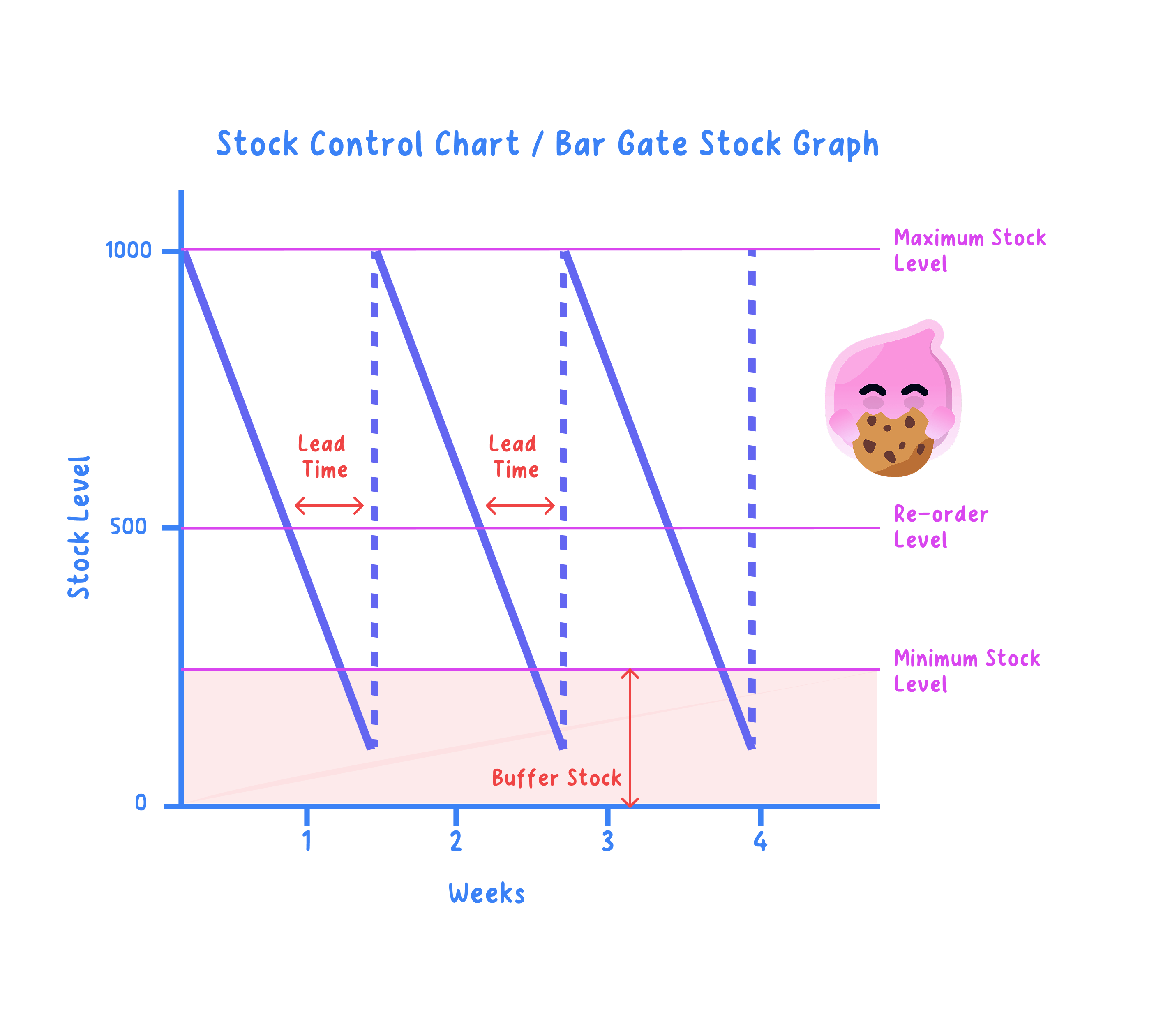
Bar gate stock graph: a chart showing how the level of stock a business holds falls as it is used and rises again as deliveries arrive.
Stock-out: running out of an item completely, so nothing can be sold or made until the next delivery lands.
- The horizontal axis is time, usually in days or weeks, read from left to right.
- The vertical axis is the level of stock held in units, so a point high up the graph means a full store room and a point near the bottom means nearly empty shelves.
- The line falls steadily as stock is sold to customers or used in production, and the steeper that slope, the faster the business is getting through its stock.
- When a delivery arrives the line jumps vertically upwards, because the whole order lands at once rather than trickling in over several days.
- Repeating that steady fall and sudden jump gives the graph its saw-tooth shape, and each tooth is one complete order cycle.
The five labels on the graph
- Five horizontal lines and measurements are marked on the graph, and an interpretation question expects you to name each one correctly.
- Maximum stock level: the most the business is willing or able to hold, set by the storage space it has and the cash it can afford to tie up.
- Re-order level: the stock level at which a new order is placed, which is never zero because the delivery takes time to arrive.
- Minimum stock level, or buffer stock: the reserve held to cover unexpectedly high demand or a delivery that turns up late.
- Lead time: the gap between placing the order and the delivery arriving, read along the graph as a horizontal distance.
- Re-order quantity: how much is ordered each time, which is the size of the vertical jump back up the graph.
- The steeper the usage line or the longer the lead time, the higher the re-order level must be set, because more stock is used up before the delivery lands.
A business can instead run with almost no buffer stock and order only as it needs, which is just in time, covered in the next guide.
Following one full cycle: a worked example
A shop holds a maximum stock level of 1,000 units and sells 200 units a week, with a buffer stock of 200 units, a lead time of 1 week and a re-order level of 400 units.
| Point in the cycle | Stock (units) | What the graph shows |
|---|---|---|
| Start of week 1 | 1,000 | Maximum stock level |
| End of week 3 | 400 | Re-order level, order placed |
| End of week 4 | 200 | Buffer stock, delivery arrives |
| Immediately after delivery | 1,000 | Vertical jump back to maximum |
- The order goes in at 400 units and another 200 units sell during the one-week lead time, so 400−200=200400 - 200 = 200400−200=200 units are still on the shelf when the delivery arrives.
- The delivery of 800 units lands on top of that buffer, so 200+800=1,000200 + 800 = 1{,}000200+800=1,000 units restores the maximum stock level.
- Those 800 units are the re-order quantity and the height of the vertical jump, and because the shop is back where it started the whole tooth repeats every four weeks.
Interpreting the graph: what it tells the business
- A buffer the line never touches means the business is holding more stock than it needs, so cash sits on the shelf as boxes instead of paying suppliers or wages.
- A line that reaches zero is a stock-out, so sales are lost that day and a customer who finds the shelf empty buys from a rival and may not come back.
- A longer lead time forces the re-order level higher, and a business like Greggs, selling cheap hot food in high volume, has such a steep usage line that it must reorder while plenty is still in the shop.
- Ordering more each time means fewer deliveries and lower delivery costs, but taller teeth on the graph mean more cash tied up in stock and more storage space needed.
- Read every value straight off the axes before you write anything, because a misread level makes the rest of the answer wrong.
- Find the lead time by measuring the horizontal gap between the re-order level being reached and the line jumping upwards.
- Use the exact terms maximum stock level, re-order level, buffer stock, lead time and re-order quantity rather than vague words like low point.
- When the question says interpret or explain, never leave a figure bare: say what it means for the shop, such as lost sales or cash tied up.
- What does each axis of a bar gate stock graph measure?
- Why is the re-order level set above zero?
- A shop reorders at 400 units, sells 200 units a week and waits 1 week for delivery, so how much stock is left when the delivery arrives?
- What does the size of the vertical jump tell you?
- Give one drawback of ordering a larger quantity less often.
2.3.2b Managing stock: just in time (JIT)
Just in time: stock arrives as it is needed, not before
Just in time (JIT): a stock system in which materials or goods arrive from the supplier at the moment they are needed for production or sale, so almost no stock is held.
Buffer stock: a deliberate cushion of extra stock held back just in case a delivery is late or demand rises without warning.
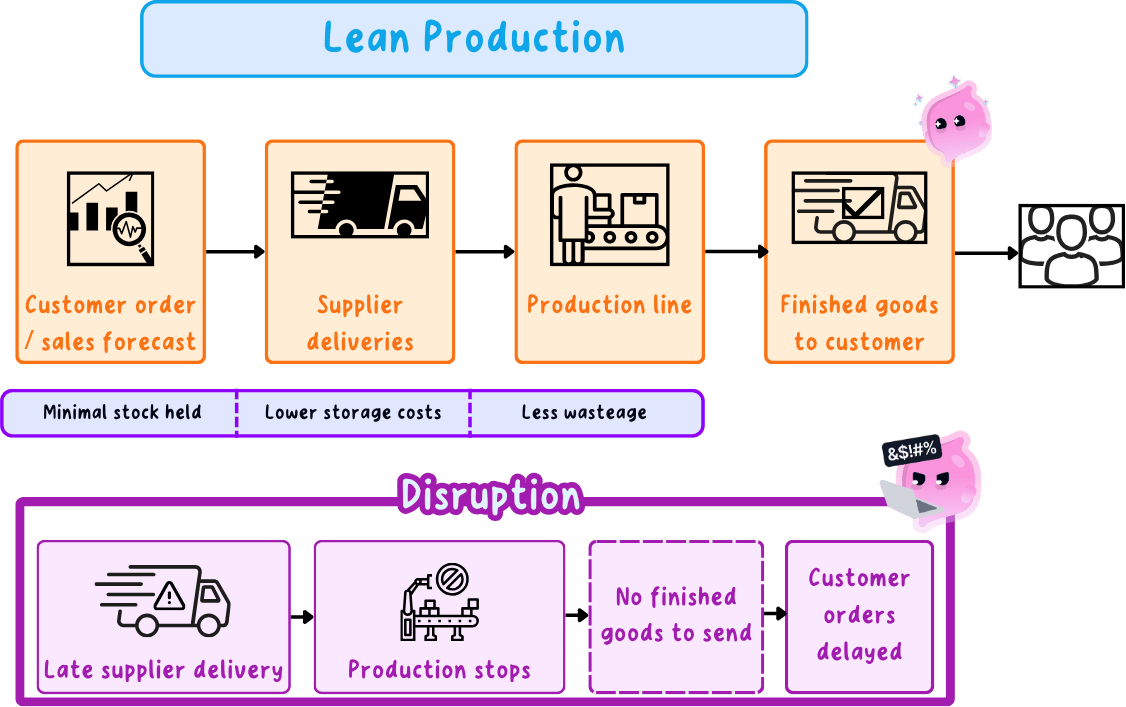
- Just in time: the business orders so that a delivery lands as the last one is being used up, which leaves the storeroom close to empty by design rather than by accident.
- Deliveries are small and frequent and timed against expected trade, so a sandwich shop takes bread each morning for that day rather than a week of loaves on a Monday.
- The alternative is to hold buffer stock, and the two systems pull in opposite directions across four things a business cares about.
| Just in time | Buffer stock (just in case) | |
|---|---|---|
| Cash tied up in stock | Very little | Large amount |
| Storage cost | Low | High |
| Risk of a stock-out | High | Low |
| Meeting a demand surge | Poor | Good |
Advantages of JIT: cash released, costs cut, waste avoided
- Cash released: stock is money standing still, so holding two days of it instead of a month frees cash for a delivery van, a marketing push or paying suppliers on time.
- Lower storage costs: less stock needs less space, so the business rents a smaller unit and pays less for heating, insurance, security and the staff time spent moving pallets.
- Less waste: fresh food, newspapers and anything with a use-by date lose their value on a fixed clock, so stock that arrives on the day it sells never has to be thrown away.
- Less risk of being stuck with it: tastes, technology and seasonal lines move on, so a business holding little stock is not forced to discount a stockroom of goods nobody now wants.
- Greggs sells cheap hot food in high volume, and a sausage roll that does not sell today cannot be sold tomorrow.
- Ordering close to the trade a shop expects that day keeps waste down, which protects the thin profit on a product sold at a low price.
- The pull runs the other way for a builders' merchant in Hull, where cement and timber do not spoil and running out costs a customer a whole day on site.
Drawbacks of JIT, and what it needs to work
- Taking away the buffer takes away the safety net, and that creates four problems.
- No cover for a late delivery: one lorry stuck on the motorway or one fault on a supplier's line stops production or empties the shelf the same day, because there is nothing behind it.
- Total dependence on the supplier: the system holds only if the supplier sends the right quantity, on time, every time, and warns the business early when it cannot.
- Higher delivery costs: many small loads cost more in transport than a few large ones, and ordering in small amounts gives up the discount a supplier offers for bulk.
- No way to meet a surge: a heatwave, a viral post or a rival closing can lift demand overnight, and a business with nothing in reserve turns those customers away.
- JIT therefore needs reliable suppliers, accurate forecasting of demand and quick communication in both directions, which is why firms running it often buy from suppliers based nearby.
- Those conditions take years to build, so treat JIT as a system a business earns rather than one it can switch on next Monday.
- Drawing stock levels, reorder levels and lead time on a bar gate stock graph belongs to the previous guide.
- How a firm builds the supplier relationships JIT rests on, and what its logistics choices cost, come in the two guides after this one.
Judging JIT: whether it suits a business depends on its suppliers and its market
- Whether a business should run JIT turns on four questions: how reliable its suppliers are, how predictable its demand is, how expensive storage is, and how much a stock-out would cost it.
- Where suppliers deliver daily and demand is steady, the risk column barely bites, so the cash freed and the storage saved arrive at almost no cost and JIT is the stronger system.
- Where an empty shelf sends the shopper to a rival on the same high street, the lost sale plus the lost repeat custom can outweigh a year of saved storage, so paying to hold a cushion is the cheaper mistake.
- On balance, JIT suits a business with dependable suppliers, steady demand and costly storage space, and it is dangerous for one whose customers go elsewhere the moment a shelf is empty.
- When the question says explain or analyse, carry the chain through: less stock is held, so less cash is tied up, so the owner can spend that cash on something that earns a return.
- Name the cost that falls rather than saying JIT saves money, because an unnamed saving is the assertion that keeps an answer in the bottom band.
- Application marks are gated on the context, so use the supplier reliability and demand pattern given in the case rather than a memorised point about supermarkets.
- When the question says justify or evaluate, decide, then say what the decision rests on: the cost of an empty shelf set against the cost of a full stockroom.
- What does just in time stock control mean?
- Give two ways JIT lowers a business's costs, and say how each one works.
- Why does one late delivery hurt a JIT business more than one holding buffer stock?
- Name two conditions a business needs in place before JIT can work.
- For which kind of business is JIT most dangerous, and why?
2.3.2c Relationships with suppliers
Procurement and the supply chain: what a business buys and where it comes from
Procurement: buying in everything a business needs to trade, which covers finding suppliers, agreeing price, quality and delivery dates, and checking that what arrives is what was ordered.
Supply chain: the whole run of businesses a product passes through, from raw material to the finished item reaching the customer.
- A sandwich shop sits at the end of a chain that runs farmer, flour miller, bakery, wholesaler and shop, and because the customer blames the shop for a stale sandwich rather than the miller, the business at the end carries every mistake made further up.
- Choosing a supplier is therefore not only buying goods, because you are also buying that supplier's reliability, its quality and its willingness to help when something goes wrong.
What a business wants from a supplier, and why each one matters
- Procurement weighs six things when it picks a supplier, and each one protects a different part of the business.
- Price: a lower cost per unit leaves more of the selling price as profit, or lets the business undercut a rival without losing money on every sale.
- Delivery on time: stock that arrives when promised keeps machines running and shelves full, and a short lead time lets the business reorder quickly instead of sitting on weeks of stock.
- Consistent quality: inputs that are the same every time keep the finished product the same, which cuts returns, complaints and the cost of remaking work already paid for.
- Availability: a supplier able to raise the quantity it sends when demand rises lets the business grow or handle a busy December without hunting for a second source in a hurry.
- Trade credit: being given 30 or 60 days to pay means the goods can be sold and the cash collected before the invoice falls due, which eases cash flow in a way a small discount does not.
- Early communication: a supplier who warns you on Monday that Thursday's delivery will be short gives you three days to find an alternative, while one who says nothing leaves you with an empty machine.
- Greggs sells cheap hot food in high volume across its high-street and retail-park shops, so its suppliers have to deliver fresh stock to every shop every morning and at a low enough cost for a sausage roll priced at a couple of pounds still to make money.
Why the cheapest supplier is often not the best
A clothing business that buys 2,000 plain shirts a month to print on asks three suppliers to quote, and the quotes differ in far more than price.
| Supplier | Price per shirt (£) | Deliveries late (%) | Faulty items (%) | Payment terms |
|---|---|---|---|---|
| A | 3.20 | 12 | 6 | Pay on delivery |
| B | 3.60 | 2 | 1 | 30 days |
| C | 3.90 | 1 | 1 | 60 days |
- Supplier A is 40p a shirt cheaper than B, saving £800 a month, but 12% of its deliveries arrive late and a late delivery leaves the printing machines idle while the staff are still being paid.
- A fault rate of 6% is about 120 shirts a month, and a flaw noticed only after printing wastes the shirt, the ink and the labour that went into it.
- If even half of those 120 shirts reach customers, the refunds at the £18 selling price come to £1,080, more than the £800 saved, so A turns out to be the dearest supplier once the whole cost is counted.
- Supplier C costs most per shirt but allows 60 days to pay, so a business short of cash can sell the printed shirts and collect the money before C's invoice falls due.
- Supplier reliability is what makes just in time stock control possible, because a business only dares hold a day or two of stock if deliveries actually turn up.
- The stock decision and the supplier decision are the same decision, and the stock methods themselves are covered in 2.3.2b.
Trust: what a long relationship gives you that no price list shows
- A supplier that has been paid on time and given steady orders for years treats the business differently from a new customer chasing the lowest quote.
- Priority and flexibility: when materials run short the loyal customer is served before a new one, and an urgent extra order is squeezed into the delivery round.
- Better terms and early warning: as trust builds the supplier extends the time allowed to pay and says a price rise is coming before it lands, so the business can order ahead or change its own prices in good time.
- Joint improvement: a supplier that knows the product well suggests a cheaper material or a stronger component, because its own orders grow when the buyer sells more.
- Depending on one supplier is risky, because a business with no alternative cannot walk away if that supplier raises its price, misses deliveries or goes out of business altogether.
- Many firms therefore split orders between two or more suppliers, accepting a slightly higher price per unit as the cost of always having a second source.
- When the question says analyse, carry the chain past the price: the cheaper supplier delivers late, so production stops, so orders are missed and customers are refunded.
- The link most often dropped is the last one, because the answer says a supplier is unreliable but never says what that unreliability costs the business.
- Where figures are given for two suppliers, compare them on the same measure and say which measure this business should weight most, given what it sells.
- When the question says justify or evaluate, name the trade-off being accepted, since paying more per unit to buy reliability is a decision rather than a mistake.
- Define procurement.
- What is a supply chain, and where does the business you are studying sit in it?
- Give three things a business wants from a supplier besides a low price.
- Using the table, calculate the monthly saving from choosing Supplier A over Supplier B, then say why the business might still reject A.
- Why do many businesses use more than one supplier for the same item?
2.3.2d Impact of logistics and supply decisions
Logistics decisions and the costs that move with them
Logistics: moving, storing and delivering goods along the supply chain, from materials arriving at the factory to the parcel reaching the customer.
Lead time: the gap between placing an order with a supplier and the goods actually arriving.
- Every logistics decision sets who carries the goods, how often they arrive and where they sit in between, and three groups of cost move with those choices.
- Transport and fuel: the further the goods travel and the more often the lorries run, the more diesel, driver hours and vehicle wear the business pays for.
- Storage and packaging: warehouse rent, heating, refrigeration and the stronger boxes a long journey needs are all paid before a single item is sold.
- Holding stock: money tied up in stock sitting on a shelf cannot be spent on anything else, and that stock can still be damaged, stolen or go past its date.
- One full lorry a week spreads the driver, fuel and vehicle cost over far more items than five small vans do, so frequent small deliveries cost more per unit even though they leave less stock sitting in the warehouse.
- Speed is the other lever and it always costs more, since air freight arrives in days where sea freight takes weeks, and a next-day courier charges more per parcel than a three-day service.
- That forces a choice between charging the customer £4.95 for next-day delivery and risking a dropped basket, or absorbing the cost as free delivery, which cuts the profit on every order and only pays if it wins enough extra ones.
The impact on reputation and on the customer: a delivery date is a promise
- Goods that arrive late or damaged reach the customer as a broken promise by the business whose name is on the box, not by the haulier it quietly hired to save money.
- Online reviews make that failure public within hours, so a one-star review about a missing parcel is read by shoppers who were never affected and who now buy elsewhere.
- Where the materials come from lands on reputation too, because customers and pressure groups ask about pay, working conditions and pollution in the factories a brand buys from, and a business that never checks its own supply chain hears about a problem at the same time as everyone else.
- Amazon offers next-day delivery on much of its range, so shoppers now treat fast, tracked delivery as normal and an online seller offering only a five-day courier looks slow even when its product is better.
- Delivery speed and reliability are therefore part of what the customer is buying, so a good product delivered late still loses the next sale and a firm that always delivers in three days keeps more customers than one that promises next day and misses one order in ten.
Sourcing at home or sourcing abroad
Buying abroad usually cuts the unit price because wages, land and materials cost less in many exporting countries, and the table sets out what that saving costs everywhere else.
| UK supplier | European supplier | Supplier in Asia | |
|---|---|---|---|
| Unit cost | Highest | Middle | Lowest |
| Lead time | One to three days | About a week | Several weeks by sea |
| Transport cost | Low | Medium | High |
| Checking quality in person | Easy | Possible | Very hard |
| Exchange rate risk | None | Yes | Yes |
- Read the table down the columns rather than across the rows, because the lowest unit cost sits in the same column as the longest wait and the weakest control over how the goods are made.
- Exchange rates add a risk a UK supplier does not, since a fall in the pound after the order is placed means the same shipment costs more pounds than it did when the price was agreed.
- That is why fresh, bulky and fast-changing products are usually bought close to home, while stable, high-volume products with a long shelf life are the ones worth shipping halfway round the world.
Judging it: should a business always take the cheapest supply option?
- The cheapest supplier can lower costs and support a lower price, but that advantage disappears if longer lead times, unreliable delivery or poor quality create refunds, lost sales or reputational damage.
- The best choice depends on how much customers value speed and reliability, how visible the supply chain is, and how costly one failed delivery would be.
- Overall, a price-led business with stable products may accept a cheaper distant supplier, while a business competing on service or reputation is more likely to benefit from paying more for reliability and control.
- Identify whether the question is about costs, reputation or customer satisfaction, then trace the supply decision to that impact.
- Use the delivery times, prices and business model in the source booklet rather than a memorised example.
- For a judgement, weigh the saving against the likely cost of a failed or slow delivery and commit to the better supplier choice.
- Name three groups of cost that change when a business alters its logistics.
- Define lead time.
- Why do frequent small deliveries cost more per unit than fewer large ones?
- Give two things a business gives up when it sources from a supplier abroad instead of a UK one.
- Why does a late delivery damage the seller's reputation rather than the haulier's?
2.3.3a Quality control and quality assurance
What quality means: doing reliably what the customer was promised
Quality: how reliably a good or service does the job the customer who bought it was promised it would do.
- The standard is set by the target customer's expectations, and the same test covers a service, so a delivery that arrives inside the slot the customer was given is quality output just as a boot that lasts five winters is.
- Quality is not the same as being expensive, because a budget product is high quality when it does exactly what it promised: a Greggs sausage roll bought for a low price is a quality product if it is hot, fresh and the same in every shop.
- Failing that standard brings refunds, rework and customers who do not come back.
- What maintaining quality does to a firm's costs and its competitive advantage is the next guide, 2.3.3b.
Quality control: checking the finished product and taking the faults out
Quality control: inspecting the finished product at the end of the process and removing the faulty ones, using inspectors rather than the workers who made it.
Quality assurance: building quality into the process itself so that faults are prevented, with every worker checking their own work as they go.
- Faults are caught before they reach the customer, so complaints and refunds fall and the shopper never sees the item that failed.
- It is cheap and simple to run, because only the inspectors need training in the standard and one checking point at the end is easier to organise than checks at every stage.
- The faulty item has already been paid for and its cause is left in place, so the materials, machine time and wages that went into a scrapped unit are lost and the setting or careless step behind it repeats the fault tomorrow.
- Quality becomes somebody else's job, so the people on the line have no responsibility for it and may pass on work they already know is poor.
Quality assurance: building quality in as the work is done
- Each worker checks their own output against an agreed standard before passing it to the next stage, so the checking runs all the way through the process instead of happening once at the end.
- A problem is found at the stage it occurs, so fewer faulty units are ever finished and less material and labour is thrown away as scrap or spent on rework.
- Staff carry the standard themselves, which tends to raise motivation because the work leaving their bench is judged as theirs rather than as an inspector's problem.
- It costs more to set up, because procedures have to be agreed and written down and every worker has to be trained, not just a handful of inspectors.
- It takes time to embed, so the training bill is paid months before the saving on wasted output shows up in the accounts.
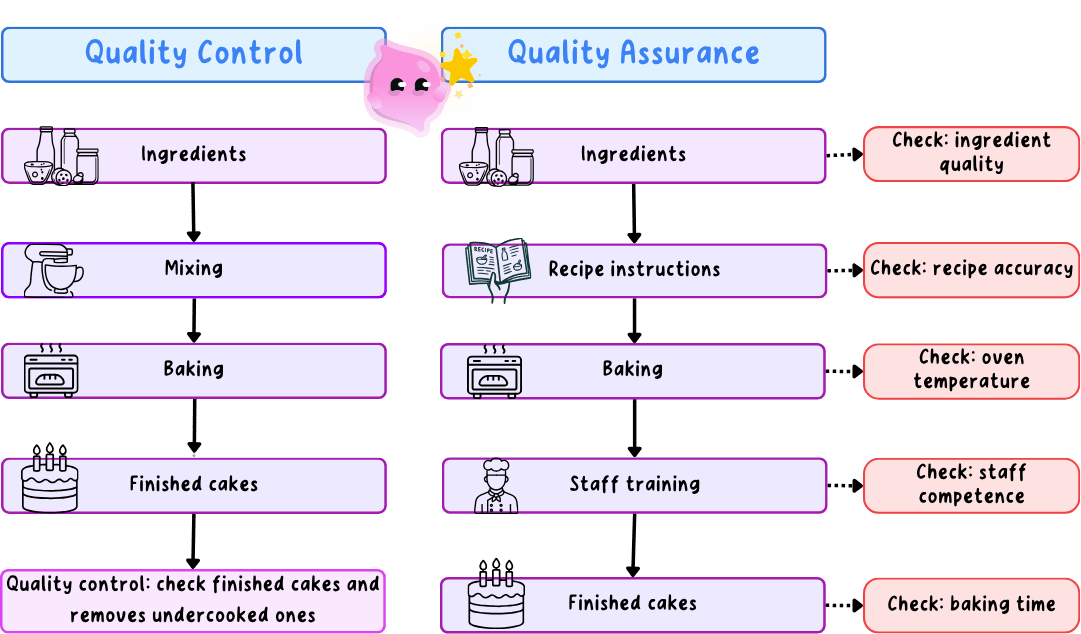
The two approaches split on four things, set side by side below.
| Quality control | Quality assurance | |
|---|---|---|
| When checking happens | Once, at the end | At every stage |
| Who is responsible | Separate inspectors | Every worker |
| Faulty output | Scrapped or reworked | Mostly never made |
| Cost | Low to start, waste continues | High to start, waste falls |
Judging which approach to use: it turns on what a fault would cost
- Quality assurance is more valuable when a fault would be expensive, damage a premium reputation or be repeated many times by flow production; quality control can be enough for cheap, simple output where a rejected unit costs little.
- The business must also be able to afford the up-front procedures and training: assurance costs more now but can cut waste later, while control is cheaper to start but allows the causes of faults to continue.
- Overall, choose by comparing the cost of preventing faults with the likely cost of one fault reaching the customer in that particular business.
- Identify whether the business uses end-of-process inspection or checks at every stage, then trace the effect through faults, waste and customer outcomes.
- For a judgement, compare the training and set-up cost with what a fault reaching the customer would cost this firm.
- Do not claim quality assurance removes faults completely; it is designed to prevent and reduce them rather than guarantee zero faults.
- What does quality mean in business?
- Why can a low-priced product still be a high quality one?
- Who does the checking under quality control, and at what point?
- Give one advantage and one drawback of quality assurance.
- Name two things that decide which approach suits a business.
2.3.3b Quality, costs and competitive advantage
The cost of maintaining quality: better inputs, trained staff and time spent checking
- Keeping quality consistent costs money before it saves any, and the spending shows up in four places.
- Better materials: a boot built to last needs thicker leather and stronger stitching than a fashion boot, and the supplier charges more for both.
- Training staff: workers have to be taught the standard before they can hit it, and training hours are paid hours in which nothing is produced.
- Inspection or assurance systems: the quality control and quality assurance methods of the previous guide have to be paid for, in testing equipment and in the wages of anyone whose job is to check rather than to make.
- Time spent checking: an item held back for a check is an item not yet sold, so output per hour falls even when nothing turns out to be wrong with it.
- All four raise the cost per unit, so a business that lifts its standards must either accept a thinner margin or charge a price customers will pay for the difference.
The cost of not maintaining quality: the bill that arrives later
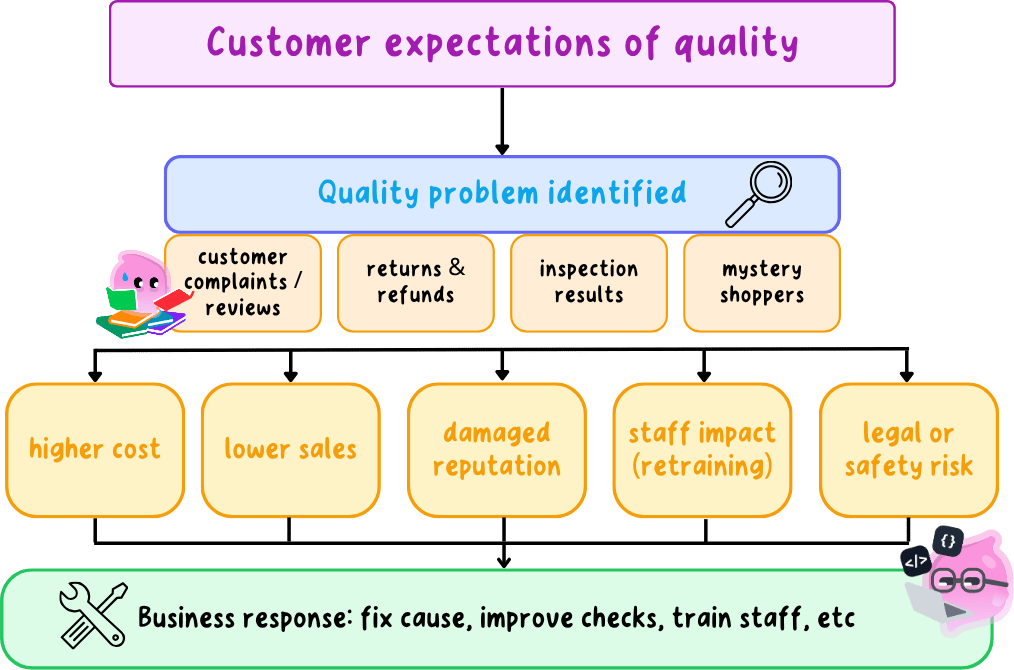
- Poor quality costs more than good quality, and the bill arrives in five places of which only the first two ever reach the accounts.
- Scrap and rework: a faulty item is thrown away or made again, so the business pays twice for one sale, once for the ruined materials and again for the labour that redoes the work.
- Refunds, replacements and repairs: consumer law gives a buyer the right to a remedy when goods are faulty or not as described, so the seller carries that cost whether it budgeted for it or not.
- Handling complaints: every complaint uses staff time on calls, emails and returns paperwork, which is time not spent making or selling anything.
- Lost repeat custom: a customer who receives a faulty order usually buys elsewhere next time, so the business loses not one sale but every sale that customer would have made for years.
- Reputational damage: one bad review sits online where every future shopper reads it, so sales are lost to people who never bought, never complained and never appear in any figure the business can count.
How quality turns into competitive advantage
Competitive advantage: a feature that makes customers choose one business over its rivals, such as a lower price, a better design or more dependable quality.
- Competitive advantage built on quality is a chain, and an answer earns its marks by saying every link out loud.
- Quality that is the same every time builds a reputation, because a customer knows what they will get before they hand over any money.
- That reputation makes customers pick this business over a cheaper rival, so demand holds up when a competitor cuts its price.
- Loyal demand lets the firm charge more without losing those buyers, so the revenue earned on each sale rises.
- A higher price on a similar cost base widens the margin, which pays for the materials, training and checks that hold the quality steady, so the advantage renews itself.
- Quality also makes the rest of the business easier to run, because fewer faults mean fewer returns for operations to process and promotion can advertise a claim the product actually delivers.
- Dyson went through over 5,000 prototypes before selling a bagless vacuum cleaner, and competes on design and engineering rather than on price.
- Customers who expect the machine to keep working accept a price well above a supermarket own-brand vacuum, so the margin on each sale is wide.
- That margin funds the engineering that keeps the next model ahead, which is how the quality and the premium hold each other up.
- A run of failures would break the chain at the first link, because the reputation is the only reason anyone pays the premium.
Quality has to be right for the market, not the highest possible
- The right level of quality is the level the customer is paying for, because spending past that adds cost the price cannot recover.
- Budget retailers: Aldi and Lidl compete on price with a narrower product range, so their target is food that is consistently fresh, safe and worth the money rather than the best version of every line.
- Premium brands: Dr Martens sells boots on durability at a high price, so a pair that fell apart in one winter would remove the whole reason for paying it.
- Both models depend on quality and simply define it differently, dependable at low cost for the discounters and made to outlast the alternatives for the premium brands.
- Write the cost of poor quality as a chain: the item is remade, so the materials are paid for twice, so the cost per unit rises, so the profit on that order disappears.
- The cost most often missed is the customer who never returns, because that loss never appears on an invoice and has to be argued rather than counted.
- Judge the level of quality against the business in the source booklet, since a discount retailer and a premium brand are aiming at different standards.
- When the question says justify or evaluate, set what the quality spending costs now against the failure costs and lost custom it prevents later, then decide for that firm.
- Give three costs a business faces in maintaining quality.
- Explain why losing a repeat customer costs more than paying a single refund.
- Set out the chain from consistent quality to a wider profit margin.
- Why does good quality mean something different to Aldi than to Dr Martens?
- Name one way quality helps operations and one way it helps promotion.
2.3.4a The sales process
The sales process: every point where a customer meets the business
Sales process: the sequence of steps a business goes through to turn an interested person into a completed sale and a customer who comes back.
Post-sales service: the support a business gives after payment, including delivery, installation, warranties, returns and repairs.
- The process starts when a customer first asks a question and ends only when any problem after the purchase has been sorted out, so it does not stop when the money is taken.
- Edexcel names five elements, which run in order through a single sale, and any one of them done badly can lose the customer on its own.
The five elements in order, and what goes wrong when each is done badly
- Product knowledge: staff understand what they sell, so they can answer questions and match the right product to the customer in front of them.
- Without it the customer is given wrong information, so they either leave without buying or return the item later, which costs the business the sale and the handling of the return.
- Speed and efficiency of service: the customer is served quickly and without fuss, whether at a till, on a phone line or through a website checkout.
- A queue at lunchtime or a page that takes ten seconds to load hands the sale to a rival, because the customer abandons the purchase rather than waits for it.
- Customer engagement: staff listen to what the customer actually needs and help them choose rather than push a product, which builds trust and often a larger sale.
- Pushing whatever the shop needs to clear makes the customer feel processed, so they buy the cheapest option to get away and are slow to come back.
- Response to customer feedback: the business acts on what customers say, whether a complaint or a suggestion, and is seen to have acted.
- Feedback that is collected and then ignored does more damage than never asking, since the customer has given up their time and been shown that nothing changed.
- Post-sales service: delivery, installation, warranties, returns, spare parts and help lines after the money has changed hands, which is where a good sale becomes a repeat customer.
- A returns policy that argues with the customer turns one faulty item into a lost customer and a public review that warns everybody else off.
- Greggs sells cheap hot food at high volume, so speed at the counter carries most of its sales process and a long lunchtime queue is the main way a sale is lost.
- Dyson sells vacuum cleaners at a premium on design and engineering, so product knowledge and a warranty matter far more than serving in under a minute.
- The five elements are the same in both, but the weight each one carries follows the price and the complexity of what is being sold.
Why the sales process decides whether the rest of the business pays off
- The sales process is the point where every other decision the business has taken finally meets the customer.
- A product designed well, priced carefully and promoted expensively can still be lost at the till, because the customer walks out over a twenty-minute queue or an assistant who cannot answer a straight question.
- Marketing therefore only converts into revenue if this last step holds, so advertising that brings a hundred extra customers into a shop that can serve sixty has paid to send forty of them to a rival.
- Operations depends on it too, since a well-made item returned because staff sold the wrong model still costs the business its materials, its labour and two lots of delivery.
- Handled well, the process delivers repeat custom, word of mouth and a reputation strong enough to support a higher price.
- Those benefits belong to the next guide on good customer service, so keep your focus here on the steps themselves.
How technology has changed the sales process
- Self-checkout and online ordering: these strip time out of the middle of the process, so Tesco can take an order through click and collect without a member of staff serving that customer at all.
- Public reviews: post-sales service used to be private, but a refund handled badly on Amazon or eBay is now read by thousands of future customers rather than by one.
- Customer data: staff can see what a customer bought and when, so a help line can check a warranty or reorder a part without asking the customer to explain their own history.
- Technology shifts the risk as well as the speed, because a checkout page that crashes loses the sale silently with no member of staff there to rescue it.
- Name the element, then carry it through: strong product knowledge, so the right model is matched to the customer, so fewer returns and more repeat custom.
- The link most often dropped is the last one, because answers name an element and describe it without saying what it does to sales, costs or reputation.
- Use the business in the source booklet, since good service at a garage means clear explanations of repairs, while at a supermarket till it means speed.
- When the command word is analyse, build one element into a full chain rather than listing all five thinly.
- Name the five elements of the sales process in order.
- Define post-sales service and give two examples of it.
- What goes wrong for the business when staff lack product knowledge?
- Give one way technology has changed post-sales service.
- Why can a well-made, well-promoted product still fail at the point of sale?
2.3.4b The importance of good customer service
Loyalty and word of mouth: the two chains that bring customers back
Customer service: all the help a business gives a customer before, during and after the sale, from advice on the shop floor to handling a fault weeks later.
Customer loyalty: the habit of buying from the same business again instead of comparing rivals every time.
- A customer who is served well has no reason to shop around, so the next time they need the same thing they come back to you rather than to the shop next door.
- That is worth money because winning a new customer costs advertising, discounts and time, while a returning one walks in for nothing.
- So the profit the business keeps from one loyal customer rises the longer the relationship lasts, even though the price on the shelf never changes.
- Word of mouth: a satisfied customer recommends the business to friends and leaves a good review, which brings in buyers the business never paid to reach.
- The reverse is true and travels faster: an angry customer tells far more people than a pleased one, and a one-star review stays visible long after the complaint was settled, putting off buyers who never gave the business a chance.
Price and returns: service protects what each sale is worth
- Customers will pay more to a business they trust to put a problem right, because part of what they are buying is the confidence that a fault will be dealt with rather than argued over.
- Dr Martens sells boots on durability at a premium price, and that promise only holds if a customer whose pair fails early is dealt with quickly, because otherwise the reason for paying the higher price disappears.
- Fewer returns and complaints: getting the order right first time is cheaper than fixing it afterwards, since a return costs the delivery out, the delivery back, the staff time to process it and often a product that cannot be sold again at full price.
- Every hour spent settling a complaint is an hour a member of staff is not selling, so weak service pushes costs up and revenue down at the same time.
- An online shoe shop picks the wrong size for a £120 order.
- It pays the return postage, checks and restocks the boots, then posts the right pair, so one sale now carries three lots of delivery cost and around twenty minutes of staff time.
- Picking the order correctly the first time would have cost nothing extra at all.
- The customer also decides on the strength of that mistake whether to order again.
Service is delivered by people, so it depends on the staff
- Every part of good service reaches the customer through a member of staff, so how well a business recruits, trains and keeps its people sets the ceiling on the service it can offer.
- A trained assistant who can say which model suits the customer keeps the sale in the shop, while an untrained one sends the shopper away to check online and usually loses them to whoever comes up first in the search.
- Staff who stay long enough to learn the stock and recognise regulars serve people faster and make fewer mistakes, so high staff turnover damages service even when the training budget has not been cut.
How a business trains and motivates those staff is covered in 2.5.3 and 2.5.4.
What service costs, and why some businesses choose to offer less
- Good service is bought rather than wished for, and it shows up in three places on the cost side.
- Training and staffing levels: staff are paid while they learn, and serving people properly needs more of them on the floor at the busy hours.
- Time per customer: an assistant who spends ten minutes advising one shopper serves fewer people in that hour, so the wage cost carried by each sale rises.
- Returns policies beyond the legal minimum: refunding a customer who simply changed their mind means taking back goods the business could have refused, which is a real cost accepted to keep them.
- Aldi competes on price with a narrower product range, and a business built on the lowest price will deliberately keep service basic, putting fewer staff on the shop floor and moving customers through the till quickly so the saving can go into the price.
- That is a legitimate choice rather than a failure, because how much service is worth depends on what the business sells and how often the customer buys it.
- For cheap hot food from Greggs on the way to work, the service the customer wants is a short queue, and a long conversation at the counter would make the experience worse rather than better.
- A Dyson vacuum cleaner, sold at a premium price on design and engineering, is bought once in years, so the buyer needs someone who knows the machine and will sort out a fault, and poor service there loses a sale worth hundreds of pounds instead of a few.
| Business | How often bought | What the customer wants most | Service level that fits |
|---|---|---|---|
| Greggs | Daily or weekly | Speed and a low price | Fast and basic |
| Aldi | Weekly shop | Low price, narrow range | Few staff, quick tills |
| Dyson | Rarely | Advice, and a repair if it fails | Detailed, with after-sales |
| Dr Martens | Rarely | Durability and easy returns | Helpful, generous returns |
- Name the benefit, then carry it through: good service leads to repeat purchase, which cuts the advertising needed to replace lost customers, which raises profit.
- The link most often dropped is the last one, where the answer stops at "customers are happy" and never reaches sales, costs or profit.
- Match the answer to the business in the source booklet, since a discount retailer and a specialist shop need different levels of service to succeed.
- When the question says justify or evaluate, set what the service costs against what it protects for that firm before you land on an answer.
- Define customer service.
- Why is selling to a returning customer cheaper than selling to a new one?
- Give two costs a business takes on when it provides good customer service.
- Explain why a bad review can do more damage than a good one does good.
- Why does service matter more to a business selling vacuum cleaners than to one selling sausage rolls?
