2.2.1a The design mix
The design mix: the three things a business balances in a product
Design mix: the balance a business strikes between function, aesthetics and cost when it designs a product.
Economic manufacture: designing a product so it can be made cheaply enough to leave a profit at the price customers will pay.
- The design mix has exactly three elements, function, aesthetics and cost, and they are settled before a single unit is made.
- It is drawn as three overlapping circles, one labelled function, one labelled aesthetics and one labelled cost.
- The product is marked somewhere inside those circles, sitting nearest the element its buyers care most about and further from the ones they will compromise on.
- Where it sits is a decision rather than an accident, because the materials, the shape and the production method are chosen at the design stage and are expensive to change afterwards.
- The design mix is not the marketing mix, and these two are confused more often than any other pair in this Theme.
- The marketing mix is the 4 Ps of product, price, promotion and place, and it is about how a product is sold.
- The design mix has three elements only, function, aesthetics and cost, and it is about how a product is designed.
- The design mix sits inside the product element of the marketing mix, so naming price, promotion or place as part of it scores nothing.
Each element in turn: what it covers and who buys on it
- Function: how well the product does the job it is bought for, covering its reliability, its durability and how easy it is to use.
- A work boot is bought on function, and Dr Martens charges a premium price because its boots last through years of wear that would finish a cheap pair.
- Aesthetics: how the product looks, feels, sounds or smells, including its styling, its finish and its packaging.
- A designer kettle is bought on looks, because the buyer wants an object worth leaving out on the worktop and will pay more than a plain kettle costs to get it.
- Cost, or economic manufacture: designing the product so it can be made at a cost that still leaves a profit at the price customers are willing to pay.
- A supermarket own-brand cereal is designed around cost, with a simple recipe and plain packaging, so a discounter such as Aldi can price it below the branded box and still earn a profit on every one sold.
- Cost in the design mix means the cost of making the product, not the price on the shelf, and it is fixed by design choices long before a customer sees it.
- James Dyson built over 5,000 prototypes before the bagless vacuum cleaner worked as he wanted.
- That engineering pushed both the design cost and the cost of manufacture far above a basic vacuum cleaner's.
- Dyson gets it back by selling on function and styling at a premium price, which works only because its buyers will pay for suction that does not fade.
- A firm designing for the value shelf could not make that choice, because its customers are buying on price and would walk past the higher price tag.
The trade-off: raising one element usually lowers another
- The three elements pull against each other, so a gain in one is normally paid for in another.
- Better materials and closer engineering improve function and aesthetics, but they raise the cost of making each unit, which either forces the price up or thins the profit on every sale.
- Designing for cheap manufacture holds the price down, but it usually means plainer styling, lighter materials and a shorter working life.
- A kettle maker that swaps a stainless steel body for thin plastic cuts perhaps £4 off the cost of each unit, so it can undercut rivals on price, but the kettle looks cheaper and scratches sooner, so buyers may not choose the same brand again.
- A well-judged design mix is one way a product stands out from its rivals, which is differentiation in 2.2.1c.
- How long the product then keeps selling is the product life cycle in 2.2.1b.
Why the right balance differs by product and by market
- There is no single correct design mix, because the balance is set by what the target market values and what it will pay.
- One firm often designs its budget range and its premium range around different elements, and both can be right.
- The value range is designed around cost, using the cheapest workable ingredients and packaging so the product can land at about 89p and still return a profit.
- The premium range from the same firm is designed around aesthetics and function, with better ingredients and heavier packaging, because those shoppers will pay £3 or more for the difference.
- Getting the balance wrong is expensive, because a product carrying more function than its buyers will pay for sits unsold at the price it needs, while one made too cheaply for a premium market is judged poor quality and left on the shelf.
- When the command word is state or identify, give function, aesthetics or cost, never one of the 4 Ps.
- When it is explain or analyse, carry one element through the chain: the design choice, what the customer notices, then the effect on sales or on profit per unit.
- Tie every element to the product in the source booklet rather than a memorised favourite, since application marks are gated on that context.
- When the question says justify or evaluate which element should come first, name what the trade-off costs the business as well as what it gains.
- Name the three elements of the design mix.
- How is the design mix drawn, and what does the position of the product show?
- Define economic manufacture.
- Give one product designed mainly around aesthetics and say why its buyers accept the price.
- Why does designing for cheap manufacture often weaken function?
2.2.1b The product life cycle
The curve: sales on the vertical axis, time on the horizontal
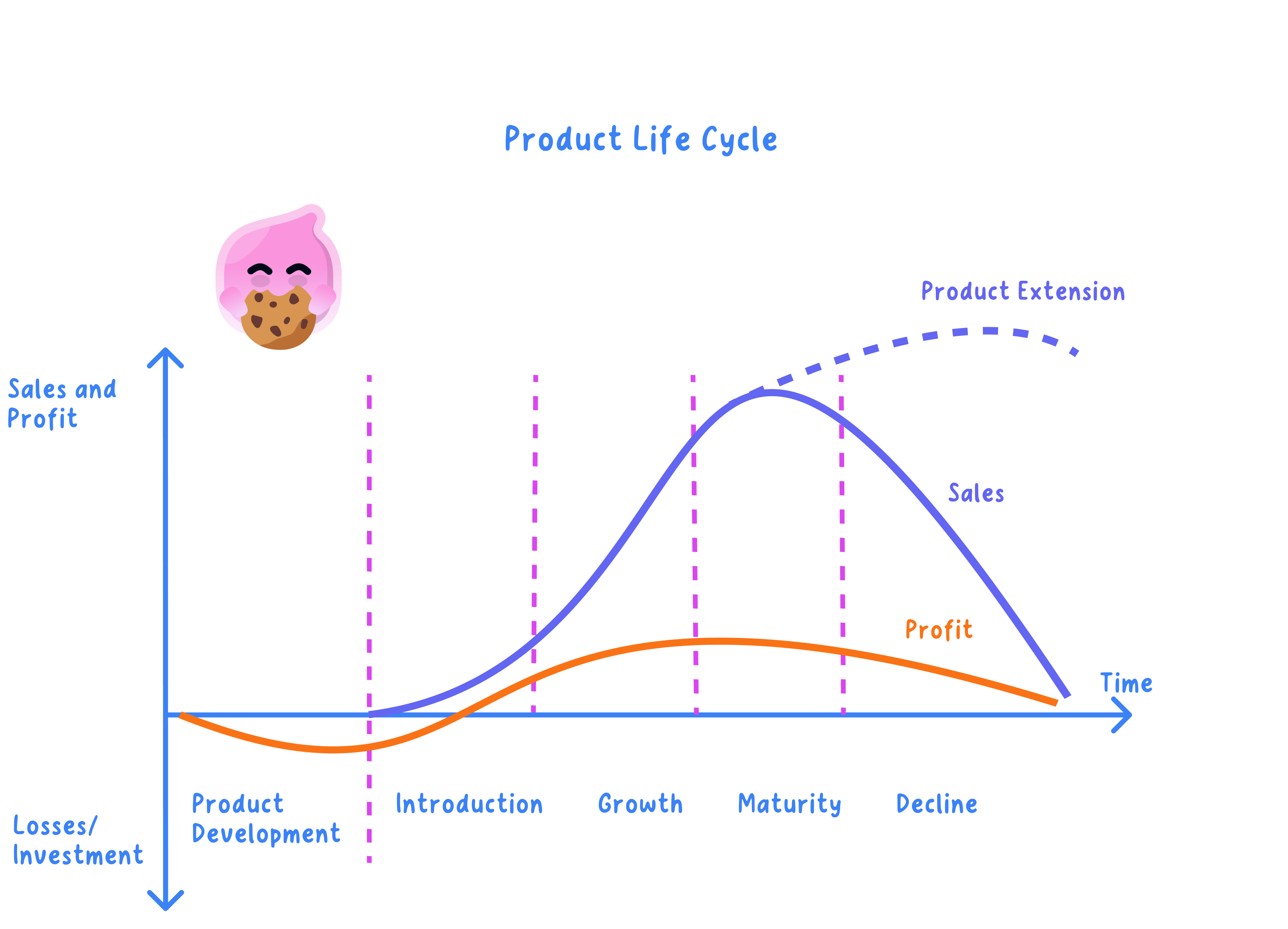
Product life cycle: the four stages a product passes through from launch to withdrawal, tracked by what happens to its sales over time.
Extension strategy: an action taken as sales flatten in maturity to lift them again and delay decline.
- The diagram plots sales on the vertical axis against time on the horizontal axis, following one product rather than the whole business.
- The curve starts low and almost flat at launch because few customers know the product exists, then climbs steeply through growth as word spreads.
- The slope then eases until the line runs flat along a peak through maturity, before falling away towards the axis in decline.
- An extension strategy bends the curve upward again from maturity, so instead of one peak and a slide you draw a run of smaller rises.
What each stage does to sales, spending and profit
- Introduction: sales are low and the business is still spending heavily on promotion and finishing the product, so it usually makes a loss.
- Cash leaves the business months before customers pay it back, so a launch is often funded from a loan or from the profits of an older product.
- Growth: sales rise fast as distribution widens, the product turns profitable for the first time, and rivals begin to copy it.
- Maturity: sales reach their peak and flatten, competition is at its strongest, and price cuts and special offers become common.
- Total profit is at its highest here because volume is greatest, but the profit on each unit is squeezed by those price cuts.
- Decline: sales fall as customers move to something newer, and the business chooses between extending the product, cutting the price to clear the remaining stock, and withdrawing it altogether.
- The four stages read most clearly side by side.
| Stage | Sales | Profit | Business action |
|---|---|---|---|
| Introduction | Low, rising slowly | Loss | Promote to build awareness |
| Growth | Rising fast | Turns positive, rises | Wider distribution, branding |
| Maturity | At peak, flat | Highest total, thin per unit | Extension strategies, offers |
| Decline | Falling | Falling | Extend, discount or withdraw |
- Profit lags behind sales, because the loss made in introduction has to be paid back out of the growth and maturity years before the product has earned its keep.
- Maturity is the row that matters most, since it is where the money is made and where the business must act if it wants to keep the curve up.
- Blockbuster rented out DVDs from high-street shops, a product that ran through the whole cycle.
- Streaming, led by Netflix, gave customers the same films without a trip to a shop, which pushed DVD rental into decline.
- No repackaging or advertising could reverse that, because the fall came from a better way of delivering the same thing.
- The UK Blockbuster business entered administration in 2013.
Extension strategies: lifting the curve before it falls
- Extending a product customers already know is cheaper and less risky than developing a replacement, so a business acts while sales are still flat in maturity rather than halfway down the decline.
- Advertising: a fresh campaign reminds people the product exists or repositions it for a different buyer, such as a breakfast cereal advertised as an evening snack.
- A new or updated version: a games console re-released in a slimmer case with more storage gives owners of the old model a reason to buy again.
- New packaging: a resealable pouch or a seasonal design makes a familiar product look new on the shelf, which can lift sales without cutting the price.
- A new market or a new audience: Greggs launched a vegan sausage roll, putting a familiar product in front of customers who do not eat meat.
- Lowering the price: taking 50p off a £2.50 sandwich wins back shoppers who thought it had become dear, although every sale then earns less.
- Adding a new feature: a mobile phone contract that gains unlimited data at the same monthly price keeps customers who were about to switch.
- The life cycle is a model rather than a timetable, so a fashion item can run the whole curve in one season while a chocolate bar sits in maturity for decades.
- Knowing which stage a product has reached tells the business where to spend, because money spent building awareness suits introduction while money spent on extension suits maturity.
- Read the sales figures before naming a stage, because rising fast is growth while high but flat is maturity.
- When the command word is explain, name the strategy, say what it does to sales, then say what that does to profit.
- Match the strategy to the product in the source booklet, since a chocolate bar and a games console need different extensions.
- When the question says justify or evaluate, weigh the cost of extending against the extra revenue and say whether the cause of the fall can be reversed at all.
- Label both axes on any curve you draw, because an unlabelled diagram earns nothing.
- Name the four stages of the product life cycle in order.
- Which axis shows sales and which shows time?
- At which stage is total profit highest, and why is profit per unit squeezed there?
- Give three extension strategies with an example of each.
- Why does the same stage last far longer for some products than for others?
2.2.1c Product differentiation
Differentiation: giving the customer a reason other than price
Product differentiation: making a product stand out from its rivals so that customers have a reason to choose it rather than comparing it on price alone.
- When customers see two products as the same, the only reason left to pick one is the price, so the business is pushed into undercutting whoever is cheapest.
- Every price cut narrows the gap between the price charged and the cost of making the item, so the business sells the same goods and keeps less from each sale.
- Differentiation breaks that comparison by giving the customer something the rival does not offer, in the product itself, in the brand around it or in the service that comes with it.
Differentiation is one way of adding value, which is covered in 1.1.3b, so use it here as the reason a customer will pay more rather than reworking the routes to added value.
How a business differentiates: six routes and how each one works
- A business can build a difference in six places, and each one works on the customer in a different way.
- Design and appearance: the product looks or works differently from anything else on the shelf, and Dyson built its position on a bagless vacuum cleaner developed through over 5,000 prototypes.
- Quality and durability: a product built to last costs more to buy but less for every year it is used, which is what lets Dr Martens sell boots at a premium price.
- Brand and reputation: a name the customer already trusts removes the risk of trying something new, and Innocent sells smoothies above the supermarket own-brand price on friendly branding rather than on different fruit.
- A feature rivals lack: Tesco and Sainsbury's offer click and collect while Aldi and Lidl do not, so a shopper who needs a fixed pickup time has only one of them to go to.
- Customer service: staff who know the product, quick replies to a complaint and easy returns give a reason to come back to a small shop even when an online seller is cheaper.
- Packaging: distinctive packaging is recognised on a crowded shelf before the customer reads a word, and heavier or better-made packaging signals that the contents are worth more.
- Gymshark was founded in 2012 by Ben Francis in Birmingham, screen-printing gym clothing in a garage.
- The fabric was not the difference, the difference was selling online through fitness influencers the target customer already followed.
- That gave the clothing a meaning larger sportswear firms could not match simply by cutting their own prices.
Why it matters: from a difference to money to reinvest
- A differentiated product has no identical alternative for the customer to price-check it against, so the buyer is weighing up the difference instead of the pound saved.
- That means the business can charge a higher price without losing the customer, which is how Dyson sells at a premium against cheaper vacuum cleaners that clean the same floor.
- A higher price on the same cost per unit protects the margin, so more of every sale is left over once the costs of making and selling the product are paid.
- That money funds new designs, better materials and more advertising, which renews the difference before rivals catch up and starts the whole chain again.
The unique selling point, and why it does not stay unique
- The strongest form of differentiation is a unique selling point, meaning a feature no rival offers at all, which is covered as one of the five routes to added value in guide 1.1.3b.
- What matters here is that a unique selling point decays, because the moment a rival copies it the price premium goes with it, so differentiation has to be renewed rather than achieved once, and how long the advantage lasts depends on how hard the difference is to copy.
- Easy to copy: a free delivery offer or an extra colour can be matched by a rival within a week, so the sales gained disappear and only the extra cost stays.
- Hard to copy: a reputation for durability built over decades, as Dr Martens has, or a genuinely better design like Dyson's, needs years, money and engineering a rival may not have.
- Differentiating badly is worse than not bothering, because a difference customers do not actually value adds cost to every unit without adding a single sale.
- A product that is different but worse loses outright, so the test is always whether this particular customer would pay more for this particular difference.
- Name the difference, say why that customer values it, then carry it through to the price, the sales or the profit, because the last link is the one that earns the mark.
- "It stands out" is not an answer, whereas "the boots last for years, so the buyer pays more once instead of replacing cheap boots twice" is.
- Use the difference the business in the source booklet actually has, since application marks are gated on that context.
- When the question says justify or evaluate, weigh the higher price won against what the difference costs to create and how quickly a rival could copy it.
- What is product differentiation?
- Give three ways a business can differentiate a product, and the mechanism behind one of them.
- Explain the chain from a differentiated product to money for reinvestment.
- Why does a unique selling point not stay unique?
- Give one difference that is easy to copy and one that is hard to copy.
2.2.2a Pricing strategies
Skimming and penetration: two opposite ways to price a launch
Pricing strategy: the approach a business takes to deciding what to charge, rather than the price itself.
Mark-up: the amount added on top of what a unit costs the business to make, which becomes the profit on that sale.
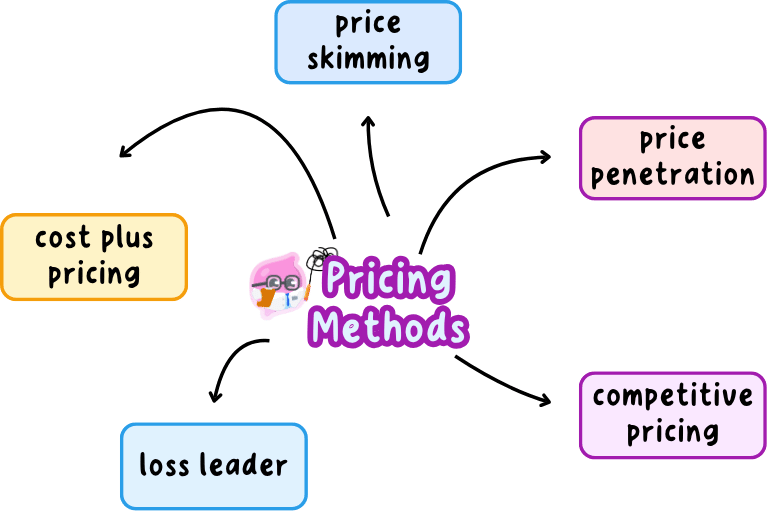
- Price skimming launches the product high and then steps the price down in stages, taking the largest profit per unit from the buyers who are least willing to wait.
- Use it when the product is genuinely new, because the first buyers have nothing to compare it with and judge the price against how much they want it, which is how a games console can sell at £999 and then £599 a year later.
- The risk is that a fat margin advertises the market, so rivals copy the product, the business is forced to cut faster than planned, and the early customers who paid full price feel overcharged.
- Price penetration launches below the going rate to buy customers quickly, then lifts the price once people are in the habit of buying and switching feels like effort.
- Use it when rivals are already established, because a new name gives a shopper no reason to move unless the price does, and volume is what makes a fixed cost such as rent affordable per unit.
- The risk is that the low price has to be paid for, so start-up costs are recovered slowly, and customers recruited by cheapness are the first to leave when the price rises.
- Both are decisions about a launch, so the test is which way the price will move afterwards, not whether it looks high or low today.
- Skimming only works where the product is new or hard to copy, so recommending it for an ordinary product with close rivals throws away the application mark.
- A price that starts low and stays low is not penetration, it is a permanent low-price, high-volume position, which is how Greggs sells cheap hot food.
Pricing from costs, from rivals and from the shopper's head
- Cost-plus pricing builds the price from the inside out: work out what one unit costs to make, add a set mark-up, and that sum is the price.
- It suits a business whose unit cost is easy to pin down, such as a bakery costing flour, labour and packaging per loaf, or a plumber quoting a job before starting it.
- The risk is that nobody outside the business is consulted, so the price can land above what shoppers will pay and sales stall, or below what they would have paid and profit is given away for nothing.
- Competitive pricing starts from the going rate and holds the price level with it, which keeps a business in the running where two products are near enough identical that a shopper will switch over pennies.
- The risk is that rivals now set your margin, so when Aldi or Lidl cut a headline line, Tesco either follows and earns less per item or holds firm and loses the trolley, and the business has to defend itself on range, service or convenience instead.
- Loss leader pricing sells one line below what it cost the business, accepting the loss because the shopper who came in for that line fills the rest of the basket at a normal margin.
- The risk is the cherry-picker who buys the cheap line and nothing else, so it works only where one item alone is not worth the trip, which is why a supermarket can run it on milk and a single-product market stall cannot run it at all.
- Psychological pricing stops the price just short of a round number so the shopper anchors on the first figure, and £9.99 is filed away as nine pounds rather than ten.
- The risk is that the gain is thin and the trick is well known, so it shifts a decision only where prices are scanned quickly, and a clean rounded price signals quality better on a premium product such as a pair of Dr Martens boots.
- A new gym opening in Leeds charges £9.99 a month while nearby clubs charge £24, filling the floor before lifting the fee to £16.99.
- That is penetration, because the low price is temporary and its job is to build a membership base fast.
- The same £9.99 figure is also psychological pricing, so one price can serve two strategies at once.
- Say which purpose you mean, because the strategy is the intention behind the price, not the digits on the label.
The six strategies side by side
This table sets each strategy against what it means and the situation it is built for.
| Strategy | What it means | When it is used |
|---|---|---|
| Cost-plus | Add a fixed mark-up to the cost of making the product | When the business must be sure each sale covers its costs |
| Price skimming | Launch high, then lower the price over time | New technology with early adopters willing to pay |
| Price penetration | Launch low to win customers, then raise the price | Entering a market with established rivals |
| Competitive pricing | Set the price at or near what rivals charge | Crowded markets where products are similar |
| Loss leader | Sell one product below cost to draw customers in | Supermarkets, where shoppers buy other items too |
| Psychological pricing | Set the price just below a round number, such as £9.99 | Retail, where the price looks smaller than it is |
- Skimming and penetration are the only two rows that describe a launch, and they answer the same question in opposite directions, so a scenario about a new product is usually asking you to pick between those two and defend the choice.
- Cost-plus is the safest row and the least responsive, because it is the only one that never looks at a rival or a customer, so a business using it can be the last to discover that shoppers would happily have paid more.
- The loss leader row depends entirely on what else is bought, so it is a strategy about the whole basket rather than the product, and it collapses the moment customers can take the bargain and leave.
- What decides which row a particular business picks, including its costs, its rivals and where the product sits in its life cycle, is the subject of the next guide.
- Name the strategy and then say which way the price moves over time, since "a low price" on its own does not identify penetration.
- When the command word is explain, run the chain: the strategy, why it fits this market, and what it does to revenue, market share or profit per unit.
- Apply it to the business in the source booklet, because the same strategy is right for a firm with a patented product and wrong for one selling what everybody else sells.
- When the command word is justify or evaluate, name the strategy you rejected and say why it would work less well here.
- Which two strategies are launch decisions, and which way does each move the price afterwards?
- State the main risk of price skimming.
- How does cost-plus pricing arrive at a selling price?
- Why can a supermarket use a loss leader when a single-product stall cannot?
- Give one reason a business might choose £10.00 over £9.99.
2.2.2b Influences on pricing strategies
Costs: the floor underneath every price
- Costs influence the price because it has to cover what the product costs to make and to sell, or the business loses money on every sale it makes.
- A bakery in Leeds whose ingredients, wages, packaging and rent work out at £1.20 a loaf has to charge more than £1.20, otherwise a busy day makes the loss larger rather than smaller.
- Costs set the lowest price the business can survive at, not the price it actually charges, so every other influence works in the gap between that floor and the most customers are willing to pay.
- Greggs prices its hot food low and sells it in high volume across high streets and retail parks.
- Each item carries only a small gap between cost and price, so the profit comes from the number sold rather than the margin on one sale.
- That makes the floor dangerous: a rise in the price of flour or in wages lifts the cost of every item, and a business already pricing close to cost has very little room before the item stops paying for itself.
Technology: customers can compare in seconds and prices can move in minutes
Price comparison site: a website or app that shows what several businesses charge for the same product side by side.
- Online comparison lets a customer check four or five rivals in seconds, so a price set above the going rate is found before the customer reaches the checkout.
- This pushes prices down and makes a high price harder to sustain, because the higher price now has to be paid for by something the customer can see, such as free delivery, a longer guarantee or better reviews.
- Technology works for the seller too, since an online price can be changed in minutes and at no cost, where a printed price list or a shelf label costs staff time to reprint and replace.
- Data from an app or a loyalty card also lets the business send a targeted discount to the customers who have stopped buying, which means the price is cut only where it is needed and the margin on everyone else is protected.
- A seller listing on Amazon or eBay appears on the same page as every rival selling the identical item.
- The comparison is done for the customer, so the seller has almost no room to price above the others and competes on delivery speed and seller rating instead.
- Selling through its own site instead, as Gymshark did through fitness influencers, keeps the customer away from that direct line-by-line comparison and protects the price.
Competition and market segments: how much freedom the business actually has
- Competition narrows the choice, because in a crowded market selling near-identical products the business has to price close to its rivals or watch customers switch over a few pence.
- Aldi and Lidl compete on price with a narrower range, which forces Tesco, Sainsbury's and Asda to hold down the price of the staples everybody buys and to compete on range and click and collect instead.
- A business with no close rival has far more freedom, so Dyson can price its bagless vacuum cleaners well above the market because a shopper comparing it with a cheaper machine is not comparing the same thing.
- Market segments matter because different groups of customers will pay different amounts for the same basic need, so one business often runs a budget range and a premium range at very different prices.
- Referring to the table below, read down the price column and none of these prices is decided by cost alone, because each one is held up or held down by a decision about who the customer is.
- PureGym and Aldi each took a cost out of the business before taking money off the price, so the low price is a sustainable position rather than a loss the business has to absorb.
| Business | Segment served | Price position | Price held by |
|---|---|---|---|
| PureGym | Budget users, any hour | Low monthly fee | No staffed reception |
| Aldi | Price-led shoppers | Below wider ranges | Narrower product range |
| Innocent | Treat buyers | Above supermarket brands | Friendly branding |
| Dyson | Performance buyers | Premium | Design, engineering |
- The strategies themselves, such as skimming, penetration, competitive, cost-plus, psychological and promotional pricing, are covered in 2.2.2a.
- The product life cycle curve and its extension strategies are drawn and explained in 2.2.1b.
The product life cycle, the brand and what the price signals
Premium price: a price set deliberately above rivals because customers believe the product is worth more.
- The stage of the product life cycle changes the strategy, because a launch, a mature product and a product in decline each face different customers and different rivals.
- A launch may use skimming or penetration, a mature product drifts towards the price of the rivals who have copied it, and a product in decline is priced to clear the stock before it is worth nothing.
- A strong brand supports a higher price, because customers who trust the name believe they are buying reliability or status, which is why Nike and Adidas hold a premium over unbranded sportswear.
- Price also signals quality, so cutting the price of a premium product can damage the image it depends on: if Dr Martens sold at the price of unbranded boots, buyers would start to doubt the durability they are paying for, and raising the price again later would lose the customers the discount attracted.
- Name the influence, then carry it through to the price and on to sales or profit, because the mark is in the chain and not in the label.
- Work it through: comparison sites let customers check rivals instantly, so an above-market price is spotted, so sales fall to the cheaper seller, so the business has to cut price and accept a thinner margin.
- Use the influence that fits the business in the source booklet, since a firm with a strong brand and a firm selling on a marketplace face completely different limits on price.
- When the question says analyse or explain, one influence developed fully beats four influences listed.
- Why do costs set a floor under the price rather than deciding the price?
- Give two ways technology changes how a business prices.
- Why does a business in a crowded market have less freedom over price than one with no close rival?
- How does the stage of the product life cycle change the price a business charges?
- Why can cutting the price of a premium product damage the business?
2.2.3a Promotion strategies for market segments
The five promotion methods: what each costs and where each is weak
Promotion: the communication a business uses to make customers aware of a product, persuade them to buy it and remind them it is still there.
Branding: building a name, logo, look and reputation that customers recognise instantly and associate with a particular level of quality.
- Advertising buys space to put your message in front of people, costing a few hundred pounds for a slot in a local paper and tens of thousands for national television, and its weakness is that the message is one-way and easy to ignore, so you rarely know which sales it caused.
- Sponsorship pays to put your name on a shirt, a stand or an event, from around £500 for a Sunday league kit to millions at the top of a sport, and its weakness is that you are tied to someone else's reputation, so a scandal attached to the team or the star lands on your business.
- Product trials give away free samples or a free first month, so the cost is the making cost of every unit handed out with no revenue against it, and the weakness is that many people take the free one and never come back as paying customers.
- Special offers such as 20% off, buy one get one free and money-off coupons cost you margin on each sale rather than cash up front, and the weakness is that constant discounting teaches customers to wait for the next deal and makes the product look cheap.
- Branding is slow and expensive to build, because years of consistent design, quality and advertising sit behind it, and although it then costs little to maintain, one poor batch or bad news story can undo it in a week.
- Innocent sells smoothies at a premium over supermarket own-brand, and its friendly branding is what persuades shoppers to pay the extra.
- That price gap is the return on years of consistent packaging and tone, not on any single advert.
- A deep discount would win a week of extra sales, but it would also tell shoppers the premium was never worth paying.
Comparing the five methods side by side
The table sets each method against what it actually involves and the job it does best.
| Method | What it involves | Best suited to |
|---|---|---|
| Advertising | Paid space in media | Reaching many people fast |
| Sponsorship | Backing a team or event | Brand awareness and image |
| Product trials | Free samples or trial period | New, unfamiliar products |
| Special offers | Discounts and multibuys | Shifting stock, first buys |
| Branding | Building a recognised name | Loyalty and a price premium |
- Read the last column as a running order: the first two buy attention, the middle two buy a first purchase, and branding buys the repeat purchases that follow.
- The row that matters most to a new business is product trials, because a customer who has never heard of you will not risk money on a product they cannot judge, so handing over one free unit removes the risk at a cost you can count.
Matching the promotion to the market segment
- The segment chooses the method, not the owner's taste, so start from where those customers already spend their attention and what moves them.
- Where they look: a segment of 18 to 25 year old gym-goers is reached through social media, which is how Gymshark grew by selling through fitness influencers, while retired customers in a market town are reached through the local paper and a leaflet drop.
- What they respond to: price-sensitive families act on a multibuy or money off, while a segment buying on quality is moved more by sponsorship of something they already care about, such as the local junior football team their children play for.
- The same £2,000 therefore buys two completely different promotions, a run of targeted posts aimed at one online segment or a full season sponsoring a community event whose spectators are your customers.
- Promotion aimed at the wrong segment is money spent reaching people who will never buy, because an advert seen by two million viewers is worthless if only a few thousand of them are in your market, which pushes the cost of every customer you do gain far above what the sale is worth.
- How technology targets promotion, including social media and targeted digital adverts, is covered in the next guide.
- Here it is enough to know that a segment which lives online is reached online and one that does not is not.
Judging which promotion suits a small business with a limited budget
- For a start-up with a few thousand pounds the realistic choice narrows to trials, special offers and tightly targeted advertising, and four things decide between them.
- Who the segment is and where they look: a bakery selling to families within two miles gains more from 5,000 leaflets and a free sample table than from any advert those families will never see.
- How much money there is: sponsorship and a run of adverts must be paid for before any extra sale arrives, while a discount costs margin only when a customer actually buys, so it is far safer for a tight cash flow.
- Whether the aim is a quick sale or long-term loyalty: money off shifts stock this week, whereas trials and branding build customers who return, and a business that needs cash by the end of the month cannot wait for the slower method to pay back.
- How easily a rival could copy it: a competitor can match 20% off by the weekend and win the customer straight back, so an offer buys sales but no lasting advantage, while a brand built over years cannot be copied overnight.
- On balance a small firm with little money should lead with product trials and special offers aimed at one narrow segment, because both convert cheaply and only cost when they work, then move the profit into branding once repeat custom makes the slower method affordable.
- Name the method, then say why it fits this segment, because the application mark is for the match rather than the list.
- Carry the chain through: a free sample removes the risk of trying an unknown product, so more shoppers taste it, so first-time sales rise and some of those buyers return.
- When the question says justify or evaluate, compare your chosen method with one you rejected and say what the business gives up by choosing it.
- Use a realistic figure such as £300 for a local advert instead of writing that advertising is expensive, since the cost argument is what carries weight for a small firm.
- Name the five promotion methods on the specification.
- Define branding.
- Give one weakness of using special offers again and again.
- A gym clothing brand targets 18 to 25 year olds, so which promotion method fits and why?
- Why is promotion aimed at the wrong segment wasted money?
2.2.3b The use of technology in promotion
Targeted adverts, viral content and e-newsletters: what each one buys you
Targeted advertising online: adverts placed so that they are shown only to people selected by their age, location, interests or what they have recently searched for.
Viral advertising: content that spreads because the audience shares it with each other rather than because the business pays to show it again.
E-newsletter: an email of news and offers sent to people who have given the business their address.
The three technologies named on your specification reach a customer in a different way and let a business down in a different way.
| What it involves | Main advantage | Main weakness | |
|---|---|---|---|
| Targeted advertising online | Adverts shown only to selected users | Little of the budget wasted | Feels intrusive to customers |
| Viral advertising | The audience shares the content | Reach costs almost nothing | Cannot be planned or relied on |
| E-newsletters | Emails to people who gave an address | Cheap and repeatable | Easy to ignore or unsubscribe |
- Targeted advertising online takes the waste out of a budget, because the platform shows the advert only to people whose data matches the target market, so more of a £500 spend lands on people who might buy and the cost of winning each sale falls.
- Its weakness is that an advert following a customer from site to site feels intrusive, and the business is holding personal data it must collect and store lawfully, which is a cost in itself and a threat to its reputation if it gets that wrong.
- Viral advertising spreads at almost no cost because the audience does the sharing, so one video made once can reach a hundred thousand people without the business buying any extra advertising space.
- It cannot be planned, though, since the audience decides what gets shared and content sometimes travels for the wrong reasons, so a business can treat a viral hit as a bonus but never as the campaign it budgeted for.
- E-newsletters go to people who have already shown interest by handing over an address, so a far higher share of them read it than would read an advert shown to strangers, and the next one costs only the time taken to write it.
- Their weakness is that an email is easy to ignore and easy to unsubscribe from, so sending too many trims the very list the business spent months building.
- ASOS sells only online, so an emailed offer arrives on the same device the customer would order from and sits one tap from the checkout.
- Tesco can email an offer to a customer who has given an address, then see whether that customer used it on a click and collect order.
- Neither message reaches anybody new, which is the trade-off: the list is small but warm.
Social media: reach, reviews and influencers
- Social media does three things for promotion that a printed advert cannot.
- Reach: a page and its posts sit in thousands of feeds for the cost of the time taken to write them, so a start-up is visible before it has any advertising budget at all.
- Spread: customers pass the message on by sharing a post or leaving a review, and a recommendation from another customer is trusted more than anything the business says about itself.
- Reply: the business can answer a question or settle a complaint in the same public thread, so a problem turns into visible evidence of good service.
- Paying an influencer to use the product borrows the trust their followers already place in them, which is how Gymshark grew by selling online through fitness influencers instead of buying television time it could not afford.
- The weakness is that complaints are public, so one angry post sits underneath the advert where every future customer can read it, and it is shared faster than the business can answer it.
- A page also has to be fed, because one whose last post is two years old tells a customer the business has probably closed, and that upkeep is paid staff time even though the account itself is free.
- Never write that social media promotion is free, because content, paid targeting and staff hours all cost money.
- "Advertise on social media" on its own earns nothing, so name the platform, the segment it reaches and why that segment fits this business.
What technology changed: the cost per person and the ability to measure
- Technology changed promotion in two structural ways, and both matter more than any single method.
- Cost per person reached: posting to a feed or emailing a list costs a fraction of a page in a newspaper, so a business run from a spare room can promote at a scale that once needed a national advertising budget.
- Measurability: the platform reports how many people saw the advert, how many clicked and how many then bought, so the business can trace a sale back to the advert that caused it.
- A shop owner who spends £300 on a billboard never learns who saw it, while the same £300 spent online shows which version produced orders, so the next £300 goes to the advert that worked and the cost per sale keeps falling.
- Measurement is what lets a business stop paying for promotion that does not sell anything, and that discipline matters most to a small firm, where £300 wasted is money it cannot spend on stock.
- Deliveroo promotes through the app on the customer's phone, so an offer lands on the same device the order is placed on and the business can see whether that offer was used.
- Name the technology, say which customers it reaches for this business, then carry the chain through to sales, costs or profit.
- The link most often dropped is the last one, where an answer names targeted advertising but never says that less waste means a lower cost per sale.
- When the question says analyse, one developed chain about one technology beats four named technologies with no development.
- When the question says justify or evaluate, weigh low cost and measurement against public complaints and staff time, then tie the decision to the size of the firm's budget and its target market.
- What information do platforms use to decide who is shown a targeted advert?
- Give one reason a business cannot rely on viral advertising.
- Why does an e-newsletter reach a warmer audience than a poster does?
- State two weaknesses of promoting through social media.
- What does it mean to say online promotion is measurable, and how does that save a business money?
2.2.4 Place
Methods of distribution: retailers, e-tailers and selling direct
Channel of distribution: the route a product takes from the business that makes it to the customer who uses it.
E-tailer: a retailer that sells through a website or app instead of from a physical shop.
- The place decision is really a decision about who does the selling for you, because each route hands a different amount of the work, the price and the customer to somebody else.
- Retailers: you sell your product to a shop, and the shop sells it on to the customer over its own counter.
- The retailer brings footfall, a location and a reputation the shopper already trusts, and its staff do the selling, so Levi Roots reached far more households once Sainsbury's stocked Reggae Reggae Sauce than he could have reached alone.
- The shop takes a share of the price, so you earn less on every unit, and it decides where on the shelf your product sits and how it is displayed.
- E-tailers: online retailers such as Amazon, ASOS, eBay and Etsy list your product on their platform and sell it to their own visitors.
- You borrow a customer base of millions and a checkout, payment and delivery system that already works, so a small firm can be selling nationally within days of setting up a listing.
- The platform charges a fee on every sale and puts your listing beside every rival selling the same thing, which pushes the shopper's choice towards whoever is cheapest.
- Selling direct: you reach the customer yourself, from a shop of your own or through your own website.
- Nobody in between takes a cut, so you keep the whole difference between your costs and the price, and you own the customer relationship and the data on what they bought and when.
- You have to do all the selling, marketing and delivery yourself, and you begin with nobody watching, so the first hundred customers are slow and expensive to find.
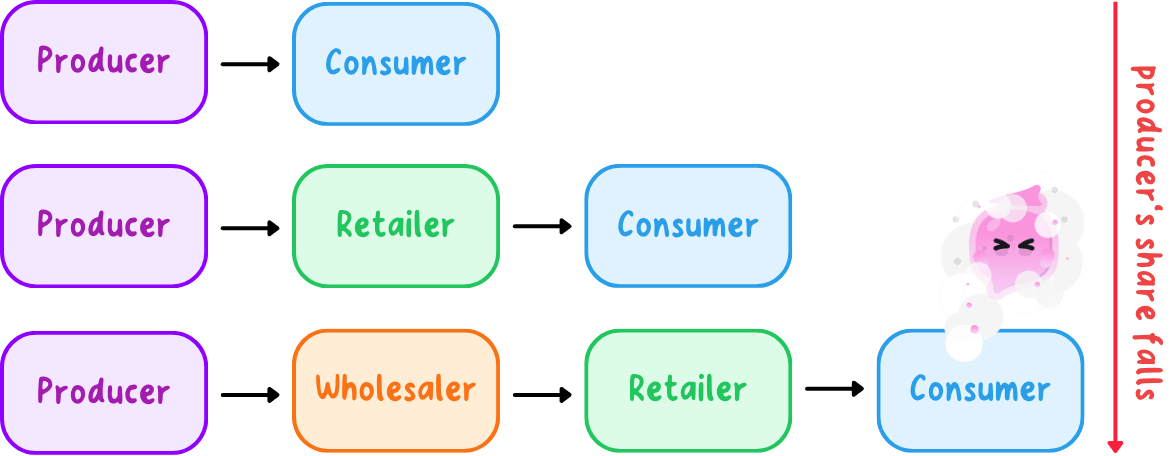
This diagram shows distribution channels more broadly. For GCSE Edexcel, focus on retailers and e-tailers (e-commerce) as the specified methods of distribution.
Comparing the three routes: who owns the customer, and what it costs you
The three methods differ on three things at once, set side by side below.
| Retailers | E-tailers | Selling direct | |
|---|---|---|---|
| Who owns the customer | The shop | The platform | The business |
| Effect on margin | Shop takes a share | Fee on every sale | Whole margin kept |
| Effort for the business | Low, the shop sells | Low, the platform handles orders | High, you do all of it |
- Read the bottom two rows together and the pattern is a straight trade: the more of the work a channel does for you, the more of your price it keeps.
- The top row matters most over several years, because a shop or a platform that owns the buyer can drop your product and keep the customer, which is why Gymshark built its own website and sold through fitness influencers rather than handing its buyers to somebody else.
E-commerce: why place stopped being a question about the high street
E-commerce: buying and selling goods and services online, through a website or an app, rather than in a physical shop.
- E-commerce widened the market from the people who walk past your door to the whole country, and to other countries if you are willing to post there.
- A website takes orders at three in the morning and on a bank holiday, and it pays no high-street rent or shop wages, so the business can carry lower fixed costs than a shop of the same size.
- Those savings are spent again on packaging, delivery and returns on every order, and on competing with every other seller a customer can compare in one search, so a wider market does not automatically mean more profit.
- A candle maker in Leeds sells around 200 candles a month at £8 each from a market stall, to whoever walks past that Saturday.
- Listing the same candles on Etsy puts them in front of shoppers across the UK, and orders now arrive overnight and at weekends.
- Each order costs about £3.50 in packaging and postage before Etsy's fee, so on an £8 candle the wider market only pays if she raises the price or sells in multiples.
- The stall stays open, because the customers who buy on the day cost nothing to deliver to.
Using more than one channel at once
- Most businesses now use more than one method of distribution at the same time, because no single route reaches every customer and each one does a different job.
- Click and collect exists because of that mix, letting the customer order on the website and pick the shopping up in store, so Tesco and Sainsbury's win the online sale without paying a driver to deliver it.
- The channels have to stay consistent, meaning the same product at the same price whichever way it is bought, because a shopper who finds the item cheaper online than on the shelf they just paid at stops trusting the business with either.
- Name the channel, then say what it does for this business, because "they should sell online" with no mechanism attached stays at the bottom of the levels.
- Carry the chain through: selling through a retailer reaches far more shoppers, so sales volume rises, but the retailer keeps a share of every price, so the profit on each unit falls.
- When the command word is explain or analyse, one channel followed all the way to its effect beats three channels listed.
- Use the channels the business in the source booklet already has, since application marks are gated on that context.
- Define channel of distribution.
- Give one advantage and one drawback of selling through a retailer rather than direct.
- Why does listing on an e-tailer such as Amazon or Etsy put pressure on your price?
- State two costs e-commerce adds and one cost it removes.
- What two channels does click and collect combine, and why must both show the same price?
2.2.5a How marketing mix elements interact
Product first: what you sell sets the limits on the other three
- The product is where the mix starts, because price, promotion and place can only work with qualities the product actually has.
- A well made, well designed product pushes the other three elements in one direction.
- Price: the extra durability gives the customer a reason to pay above the market average, so the business can hold a higher price without losing the sale.
- Promotion: the advertising has to show the materials and the making, since quality is the reason the price is high, and money off would contradict it.
- Place: it has to be sold somewhere that feels as careful as the product, because where a customer buys becomes part of what they think they are buying.
- Dr Martens sells boots on durability at a premium price, and the identical boots stacked in a discount shop would fetch less, because the surroundings tell the shopper the product is ordinary.
Price, promotion and place pull on each other
- Price and promotion: a low price propped up by constant discounting teaches customers that the full price is never the real price, so they wait for the next offer and full-price sales fall.
- A premium price needs promotion that builds an image instead, because an advert shouting about money off tells the customer the product was overpriced to begin with.
- Place and price: selling through a retailer or an e-tailer hands over a share of every sale, so the business must either accept a thinner margin or set a higher price than it would charge selling direct.
- A maker selling a bag direct at £20 keeps all £20, while a marketplace taking a fifth of the price returns £16, so the shelf price has to rise to £25 to leave the maker where it started.
- Place and product: a product that has to be explained, fitted or tried on sells badly through a marketplace where nobody serves the customer, while a simple repeat purchase such as printer ink suits online selling because the buyer already knows exactly what they want.
- Promotion and place: there is no point promoting to customers who cannot conveniently buy, so a campaign has to be matched by availability, or the interest it creates is collected by a rival who is stocked nearby.
- Greggs sells cheap hot food, which is quick to make in volume and needs no explaining at the counter.
- That product supports a low price, so the shops need heavy footfall to turn thin earnings per item into worthwhile takings.
- High streets and retail parks deliver that footfall, and the promotion talks about value and new lines such as the vegan sausage roll.
- Move the same food to an appointment-only shop down a side street and the volume the low price depends on disappears.
A consistent mix: four signals that say the same thing
Consistent marketing mix: a mix in which product, price, promotion and place all tell the customer the same thing about what the product is.
Every element is a signal, and the table sets a premium mix against a budget one, then shows what the customer sees when one element does not fit.
| Premium mix | Budget mix | Signal clash | |
|---|---|---|---|
| Product | Distinctive, high quality | Basic, cheap to make | Basic product, premium price |
| Price | Above the market average | Low and keen | High price, constant offers |
| Promotion | Image and craftsmanship | Deals and value | Luxury advert, cheap deals |
| Place | Selected stockists | High footfall and online | Premium brand, bargain bin |
- Read the table down a column rather than across, because the customer meets all four elements and builds one impression out of them.
- The third column shows the cost of a clash: a shopper who cannot tell which signal to believe assumes the cheaper one, so the high price stops looking credible and the spending on the other three elements is wasted as well.
Using a consistent mix to build an advantage over rivals is the next guide, on the integrated marketing mix.
Change one element and you must re-check the other three
- A price cut is never only a price decision, so trace it through the rest of the mix before deciding it is worth making.
- Product: the lower price may only be affordable if cheaper materials are used, which loses the customers who were buying for the quality.
- Promotion: the message has to move from quality to value, otherwise the new price and the old advertising contradict each other.
- Place: the extra volume a lower price is meant to bring has to be sold somewhere, so wider distribution or an online channel is usually needed to carry it.
- The same re-check follows any change, so a move from shops to online selling cuts rent, allows a lower price and shifts who the promotion should aim at.
- Name the two elements you are linking, then run the chain: this choice in one element, so this effect on the other, so this effect on sales or on the margin.
- Four separate descriptions of product, price, promotion and place earn little when the question asks how they influence each other.
- Use the business in the source booklet rather than a memorised favourite, since application marks are gated on that context.
- When the question says justify or evaluate, judge whether the mix is consistent and name the element that does not fit the rest.
- Why does the product decide what price the rest of the mix can support?
- What happens to full-price sales when a business discounts constantly?
- A marketplace takes a fifth of a £20 selling price, so how much reaches the maker?
- Define a consistent marketing mix.
- Name two elements a business must re-check after cutting its price.
2.2.5b The integrated marketing mix and competitive advantage
An integrated marketing mix: four choices, one position
Integrated marketing mix: product, price, promotion and place chosen together so that all four support the same position in the market.
Competitive advantage: something a business offers that customers value and rivals do not match, giving customers a reason to buy from it rather than from anyone else.
- Integration means the four elements are decided as one package aimed at one group of customers, so each element makes the other three more believable.
- The test is whether a customer who met only one element could guess the other three, because £2.50 hot food, a plain shop on a busy high street and a promotion about value all point at the same shopper.
- When one element pulls against the rest the customer believes the weakest signal, so a high price in a scruffy shop reads as overcharging rather than as quality, and the money spent building that price position is wasted.
- The most common mistake in a recommendation is a mix whose elements argue with each other, such as a premium product put on discount every week.
- Constant discounting teaches customers to wait for the offer, so the premium price stops working and the image the business paid to build is spent.
- Check any mix you recommend by asking whether all four elements would make sense at once to a single customer standing in front of them.
Two positions, two mixes: budget and premium
The same four elements can carry opposite positions, provided every one of them points the same way.
| Element | Budget position | Premium position |
|---|---|---|
| Product | Simple, narrow range | Distinctive, high quality |
| Price | Low, close to rivals | High, held firm |
| Promotion | Value, offers and price | Image, design and quality |
| Place | High-volume shops and online | Selective places that match |
- Aldi and Lidl sit in the budget column, where a narrower product range cuts buying and stock-handling costs, which is what makes the low price profitable rather than a loss.
- Dyson sits in the premium column, where over 5,000 prototypes went into the bagless vacuum, the promotion sells that engineering, and the high price both repays the development and signals that the machine is worth more than a cheap rival.
- The row that breaks the pattern does the damage, because a premium price on a business built for volume leaves the product too dear for budget shoppers and too plain for premium ones, so it loses both.
From a mix that fits to an advantage that holds
- Competitive advantage begins with fit, because a mix that matches its target customers more closely than the rival's mix gives those customers a reason to choose this business.
- That reason is what wins the sale without undercutting on price, so the margin on each sale survives instead of being competed away.
- A surviving margin leaves money to reinvest in the product and the promotion, which improves the fit again and widens the gap the rival has to close.
- A single element is cheap to copy, since a rival can match your price by Friday and run its own version of your promotion inside a week.
- Copying a whole position is different work, because the rival has to redesign the product, change the places it sells through and rebuild a reputation customers already attach to you, which takes years rather than days.
- No position is permanent, so when customers' tastes, rivals' offers or the technology move, a mix that fitted becomes a mix that fits nothing, which makes integration a decision you revisit rather than one you make once.
- Blockbuster's mix once held together: DVDs to rent, a price per rental, promotion inside the shop and shops customers could walk into on the way home.
- Streaming changed where people wanted to get films, so every element of that mix was suddenly aimed at a place customers had stopped going.
- The UK business entered administration in 2013, and Netflix took the customers with a mix built around the new technology.
- Integration protected Blockbuster while the market stood still and trapped it once the market moved.
Judging what matters more: the whole mix or one strong element
- A single strong element can win customers quickly and may suit a start-up with limited cash, but it is usually easier for rivals to copy than a consistent position across all four elements.
- An integrated mix becomes more valuable when products differ, the business can afford to support all four elements and it wants an advantage that lasts rather than a short-term sales boost.
- Overall, established firms usually gain more from a coherent integrated mix, while a cash-limited start-up may sensibly lead with one distinctive element and build the rest of the position over time.
- State the market position first, then show how the four elements support it rather than listing four separate decisions.
- Use the customers, rivals and budget in the source booklet and trace the mix through sales, margin and competitive advantage.
- For a judgement, consider whether the firm can afford to change all four elements and whether a whole position is harder to copy than the strongest single element.
- What does it mean to call a marketing mix integrated?
- Give one product decision and one place decision that fit a budget position.
- Explain how holding the margin on each sale widens a competitive advantage.
- Why can a rival copy a price far faster than it can copy a whole position?
- Name one change that can make a well-integrated mix stop fitting its market.
