2.5.1a Organisational structures
Reading an organisational chart: who reports to whom
- An organisational chart is drawn as a pyramid: a single box at the top for the owner or managing director, a wider row of department managers below it, and under each manager the row of staff that manager is responsible for, with a line joining every box to the box above that it reports to.
- Hierarchy and levels: the layers of authority from top to bottom, one level for each horizontal row of boxes on the chart.
- Chain of command: the line down which instructions pass from the top to the bottom, so a long chain puts more layers between the decision and the person carrying it out.
- Span of control: the number of people a manager is directly responsible for, wide when many report to one manager and narrow when only a few do.
- Tall structure: many layers, narrow spans of control and a long chain of command.
- Flat structure: few layers, wide spans of control and a short chain of command.
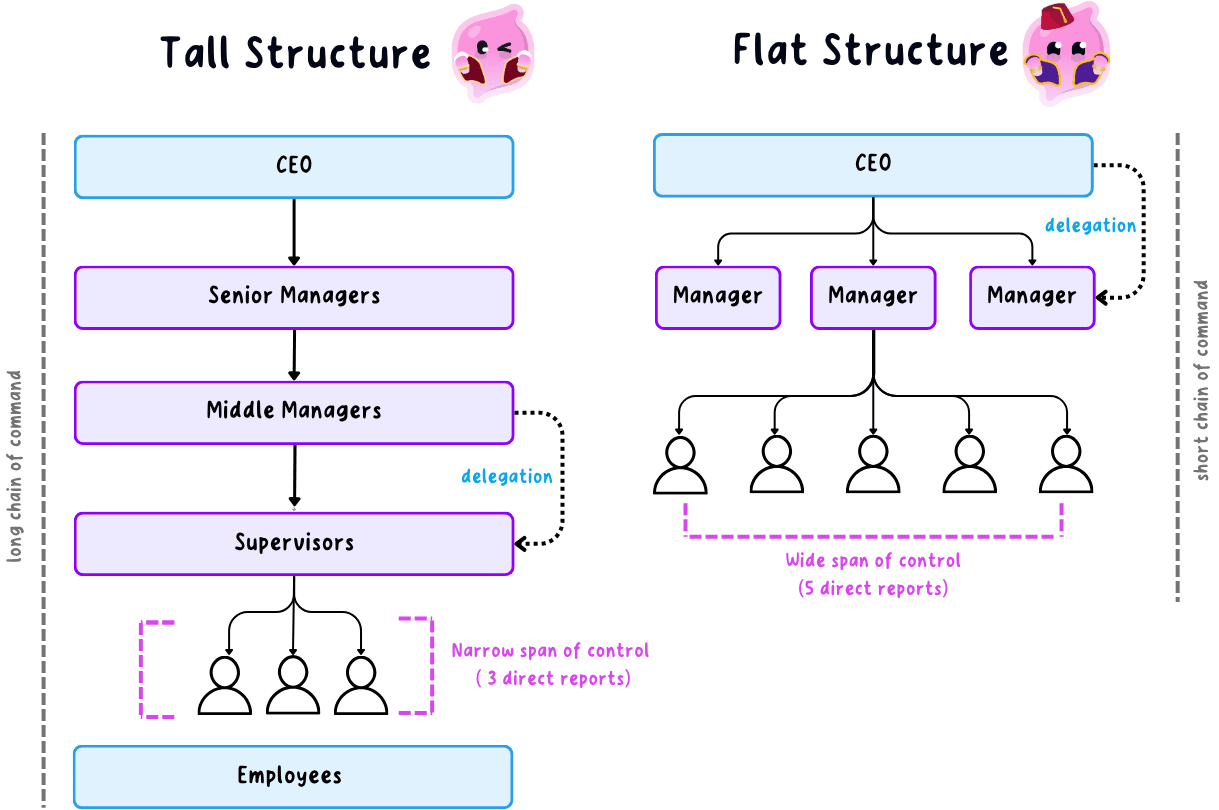
The diagram uses the term tall structure. For GCSE Edexcel, focus on hierarchical and flat structures; a tall structure is a hierarchical structure with more management levels and a longer chain of command.
- Centralised decision making: decisions taken at the top of the business and passed down the chain to be carried out.
- Decentralised decision making: decisions delegated to managers or staff further down the hierarchy.
Tall or flat: what each shape does to the business
The table sets the two shapes side by side on the five features an exam question tests most often.
| Feature | Tall structure | Flat structure |
|---|---|---|
| Number of layers | Many | Few |
| Span of control | Narrow | Wide |
| Speed of communication | Slow | Fast |
| Cost of managers | High | Low |
| Staff responsibility | Limited | Greater |
- The rows move together rather than separately, because taking out a layer leaves the remaining managers holding the staff that layer used to supervise, so every gain in speed and cost is bought with a wider span.
- A tall structure gains control: each extra layer is another rung on the promotion ladder for an ambitious employee, and a supervisor watching six people can spot a mistake the day it is made.
- A tall structure loses time: every instruction stops at each layer on the way down, so a change agreed by a director on Monday may still not have reached the till by the following week, and staff at the bottom feel remote from choices they had no part in.
- A flat structure gains pace and commitment: an idea from the shop floor reaches the owner in one step, and staff given real responsibility usually work harder at decisions they helped make themselves.
- A flat structure loses supervision and promotion: a manager responsible for twenty staff cannot coach each one, and an employee with no next rung to climb to often leaves for a business that has one.
- Tall does not mean big, because a large business can run a flat structure and a small one can stack up several supervisor layers.
- Judge the shape by counting rows of boxes down the chart, never by counting employees.
- Span of control counts people sideways, not layers downwards, so a manager with three levels beneath them may still have a narrow span.
Centralised or decentralised: where the decision is taken
- Centralising gains consistency and tight control, because every branch follows one procedure and one head-office team sets the price, which is how Aldi holds a narrow product range at the same low prices in every store.
- Centralising loses local speed, because a store that spots a problem has to wait for head office to agree a change, and staff who are never asked come to feel untrusted and stop passing ideas up.
- Decentralising gains quicker local decisions and uses knowledge head office does not have, so a supermarket branch manager can build rotas around the shopping patterns of that town rather than a national average.
- Decentralising loses consistency, because two branches may settle the same complaint differently, and it works only with capable, trained staff since one weak manager given real authority can damage the brand across a whole town.
Judging which structure suits a business
- A small business in a fast-moving market is more likely to benefit from a flat, decentralised structure, while a larger or more stable business may accept more hierarchy and central control to keep standards consistent.
- Staff skill and trust set the limit: wide spans and decentralised decisions work better with experienced employees, while new or high-risk work may need closer supervision.
- Overall, choose the structure that fits what the business competes on, balancing consistency and control against speed, local knowledge and employee responsibility.
- Keep levels of hierarchy, chain of command and span of control separate, then develop the effect of the structure on this business.
- Use the staff experience, size and pace of change in the source booklet when deciding whether close control or faster delegated decisions matter more.
- For a judgement, name the factor that decides it and commit to one structure rather than listing both.
- Define span of control.
- State three features of a tall structure.
- One supervisor watches six people and another manager is responsible for twenty, so which of them has the wider span of control?
- Give one drawback of centralised decision making.
- Name two things that decide whether a flat structure suits a business.
2.5.1b The importance of effective communication
What effective communication means: the right information, to the right person, in time
Effective communication: information that reaches the person who needs it, early enough for them to act on it, and is understood as the sender meant it.
Feedback: the response from the receiver that shows the sender whether the message was understood.
- Effective communication has to pass three tests, because sending a message and communicating it are not the same thing.
- The right person: the information reaches whoever has to act on it, not everyone in the building and not only the manager who already knew.
- In time: it arrives while the receiver can still do something with it, since a change to an order sent after the delivery van has left changes nothing.
- Understood: the receiver takes the same meaning from it as the sender intended, which is what feedback tests, because a reply or a repeated-back instruction proves understanding where silence proves nothing.
What a business gains when communication works
- Fewer mistakes: staff who know exactly what is expected do the job right first time, so less material is wasted and less labour is paid for twice.
- Faster response: a decision reaches the people carrying it out in hours rather than days, so the business can cut a price or pull a faulty batch before customers or rivals react.
- Better morale and lower staff turnover: staff who are kept informed about changes feel trusted and valued, so fewer of them leave and the business spends less on recruiting and training replacements.
- Greggs sells cheap hot food at high volume from high street and retail park shops across the UK, so one head office message has to land in every branch on the same morning.
- When it launched its vegan sausage roll, counter staff needed to know what it was and what it cost before the first customer asked.
- In a shop where that message did not arrive, a national launch becomes a customer being given the wrong answer at the till.
Insufficient communication: what too little does to efficiency and motivation
- Mistakes and duplicated work: two people process the same order because neither was told the other had it, so the labour is paid for twice and the customer still waits.
- Wasted time: staff stop work to chase a manager for information that should have arrived with the task, so output per hour falls while the wages carry on being paid.
- Low morale: staff who hear about a change from a customer rather than from their manager feel left out, so motivation drops and absence and turnover rise.
- Poor customer service: staff who do not know that an offer has started or that a product has been withdrawn give the wrong answer, so the business looks disorganised and the sale goes elsewhere.
- Slow decisions: a manager waiting on figures from another department cannot choose, so a supplier discount or a delivery slot is gone before anyone acts.
Excessive communication: what too much does to efficiency and motivation
- Excessive communication is the opposite fault: staff are copied into every email, added to every group chat and booked into meetings that have nothing to do with their own work.
- Efficiency falls because the working day goes on reading messages and sitting in meetings instead of doing the job, so a supervisor booked into three meetings has three fewer hours on the shop floor and the orders go out late.
- The message that mattered is lost among the ones that did not, so a price change or a safety notice is skimmed past with the rest and missed altogether.
- Motivation falls because being copied into everything while having no say in any of it is draining, and staff soon learn that most of what arrives can be ignored.
- Messages arriving at any hour blur the line between work and home, since staff who feel expected to answer in the evening never properly switch off and come in tired.
- A manager who forwards everything signals that they do not trust staff to work out what matters, so experienced people feel watched rather than relied on.
- Too little and too much end in the same place for the business, because output per hour falls either way and the staff with the most choice about where they work are the first to leave.
Barriers: why messages fail, and where structure comes in
- Too many layers: a message sent down the long chain of command of a tall structure is reworded at every level it passes, so it arrives late and distorted, which is one of the main arguments for the flatter structures covered in the previous guide.
- The wrong medium: a long email about an urgent shift change is read too late, and a quick verbal instruction for a complicated safety procedure leaves no record anyone can check.
- Information overload: so much is sent that the one message that mattered is skimmed past with the rest, which is the barrier that excessive communication builds.
- Language and jargon: the receiver does not know the technical words or does not read English fluently, so they act on a guess instead of the instruction.
- No feedback: nobody replies or checks, so the sender never learns the message was misunderstood until the work comes back wrong.
- Technology has flattened two of these barriers, because messaging apps, video calls and shared systems reach a home worker or a distant branch instantly, though the same tools are what make excessive communication so easy to fall into.
- Name the barrier with the proper term, because 'information overload' or 'a long chain of command' earns more than 'bad communication'.
- Match the fix to that barrier, since plain language cures jargon but only removing layers cures distortion between them.
- Say whether the fault is too little or too much communication, then finish the point on costs, sales or profit rather than on the staff.
- When the question says explain or analyse, one developed chain applied to the business in the source booklet beats four unlinked problems listed in a row.
- What three tests must a message pass to count as effective communication?
- Give one effect of insufficient communication on efficiency and one on motivation.
- Name four barriers to effective communication.
- Why does a long chain of command make communication slower and less accurate?
- Give one way excessive communication harms efficiency and one way it harms motivation.
2.5.1c Different ways of working
Hours of work: part-time, full-time and flexible hours
- Part-time: working fewer hours than the business's standard week, often evenings and weekends only.
- The business buys cover exactly when customers arrive and pays nothing for the quiet hours, so a Saturday rush can be staffed for a few hundred pounds a month rather than by funding a whole extra full-time post.
- The employee can fit the job around college or caring for a relative, but total pay is lower because pay follows the hours worked.
- The cost is continuity, since three part-timers need three lots of training and a rota, and a customer may deal with a different face on every visit.
- Full-time: working the standard week, usually somewhere around 35 to 40 hours.
- The business has the same people available every day, and they build up experience of its products, its systems and its regular customers, which makes spending money on their training worthwhile.
- The employee gets a steady income they can budget on and usually better benefits, such as paid holiday, sick pay and a workplace pension.
- Those wages have to be paid in a quiet week as well as a busy one, so a fall in demand cuts straight into profit before the business can cut its wage bill.
- Flexible hours: staff choose their own start and finish times inside limits set by the employer, often around a core period when everyone has to be there.
- The business keeps staff who would otherwise leave for an employer that offers it, and the phones stay answered across a longer day because early starters and late finishers overlap.
- The employee controls their own time, so a parent can start at 7.30am and still collect a child at 3pm without giving up hours.
- Cover becomes harder to guarantee, because an 8am delivery or a team meeting can find half the staff not yet in, so the employer has to fix core hours and plan the rota round them.
Contracts: permanent, temporary and freelance
Permanent contract: ongoing employment with no agreed end date, lasting until the employee leaves or is dismissed.
Temporary contract: employment for a fixed period or until a particular job is finished, such as a summer season.
Freelance contractor: a self-employed person paid for a job rather than employed, so they are never on the payroll.
The three sit in a clear order on the four things an owner weighs before offering work to anybody.
| Permanent | Temporary | Freelance | |
|---|---|---|---|
| Cost to the business | Wage plus holiday and pension | Wage for the fixed period | Fee per job, no wage bill |
| Commitment | High | Often lower | Low, has other clients |
| Flexibility for the business | Low | High, ends on the date set | Highest, hired job by job |
| Security for the worker | High | Low, the job has an end date | None, income varies weekly |
- Continuity is what the permanent row buys, since staff who know the regular customers keep them coming back and training paid for in year one is still earning in year three, though cutting that team back later means notice periods and redundancy pay.
- A temporary contract lets a garden centre carry its spring peak or a warehouse cover a six-week Christmas run without carrying those wages in February, but each new intake has to be trained again, which eats into the saving if the peak comes round every year.
- Freelance work buys a specialist only for the hours the skill is needed, which is how Gymshark used fitness influencers to sell online rather than employing a marketing department, but the business controls the result far less than it controls an employee and has no guarantee that the same person is free next time.
Judging the mix: what the right pattern of working depends on
- How much demand varies through the year: a seaside cafe that takes most of its revenue between June and September would run out of cash paying a permanent full-time team through the winter, so the peak belongs on part-time and temporary contracts.
- Whether the work needs specialist skills: a skill used twice a year, such as rebuilding a website, is cheaper bought freelance, because a specialist on the payroll is paid for the ten months nobody needs them.
- How much the business values continuity with its customers: a hairdresser or a dentist keeps customers partly because the same person sees them each visit, so permanent staff protect revenue in a way a stream of temporary faces cannot.
- What the business can afford: a start-up with £5,000 behind it cannot promise permanent wages before the sales arrive, so it opens with part-time and freelance help and makes posts permanent once the revenue is predictable.
- Most businesses therefore settle on a permanent core sized to their quietest month, with part-time, flexible, temporary and freelance workers layered on top for the peaks, because the core protects quality and customer relationships while the layer stops the wage bill becoming a fixed cost the business cannot cover when demand drops.
- Say which thing the arrangement changes, the hours worked or the length of the contract, because part-time is about hours while temporary is about how long the job lasts, and a part-time job can be permanent.
- Build the chain in three links: the arrangement, what it does to costs or to cover, then what that means for profit or service in this business.
- Every arrangement still sits under the employment law from 1.5.3b, so never argue that part-time or temporary staff can be paid below the minimum wage.
- When the question says justify or evaluate, weigh the wage saving against the loss of commitment and choose the mix that matches the demand pattern given in the source booklet.
- What is the difference between a part-time contract and a temporary contract?
- Give one benefit of flexible hours to the business and one to the employee.
- State one drawback to a business of staffing a shop entirely with part-time workers.
- Why might a business pay a freelancer instead of employing someone permanently?
- Which contract gives the worker the most security, and what does the business give up to offer it?
2.5.1d Impact of technology on ways of working
Remote and hybrid working: the job stops needing an office
Cloud storage: files kept online rather than on one office computer, so the same document can be opened and edited from any device with a connection.
Automation: using software or machines to carry out a task that a person used to do by hand, usually a repetitive one such as sending invoices or booking appointments.
- Video calls, cloud storage and instant messaging mean the tasks of most office jobs can be done from any room with a connection, so the building stops being the thing that holds the work together.
- The business gains on two fronts when it lets staff work at home or split the week between home and office.
- Lower premises costs: if staff come in on alternate days the firm can rent a smaller office and share desks, so rent, heating and cleaning all fall, and those are fixed costs that had to be paid whether trade was good or not.
- A wider choice of staff: a vacancy can be filled by someone two hundred miles away, so the firm recruits from a national pool instead of one town, and experienced staff who value flexibility stay rather than leave.
- The same arrangement costs the business three things.
- Supervision is harder: a manager cannot see who is stuck, so a problem surfaces days later, and performance has to be judged on output rather than on hours visibly spent at a desk.
- A team is harder to build: a new employee at home picks up far less from overhearing experienced colleagues, so informal learning slows and loyalty to the team is weaker.
- Equipment and security must be provided: a laptop, a phone and a secure connection are needed in every home, and customer records now sit outside the office where they are easier to lose.
- For the employee the gain is concrete, because losing a commute returns an hour a day and the £5 or so it cost in fares or fuel, and the working day can bend around childcare or a college course.
- The cost to the same employee is isolation and a blurred line between work and home, since the laptop sits in the same room as the sofa and a message at nine in the evening is easy to answer and hard to ignore.
Flexible hours, automation, messaging and monitoring: a gain and a cost in each
- Flexible hours only became practical once technology stopped work having to happen in one place at one time, and three further changes follow the same pattern of a gain with a cost attached.
- Automation is the row with the sharpest split, because software takes the repetitive work and frees staff for tasks that need judgement, such as calming an angry customer, while some jobs disappear altogether and the staff who remain must be retrained on the new system.
- Monitoring is the row most likely to backfire, since tracking output lets a manager see a falling delivery rate in days rather than months, but staff who feel watched trust their employer less, and demotivated staff work slower, which eats the gain the tracking was bought for.
| Change | Gain | Cost to weigh |
|---|---|---|
| Flexible hours | Longer trading day covered | Handovers and cover gaps |
| Automation of routine tasks | Repetitive work done faster | Jobs lost, retraining needed |
| Messaging and shared files | Quicker decisions | Message overload, instant-reply pressure |
| Monitoring software | Problems spotted early | Feels like surveillance |
- Deliveroo launched in London in 2013 and depends on smartphones, which connect the restaurant, the rider and the customer.
- The app is what makes the hours flexible, because a rider can log on when it suits them instead of turning up for a fixed shift.
- The same app is also the supervisor, since it hands out the orders and shows where the food is, so nobody has to stand in a depot counting riders in.
- Take that technology away and the business does not exist in a smaller form, it does not exist at all.
Technology changes who a business can employ, not only how
- The deepest change is to the labour market a business is fishing in, because a firm that allows remote working can hire someone hundreds of miles away and one that does not is limited to people within commuting distance.
- A small accountancy practice in Norwich that accepts home working can take on a bookkeeper in Glasgow, so it appoints on skill rather than on postcode and is less likely to be forced into a pay rise to tempt the only qualified applicant nearby.
- It cuts the other way for the employee, because a job that can be done from anywhere can also be done by anyone anywhere, so the competition for it is national rather than local.
What the technology costs to buy and to depend on
- None of these gains is free, because laptops and phones have to be bought, software is usually charged as a licence per user every month, and someone has to be paid to fix it when it stops.
- Training is the cost that is easiest to forget, since every hour a member of staff spends learning a new system is an hour they are paid for but not producing, and output usually dips before it improves.
- Dependence is the sharper risk, because a business that has moved its orders, files and payments online has no paper system to fall back on, so a broadband or server failure stops everybody at once rather than slowing one department.
- That is why the smaller the firm, the harder these costs bite, as a sole trader pays the same monthly licence fee as a large company but spreads it over far less revenue.
- Name the technology, then the way of working it changes, then the effect on the business: cloud files allow home working, so the firm rents a smaller office, so fixed costs fall.
- The link most often dropped is the last one, where an answer names a technology but never says what it does to costs, output or staff.
- Answer for the business in the source booklet, because remote working suits an insurance office and does nothing for a hairdresser or a bakery counter.
- When the question says discuss, justify or evaluate, set an employer gain against an employee cost rather than listing two gains.
- Define automation.
- Give one gain and one cost to a business of letting office staff work from home.
- Why does allowing remote working widen the pool of people a business can employ?
- State two costs a business faces when it introduces new technology for its staff.
- Why can monitoring software damage the relationship between a manager and their staff?
2.5.2a Different job roles and responsibilities
Directors and senior managers: setting the direction and running the functions
- Directors are appointed by the owners or shareholders and are accountable to them for the performance of the business as a whole.
- They set the overall aims and the long-term strategy, deciding the matters that commit the whole business, such as entering a new market or investing in a new site.
- Because they answer to the shareholders, a run of falling profit is a director's problem before it is anyone else's.
- Senior managers each run a whole function, such as marketing, finance, human resources or operations.
- Their job is to turn the directors' strategy into plans with targets, deadlines and the people to deliver them.
- They control that function's budget and staff, so they decide how the money allocated to their area is spent and who does what within it.
- They answer to the directors for their function's results, so it is the marketing manager who is asked why sales have fallen.
- Greggs sells cheap hot food at high volume from shops on high streets and retail parks.
- Adding a new line such as the vegan sausage roll is a director-level call, because it commits every shop in the chain to new suppliers, new equipment and a national advertising spend.
- A senior manager in operations then works out which bakeries make it and how much each shop receives.
- The shop supervisor puts it on the rota and the counter staff sell it, and none of them chose to launch it.
Supervisors, team leaders and the staff who do the work
- Supervisors and team leaders run a team day to day and are the link between the managers above them and the staff doing the work.
- They allocate the work, set the rota, check it has been done to the required standard and pass any problem they cannot solve up the chain.
- Operational staff do the work the business exists to do, such as baking the bread, driving the delivery van or serving at the till.
- They are responsible for their own output and for following the procedures set above them, such as food hygiene rules or a safety check before a machine is used.
- They answer to their supervisor or team leader rather than to a director, so a problem with the work goes up one level first.
- Support staff keep the business running behind the front line, in administration, IT, human resources and finance.
- They bring in no sales directly, but if the payroll is wrong or the tills stop working the shop cannot trade, so what they are responsible for is keeping everyone else able to work.
- They answer to the senior manager of the function they sit in, such as the head of finance for the person who runs payroll.
Tall and flat structures, span of control and chain of command belong to 2.5.1a, so here you need only place each role at the right level.
How the roles map onto the structure
The same jobs still have to be done whatever the size of the firm, as this comparison shows.
| Job to be done | Market stall | Supermarket chain |
|---|---|---|
| Setting the aims | The owner | The board of directors |
| Running a function | The owner | Senior managers |
| Allocating daily work | The owner | Supervisors and team leaders |
| Serving the customer | The owner | Operational staff |
| Payroll and IT | The owner, or a hired accountant | Support staff |
- On the market stall every one of those jobs is still done, but one person does all of them, so the roles exist as tasks rather than as job titles.
- As a business grows the jobs split off one at a time, supervision usually first, which is why the word manager can mean a department of two hundred in one firm and a shift of three in another.
- Name the role, then a responsibility, then the effect on the business, because a role named on its own earns nothing.
- Match the decision in the source booklet to the right level: opening a new site to a director, a departmental budget to a senior manager, next week's rota to a supervisor.
- Do not confuse a senior manager, who runs a whole function and its budget, with a supervisor, who runs one team's day.
- When the question says outline or explain, say who the role answers to as well as what it does, since that is the half most often left out.
- Who appoints the directors, and what are they accountable for?
- What does a senior manager control that a supervisor does not?
- Give two support staff roles and say why a shop cannot trade without them.
- Name the five job roles in the order they sit in the hierarchy.
- Who does a member of operational staff answer to day to day?
2.5.2b Recruitment documents
The job description: what the business needs done
Job description: a document written by the business setting out the title, duties and responsibilities of a particular job.
- A vacancy starts with the business writing down three things about the role, because it cannot describe the right person until it knows the work.
- Job title and reporting line: the name of the post, where it sits in the structure and which manager the person answers to.
- Duties and responsibilities: the tasks the person carries out day to day and what they are held accountable for.
- Hours and location: full time or part time, the shift pattern, and the site or shop the person works at.
- Its first job is to tell an applicant what they would actually be doing, so someone who wants different work rules themselves out before applying.
- Its second job starts after the hire, because the listed duties become the standard the manager measures the employee against when the work is reviewed.
The person specification: who could do it
Person specification: a document written by the business setting out the qualifications, skills, experience and personal qualities the ideal candidate needs.
- The person specification turns those duties into the qualities someone would need to carry them out, and the requirements are usually split into two lists.
- Essential: the candidate cannot do the job without it, such as a full clean UK driving licence for a delivery round.
- Desirable: it would help but can be trained later, such as having used the same till system before.
- The split gives the business objective criteria, so every applicant is measured against the same written list rather than against whichever candidate the manager warmed to.
- The job description is about the job, and the person specification is about the person, which is the distinction thrown away most often in this topic.
- Sort any item by asking whether it describes work to be done or a quality a human has.
- "Serve customers at the till" belongs in the job description, while "friendly and reliable" belongs in the person specification.
- Listing duties under the person specification scores nothing, however accurate the detail is.
The application form and the CV: what the applicant sends back
- An application form is a standard set of questions written by the business, covering personal details, qualifications, work history, why the applicant wants the job and who will give a reference.
- Because every applicant answers the same questions in the same order, the business can hold each form against the person specification and shortlist quickly and fairly.
- A curriculum vitae, or CV, is the applicant's own summary of their education, work history and skills, written and laid out however they choose.
- That gives more of a sense of the person, and the layout itself shows how clearly the applicant writes.
- It also makes comparison slower, because no two CVs are set out the same way and an applicant can leave a gap in their work history out altogether.
- A chain such as Greggs, hiring across hundreds of high-street shops at once, needs every applicant to answer the same questions, because nobody can read that many differently laid out CVs against the same criteria.
- The form costs time to design, but that cost is spread over every vacancy it is later used for.
- A bakery in Leeds hiring one Saturday assistant gains little from designing a form, so asking for a CV is cheaper and quick enough at that scale.
Why these documents matter beyond paperwork
- Written documents make selection more objective, because each applicant is judged against criteria fixed before anyone applied rather than against a manager's impression on the day.
- That helps the business meet the legal duty not to discriminate covered in 1.5.3b, since the person specification is the evidence that the same test was applied to everyone.
- The documents also cut the risk of hiring the wrong person, which is expensive because the business pays to advertise, interview and train someone before that person is productive.
- A vague job description is the usual cause of that waste: the person hired expected different work, so they leave within months and the whole cost of recruiting and training is spent again on a replacement.
- When the command word is define or state, name who writes the document and what it holds, because that one sentence is the whole answer.
- When the command word is explain, carry the document through to a consequence: a standard form means identical answers, which means faster shortlisting, which means a lower recruitment cost.
- Sort any item you are given by asking whether it describes the work or the worker, a test that settles almost every option offered.
- Name the business in the source booklet and the sort of staff it hires, because application marks are gated on that context.
- Which document describes the job, and which describes the person?
- Give three things a job description contains.
- What is the difference between an essential and a desirable requirement?
- State one advantage to a business of an application form over a CV.
- Why can a vague job description end up costing a business money?
2.5.2c Recruitment methods
Internal recruitment: filling the post from people you already employ
Internal recruitment: filling a job vacancy with someone who already works for the business.
- Internal recruitment happens in two ways: promoting an employee into a more senior post, or transferring one sideways from another department or branch.
- Shorter induction: the appointee already knows the products, the till system, the suppliers and the customers, so they are working properly within days instead of spending weeks being shown round.
- A visible promotion ladder: staff who watch a colleague move up can see that effort is rewarded, so they work harder and are less likely to leave for a rival.
- No new thinking: an insider has only ever worked the way this business works, so a firm that promotes from within year after year keeps repeating methods nobody has questioned.
- A knock-on vacancy: promoting a supervisor empties the supervisor's own post, so one recruitment has quietly become two and the saving is smaller than it first looked.
External recruitment: buying in what the business does not have
- External recruitment fills the post with someone from outside, chosen from people who have never worked for the business.
- Skills and experience: someone who has run an online shop for a rival arrives knowing how to do it, which is the only way a firm gets a skill no current employee has ever used.
- Room to grow: going outside is the only route that adds a person to the payroll, because promoting an insider just moves the same employee around.
- A long induction: a newcomer has to learn the products, the systems and the people while drawing full wages, so for a technical post the business pays for months of work it does not yet get back.
- Managers weigh the two routes across five things.
| Internal recruitment | External recruitment | |
|---|---|---|
| Cost | No advert or fee | Adverts and agency fees |
| Speed | Days, no notice period | Weeks or months |
| Choice of candidates | Current employees only | Anyone who applies |
| Risk of a poor hire | Low, performance already seen | Higher, judged from an interview |
| Effect on existing staff | Motivating, some resentment | Staff can feel blocked |
Four of the five rows favour the internal route for the same underlying reason: the business is choosing from people it has already trained and watched, so it is not paying to find out what it already knows.
The choice row overturns the other four, because a fast, cheap, low-risk appointment is worth nothing if the person appointed cannot do the job.
Where a business advertises an external vacancy
- Own website and social media: close to free, and it reaches people who already follow the business, which is how a firm like Gymshark reaches an audience built through fitness influencers.
- Job boards and recruitment agencies: a board puts the vacancy in front of thousands of people within a day, while an agency can approach experienced people who are not even looking, in return for a fee that often runs into thousands of pounds for one appointment.
- Local press, shop windows and word of mouth: cheap and strictly local, so they suit a delivery driver or a Saturday shop assistant rather than a specialist post.
Judging which route a business should take
- Do the skills already exist inside: if no current employee has ever run a payroll or a website, promotion cannot invent that skill, so the business has to go outside however much it costs.
- How fast, and for how much: a high-street bakery like Greggs that loses a shift supervisor before a busy weekend needs the post covered in days and will not pay an agency fee for a role it can fill from the counter.
- New thinking or continuity: a business with falling sales gains from someone who has done the job differently elsewhere, while one that is trading well gains more from a person who will keep it steady.
- Overall, promote from inside when the skill is already there and the post must be filled quickly, and recruit outside only when the business needs a skill or an outlook nobody inside has, because that gap is the one thing money spent on advertising can actually close.
- When the question says analyse, run the chain out: internal recruitment is faster, so the post is covered sooner, so customers are still served while the job is being filled.
- Application marks are gated on the context, so use the budget, size and existing staff of the business in the source booklet instead of a general answer.
- If you recommend promoting from within, say what the business will do about the colleagues who applied and were turned down, because that is where judgement is credited.
- Do not answer a methods question with a list of channels, since the marks come from matching one channel to the role and saying why it fits.
- Define internal recruitment.
- Why does promoting a supervisor often leave the business with a second vacancy?
- Give two things an external candidate can bring that an internal one cannot.
- Which advertising channel suits a specialist senior post, and what is the drawback?
- Give one business need that makes external recruitment the better choice than internal.
2.5.3a How businesses train and develop employees
Formal, informal and self-learning: three ways to build a skill
Formal training: organised, structured sessions run either in-house or by an outside provider, often leading to a recognised qualification.
Informal training: learning the job by watching a colleague and being shown how, with no set programme and no certificate at the end.
- Formal training follows a planned programme, such as a food hygiene course, a first-aid certificate or an apprenticeship run with a local college.
- Every trainee leaves doing the task the same correct way, which matters where a mistake injures someone or loses a customer, but the fee is paid up front and the worker is away from the job while it happens.
- Informal training happens at the workbench or the counter, where an experienced colleague shows the new person how the machine is loaded or how a difficult customer is handled.
- Nothing is spent beyond the colleague's time and the learner keeps producing while they learn, but what gets taught depends entirely on who is teaching, so shortcuts and bad habits are passed on with everything else.
- The induction a new starter is given in their first days, being shown the till, the stockroom, the safety rules and who to ask, is informal training at its most common.
- Self-learning puts the employee in charge, working through online courses or materials the business provides in their own time or in quiet periods.
- It costs the business almost nothing and never takes anyone off a shift, but it relies on the person choosing to do it, and nobody checks that the learning has actually happened.
- The three methods differ on four things a business weighs before choosing, and none of them wins on all four.
| Formal | Informal | Self-learning | |
|---|---|---|---|
| Cost to the business | High: fees and cover | Low: a colleague's time | Very low: materials only |
| Time away from the job | Often a full day or more | None, learns while working | Own time or quiet periods |
| Consistency of quality | Same content every time | Varies with the trainer | Varies with the material |
| Leads to a qualification | Usually | No | Rarely |
The last row settles most decisions, because only formal training ends in something an outsider will accept as proof, which is why a food business pays for hygiene certificates instead of relying on a colleague's explanation.
Ongoing training: what carries on for staff already in the job
- Ongoing training continues throughout someone's employment instead of stopping in their first week, because products, systems and the law all change while a person is in the job, so staff at a supermarket who learned the old checkout system need training again once it is replaced.
- Ongoing training also changes how motivated staff feel and how many of them stay, which the next guide develops.
- Retraining staff to use new technology is covered in the guide on technology and employees.
Target setting and performance reviews: how a business decides who needs what
Performance review: a meeting, usually once or twice a year, in which a manager and an employee look back at what was achieved and agree targets for the period ahead.
- The targets agreed have to be specific and measurable so that both sides can tell at the next review whether they were met, which is why 'complete the food hygiene certificate by June' works where 'improve your customer service' does not.
- Training needs surface early: the review shows the gap between what someone can do now and what the job needs, so a course is booked before that gap turns into a complaint, a wasted batch or an accident.
- Effort is pointed at what matters: a member of staff with three agreed targets knows which parts of the job the business is judging, so their week is spent on those rather than on whatever is nearest.
- The business builds a written record: if someone eventually has to be let go, there is evidence that targets were agreed, missed and discussed, rather than one manager's opinion.
- Reviews go wrong when the target measures the easy thing rather than the important one, so a target on calls answered per hour gets calls rushed and customers ringing back with the same problem.
- A review nobody follows up teaches staff it is a form-filling exercise, since a course promised in March and never booked makes the next set of targets worth less.
- A target the employee had no say in is resented rather than owned, so they work to the number instead of to the job.
Judging how much a business should spend on training
- Training spending should rise with the skill and safety demands of the job and with how quickly technology or working methods change; simple, stable work can rely more on informal training and self-learning.
- Staff turnover matters because training is repaid over the time an employee stays, but a high leaving rate is usually a retention problem to fix rather than a reason to leave the remaining workforce untrained.
- Overall, compare the cost of training with the likely cost of mistakes, waste, accidents and lost customers if employees do not have the skills the job requires.
- Name the method precisely: formal, informal, self-learning or ongoing training; use target setting and performance reviews when the question is about identifying development needs.
- Carry the effect through to the business, such as better skills leading to fewer mistakes, lower costs or stronger customer service.
- For a judgement, match the method and spending to the firm's skill needs, cash and staff turnover, and compare training costs with the cost of not training.
- What happens in a performance review, and how often does one usually take place?
- Give one advantage and one drawback of formal training.
- Why can informal training be risky even though it costs almost nothing?
- What does self-learning rely on that the business cannot control?
- Give one way target setting helps a business and one way a target can backfire.
2.5.3b Link between training, motivation and retention
How training raises motivation: competence, value and a way up
Motivation: the willingness an employee has to put effort into their work rather than doing the minimum.
Staff retention: how well a business keeps its employees over time instead of losing them to other employers.
- Training reaches motivation by three separate routes, and each one ends in more effort from the same person.
- Competence: an employee who has been trained can do the job properly, so they stop dreading the parts they used to get wrong, and that confidence shows up as faster, calmer work.
- Feeling valued: paying for someone's training is a signal that the business expects to keep them, so they read it as being invested in rather than being used up.
- A route upwards: training that adds a recognised skill puts promotion within reach, which gives an employee something to work towards instead of a job that looks identical in five years.
- The three routes reinforce each other, because someone who is good at the work and can see a way up has a reason to try today and a reason to still be there next year.
- Greggs sells cheap hot food in high volume, so how quickly the counter moves at lunchtime decides how many customers a shop can serve.
- An assistant trained on the ovens and the till keeps that queue moving instead of freezing when six people arrive at once.
- Handling the rush well is what makes the shift feel manageable, and an employee who is not dreading the rush is far more likely to want the next one.
From motivation to retention: keeping the skills you paid for
- A motivated employee is more likely to stay, because the usual reasons for leaving are boredom, feeling stuck and feeling unnoticed, and training works directly on all three.
- When they stay, the business keeps the skills and experience it has paid to build, so the money spent on the course goes on earning for years rather than months.
- Training bought for someone who resigns six months later is largely money spent on a rival's employee, which is why retention is the step that turns training from a cost into a return.
What losing an employee actually costs
Every resignation costs the business in four separate places, and the table sets each one against what has to be paid for.
| Cost of a leaver | What the business pays for | Effect on the business |
|---|---|---|
| Recruiting a replacement | Job adverts, agency fees, manager time | Cash out before any work is done |
| Induction and training | Trainer time, cover, pay while learning | The same skills bought twice |
| The gap in between | Overtime, agency cover, unfilled shifts | Output falls and service slows |
| Knowledge that walks out | Nothing, and that is the problem | Errors rise for months |
- The first two rows are the business paying twice for one set of skills, once for the leaver and again for the replacement, and that spending buys no extra output at all.
- The middle row is the part customers notice, because a short-staffed shop serves more slowly and a half-trained replacement makes the mistakes the leaver stopped making years ago.
- The last row never appears on an invoice and lasts longest, since a replacement can be taught the process but not which customers chase a late order and which supplier always delivers short.
- A bakery in Leeds loses a counter supervisor who had been there three years.
- Advertising the post and the owner's hours spent shortlisting and interviewing come to roughly £600 before anyone is hired.
- The replacement is then on full pay for two weeks of induction and shadowing before they can run a shift alone.
- Through those weeks the lunchtime queue moves slowly and some regulars switch to the café opposite, so one resignation costs the owner far more than the advert did.
The loop, and what training cannot do on its own
- Put plainly, the loop runs in one direction: training raises motivation, motivation raises retention, and retention protects the return on the training.
- A business that refuses to train still pays, because unmotivated staff leave sooner, so it recruits more often than the rival that trained and usually spends more on replacing people than the training would have cost.
- The loop breaks where pay or management is poor, since no course keeps an employee who is underpaid for the work or supervised by someone who never listens.
- Training also makes an employee more attractive to rivals, so a competitor can offer a wage the business cannot match and walk off with the skills it funded.
- Training therefore works as one part of a package with fair pay, real promotion prospects and decent day-to-day management, and cannot carry retention by itself.
- Write the chain with every link in place: trained, so more confident, so more motivated, so less likely to leave, so the business avoids the cost of replacing them.
- The link most often dropped is the last one, where an answer stops at "staff are happier" and never reaches a cost the business saves.
- Name the saving you mean, such as advertising the post or paying a replacement while they learn, because a vague "saves money" earns little.
- When the question says justify or evaluate, add the limit that training will not hold someone who is badly paid, then decide using what else the business in the source booklet offers.
- Give the three routes by which training raises an employee's motivation.
- Define staff retention.
- Explain why a motivated employee is more likely to stay with the business.
- Name the four places a resignation costs a business money.
- Why can training on its own fail to improve retention?
2.5.3c Retraining to use new technology
Why new technology forces a business to retrain
Retraining: teaching existing staff the new skills their job needs after the way the work is done changes, most often because the business has bought new technology.
- Technology in a business does not stand still, so a new till system, a new machine, a new piece of software or a move to online ordering all change what the job actually consists of.
- Without retraining the investment does not deliver, since equipment nobody can operate properly produces nothing.
A bakery that fits a £6,000 ordering and stock system shows the chain: if the counter staff keep writing orders on a pad, the system never sees the real sales, so its stock figures are wrong, so the owner over-orders flour and the machine that was bought to cut waste has increased it.
What retraining looks like in practice
Few businesses send everyone away on a course, so retraining for a new system usually arrives by one of three routes.
| Route | Who runs it | Cost to the business | Best suited to |
|---|---|---|---|
| Supplier session | The firm that sold the equipment | Often bundled into the purchase price | The first days after installation |
| In-house training | A colleague trained up first | Low, but pulls them off their work | Rolling the system out across a team |
| Online modules | The employee, at their own pace | A licence fee for each user | Software and refresher training |
- The supplier route is the quickest but it ends when the engineer drives away, so most owners pair it with in-house training to keep the knowledge in the building.
- Every route carries the same hidden cost of a period of lower output, so a counter assistant who took 20 seconds to ring up an order may take 45 in the first week and the lunchtime queue grows.
Benefits: what the business gets back for the training bill
- The promised productivity gain arrives: staff who know every function log orders as they take them, so the owner spends two hours a week on paperwork instead of six, and those four hours go into serving customers.
- Fewer mistakes and less waste: trained staff enter the stock counts correctly, so the system orders the right quantity of flour, so less is thrown out on a Sunday night and the cost of sales falls.
- Staff can be moved between tasks: once everyone can work the system, an absence on the counter is covered from the kitchen, so the shop opens on time and nothing is paid to an agency for cover.
- Experience stays in the business: someone retrained rather than replaced still knows which customer orders twenty rolls every Friday and which supplier delivers late, and a new hire would take months to learn either.
- Tesco sells through its shops and also offers click and collect.
- Picking an online order is a different skill from filling a shelf, because it means working a handheld device, choosing a substitute the customer will accept and finishing before the collection slot.
- Retraining shop-floor staff for that work uses people who already know where every product sits, so orders are picked faster than a newly hired picker could manage.
The costs and difficulties of retraining
- The direct cost: a supplier's training day might be £400 on top of the equipment, and the wages of everyone sitting in that room are paid whether or not anything is sold.
- Lost output while people learn: the shop serves fewer customers for a fortnight, so takings dip in exactly the weeks when the first repayment on the new system falls due.
- Resistance from staff: nobody on the counter asked for the change and some fear the technology is there to replace them, so they use only the parts they already understand and quietly keep the paper pad going.
- Saying early what the system is for, and that the plan is to retrain rather than cut jobs, removes most of that fear, because the anxiety comes from not knowing.
- The risk of losing the skill: a retrained employee is now worth more to a rival as well, so the business can pay to create a skill that walks out of the door in six months.
- The true cost of a new system is therefore the price of the equipment plus the training, the lost output and the management time behind it, which is why a purchase that looked affordable can overrun its budget.
- Retraining is what turns a technology purchase into a technology benefit, because a system only repays its cost once someone can use every part of it.
- Name the technology and the skill it demands, then trace the effect through to output, cost, quality or customers.
- Develop one complete chain rather than listing several benefits without saying what changes for the business.
- For a judgement, weigh the training cost and temporary dip in output against the gain, using how long the system will be used and the firm's cash position.
- Why does buying new technology on its own not raise output?
- Give two routes by which a small business can deliver retraining.
- Build one chain from retraining to lower waste.
- State two costs of retraining beyond the price of the course.
- Why might a business hesitate to retrain someone a rival could poach?
2.5.4a The importance of motivation
Motivation: the effort that goes beyond the minimum
Motivation: the desire someone has to do their job well, which shows in the effort they put in beyond the minimum the job requires.
Productivity: output per worker in a given time, such as the number of orders one packer completes in an hour.
- A manager can require an employee to turn up on time and follow the rules, but no contract can require them to care about the work.
- Motivation is what closes that gap, because a motivated worker chooses to do the extra check, the extra tidy and the extra customer that nobody has told them to do.
- Two people on the same wage, doing the same job after the same training, can produce very different amounts of work, and the difference is usually motivation rather than ability.
What a motivated workforce gives the business
Motivation shows up in multiple effects a business can assess.
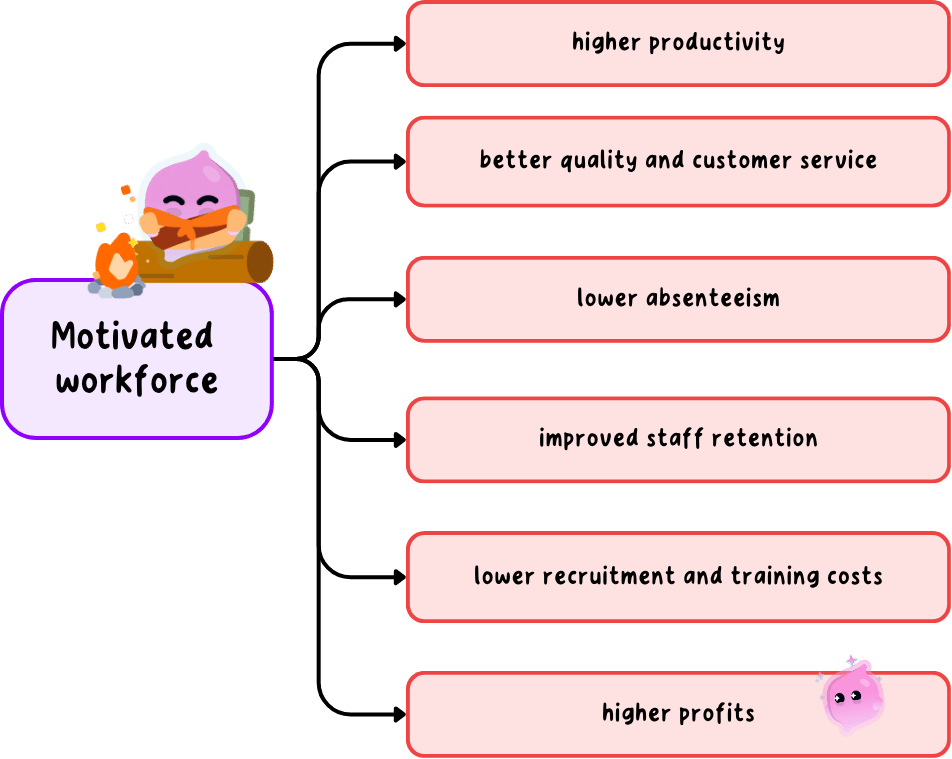
- Higher productivity: motivated staff work faster and waste less time between tasks, so output per worker rises and the same rent, machinery and management are spread over more units, which cuts the cost of producing each one.
- Better quality: someone who cares about the work checks it before it leaves their hands, so there are fewer faults, fewer returns to refund and less material thrown away as waste.
- Better customer service: staff who want to be there greet people, answer questions properly and sort problems out, which brings repeat custom and good online reviews that pull in new customers at no extra cost.
- Lower absenteeism: motivated staff take fewer unnecessary days off, so the business does not pay overtime or agency fees for cover and does not lose a day of output every time someone stays at home.
- More ideas: the people closest to the work can see where time and material are wasted, and they suggest improvements when they believe their views count for something.
- Greggs sells cheap hot food in high volume, so a shop earns its profit on the number of customers served rather than on a high price per item.
- At the lunchtime rush, a server who keeps the queue moving and gets each order right adds directly to the takings of that hour.
- A slow, distracted server on exactly the same wage loses sales the moment the queue is long enough for people to walk out.
- The wage cost is identical either way, which is why the effort of the person on the till changes the profit of the shop.
Retaining staff and attracting new ones
- A demotivated workforce runs all of that backwards, with low output, poor quality, complaints, high absence and, in the end, people walking out and a recruitment bill the business never planned for.
- Higher retention: motivated staff stay, so the business avoids the cost of advertising a vacancy, interviewing and training a replacement, and keeps experience that a new starter takes months to build.
- Attracting employees: a business known for treating its staff well receives more applications for each vacancy, so it can pick a stronger candidate and fill the post before the gap starts costing output.
- A reputation for miserable staff does the reverse, because word travels through reviews and former employees, so posts stay open for longer and the staff who remain cover the extra work and become demotivated themselves.
- Keep labour turnover, the proportion of staff who leave in a year, separate from absenteeism, which is staff being off work while still employed.
- A rising figure for either points to a motivation problem, but they cost the business in different ways.
- Writing that motivation increases profit, with nothing in between, is an assertion rather than analysis.
Why motivation is a financial issue and not only a people issue
- Motivation reaches profit from both directions at once, because more output and better quality lift revenue while lower absence and lower turnover cut costs, and profit is what is left when costs come out of revenue.
- That is why two shops with the same stock, the same prices and the same wage bill can finish the year with very different profits.
- Pay is only one of the things that decides how motivated people are.
- How people are managed: whether a manager listens, gives credit for good work and treats everyone consistently.
- What the work itself is like: whether the job carries some variety and some control over how it is done, or is one task repeated for eight hours.
- Whether there is anywhere to go: someone who can see a route to a better job tries harder than someone who knows next year will look exactly like this one.
- Businesses draw on two sets of tools, financial methods and non-financial methods, which the next two guides take in turn.
- Use a precise measurable effect such as productivity, absenteeism or labour turnover, then trace it through to costs or revenue.
- Apply the chain to the business in the source booklet and develop the most relevant effects rather than listing many benefits.
- For a judgement, weigh what the motivation method costs against the output and retention it is likely to produce.
- Define motivation in one sentence.
- Give three effects of a motivated workforce that a business can measure.
- Explain the chain from higher motivation to a lower cost per unit.
- Why does high labour turnover cost a business money even when a replacement is found quickly?
- Name two things other than pay that affect how motivated someone is.
2.5.4b Financial methods of motivation
Remuneration and fringe benefits: the package the job comes with
Remuneration: the money an employee is paid for doing their job, whether as an hourly wage or a fixed annual salary.
Fringe benefits: extras an employer gives on top of pay that are not cash, such as a staff discount or a pension contribution.
- Remuneration is the basic wage or salary, and it is the reward every other financial method is added on top of.
- It motivates because earning money is why most people work at all, and a rate set above the going rate in the area attracts stronger applicants and keeps existing staff from leaving for a rival.
- Its weakness is that a pay rise is treated as normal within a few months, and no hourly rate makes a repetitive job interesting to do.
- Fringe benefits are the non-cash extras, such as a staff discount, a company vehicle, a pension contribution, free meals or private healthcare.
- They motivate because they improve daily life in a way the employee notices every week, and a discount card or a subsidised canteen is often valued at more than it costs the employer to provide.
- Their weakness is that they cost money whether or not that particular employee wants them, and a benefit that has been there for years is taken for granted rather than felt as a reward.
Rewards tied to results: bonus, commission and promotion
- Bonus: an extra payment on top of normal pay for hitting an agreed target or for a strong performance review.
- It motivates because the employee can see exactly which effort earns the extra money, so attention goes straight to the thing being measured.
- Its weakness is that staff chase the target at the expense of everything else the job needs, and a bonus people expect and then do not receive causes more resentment than never offering one.
- Commission: a payment for each item sold, or a percentage of the value sold, paid on top of or instead of a basic wage.
- It motivates because earnings rise directly with effort, so a hard week shows up in this month's pay rather than in a review a year away.
- Its weakness is that it pushes staff to talk customers into a purchase that does not suit them, which costs the business repeat custom, and it leaves take-home pay unpredictable in a quiet month.
- Promotion: moving an employee up into a more senior, better paid role carrying more responsibility.
- It motivates because good work is rewarded with a permanent rise rather than a one-off payment, and everyone below can see a route upwards worth working towards.
- Its weakness is that a business has only so many senior posts, so most of the workforce cannot be promoted this year, and promoting the wrong person costs twice by losing a good worker from the old job and putting a weak manager over a team.
Matching the method to the job
What sets each payment off is what decides the behaviour the business is buying, and the role each method fits follows from that.
| Method | What triggers the payment | Role it suits best |
|---|---|---|
| Remuneration | Doing the job for the hours agreed | Every role, as base pay |
| Bonus | Reaching an agreed target | Shop and team managers |
| Commission | Each sale, or the value sold | Sales staff |
| Promotion | A senior post falling vacant | Staff who want to progress |
| Fringe benefits | Being employed and staying | Roles that are costly to replace |
- Bonus and commission are the only two an employee can raise by themselves this month, which is why they shift daily effort hardest and why they bend behaviour towards whatever is counted.
- Promotion depends on a post existing, so a firm growing quickly, as Gymshark did after Ben Francis started screen-printing gym clothing in a Birmingham garage in 2012, can offer it far more often than a business whose size has been steady for years.
The limits of paying people more
- Every financial method raises the wage bill straight away, and pay is difficult to cut back, so the cost carries on into years when trading is weaker.
- The effect usually fades because the higher pay becomes the new normal, leaving the business paying permanently more for effort that lifted only for a while.
- Money also does nothing about work that is dull or a manager who never says thank you, so a firm that answers every complaint with a rise ends up paying to keep staff who still dislike the job.
- The methods that reach those problems, job rotation, job enrichment and autonomy, are non-financial and are covered in the next guide.
- When the question says explain, name the method, say what triggers the payment, then carry the chain through to the effect on the business, such as lower staff turnover or higher output per hour.
- Application marks are gated on the context, so choose the method that fits the job in the source booklet: commission for a sales team, a bonus for a shop manager with a monthly target.
- The mark most often dropped is the drawback, because answers name the reward and stop before the cost to the business or the behaviour it distorts.
- When the question says justify or evaluate, weigh the cost of the method against what the firm gains from it and settle on one answer tied to the size of the business and the money it has.
- Define remuneration.
- Name three fringe benefits a UK employer might offer.
- Give one weakness of paying a bonus for hitting a target.
- Why can promotion motivate only part of a workforce?
- Why does the motivating effect of a pay rise tend to fade?
2.5.4c Non-financial methods of motivation
Motivation you do not pay for: changing the job, not the pay packet
Non-financial motivation: raising an employee's willingness to work through the job itself and the way they are managed, rather than through extra money.
Job satisfaction: how much an employee enjoys their work and takes pride in doing it well.
- Edexcel names three non-financial methods, job rotation, job enrichment and autonomy, and each one changes what the employee actually does all day.
- Pay and working conditions sit underneath all three, and the financial methods, remuneration, bonus, commission, promotion and fringe benefits, are covered in 2.5.4b.
The three methods: rotation, enrichment and autonomy
- Job rotation: moving staff between different tasks in the business, usually tasks at the same level of difficulty.
- It motivates because variety cuts boredom and because each person builds a wider set of skills, so a Greggs shop moving staff between the counter, the ovens and the cleaning would keep the shift from dragging and could still open properly when someone calls in sick.
- Follow the chain to the business: concentration holds up across a long shift, so fewer errors reach the customer and less product is thrown away, which lifts productivity without raising the wage bill.
- Rotation also shows a manager which task each employee is quickest at, so the rota can be built around strengths instead of habit.
- Its weakness is that the tasks may all be equally dull, so swapping between them changes very little, and output dips every time somebody starts a job they are still learning.
- Job enrichment: giving an employee more challenging and more responsible work, such as handling complaints or ordering stock, rather than simply more of the same work.
- Enrichment hands over a whole slice of the job, such as one employee owning the weekly stock order from counting the shelves to placing it with the supplier, so they see the result of their own decision rather than a fragment of somebody else's.
- It motivates because the work itself becomes more interesting and because handing over responsibility tells the employee they are trusted, so they take more care over the result and are less likely to look for another job.
- It also builds the skills a supervisor needs, so the next vacancy can be filled from inside, which saves the cost of advertising the job and of training a stranger.
- Its weakness is that the harder work has to be trained for first, and not everyone wants more responsibility, so an employee who was content as they were may read the change as pressure.
- Autonomy: giving staff control over how they do their work and letting them make decisions without asking a manager first.
- It motivates because being trusted raises commitment, and because the people closest to the work usually know the quickest way to do it, so a problem on the shop floor is fixed in minutes instead of waiting for permission.
- Autonomy works best with a written limit, such as a team leader allowed to refund up to £20 without asking, so staff know where their own judgement ends and a quick decision cannot become an expensive one.
- Its weakness is that it only works with capable, well-trained staff, and it produces inconsistency, since two employees left to their own methods will not deal with the same customer in the same way.
- The three differ in what they change for the employee, what they cost the business and what the business must already have in place.
| Job rotation | Job enrichment | Autonomy | |
|---|---|---|---|
| What changes for the employee | More variety, same difficulty | Harder work, more responsibility | Control over how work is done |
| Cost to the business | Lost output while learning | Training time and cost | Cost of mistakes made alone |
| What it requires to work | Tasks that can be swapped | Staff who want to be stretched | Well-trained, capable staff |
Judging the three methods against paying more
- A better-designed job will not hold staff who can earn more for the same work elsewhere, so a business paying below the going rate should deal with pay first.
- Once pay is competitive, rotation suits repetitive work, autonomy suits capable staff who need more control, and enrichment works when managers can hand over real responsibility rather than simply extra tasks.
- Overall, choose the method that matches the cause of low motivation and the employee's skills, rather than assuming either more pay or one job-design method will work for everyone.
- Match the method to the problem: rotation for repetitive work, enrichment for someone who needs more challenge and responsibility, autonomy for capable staff who need more control.
- Carry the chain through to the business and include the main condition or risk, such as training needs or inconsistent decisions.
- Keep financial methods separate; for a judgement, consider whether pay is already competitive and whether staff are skilled enough for the method proposed.
- What is job rotation, and what is its main weakness?
- How does job enrichment differ from simply giving somebody more tasks to do?
- Give one reason autonomy raises commitment and one risk it creates for the business.
- Skilled fitters complain their supervisor checks every decision they make, so which of the three methods fits and why?
- Why does a pay rise often motivate for a shorter time than a more interesting job?
