Liability: whether the law sees the business as separate from its owner
Definition
Unlimited liability: the owner is personally responsible for all the debts of the business, with no upper limit on the amount.
Limited liability: the owner can lose only the money they have put into the business, because the business owes its debts itself.
- Liability answers one question: if the business cannot pay what it owes to a bank, a supplier or HMRC, whose money settles the bill?
- The answer turns on whether the law treats the business as a separate thing from the person who owns it.
- With unlimited liability the owner and the business are the same legal thing, so the debts of the business are simply the owner's own debts.
- With limited liability the business is a separate legal body, so it owes the money itself and a creditor sues the company rather than the person behind it.
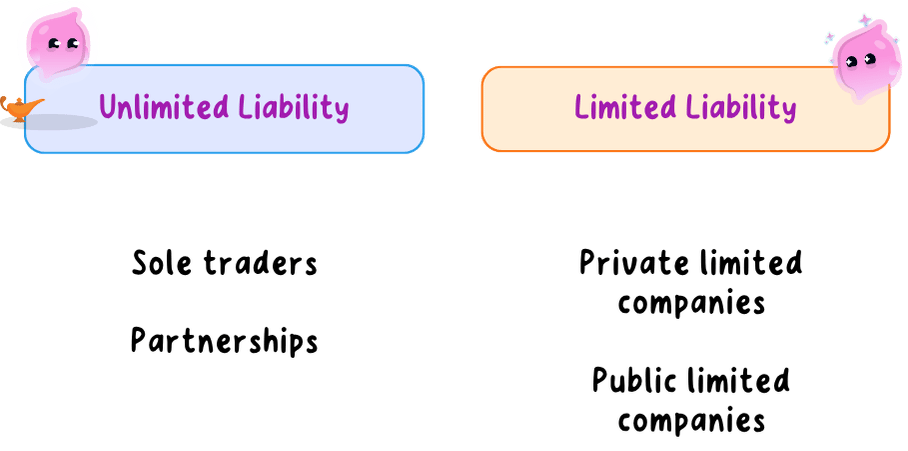
- Sole traders and ordinary partnerships carry unlimited liability, while private limited companies carry limited liability.
Note
- The ownership types themselves, with their full advantages and disadvantages, are covered in the next guide, 1.4.1b.
- Here you need them only as the labels that tell you which kind of liability applies.
Unlimited liability: the owner's own money stands behind the debts
- Because there is no legal wall between the two, a supplier chasing an unpaid £8,000 invoice can claim against the owner in person once the business has run out of money.
- Personal possessions can then be sold to settle business debts.
- A car, a savings account and, in the worst case, the family home are all within reach of the people the business owes.
- The loss is not capped by the amount invested, so what is at risk is everything the owner owns rather than the sum they chose to put in.
Example
- Two friends run a sandwich shop in Leeds as an ordinary partnership and each put in £6,000 of savings.
- The shop closes owing £24,000 to its bank and its wholesaler.
- Each partner can be pursued for the whole £24,000 rather than half of it, because unlimited liability does not divide the debt neatly between them.
- Their £6,000 stakes set no ceiling, so one of them may end up selling a car and emptying an ISA long after the shutters came down.
Limited liability: the loss stops at what you put in
- The company owes its own debts, so the most an owner can lose is the money they paid in for their shares.
- A home, a car and personal savings sit outside the business, so they cannot be taken to pay its creditors.
- Private limited companies carry this protection, which is why owners planning to borrow heavily or buy expensive equipment tend to want that structure.
- A capped downside changes what an owner is willing to try, because failure now costs the £50,000 invested instead of the roof over the family.
- James Dyson worked through over 5,000 prototypes before he had a bagless vacuum cleaner worth selling, and a run of failures on that scale is only survivable when each one costs money put into the business rather than the owner's house.
Common Mistake
- Limited liability does not mean the owner walks away with nothing lost.
- If the company fails the shares become worthless, so the whole investment is gone.
- The protection is that the loss stops there and cannot spread to money the owner never put in.
The price of protection: what limited liability costs the owner
- Limited liability is not free, because a company has to be registered and reported on in ways a sole trader avoids.
- The company registers with Companies House and files accounts every year, which brings paperwork and an accountant's fee the owner has to pay whether the business made a profit or not.
- Those accounts are public, so a rival, a supplier or a customer can look up figures that a sole trader keeps to themselves.
- Banks often ask the owner of a small company to sign a personal guarantee before lending, which makes that person personally responsible for repaying the loan if the company cannot.
- A bank loan is usually the largest debt a small firm carries, so a guarantee removes the protection exactly where it mattered most.
Exam technique
- Questions ask for the implications for the owner, so name the possession at risk instead of writing that the owner is responsible for debts.
- Carry the chain through: the shop owes £24,000, the owner has unlimited liability, therefore savings and the car can be sold, therefore the failure follows the owner after the business has closed.
- Say that the shareholder still loses the money invested, because answers claiming limited liability means losing nothing are marked down.
- On a longer question, set the protection against the public accounts and the personal guarantee a bank may demand, since that balance is where the judgement mark sits.
Self review
- Define unlimited liability.
- Which two types of business named in this guide have unlimited liability?
- An owner pays £4,000 for shares in a private limited company that later fails owing £90,000, so what is the most they can lose?
- Give two costs a business accepts in return for limited liability.
- Why does a personal guarantee weaken the protection limited liability gives?
