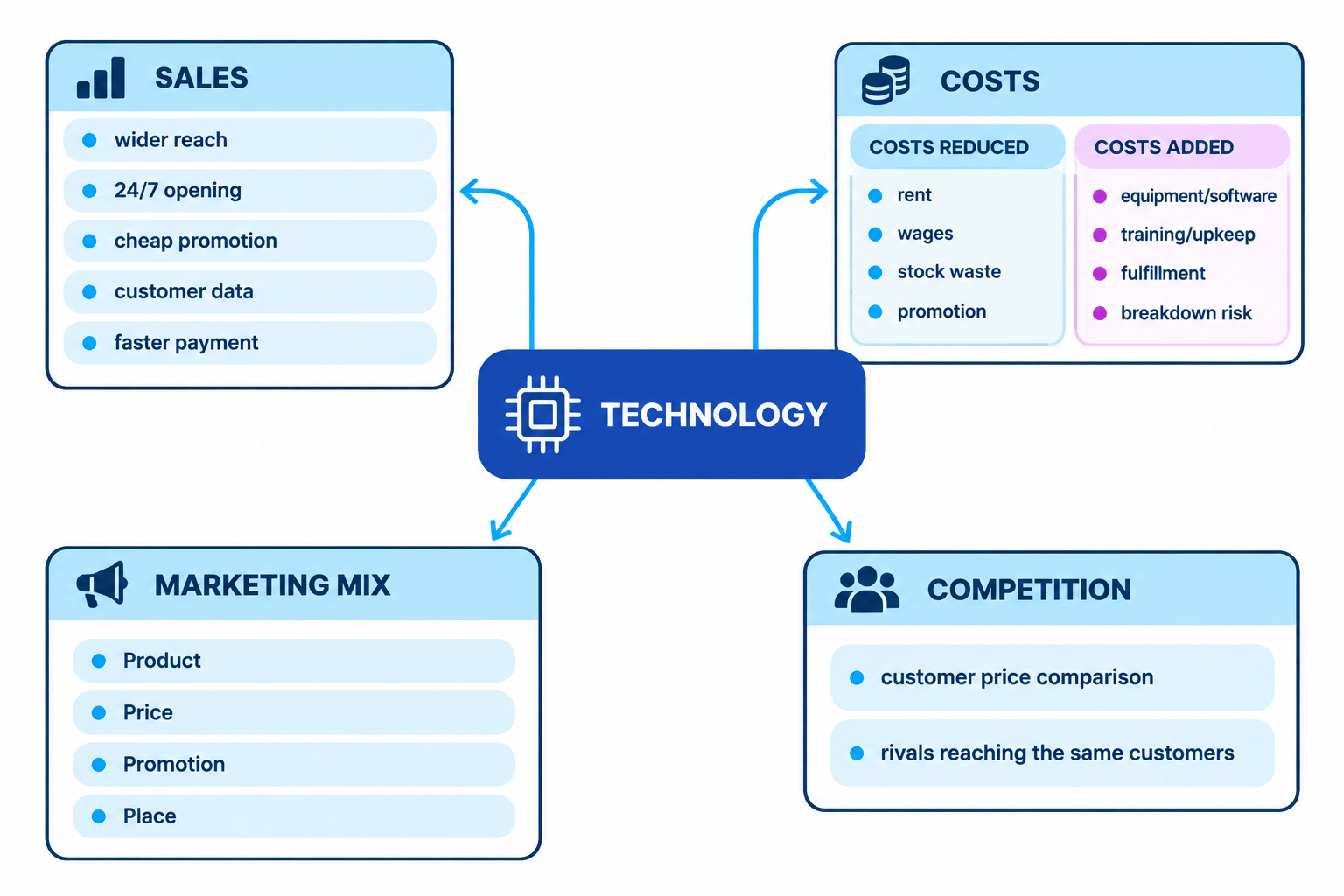
Sales: a national market, and a national set of rivals
- Technology lifts sales through five mechanisms, and each one needs its chain stating rather than naming.
- Reach: selling online replaces a catchment of a few miles with a national or international market, so the number of people who could buy rises without the business renting a second shop.
- Opening hours: the site takes an order at two in the morning when the shop is locked, so sales that closing time would have killed are still made.
- Cheap reach: one social media post reaches thousands of followers at no cost per view, so a small firm speaks to an audience it could never afford to buy in print.
- Customer data: the checkout records what each shopper bought, so the business can recommend related items and raise the average order value.
- Faster payment: saved card details and contactless cut the number of shoppers who abandon a full basket at the last step, so more visits end in a sale.
- The same reach works in reverse, because a customer can compare your price with twenty other sellers in seconds, so a shop once protected by being the only one in town loses trade to a cheaper rival two hundred miles away.
- A business with no online presence now loses sales by default, because a customer who searches and does not find it simply buys from whichever seller does appear.
Example
- Gymshark was started in 2012 by Ben Francis screen-printing gym clothing in a Birmingham garage, and sold nationally through fitness influencers rather than through shops.
- Blockbuster rented DVDs from high-street shops and entered administration in the UK in 2013, once Netflix let the same customers stream at home instead.
- The technology that carried one firm's sales up is the technology that took the other's away.
Costs: what technology takes away and what it adds
- Technology cuts four costs in particular.
- Rent: an online seller trades from a spare room or a cheap unit rather than a high-street site, so the biggest overhead in retailing disappears.
- Wages: self-service checkouts, online ordering and automatic email replies mean fewer people on tills and phones, as at PureGym where sites open 24 hours with no staffed reception.
- Stock: the till updates the stock record as each item sells, so the owner reorders on real figures and throws away less unsold stock.
- Promotion: an email or social media campaign costs a fraction of print or television advertising, so a budget of a few hundred pounds still buys a wide audience.
- Technology also adds costs, and this is the half most answers leave out.
- Buying in: the equipment, the website and the software licences are paid for before a single extra sale arrives, which drains cash from a young business.
- Training and upkeep: staff must be taught to use the system and it then has to be maintained and updated, so the spending does not stop at the purchase price.
- Fulfilment: postage, packaging and free returns eat into every order, and the payment provider takes a fee on each transaction the business takes online.
- Breakdown: when the site or the card terminal fails the business cannot take money at all, so a fault costs a day of trade on top of the repair bill.
Key Idea
- Technology usually swaps variable costs for fixed ones.
- A machine or a £40 monthly subscription is paid for whether trade is strong or weak, while the hours of a part-time assistant can be cut in a quiet week.
- That makes technology a bigger risk for a business with unpredictable sales, because the cost stays put when the revenue falls.
The marketing mix: one shift in each of the four Ps
- Product: a business can now sell a purely digital product such as a streaming subscription, or bolt a digital feature such as an app onto a physical one.
- Price: easy comparison drags prices down because the cheaper seller is one click away, though customer data also lets a firm send an offer to one shopper instead of cutting the price for everybody.
- Promotion: social media posts, influencers and email lists have taken the place of the print and television advertising a small firm could never afford.
- Place: the website becomes the shop, and click and collect at Tesco and Sainsbury's joins the two by letting a customer order online and pick the goods up in store.
- Adopting technology is no longer a free choice for most businesses, because once rivals offer card payment, next-day delivery and an app, customers treat all three as the minimum and go elsewhere when they are missing.
Exam technique
- Choose one of the three areas, then build the chain: name the technology, say what it changes, and finish on sales revenue, a cost or a named P.
- Do not describe the technology itself, because "social media lets a business post pictures" earns nothing without the effect on the firm.
- On any question about costs, give one cost technology removes and one it adds, since the marks sit in that comparison.
- Apply it to the business in the source booklet, because a market stall and a national retailer gain very different amounts from the same website.
Self review
- Give two mechanisms by which selling online raises sales.
- Name one cost technology removes and two costs it adds.
- Why does technology tend to swap variable costs for fixed costs, and why does that raise risk?
- State one effect of technology on price and one on place.
- Why can a business lose sales to technology even when its product has not changed?