2.1.1a Internal (organic) growth
Internal growth: getting bigger out of the operations you already own
Internal (organic) growth: expanding by adding to the business's own operations, such as more products or more customers, rather than by buying or joining with another firm.
- Every extra pound of revenue under internal growth comes from capacity the business has built and paid for itself, so nothing is bought in ready-made from another company.
- Growth is measured by revenue, output, number of outlets, employees or share of the market, and internal growth lifts those figures one step at a time rather than in a single jump.
- If a question asks how a business could grow internally, never suggest a merger or a takeover, because those bring in another firm's operations and count as external growth.
- Opening ten shops of your own is internal growth, while buying a rival that already owns ten shops is not.
- The test is whether the extra sales existed before, since internal growth creates new ones and external growth transfers somebody else's.
- Franchising is examined as a form of business ownership in 1.4.1, not as a method of internal growth here.
The two routes: new products and new markets
- A firm growing internally has two routes open to it, and each one raises revenue by a different mechanism.
- New products: adding a line the firm can sell through the shops, staff and customers it already has, so the same rent and wages are spread over more sales.
- Innovation turns an idea into something a customer will pay for, and research and development is the designing, prototyping and testing that gets it there, which is why Dyson worked through over 5,000 prototypes before the bagless vacuum cleaner reached a shop.
- Research and development is paid for long before the first sale, so a line that flops takes the money with it, which is why a firm often trials a new product in a handful of branches before a national launch.
- New markets: selling the range the firm already makes to a different group of buyers, reached by changing the marketing mix, by taking advantage of technology, or by expanding overseas.
- Changing the marketing mix: a smaller pack at a lower price, or promotion aimed at a different age group, puts the same product in front of buyers who would not have bought the original version.
- Taking advantage of technology: selling through a website or an app makes the market the whole country instead of the streets around the shop, at a fraction of the rent of another unit, and social media reaches those buyers without a national advert.
- Expanding overseas: selling in another country spreads risk, because a fall in UK spending no longer hits every sale, though the firm pays for transport, translation and any tariffs and may find local tastes differ.
- Opening a shop, branch or warehouse in another town is the same route in physical form, reaching customers who live too far from the existing site to use it.
- New markets are usually the cheaper route, because the product already exists and the spending goes on promotion and delivery rather than on years of development.
- Greggs has grown internally by opening more shops on high streets and retail parks rather than by buying another bakery chain.
- Its vegan sausage roll is the new-product route, an extra line sold across counters that were already there.
- Gymshark reached a new market through technology, growing from screen-printing in a Birmingham garage in 2012 to selling online through fitness influencers.
- Neither firm needed to buy another company to get bigger.
Advantages: control kept, cost low, and a pace the business can absorb
- Control stays with the existing owners: no shares go to another firm's shareholders and no outside board arrives with different plans, so the way the founder runs the business survives the expansion.
- It costs less: the firm pays for one shop fit-out or one product launch at a time, perhaps £80,000 for a small unit, where buying a rival means paying for its entire premises, stock, staff and brand in one deal.
- Much of that bill can be met from retained profit, so there is no interest to pay and no new investor asking for a say in decisions.
- The pace is gradual: managers can train staff, settle supply problems and learn from a poor site before the next one opens, which means an early mistake stays small and can be corrected.
- There is no culture clash: new branches are staffed and run the firm's own way from the first day, rather than merging a workforce used to different pay, rules and habits.
Where the money for growth comes from, internal sources such as retained profit set against external sources such as loans and share capital, is covered in the guide on financing growth.
Disadvantages: slow, capped by your own money, and still a strain
- It is slow: a new unit takes months to find, fit out and staff and a new product can take years to reach the shelf, while a takeover adds a whole trading chain on the day the deal completes.
- A rival can take the opportunity first: if a competitor opens in that town or launches the same idea while your version is still being built, the customers there are already loyal to them when you arrive.
- The pace is capped by what the firm can fund itself: retained profit only builds up as fast as the business earns it, so a firm making little profit grows slowly however good its plan is.
- Growth still stretches cash and management: an outlet is paid for months before it takes any money, and the owner who once watched a single site now supervises staff in several towns, so standards can slip.
- Name the route precisely, such as launching a new product, changing the marketing mix or selling overseas, because a vague "they should expand" gives the analysis nothing to build on.
- Then run the chain: a new product sells through counters the firm already staffs, so revenue rises faster than costs, so there is more retained profit to fund the next launch.
- Where the command word is explain or analyse, tie the route to what the firm in the source booklet actually sells, since application marks are gated on that context.
- Where it is justify or evaluate, weigh the control and low cost of internal growth against its slower pace, and say which matters more for a business of that size in that market.
- What makes growth internal rather than external?
- Name the two routes to internal growth and say what each one adds to the business.
- Give the three ways a business can reach a new market with the product it already sells.
- Give one reason internal growth costs less than a takeover.
- Give one drawback of funding growth only from retained profit.
2.1.1b External (inorganic) growth
External growth: buying a business instead of building one
External (inorganic) growth: expansion that comes from joining with or buying another business rather than from selling more yourself.
Merger: two businesses agreeing to join together to form one new, larger business.
Takeover: one business buying enough of another business, normally more than half its shares, to take control of it.
- Edexcel names two forms of external growth, and the sharp difference between them is consent.
- Merger: both sets of owners agree to combine, so the two firms become one new business, usually with a new name, a single board and one set of shareholders.
- Takeover, also called an acquisition: the buyer purchases enough shares to control the target, and because the target's directors do not have to agree, a takeover can be resisted.
- A gym chain with 20 sites wants 40, so it buys a rival chain of 20 sites for £14 million.
- On completion day it owns 20 fitted-out buildings, the members who already train in them and the staff who run them.
- Building those 20 sites itself would mean finding premises, paying for the fit-out and waiting years for memberships to build.
- The £14 million buys time, which is the one thing organic growth cannot supply.
Advantages: what the buyer gets on the day the deal completes
- Growth is immediate, because the premises, equipment, customers and staff already exist and simply trade under new ownership from completion day, and speed is the real attraction of a takeover.
- Customers and market share: the target's buyers become your buyers at once, so revenue rises without waiting for a marketing campaign to take effect.
- Brand and reputation: a name shoppers already trust takes years of consistent trading to earn, so buying one is often quicker and cheaper than building one.
- Staff and expertise: trained people transfer with the business and bring knowledge the buyer lacks, such as how to run a warehouse network or a delivery app.
- Buying a rival also removes a competitor from the market, so the combined firm is under less pressure to undercut on price and keeps more of the customers it has just paid for.
- The larger firm orders stock in greater bulk, so suppliers charge it less per unit and its cost per item falls, which means it can either cut its prices or widen the gap between price and cost.
Disadvantages: the price of the deal and the trouble afterwards
- Buying a business is expensive, so the money usually comes from heavy borrowing, and the interest has to be paid every month whether the deal works or not.
- The problems that follow completion are as serious as the problem of paying for it.
- Culture clash: the two workforces arrive with different pay rates, shift patterns, software and habits, and staff who resent the new way of working leave or stop trying.
- Job cuts: two head offices and two accounts departments do the same work, so redundancies follow, and morale falls among the very employees the buyer wanted.
- Overpaying: the buyer judges the target from the outside, so worn-out equipment, lost contracts and unhappy customers only come to light once the money has gone.
- A combined business can also become too big to manage well, because decisions pass through more layers of managers, so a problem in one shop takes far longer to reach anyone able to fix it.
Judging organic against external growth: what it depends on
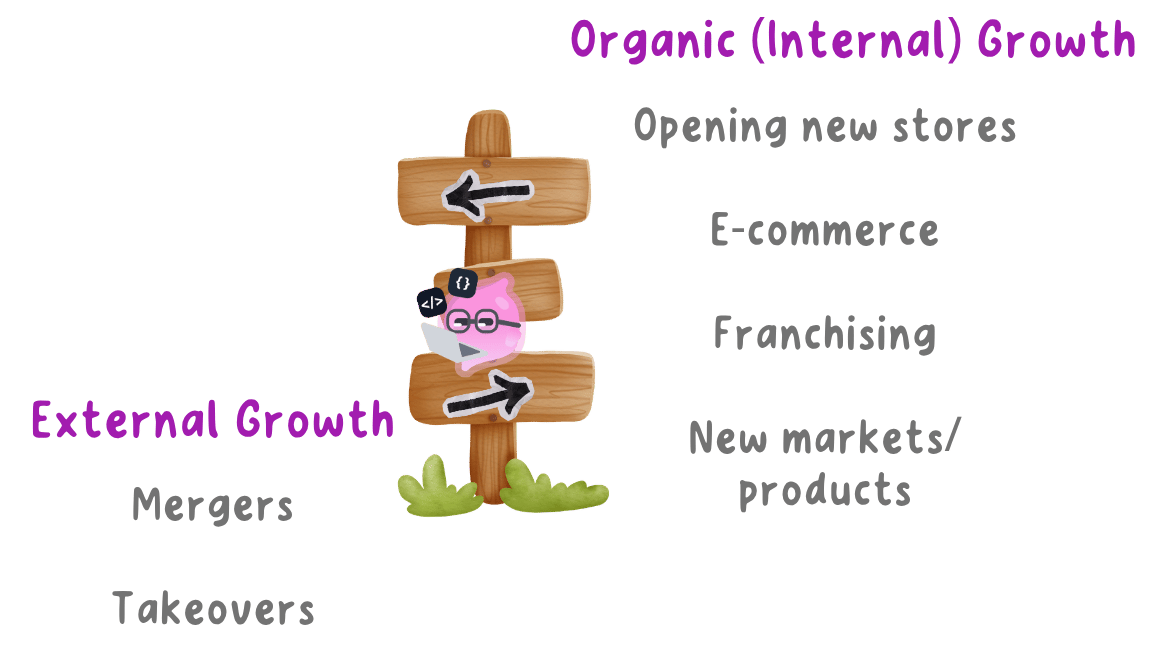
- External growth suits a business that needs speed and has the finance and management capacity to absorb another firm; organic growth suits one that values lower risk, control and a manageable pace.
- The key question is whether the target genuinely fits, because poor systems, culture or customers can turn the expected benefits into integration costs.
- Overall, external growth is strongest when speed matters enough to justify the higher financial and integration risk.
- Distinguish merger from takeover, then focus on the effect of gaining another firm's operations immediately.
- For analysis, link the immediate growth to customers, revenue, costs or expertise in the source-booklet business.
- For a judgement, weigh speed against finance and integration risk.
- What is the difference between a merger and a takeover?
- Roughly what proportion of a company's shares does a buyer normally need to control it?
- Give three things a buyer gains on the day a takeover completes.
- Give two reasons a takeover can leave the buyer worse off than before.
- Name two things that decide whether a firm should grow organically or externally.
2.1.1c Ownership for growing businesses
Why ownership changes as a business grows: finance and standing
- A sole trader or a partnership suits a business at start-up, but growth exposes two limits that a change of ownership fixes.
- Finance: the owners' savings, the profit the firm keeps back and what a bank will lend against those run out once growth means new premises, machinery or a national advertising push.
- Standing: suppliers and lenders treat a registered company that files accounts at Companies House as more permanent than one person trading alone, so they offer larger trade credit limits and better loan terms.
- Most growing firms become a private limited company first, and the small number that need capital on a national scale then take one further step.
Becoming a plc: shares anyone can buy
Public limited company (plc): a company whose shares can be bought and sold by the general public on the stock exchange.
Flotation: the moment a company first offers its shares for sale to the public, turning a private limited company into a plc.
- The legal difference from an Ltd is who may buy the shares, because an Ltd sells them privately to people the existing owners approve while a plc sells them to anyone with the money to pay.
- That one change is what raises far larger sums, and it brings three gains.
- Large amounts of capital: thousands of investors each buying a small stake add up to sums no handful of private shareholders could put in, enough to fund a nationwide roll-out or a new factory.
- Profile and credibility: a listed company's results are reported in the press, which makes suppliers readier to deliver on 60 days' credit and banks readier to lend at a lower rate of interest.
- Shares that are easy to sell: a holding can be sold on any day the stock exchange is open, so investors risk their money more willingly and the next share issue is easier to sell.
- Money raised by selling shares is not a loan, so there is no interest and no repayment date, which means a bakery chain like Greggs could fit out and stock a run of new high-street shops without adding a monthly repayment to its costs before those shops earn anything.
The price of floating: cost, scrutiny and takeover
- Floating costs the business in five ways, and each one is a reason many profitable firms never do it.
- Cost and complexity: the company must pay lawyers, accountants and a bank to handle the sale and to produce a legal document setting out its finances, and those fees run into hundreds of thousands of pounds before one share is sold.
- Public and press scrutiny: a plc publishes detailed accounts, so competitors can read its sales and costs and reporters cover every fall in profit, which can knock customer and supplier confidence.
- Loss of control: founders who sell part of the company keep a smaller share of the votes, so a decision they oppose can be carried against them at the annual meeting of shareholders.
- Open to takeover: nobody chooses the buyers, so a rival that quietly builds a holding of more than half the shares takes control of the company and can replace its managers.
- Pressure for short-term profit: shareholders want a dividend now and a rising share price, which pushes managers to cut spending on staff training and new products that would only pay off in five years.
- A public limited company is not part of the public sector.
- Public here means the public may buy the shares, and the firm stays a private-sector business owned by its shareholders rather than by the government.
- Size does not make a company a plc either, because some very large UK firms are owned privately and stay that way by choice.
Judging whether a growing business should become a plc
The owners of a successful Ltd have three routes, and the table sets out what each does to their finance, their control and their exposure.
| Stay a private Ltd | Float as a plc | Sell the business | |
|---|---|---|---|
| Finance raised | Owners and bank only | Very large sums | None for the firm |
| Who may buy shares | People the owners choose | Anyone | A single buyer |
| Founders' control | Kept in full | Shared and reduced | Given up |
| Scrutiny of accounts | Limited | Public and press | Passes to the buyer |
| Takeover risk | Low | Open to anyone | Already sold |
- Floating is most attractive when the business needs very large sums and the owners are willing to trade some control for faster expansion.
- It is less suitable when the funding need is modest or the founders strongly value privacy, family control or protection from takeover.
- Overall, a business should float only when the scale of its growth plan justifies the cost and loss of independence.
- Distinguish Ltd from plc by who may buy the shares, not by business size.
- Link flotation to the capital the business can raise and what that finance allows it to do.
- For a judgement, weigh the finance raised against the control, scrutiny and takeover risk the owners accept.
- Define flotation.
- Give the one legal difference between a private limited company and a plc.
- State two pressures that push a growing business to change its ownership type.
- Explain why becoming a plc leaves a business open to a takeover.
- Give two reasons an owner might deliberately keep the company private.
2.1.1d Finance for growing and established businesses
Growth finance: what changes once a business is already trading
- A start-up is funded on the strength of a plan, while a business already trading is funded on the strength of its record, which is why growth finance is usually cheaper and easier to get.
- A trading record: accounts and bank statements let a lender check that the business really makes money, so the loan is less of a gamble and the interest rate is lower.
- Assets: premises, machinery and vehicles can be offered as security, so the bank can recover its money if repayments stop and will lend a larger sum.
- Past profits: years of profitable trading build a fund inside the business that the owners can spend without asking a bank or an investor at all.
Internal sources: money the business has already made or already owns
Retained profit: profit kept in the business from previous years instead of being taken out by the owners as drawings or paid to shareholders as dividends.
- Retained profit is the first place a profitable firm looks, because the money is already sitting in the business and needs nobody's permission to spend.
- Advantage: there is no interest to pay and no ownership given away, so the whole return on the new oven, van or shop stays with the existing owners.
- Drawback: the amount is capped by how profitable the business has been, and a pound put back into growth is a pound the owners cannot take out this year.
- Selling assets turns equipment, vehicles or property the business no longer needs into cash, with no interest charged and no repayments to follow.
- Drawback: the asset has gone for good, so the business must buy or hire again if it needs that machine back, and a sale raises money once rather than every year.
- Greggs sells cheap hot food in high volume from shops on high streets and retail parks, so profit those shops have already earned is the obvious money to fund the next shop with.
- A bakery in Leeds trading for eight years buys a second oven for £7,000 out of retained profit, doubling what it can bake with no interest to pay.
- When it replaces its delivery van it sells the old one, and that cash cuts what it has to find for the new one.
- Neither route existed in year one, when there were no past profits to keep and no spare equipment to sell.
External sources: loan capital and share capital
Loan capital: a fixed sum borrowed from a bank and repaid in instalments with interest over an agreed number of years.
Share capital: money raised by selling shares in a company, which makes the buyer a part-owner entitled to a share of the profit.
- Loan capital for growth is usually secured on premises or machinery, which is exactly what a trading business has and a start-up does not.
- Advantage: control is kept, because the bank votes on nothing and takes no share of the profit once the loan is repaid.
- Drawback: repayments fall due whatever the trading, so a quiet quarter costs the same as a busy one, and missed payments can cost the business the secured asset.
- Share capital never has to be repaid and carries no interest, so instalments do not drain the cash while the expansion is still costing more than it earns.
- A private limited company sells shares privately to invited investors, and only a public limited company can go further and float on the stock market, selling shares to the public and raising far larger sums.
- Drawback: ownership, profit and control are all shared, because every new shareholder takes a slice of future dividends and a vote on how the company is run.
Judging which source suits a growing business
Set the four sources side by side and the trade-off is size against cost and control.
| Retained profit | Selling assets | Loan capital | Share capital | |
|---|---|---|---|---|
| Internal or external | Internal | Internal | External | External |
| Repaid | No | No | Yes, with interest | No |
| Control given up | None | None | None | Yes, ownership shared |
| Sum available | Capped by past profit | One-off, usually small | Large if secured | Very large if floated |
- The internal two cost nothing and give nothing away, but neither stretches: retained profit only exists if trading has been profitable, and an asset can only be sold once.
- How much is needed therefore decides first, because an £8,000 delivery van can come out of retained profit while a £2 million second factory cannot.
- After that it depends on whether the owners will give up control, and on whether the business can carry fixed repayments in the months when the new site is still costing more than it brings in.
- Overall, an established firm expanding steadily should fund growth from retained profit first and top it up with a secured loan, because that is the cheapest money and leaves ownership whole; a firm whose growth plan is far bigger than its past profits has to sell shares and accept sharing the profit that growth creates.
- Name the source, then say why it fits this firm: "it has traded for six years and owns its premises, so it can secure a bank loan" is what earns the application mark.
- Do not answer a growth question with an overdraft or trade credit, because those cover day-to-day cash gaps rather than the cost of a second site.
- Build the chain: retained profit costs no interest, therefore more of the profit from the new shop stays in the business, therefore the shop after that can be funded the same way.
- When the question says justify or evaluate, weigh one internal source against one external one and finish by naming the source the business should use and why.
- Name the two internal sources of finance a growing business can use.
- Why can an established business usually borrow at a lower interest rate than a start-up?
- Give one drawback of funding growth by selling shares.
- What is a stock market flotation, and which type of company can use one?
- State two things that decide whether a firm should fund growth from retained profit or from a loan.
2.1.2a Why aims and objectives change
Aims are not fixed: they shift as the business develops
- The aims written down at start-up describe what mattered to the owner in that first month, so they are reviewed as the business, its market and its owner all move on.
- One pattern repeats across most firms, with a different aim dominating at each stage.
| Stage of the business | Aim that dominates | What it drives day to day |
|---|---|---|
| First year or two | Survival | Low prices, cash kept for bills |
| Established, regular custom | Growth | Second site, wider range, online |
| Mature, market largely won | Profit or market share | Protecting margins and share |
Referring to the above table:
- Survival dominates early because cash is thin and one quiet month can leave the owner unable to pay rent, so a low profit is accepted in exchange for staying open.
- Once regular custom is established the survival aim is met, so the owner reinvests profit in a second van, a second unit or an online shop, which is a growth aim.
- Later, with the customer base largely won, the aim turns to profit for the owner or to market share taken from rivals, because there is less new ground left to take.
- The sequence runs backwards as easily as forwards, and Wilko had traded since 1930 with around 400 shops before it entered administration in August 2023, which shows that age and size do not protect an aim.
- Ben Francis founded Gymshark in Birmingham in 2012, screen-printing gym clothing in a garage.
- At that point the aim was to cover the cost of fabric and printing and keep trading.
- Selling online through fitness influencers brought in enough orders to make survival safe, and the aim moved on to growth into a global brand.
Outside the business: market conditions, technology and the law
- Market conditions change when new rivals arrive, when demand shifts to something else, or when a product the firm relied on stops selling.
- Aldi and Lidl compete on price with a narrower range, so a nearby grocer loses its price-sensitive shoppers, revenue falls, and an aim of opening a second branch is replaced by an aim of holding on to the customers it still has.
- A firm that takes most of its income from one product is hit hardest, because when that product stops selling the growth aim becomes a survival aim within a single trading year.
- Technology changes aims by making an old objective pointless and putting a new one in its place, most often a new way of selling or a cheaper way of producing.
- An objective of opening three more shops becomes an objective of taking a third of sales online, because a website reaches the whole country for a monthly fee while a high-street unit costs several thousand pounds a year in rent.
- Blockbuster rented DVDs from shops and did not move its aims fast enough once streaming arrived, and its UK business entered administration in 2013 while Netflix took the customers.
- Legislation changes aims by forcing spending and management time onto compliance, which pushes the objectives the owner would rather pursue further back.
- A rise in the National Living Wage lifts the wage bill of a café with eight staff, so the £12,000 saved towards a second site pays wages instead and the expansion objective slips by a year.
- Tighter environmental or consumer law works the same way, since new packaging or new record-keeping has to be paid for before any growth target is funded.
Inside the business: performance and internal reasons
- Performance against an objective sets the next one, because a target hit early and a target missed badly point the aim in opposite directions.
- Hitting an objective early shows there is more demand than expected, so the business raises its sights and sets a more ambitious target.
- Missing one badly forces the opposite, and a growth objective drops back to survival until trading steadies.
- Internal reasons start with the owner, whose own priorities change when they want more time away from the business or decide to sell up.
- Taking on investors brings in people who expect a return and push for profit or growth, and new managers arrive with plans of their own.
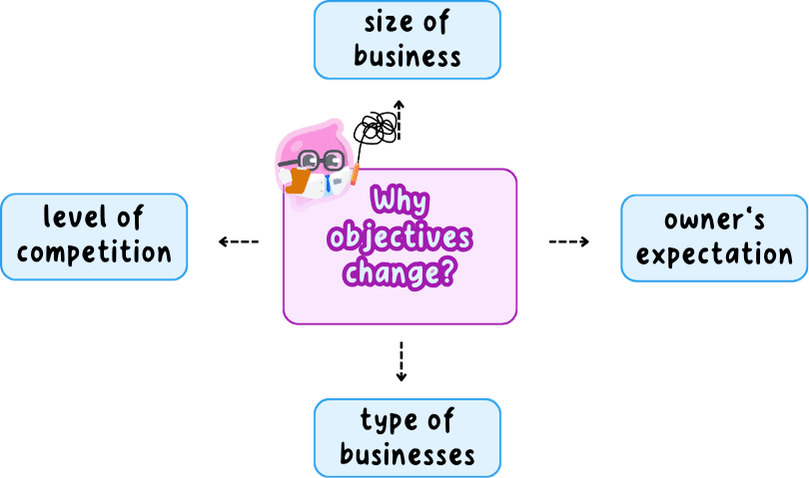
- Name the trigger from the source booklet, say which aim it makes unworkable, then name the aim that replaces it.
- The link most often dropped is the middle one, because answers describe the change and then jump to a new aim without saying why the old one failed.
- Finish with the spending decision the new aim forces, such as postponing a second unit, since that is where the analysis is credited.
- When the question says explain, one trigger carried the whole way through scores better than three triggers listed.
- Which aim dominates in a business's first year or two, and why?
- Give one change in market conditions that turns a growth aim into a survival aim.
- How can a change in technology make an existing objective irrelevant?
- How does hitting an objective early, or missing one badly, change the objective a business sets next?
- Give one internal reason, coming from the owner or from new investors, that changes a business's aims.
2.1.2b How aims and objectives change
From survival to growth: the first switch a business makes
- A new business starts with survival as its objective, which means covering its costs, keeping enough cash in the bank to pay suppliers and holding on until custom becomes regular.
- Once the business is established and sales are steady, that objective becomes growth, so profit that was being held as a cash cushion is reinvested instead.
- Spending changes direction, because money that sat in the account now buys a second van, more stock and an extra member of staff.
- The measure of success changes with it, since the owner stops watching the closing bank balance each week and starts watching sales, orders and the number of outlets.
- Gymshark was founded in 2012 by Ben Francis, who started by screen-printing gym clothing in a garage in Birmingham.
- A business of that size is aiming to survive, so its target is covering the cost of the next batch of fabric.
- Gymshark went on to sell online through fitness influencers, which is a growth objective made real: reaching more customers rather than protecting a balance.
- Paying for promotion is money a firm still chasing survival would not risk, which is why the change of objective shows up in what gets bought.
From growth to profit or market share: two different directions
- Once a business is large, growing for its own sake stops being a useful target, so the objective narrows to either profit or market share.
- A profit objective points the business inwards at its margins, so it cuts costs, drops lines that sell steadily but earn little and raises prices where the brand allows it.
- A market share objective points it outwards at rivals, so it holds prices down and spends on promotion to take customers from them.
- The two pull against each other, because winning share by undercutting rivals lowers the profit earned on every sale, which means a business cannot chase both hard at the same time.
Entering new markets and changing the product range
- Entering a new market: once the home market is saturated and almost everyone who wants the product already buys it, further growth has to come from somewhere else, including overseas.
- The business then judges itself on sales made outside its original market, and money moves into distribution, translated packaging and adapting the product to local tastes.
- Increasing the product range: when an existing product reaches the end of its life and its sales fall away, adding new lines beside it becomes an objective in its own right.
- Spending shifts towards design and development, and progress is measured by how much revenue comes from products launched in the last year or two.
- Decreasing the product range: dropping the slow sellers frees shelf space, releases the cash tied up in stock nobody is buying and simplifies deliveries, which is how Aldi and Lidl hold costs down with a narrower range than Tesco or Sainsbury's.
- Social and environmental targets, and the trade-off between behaving ethically and making a profit, have their own guide later in this topic.
- How a firm actually grows, by opening sites, merging or taking over a rival, belongs to the guide on methods of growth.
Exiting a market: why a business pulls out and what leaving costs
- Exiting a market means pulling out of it altogether: the shops or the website serving it close, the product is withdrawn and the customers there are let go.
- It never became profitable: sales never rose far enough above the cost of serving that market, so the firm has been covering the losses out of what it earns elsewhere.
- A rival took it: a competitor with lower costs or a better product won the customers, and matching its price would mean selling at a loss, so staying costs more than going.
- The cost of serving it rose: higher rent, a tariff added to exports or a supplier putting prices up can turn a market that just about paid into one that does not.
- The firm wants to concentrate where it is strong: money and managers are limited, so a market that earns an average return is dropped to put both behind the one that earns most.
- Leaving is expensive at the moment it happens, because stock that nobody will now buy and equipment fitted for that market alone are written off.
- The customers built up there are lost, and a firm that returns later has to win them back from whoever served them in the meantime.
- What the business gains is the cash and the management time released, which it can put behind a market where the same effort earns more, so exiting can be part of a growth objective rather than a retreat.
A change of objective changes what the business measures
Every objective brings its own measure of success, and the table sets out what a business watches and where its money goes under each one.
| Objective | What is measured | Where money goes | Effect on staff |
|---|---|---|---|
| Survival | Cash balance | Rent, wages, stock | Owner does most jobs |
| Growth | Sales and outlets | New sites and stock | Hiring |
| Profit | Profit margin | Cost cutting | Roles merged |
| Market share | Share of market sales | Lower prices, promotion | Sales team grows |
- The workforce moves with the objective, since growth means recruiting salespeople and adding a layer of managers, while a profit objective reduces the workforce by merging roles and leaving vacancies unfilled.
- In a downturn the direction reverses, so a business that was chasing growth goes back to survival, exiting its weakest markets, cutting the product range to the profitable core and reducing its workforce.
- Name the old objective and the new one, then say what the business does differently, because the mark is for the change rather than for a list of objectives.
- When the command word is explain or analyse, carry the chain through: the home market is saturated, so growth must come from abroad, so money moves into overseas distribution.
- Match the objective to the stage the source booklet business has reached, since a target that suits a two-year-old firm is wrong for a national chain.
- Look in the data for signs of a reversal, such as falling sales, a range being cut or shops closing, which point to a move back towards survival.
- What usually replaces survival as the objective once a business is established, and what happens to its profit?
- Give one thing a business does differently when profit replaces growth as its objective.
- Why does a saturated home market push a business towards entering new markets?
- Give two reasons a business might exit a market, and one cost it pays for leaving.
- What happens to a growth objective in a downturn, and what does that do to the product range and the workforce?
2.1.3a The impact of globalisation on businesses
Globalisation: national economies growing into one connected market
Globalisation: the process by which national economies become more connected through trade, investment and technology, so businesses buy, sell and produce across borders.
- Globalisation matters to a UK business because it changes who its suppliers are, who its customers are and who its rivals are, often all at once.
- Three developments drove it: container shipping cut the cost of moving goods, the internet let a firm sell and manage abroad without an office there, and many governments agreed to trade more freely with each other.
- The result is that a bakery in Leeds can buy Italian flour, a Birmingham clothing brand can take an order from Australia overnight, and both can be undercut by a producer they have never heard of.
Imports and exports: cheaper supplies for one firm, tougher rivals for another
- Imports are goods and services bought from abroad, and they reach a UK business down two very different routes.
- Buying from overseas: a UK firm can source materials more cheaply, so a metal bracket bought abroad at £4 instead of £7 from a UK supplier cuts the cost of every unit it makes and leaves room to cut its own price.
- Competition from overseas: the same open border brings finished foreign goods onto UK shelves, so a UK manufacturer paying UK wages is undercut on price inside its own home market.
- Exports are sales to customers in other countries, which turns a market of one country into a market of many and lifts potential sales without the firm changing its product.
- Exporting also spreads risk, because a firm selling into several countries is less exposed if UK consumer spending falls, although shipping, paperwork and a moving exchange rate all eat into the extra revenue first.
- A furniture workshop in Leeds buys imported timber and imported fittings, cutting the material cost of every wardrobe it builds.
- The same trade route brings finished imported wardrobes into UK shops at a price the workshop cannot match.
- Globalisation helped that business as a buyer and hurt it as a seller in the same year.
- Dyson shows one escape route, selling on design and engineering at a premium price so a cheaper imported vacuum is not a straight substitute.
Changing location and multinationals: production moves to where it pays
Multinational: a business that runs operations, such as factories, offices or shops, in more than one country.
- Globalisation lets a business put each stage of production wherever it pays best, and UK firms move abroad for two main reasons.
- Lower costs: wages, land and energy are cheaper in some countries, so moving assembly there cuts the cost of making each unit and protects profit when rivals cut prices.
- Closer to the market: producing inside a large overseas market shortens delivery times and cuts the cost of shipping finished goods to the customers who actually buy them.
- Neither move is free, because a factory thousands of miles away adds weeks of transport time, makes faults harder to spot early, and can damage the firm's reputation at home when UK jobs go with it.
- Multinationals coming the other way bring investment and jobs to the UK and widen the choice shoppers have, since Netflix reached UK households with a streaming service no rental chain could match.
- They also take sales from local rivals and send profits back to a parent company abroad, and streaming is part of why the UK Blockbuster business entered administration in 2013.
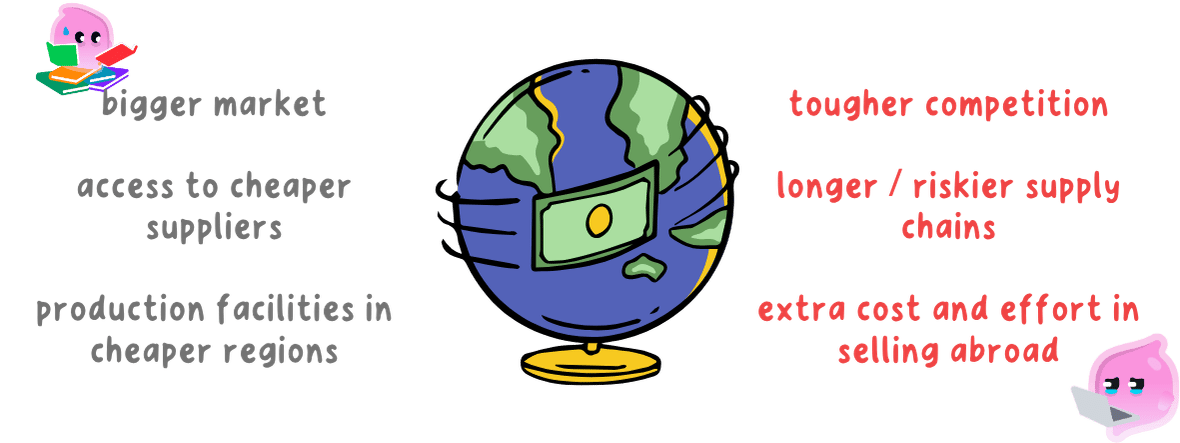
For GCSE Edexcel, use this as an overview. The specification focus is imports, exports, changing business locations and multinationals.
- Tariffs and other barriers to trade are covered in the next guide, and how firms compete internationally comes after that.
- Exchange rates were covered in Theme 1, and they move the price of an import or an export without either business changing anything it does.
Judging globalisation: whether it is good depends on which UK business you mean
Globalisation does not push all UK businesses the same way, and the table sets each change against the firm it helps and the firm it harms.
| Change | UK business that gains | UK business that loses |
|---|---|---|
| Cheaper imported materials | Furniture maker buying timber | UK timber supplier |
| Imported goods in UK shops | Importer and retailer | UK factory competing on price |
| Export markets open up | Online seller with spare capacity | Local hairdresser, no reach abroad |
| Production moved abroad | Owners, through lower unit costs | UK workers whose jobs go |
| Multinational opens in the UK | Shoppers and new employees | Small local rival |
- The balance depends on whether the business imports, exports or produces abroad, and whether it can differentiate itself from overseas rivals.
- Overall, globalisation offers larger markets and lower-cost sourcing, but those gains matter only if the business can manage the extra competition and complexity.
- Identify whether the business is importing, exporting or producing abroad before judging the effect.
- Trace one impact through to costs, sales or profit using the source-booklet business.
- For a judgement, weigh one opportunity against one threat and decide which matters more for that firm.
- Define globalisation.
- Give the two ways imports affect a UK business.
- State two reasons a UK firm might move production to another country.
- Give one benefit and one drawback of a multinational opening in the UK.
- Which kind of UK business gains least from globalisation, and why?
2.1.3b Barriers to international trade
Tariffs: a tax on imports that ends up in the price
Tariff: a tax charged by a government on goods brought into the country from abroad.
- A tariff is usually charged as a percentage of the value of the goods, and a government uses it to make imports dearer than home-made rivals while raising money for itself.
- The tariff is paid by the importing business when the goods cross the border, so a firm bringing stock into the country carries the cost before a single item is sold.
- The chain from that first payment runs all the way to the shelf.
- The importer's cost per unit rises, since the tax is added to what the supplier already charged.
- The importer then chooses: put the shelf price up and recover the tax from customers, or hold the price and accept a smaller margin on every sale.
- Either way the imported good is less competitive, because it now costs more than it did against a home-made rival whose costs have not moved.
- Domestic producers are protected and customers pay more, so the same tax that wins a UK factory orders leaves shoppers with a dearer product and less choice.
- How much damage the tariff does depends on how easily buyers can switch, so a tariff on a product with a close local substitute costs the exporter far more sales than a tariff on something only that firm makes.
- An exporter that absorbs the tariff rather than passing it on keeps its sales volume but earns less on every unit, which a firm working on a thin margin cannot do for long.
- A UK boot maker sells abroad on durability at a premium price, the ground Dr Martens competes on.
- If a government abroad charges a tariff on imported footwear, the importer in that country pays the tax at the border.
- The boots reach the shop with a higher price, so buyers there switch to cheaper local footwear and the UK maker loses overseas sales.
- A tariff charged by another country is therefore a problem for a UK exporter, not just for UK shoppers.
Trade blocs: inside the group you trade freely, outside it you do not
Trade bloc: a group of countries that agree to trade with each other on favourable terms, usually with no tariffs on goods moving between members.
- A business based inside a bloc sends goods to other members without paying a tariff, so its price on a member's shelf is the price it set at home.
- A business outside the bloc meets the tariff the bloc charges non-members, so its goods arrive dearer than an insider's identical product.
- A bloc therefore helps members and disadvantages non-members, which is why membership matters so much to firms that sell across borders.
- Members usually agree the same tariff on outsiders and common rules on standards and labelling, so one version of a product can be sold across the whole bloc without a redesign for each country.
- Membership cuts both ways for a member firm, because the open border that lets it sell into the other members also lets their producers undercut it at home.
- One response is to produce inside the bloc rather than export into it, since goods made in a member country move as an insider's goods.
- That decision is expensive, because the firm must fund a factory or a partner abroad before it saves anything on tariffs.
- Blocs and their membership change over time, so learn the mechanism rather than the current list of agreements.
- Globalisation as a whole, including imports, exports and multinationals, is covered in 2.1.3a.
Who the barriers hit, and the practical obstacles alongside them
- A tariff protects domestic producers by making the foreign version dearer, so a UK manufacturer keeps orders it would have lost on price.
- The same tariff raises costs for domestic firms that import their materials, because a bakery in Leeds buying imported flour pays the tax, so its costs rise, its margin falls and it must either charge more or earn less on every loaf.
- Barriers also invite retaliation, since other governments answer with barriers of their own and UK exporters then lose sales abroad.
- Alongside the two barriers named above sit practical obstacles: different legal and safety standards, another language and culture, longer transport and delivery times, and customs paperwork at the border.
- None of those is a tax, but each adds cost or delay, and most of the cost is fixed, so a redesign or a translated advert weighs far more heavily on a firm selling 500 units abroad than on one selling 50,000.
- Define the barrier in one precise sentence, because a vague phrase such as a block on trade earns nothing.
- When the command word is explain, run the chain to the end: the tariff raises the importer's cost, so the price rises or the margin falls, so sales of the imported good drop.
- Always say who is affected, since the barrier that protects a domestic producer raises costs for a domestic importer and for the customer.
- Use the business in the source booklet rather than a memorised example, because application marks are gated on that context.
- What is a tariff, and which business pays it first?
- Explain how a tariff on imported goods protects a domestic producer.
- What is a trade bloc, and why is a non-member firm at a disadvantage?
- Why might a firm choose to produce inside a trade bloc rather than export into it?
- Name one way a trade barrier can raise costs for a firm in the country that charges it.
2.1.3c How businesses compete internationally
The internet and e-commerce: your own site and an overseas marketplace
- Why a business sells abroad is covered in 2.1.3a and the tariffs and trade blocs it meets are covered in 2.1.3b, so this guide takes both as read and deals only with how the business wins customers in that country.
- A website is visible in every country from the day it goes live, so the business can take orders from abroad without renting a unit, hiring staff or holding stock in that country.
- Selling through its own site, the business keeps the whole selling price, controls how the brand looks and holds the customer's email address for future offers.
- It has to earn the visitors itself, paying for search advertising or influencers, because nobody types in the address of a shop they have never heard of.
- Selling through an overseas marketplace such as Amazon, eBay or Etsy puts the product in front of buyers who are already searching there, and the site handles payment in their currency.
- The marketplace takes a commission on every sale and shows rival products on the same page, so the firm trades margin and control for ready-made traffic.
- Either route sells more once the pages are translated and prices are shown in the local currency with a payment method people there already use, since a shopper asked to pay in pounds through an unfamiliar system usually abandons the order.
- The difficulty moves to what happens after the order, since posting a parcel to another country costs more than a UK delivery and takes longer, so either the price rises or the profit on each sale is squeezed.
- Returns and customer service cost more too, because return postage from abroad is dear and somebody has to answer emails in another language and another time zone.
- Gymshark was founded in Birmingham in 2012 by Ben Francis, who started by screen-printing gym clothing in a garage.
- It sold online and used fitness influencers to promote the brand, which brought buyers to the product without the firm renting a shop at all.
- For any UK online seller taking orders from abroad, each of those parcels still has to be packed and posted from the UK, which is where the cost of competing this way sits.
Changing the marketing mix: the product and the price
- Each of the four elements, taught in full in 2.2, is checked against the overseas market before the business starts trading there.
- Product: recipes, sizes and styles are changed to suit local tastes, while packaging has to carry the local language and meet local safety and labelling rules, and an electrical product needs the right plug.
- Changing the product itself is the dearest option, because a new recipe or a different plug means a separate production run, so a smaller firm often ships the UK version and changes only the label.
- Price: the price has to sit against local incomes and what local rivals already charge, so a figure that looks ordinary in the UK can be out of reach elsewhere.
- The same price also has to cover the delivery, translation and adaptation the overseas sale needs, so the firm is squeezed between higher costs and a market that will pay less.
- Do not answer that the business simply advertises more, because that names no element of the mix and earns nothing.
- Say which element changes, what it changes to and why that suits the buyers in that country.
- The marketing mix here is the four elements of product, price, promotion and place, not the three-part design mix.
Changing the marketing mix: promotion and place
- Promotion: adverts have to work in the local language and culture, because a slogan that is funny in English can mean nothing, or something rude, once it is translated.
- The platforms differ as well, so the campaign runs on whichever apps and search engines people in that country actually use, and a local influencer who speaks the language does what a translated advert cannot.
- Place: the goods still have to reach the buyer, which usually means signing a local distributor, getting shelf space in a local retailer or paying a delivery network in that country.
- Place also covers what happens when an order goes wrong, so a local returns address and delivery in days rather than weeks is often what persuades a first-time buyer abroad to risk the order at all.
- Every change costs money, because a separate recipe, label and advertising campaign has to be paid for in each country, so a smaller firm often adapts the packaging and the promotion and leaves the product itself alone.
- Name the method, then apply it to the exact product and country in the source booklet, since application marks are gated on that context.
- Carry the chain through: the firm sells through its website, so it reaches Spanish customers without renting a shop, so its fixed costs stay low, so it can price against local rivals and still make a profit.
- The mark most often dropped is the cost of the method, so pair every gain with the delivery bill or the adaptation spending.
- When the command word is justify or evaluate, choose between the two methods using the firm's size, its finances and how well it already knows that market.
- How does selling through the business's own website differ from selling through a marketplace such as Amazon?
- How does a website let a business reach customers abroad without opening premises there?
- Give one way each of the four elements of the marketing mix might be changed for an overseas market.
- Why does selling online to an overseas customer cost the business more after the order than a UK sale does?
- Why might the same product be priced differently in another country?
2.1.4a Ethical and environmental considerations
Ethical considerations: the fair choice when the cheap one is legal
Ethics: the moral standards of right and wrong that guide how a business treats the people it deals with.
- Acting ethically means choosing the fair and honest option even when a cheaper one is perfectly legal and would make more profit, and it shows up in four decisions.
- A fair price to suppliers: paying a farmer or a small maker enough to cover their costs and earn a living, instead of squeezing the price down because you are the bigger buyer.
- Pay and treatment of staff: wages above the legal minimum, proper breaks and settled hours rather than shifts cancelled the night before.
- Safe conditions all the way down the supply chain: checking that the factories making your goods abroad are safe and that no child labour is used at any stage, even though those workers are not on your payroll.
- Honest marketing: describing the product truthfully, so a word like handmade or recycled means what the shopper takes it to mean.
Environmental considerations: waste, emissions, sourcing and disposal
Sustainability: meeting today's demand without using up resources or damaging the environment that future generations will need.
- A business harms the environment when it makes, packs, moves and finally disposes of its product, so there are three places it can act.
- Waste and packaging: fewer layers, thinner materials and recyclable cartons rather than landfill, plus a plan for the product itself once the customer has finished with it.
- Emissions and energy: LED lighting, efficient ovens and fuller delivery vans on shorter routes cut carbon and the energy bill at the same time.
- Sustainable sourcing: buying materials that can be replaced, such as timber from managed forests or recycled plastic, instead of ones that run out.
The trade-off: what it costs and what it gives back
Every one of those choices has a price attached, and the table sets four common ones against what the business gets in return.
| Decision | What it adds to costs | What it can give back |
|---|---|---|
| Pay suppliers a fair price | Higher price for every unit bought | Reliable supply, believable claim |
| Pay staff above the minimum | Higher wage bill every month | Fewer people leaving, less retraining |
| Switch to recyclable packaging | New materials and machine changes | Greener shoppers, less landfill |
| Cut energy use and waste | Up-front spend on equipment | Lower bills from the first month |
- The first three rows all raise costs before they return anything, so the business either accepts a smaller profit on each sale or puts its prices up and risks losing the customer who was buying on price alone.
- The bottom row is where a business short of money starts, because using less energy and less material genuinely cuts costs from the first month rather than paying back years later in goodwill.
- More customers now choose businesses they trust, which holds sales up and can carry a higher price, which is how Innocent sells smoothies above the supermarket own-brand sitting beside it on the shelf.
- Staff also stay longer at a business they are proud of, so it spends less on recruiting and training replacements and keeps the experience it has already paid for.
- The fourth benefit is avoiding the cost of being caught, because a report of unsafe factories or a polluted river brings bad publicity, cancelled orders and a campaign against the brand.
- How pressure groups run those campaigns, and how a business changes its marketing mix in response, is the next guide.
Judging it: should a business put ethics and the environment before profit?
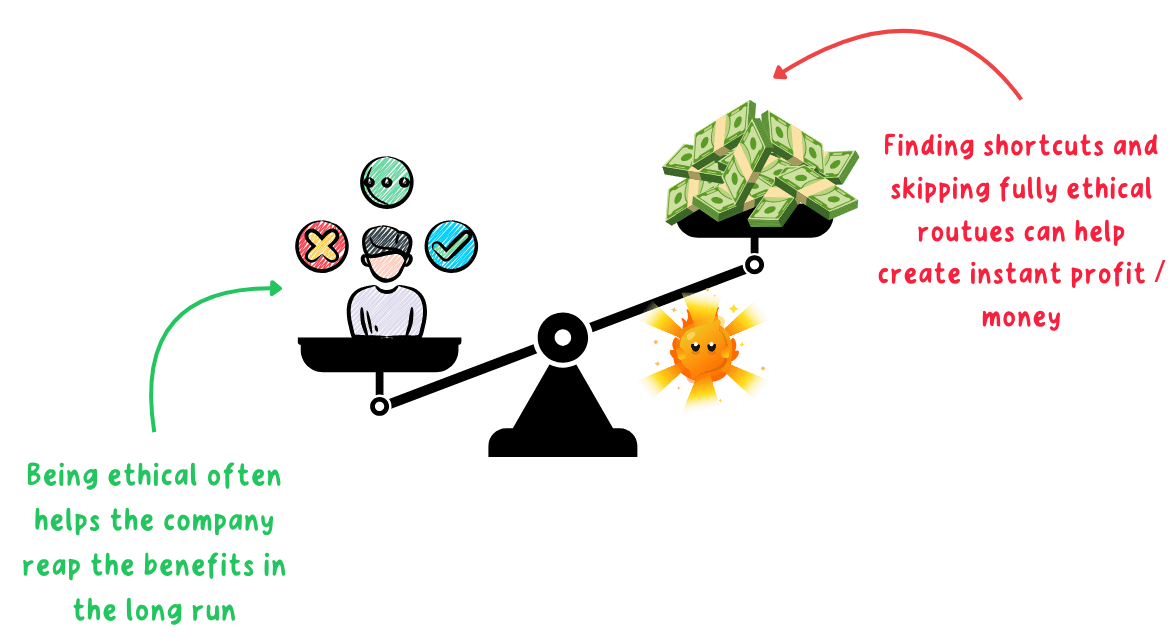
- Ethical or environmental changes are more likely to raise profit when customers value them enough to stay loyal or pay more, or when the change also reduces waste, energy use or staff turnover.
- The trade-off is harder for a cash-limited or price-led business because the extra cost arrives immediately while reputation and customer loyalty may take much longer to repay it.
- Overall, visible brands selling on trust have more reason to invest early, while a smaller price-led firm should prioritise ethical and environmental changes that also cut costs and add the more expensive measures as finances allow.
- Trace the change through its cost, the customer or staff response, and the effect on sales or profit.
- Do not assume ethical automatically means profitable; explain what must be true about the customers or cost savings for it to pay.
- For a judgement, compare the cost and benefit in the source-booklet business and commit to the better trade-off.
- Give two ethical considerations that reach beyond a business's own staff into its supply chain.
- Define sustainability.
- State three ways a business can reduce its environmental impact.
- Which environmental change lowers a business's costs instead of raising them, and how?
- Explain why the same ethical decision can raise profit for one business and cut it for another.
2.1.4b Pressure group activity and the marketing mix
Pressure groups: no legal power, so they work through your customers
Pressure group: an organised group that campaigns to change how a business or the government behaves on one issue, such as plastic packaging, animal testing or pay in supplier factories.
Boycott: an organised refusal by customers to buy from a business until it changes what it does.
- A pressure group is not a regulator and owns no part of the business, so it cannot fine a firm, cancel its contracts or order it to stop.
- Its power is borrowed from other people, because every method it uses is aimed at the customers who decide whether to keep buying, the journalists who repeat the story and the MPs who write the law.
- Publicity and social media: one video or hashtag reaches millions of shoppers in days and costs the group almost nothing to send.
- Petitions and protests: a signature count gives journalists a number and a demonstration outside a shop or head office gives them a picture, which is what keeps a story running.
- Boycotts: this is the only method that shows up in the accounts straight away, because refusing to buy cuts revenue in the week it happens.
- Lobbying: pressing the government for tougher rules changes the whole industry at once, so no rival gains an advantage by refusing to follow.
Why a business responds when nothing forces it to
- Criticism now reaches customers directly rather than through a newspaper that might not print it, so a firm can lose control of what its brand means in a single weekend.
- Follow the chain: shoppers see the campaign, some switch to a rival, revenue falls, and the advertising needed to win those customers back costs more than reformulating the product would have cost in the first place.
- The firms with most to lose are those charging a premium on brand image, because a customer paying more for Nike or Innocent is paying for how the brand makes them feel, so an attack on the image is an attack on the price.
The effect on each element of the marketing mix
- A campaign usually names one element, but a response that holds up moves all four, and each move carries its own cost.
- Product: the firm reformulates or redesigns, removing the material or ingredient the campaign named, switching packaging to recyclable card, or adding a plant-based or cruelty-free range alongside the original.
- Adding a range rather than replacing the old product answers the criticism without losing the customers who still buy the original.
- Price: sustainable materials and fairly paid suppliers raise the cost of every unit, so the business has to decide whether to pass that cost on or absorb it.
- Passing it on protects profit per unit but sends price-sensitive shoppers to a cheaper rival, while absorbing it holds the price and the sales volume but leaves less profit on each item sold.
- Promotion: the business advertises its ethical credentials to answer the criticism, putting the recycled packaging or the new sourcing rule at the centre of the message.
- Every claim has to be accurate and provable, because a group that finds an exaggeration will publicise it and the advert itself becomes the next story.
- Place: the firm changes where it buys and how goods travel, dropping a supplier accused of poor conditions, shortening delivery routes to cut emissions, or pulling out of a country entirely.
- Finding and approving a new supplier takes months and often costs more per unit, so place is the slowest element to move and the one customers notice last.
- Greggs sells cheap hot food in high volume on high streets and retail parks, and it launched a vegan sausage roll alongside its meat range.
- Campaigning about meat, animal welfare and the environment changes what a share of customers ask for, and an added range meets that demand without removing the product most buyers still want.
- Because the whole business rests on low prices, a new range only works if it can be made cheaply enough to sit near the existing price, which is the price element deciding what the product element is allowed to be.
Responding badly costs more than not responding
- A change to the advertising that is not matched by a change in the factory is found quickly, because campaigners check the supply chain rather than the slogan.
- The business then faces two stories instead of one, the original issue and the accusation that it tried to cover the issue up, and the second is harder to answer because it is about honesty.
- A change that is real but small is still worth making, provided the promotion describes it exactly, since a firm claiming one recyclable box is safer than a firm claiming to be green.
- Name the pressure group method, name the element of the mix it hits, then carry it through to sales, costs or reputation, because the marks are in the last link.
- Do not stop at "the business changed its product", since the answer needs the reason customers now buy or stop buying.
- When the question says explain or analyse, take one element and go deep rather than listing all four thinly.
- When the question says justify or evaluate, weigh the cost of the change against how exposed that particular business is, using its size, its customers and its market from the source booklet.
- What is a pressure group, and why can it not force a business to change?
- Give two methods a pressure group uses and say which one affects revenue fastest.
- How might a campaign about packaging change the product and the price?
- Why must a promotional claim about being ethical be provable?
- Explain why place is usually the slowest element of the mix to change.
