1.1.1a Why new business ideas come about: technology and consumers
Changes in technology: new products, new services and new ways of selling
Technological change: the arrival of new products, materials, processes and ways of trading that were not available before.
E-commerce: buying and selling goods and services online instead of in a physical shop.
- Technological change creates business ideas because it changes what can be made, what can be sold and how cheaply it can be delivered.
- It opens three routes to a new idea.
- New products: technology makes something exist that could not exist before, such as electric cars, smart watches and home 3D printers.
- New services: technology makes a service possible to run at scale, such as video streaming, mobile banking and live delivery tracking.
- New ways of trading: e-commerce lets a business sell across the country from a spare room instead of renting a unit on the high street.
- Technology also gets cheaper as it spreads, so the cost of starting up falls and an entrepreneur needs less money to test an idea.
- A website and a social media page can reach thousands of customers for under £100 a month, where a high-street unit would cost several thousand pounds in rent.
- Deliveroo launched in London in 2013, once smartphones with GPS had become normal.
- Restaurants and hungry customers both existed long before that.
- The new technology was what made an app that matches the two, tracks the rider and takes the payment workable.
- Will Shu did not create the need, he used new technology to meet an old need in a new way.
Changes in what consumers want: when lifestyles move, demand moves with them
Consumer wants: the goods and services people would like to buy, which shift as their incomes, tastes, priorities and way of life change.
- When people change how they live, work and spend, demand drains away from old products, and four shifts in what UK consumers want have produced most of the business ideas you would recognise.
- Health and fitness: rising interest in wellbeing built demand for budget 24-hour gyms such as PureGym and for low-sugar drinks.
- Environmental concern: shoppers wanting less plastic and less meat opened the way for refill shops, reusable bottles and the Greggs vegan sausage roll.
- Time pressure and expectations of speed: households with less time to cook created demand for meal-kit boxes such as HelloFresh, for click and collect at Tesco and for rapid grocery delivery.
- Home working: spending moved towards desk chairs, video-call software and coffee shops in market towns rather than city centres.
- An entrepreneur who reads a shift early sells into a market with few rivals, so can charge a higher price and build a customer base before larger firms copy the idea.
- Do not stop at describing the change, because the mark is for linking it to the business idea it creates.
- "More people care about fitness" on its own earns nothing.
- Carry it through: more people care about fitness, so demand for cheap gym access rises, so an entrepreneur opens a 24-hour gym with no staffed reception and low monthly fees.
- Keep the change as the driver and the idea as the result, not the other way round.
The two drivers usually push in the same direction
- The drivers rarely act alone, because a change in what people want only becomes a business once technology exists to serve it cheaply enough.
- Both are external drivers, meaning they happen outside the business and no entrepreneur can control them.
- Because both keep moving, the supply of new ideas does not dry up, and a business that stands still is overtaken by one that reads the change.
- The same two drivers also work in reverse, by making existing products unwanted.
- That process is obsolescence, and the next guide covers it.
Judging a change: whether it is worth acting on depends on the business
- Not every change is worth chasing. A lasting shift such as online shopping is more attractive than a short-lived craze, especially if rivals cannot copy the opportunity immediately.
- The business must also be able to afford the response. New technology or stock may require spending before extra revenue arrives, which can rule out an otherwise attractive idea for a cash-limited start-up.
- Overall, a technology or consumer change is worth acting on when demand is likely to last, the business can afford the response and the expected advantage is not likely to disappear immediately.
- Build the chain in three links: name the change, state the idea it makes possible, then say why customers will now pay for it.
- The link most often dropped is the last one, because the answer names the change and the idea but never says why anyone buys.
- Use the business in the source booklet rather than a memorised favourite, since application marks are gated on that context.
- On a justify or evaluate question, finish by weighing whether the change looks permanent enough to justify the spending, because that is where the judgement is credited.
- What three routes to a new business idea does technological change open?
- Define e-commerce.
- Give one change in consumer wants and name a business idea it created.
- Why are technology and consumer wants called external drivers?
- Name two things that decide whether a change is worth acting on.
1.1.1b Why new business ideas come about: obsolescence
Obsolescence: the product dies but the need survives
Obsolescence: when a product or service is no longer wanted because something better, cheaper or more convenient has replaced it.
- A product becomes obsolete when customers stop buying it, even though the need it once met is still there.
- Four forces push a product towards obsolescence.
- Better technology: streaming delivers a film instantly, so the rented DVD lost the one thing it was good at.
- Changing consumer wants: as shoppers moved towards plant-based food and away from sugary drinks, products built for the old taste stopped selling.
- Changes in the law: UK shops were banned from selling most halogen light bulbs from September 2021, which made the LED bulb the only option.
- A cheaper substitute: once a rival meets the same need for less money, customers switch and the older product cannot cover its costs.
- The need outlives the product, because people still want to watch a film at home, they simply do it through Netflix instead of a rented disc.
- Obsolescence is usually gradual rather than sudden, so a business gets warning if it is watching.
- Sales fall first, then prices are cut to hold volume, then margins shrink, and only after that is the product withdrawn.
- Blockbuster rented DVDs from hundreds of UK high-street shops and charged late fees when you kept one too long.
- Faster home broadband let Netflix deliver the same film with no journey, no queue and no late fee.
- Blockbuster still paid rent on every shop, so its costs stayed high while its revenue fell.
- The UK business went into administration in 2013 and its remaining shops closed that year.
- Demand for watching films at home never fell, only the way people paid for it changed.
Obsolescence opens as many doors as it closes
- Every product that dies leaves behind customers who still have the need and still have the money, so obsolescence hands an entrepreneur a market that is already proven.
- There are three ways to build a business on someone else's obsolescence.
- Sell the replacement: offer the newer product that meets the old need better, as streaming services did to rental shops.
- Serve the switch itself: as drivers move to electric cars, firms that fit home charging points sell to people in the middle of changing over.
- Serve what is left behind: vinyl records, film cameras and retro consoles support smaller businesses selling to a loyal group with almost no large rivals left.
- The replacement business often has lower costs than the one it displaces, because it does not carry the shops, the stock or the staff the old model needed.
- Lower costs let the new entrant charge less, which speeds up the switch and pushes the older firm out faster.
- Do not write that obsolescence means a product has worn out or broken.
- A DVD player still works, and people stopped buying them anyway.
- Obsolescence is about being no longer wanted, not about being broken.
- Do not say the need disappeared either, because saying the need survived is the point most answers miss.
Spotting obsolescence early: the signals a business can read
- Five signals tell a business its product is being overtaken.
- Repeat customers buy less often, which shows they have found another way to meet the need.
- Sales only hold up when the price is cut, so revenue per unit falls while volume stands still.
- A new technology moves from expensive to affordable, which is the point at which ordinary customers switch.
- A law is passed with a deadline attached, which gives the business a date by which the product will be unsellable.
- Younger customers never buy it at all, which shows the decline will continue as older customers stop.
- Reading the signals early is what separates a business that launches the replacement from one that is replaced by it.
- Answers on obsolescence score when they name what replaced the product and say why customers preferred it.
- "People stopped buying DVDs" is a description, while "streaming removed the journey to the shop and the late fee, so customers switched" is the reason.
- The mark most often dropped is the opportunity side, since the question usually asks how obsolescence creates a business idea, not only how it destroys one.
- If the source booklet business sells something being replaced, use its own product rather than a memorised example.
- Define obsolescence.
- Name the four forces that push a product into obsolescence.
- Why did Blockbuster's costs stay high while its revenue fell?
- Give three ways an entrepreneur can build a business on another firm's obsolescence.
- Give two signals that tell a business its product is being overtaken.
1.1.1c How new business ideas come about
Two routes to a new business idea: original or adapted
Original idea: a product or service that has not been offered before, so the business is first into the market.
Adapting an existing idea: taking a product, service or business model that already works and changing it for a different customer, place, price or purpose.
- Edexcel splits new business ideas into two routes: they are either original or adapted from something that already exists.
- An original idea means nobody is selling it yet, so the entrepreneur has no rival and no proof that anyone will buy.
- With no competitor, the business can set its own price and build the brand customers think of first.
- With no proof of demand, market research is guesswork and the money spent developing the product may never come back.
- Adapting an existing idea starts from something customers already buy, and changes one part of it.
- A new customer group: gym clothing sold to serious young lifters rather than to general sportswear shoppers.
- A new price point: budget gyms stripped out the pool, the sauna and the staffed reception to sell membership for around £20 a month.
- A new place: a street-food dish that sells well in London is brought to a market town that has nothing like it.
- A new feature: the same coffee shop menu with oat milk as standard and an app that stores your loyalty stamps.
- Two ideas joined: a barber shop that also sells coffee, so one visit meets two wants.
- Most UK start-ups adapt rather than invent, because an adapted idea is cheaper to launch and the demand for it has already been proved by someone else.
- Improving something that already exists is called innovation, and it is how most successful firms began, so an adapted idea is not a second-best version of an original one.
- Ben Francis started Gymshark in 2012, screen-printing gym wear in a garage in Birmingham.
- Gym clothing was not an original idea, since Nike and Adidas had sold it for decades.
- What he adapted was the fit, the customer and the way it was sold: tighter cuts aimed at young weight trainers, sold online through fitness influencers rather than through sports shops.
- Because the product already had proven demand, he did not have to persuade anyone that gym clothing was worth buying, only that his version fitted them better.
Where an idea to adapt comes from
- Ideas rarely arrive from nowhere, and most come from a market the entrepreneur already knows well.
- Working in a trade, or following a hobby, shows you what customers complain about and what the existing firms do badly.
- A gap left by rivals, or a product that already sells well in another town or country, gives something that can be copied and changed for local customers.
- Buying a franchise is another way in that uses someone else's proven idea, and it is examined as a type of ownership in 1.4.1.
- Do not treat "original" as meaning "good" and "adapted" as meaning "lazy".
- An adapted idea is the safer commercial choice for most start-ups, and examiners reward you for saying why.
Judging the two routes: which suits this entrepreneur
- An original idea offers no direct rivals and more pricing freedom, but development costs are higher and demand is unproven.
- An adapted idea starts from proven demand and usually costs less to launch, but established rivals mean the business must differentiate or compete on price.
- The better route depends on the entrepreneur's savings, access to finance and how quickly the business needs the idea to start paying.
- Overall, an entrepreneur with limited savings and no track record is usually safer adapting a proven idea, while someone able to absorb greater risk may prefer the higher potential reward of an original idea.
- When a question asks whether an idea is original or adapted, say which and then say what has been changed.
- Naming the change is what turns a bare statement into a linked point.
- The mark most often dropped here is proof of demand, since that is the real advantage of adapting and the real weakness of an original idea.
- On a justify question, tie your conclusion to the entrepreneur's finances rather than to which idea sounds more exciting.
- What are the two routes by which new business ideas come about?
- Give one reason an adapted idea is cheaper to launch than an original one.
- Give three things an entrepreneur can change when adapting an existing idea.
- Why is it easier to get a bank loan for an adapted idea than an original one?
- Name one drawback of launching an original idea.
1.1.2a Risk in business activity
Risk: what an entrepreneur puts on the line
Risk: the chance that a business decision goes wrong and the owner loses money, time or security.
Business failure: when a business can no longer pay what it owes and has to stop trading.
- Edexcel names three risks an entrepreneur takes on.
- Business failure: the business runs out of cash, cannot pay suppliers or rent, and closes.
- Financial loss: the savings, redundancy money or loan the owner put in are gone and cannot be recovered.
- Lack of security: there is no guaranteed wage, no sick pay, no paid holiday and no redundancy payment if it ends.
- Failure is common rather than rare, since roughly one in five new UK businesses stops trading within its first year and only around four in ten are still going after five years.
- The financial loss is larger than the cash put in, because the entrepreneur also gives up the wage they would have earned elsewhere.
- Someone who leaves a £28,000 job and puts £15,000 of savings into a shop has staked £43,000 in the first year, not £15,000.
- Lack of security bites hardest in the early months, when takings swing from week to week but the rent, the stock bill and the household bills do not.
- Wilko had traded on UK high streets since 1930 and ran around 400 shops.
- Falling sales and rising costs left it unable to pay its suppliers, so it entered administration in August 2023.
- Every shop had closed by October that year and around 12,500 people lost their jobs.
- Size and age do not remove risk, since a business fails when it cannot pay what it owes, however long it has traded.
The impact of risk: it changes what a business actually does
- Risk shapes the decisions an entrepreneur makes from day one, and each common response to it cuts the possible loss while taking something away in return.
- Start small or part-time: keeping a job while trading at weekends means a failed idea costs savings rather than the household income, but growth is slower while the gap in the market fills up.
- Do market research first: asking customers before committing reduces the chance of stocking something nobody buys, though it costs money and weeks that a faster rival can use to reach those customers first.
- Rent rather than buy: renting equipment and premises keeps the amount tied up small enough to walk away from, but costs more over several years than buying would have done.
- Hold a cash buffer: money set aside covers a slow month, since most failures come from running out of cash rather than from a bad idea.
- Insure against the losses you cannot absorb: stock, premises and public liability cover turn a possible disaster into a monthly premium that is paid whether anything goes wrong or not.
- Choose the ownership type carefully: setting up as a private limited company separates the owner's personal money from the firm's debts, which is covered in 1.4.1.
- Because reducing risk usually means accepting a smaller or slower return, the entrepreneur is trading one against the other rather than escaping either.
- Risk also pushes decisions the other way, because an entrepreneur who is too cautious never commits enough to make the idea work.
- Risk is only half of this spec point, since Edexcel pairs it with reward, which 1.1.2b covers and which exam questions usually ask you to weigh against the risk.
- Do not write that a business "took a risk" and stop there.
- Name which of the three risks you mean: business failure, financial loss or lack of security.
- Then say who bears it, since the owner's savings and the employee's job are different losses.
- Do not treat risk as something only new businesses face, because established firms fail too.
Judging how much risk is worth taking
- Judge whether the entrepreneur could survive the loss. The same amount of money can be manageable for someone with spare savings but damaging for someone relying on it for household security.
- Compare that risk with the possible reward and whether the idea can be tested cheaply before large spending is committed.
- Overall, a risk is more reasonable when the potential loss is survivable and the entrepreneur can learn about demand before making the largest commitment.
- Use Edexcel's own three words, since "business failure", "financial loss" and "lack of security" are the wording the mark scheme rewards.
- Build the chain from the risk to a consequence for this owner: no sick pay, so a week off ill means no income, so the household bills still have to come from savings.
- The mark most often dropped is the forgone wage, because answers count the money put in and forget the salary given up.
- If the source booklet gives figures for savings or start-up costs, quote them, since application marks depend on using that business's numbers.
- Name the three risks Edexcel lists for business activity.
- Define business failure.
- Why is the true financial loss bigger than the money the owner puts in?
- Give three ways an entrepreneur can reduce risk, and one cost of doing so.
- What does lack of security mean for someone who is self-employed?
1.1.2b Reward in business activity
Reward: what pulls someone into business despite the risk
Reward: what an entrepreneur gains if the business works, which is what makes taking the risk worthwhile.
Profit: the money left over once all the costs of running the business have been taken off its revenue.
Independence: being your own boss, so you decide what the business sells, when you work and how it is run.
- Nobody accepts the risks of the previous guide for nothing, so Edexcel pairs them with three rewards.
- Business success: the idea works, customers come back, and the business grows a reputation that makes the next sale easier.
- Profit: what is left after costs belongs to the owner, not to an employer.
- Independence: the owner sets the hours, chooses the products and answers to customers rather than to a manager.
- Profit is the reward that pays for the other two, since it funds the owner's wages and the money put back into growing the business.
- A market stall that takes £1,280 in a week and spends £950 on beans, cups and the pitch is left with £330, which shows how thin the reward can be at the start.
- Business success is broader than profit, because a firm can count survival, a growing customer base or a well-known name as success before the profit arrives.
- Julian Dunkerton started Superdry from a market stall in Cheltenham.
- The stall grew into a clothing brand sold on high streets, which is business success on a scale a single pitch could never reach.
- All three rewards show up there: the profit from selling clothes, the success of a recognised brand, and the independence of choosing his own designs and shops.
- The stall could equally have failed, which is why reward is the return for accepting risk rather than a prize for having an idea.
The impact of reward: it decides what a business chases
- Which reward an owner wants most changes the decisions the business makes.
- An owner chasing profit prices to protect the margin, controls costs tightly and drops products that do not pay.
- An owner chasing business success may cut prices to win market share and accept a thin profit for a few years.
- An owner who values independence may refuse outside investors and stay small, because taking their money means sharing control.
- Reward is also what keeps a business going through the difficult first years, since the prospect of profit is what justifies the unpaid hours.
- Reward is closely tied to the aims and objectives a business sets.
- Financial and non-financial aims are examined in 1.3.1, so keep the detail of survival, market share and social objectives for that guide.
Each reward comes with a catch
- None of the three rewards arrives cleanly, and naming the catch is what turns a list into analysis.
- Profit: it is uncertain and often late, so many owners pay themselves less than they earned as an employee for the first year or two.
- Independence: being in charge means there is nobody else to cover a sick day, so the hours are longer and the responsibility does not switch off.
- Business success: growth brings staff to manage, premises to pay for and, if investors are brought in, a loss of the very independence that attracted the owner.
- The three rewards can also pull against each other, since the quickest route to profit is often to take investment that costs the owner some control.
- Do not treat profit and revenue as the same thing.
- Revenue is everything that comes in, and profit is only what survives after the costs are paid.
- A stall taking £1,280 a week is not making £1,280 a week.
- Do not assume reward means money either, since independence is a reward the mark scheme credits just as readily.
Judging whether the reward justifies the risk
- Start with what the entrepreneur values. Someone seeking independence may accept a lower profit than someone whose main reward is financial.
- Then consider how likely the reward is and how long it will take to arrive. A large possible profit is less attractive if competition makes it unlikely or the owner cannot wait years for it.
- Overall, reward justifies risk when what the entrepreneur is likely to gain matters more to them than the loss they could reasonably face.
- Questions here almost always ask you to weigh risk against reward rather than to list one of them.
- Give a developed chain on each side, then judge using what this owner seems to want.
- The mark most often dropped is independence, since answers reach for profit and forget that being your own boss is one of the three rewards.
- Where the source booklet quotes profit figures, use them, and say what the number means for the owner rather than repeating it.
- Name the three rewards Edexcel lists for business activity.
- Give one measure of business success other than profit.
- A stall takes £1,280 and has costs of £950, so what is its profit?
- Give one drawback of independence as a reward.
- Why might two entrepreneurs judge the same idea differently?
1.1.3a The role and purpose of business activity
The purpose of business activity: turning resources into something people will buy
Business activity: the work a business does to turn resources into goods or services that customers will pay for.
Goods: physical products a customer can touch, own and take away.
Services: work done for a customer that has no physical form, such as a haircut, a train journey or insurance.
- Every business, from a market stall to Tesco, does the same basic job: it takes resources in, changes them, and sells the result.
- The inputs are materials, equipment, premises, money and people's time.
- The process is whatever the business does to them, such as baking, assembling, designing or delivering.
- The output is the good or service the customer pays for.
- The output is either a good or a service, and the difference is whether the customer walks away with something physical.
- Goods: a Greggs sausage roll, a pair of trainers, a bag of cement.
- Services: a Netflix subscription, a dentist appointment, a plumber unblocking a drain.
- Plenty of businesses sell both, since a garage sells the replacement tyre as a good and the fitting of it as a service.
- The distinction matters because a service cannot be stored, so an empty seat on a train or an unbooked hour in a salon is revenue that can never be recovered.
- A Greggs shop takes in flour, meat, pastry, ovens, staff hours and a rented unit.
- The process is baking on site through the day rather than delivering everything ready-made.
- The output is a hot sausage roll sold in a few seconds to someone on a lunch break.
- The customer need being met is a cheap hot meal with no waiting, which is why the shops sit near stations, high streets and retail parks.
Meeting customer needs: the test every business has to pass
- Producing something is only half the purpose, because a business survives only if what it produces is what customers actually want.
- A customer need is what the buyer requires from the product before they will part with their money.
- Meet it better than rivals and customers return, which brings repeat sales and word of mouth.
- Miss it and the product sits unsold, so the money spent on stock and staff is lost.
- Needs change over time, so a business that met them five years ago has to keep checking that it still does.
- This is why production and marketing are the same problem seen from two ends: one makes the product, the other makes sure it is the product people want.
- This guide covers meeting customer needs as a purpose of business activity.
- How a business identifies and researches those needs, including price, quality, choice and convenience, is examined in 1.2.1.
Business enterprise: spotting the gap and organising what is needed to fill it
Business enterprise: the activity of spotting a business opportunity and bringing together the resources needed to turn it into a working business.
Business opportunity: a gap in the market where customers have a need that no existing business is meeting well.
- Business enterprise is the activity that gets a business started, and it does three jobs.
- It spots the opportunity, by noticing a need nobody is serving or serving badly.
- It organises the resources, by finding the money, the premises, the suppliers and the people to make the product.
- It accepts the risk, since the resources have to be paid for before anyone knows whether customers will buy.
- Enterprise matters beyond the individual business, because it is what keeps the wider economy moving.
- New businesses create jobs and pay wages, which gives other people money to spend.
- They add choice and competition, which pushes existing firms to improve quality or cut prices.
- They pay tax on profits and collect VAT, which funds public services such as the NHS.
- The person who carries out business enterprise is the entrepreneur, and their specific roles are covered in the guide after next.
- Do not answer "the purpose of business activity is to make profit" on its own.
- Edexcel wants producing goods or services and meeting customer needs, with profit as the result of doing both well.
- Charities and the NHS carry out business activity too, and neither exists to make a profit.
- If you are asked to state the purpose of business activity, give producing goods or services and meeting customer needs.
- For an "explain" question, say which need the named business meets and how its product meets it.
- The mark most often dropped is naming the need, because answers describe what the business sells without ever saying what problem it solves for the buyer.
- Sort the business in the source booklet into goods, services or both before you start writing, since it steers every later point.
- State the two purposes of business activity Edexcel lists.
- What is the difference between a good and a service?
- Why can an unsold service never be recovered?
- Define business enterprise and give the three jobs it does.
- Give two ways new businesses benefit the wider economy.
1.1.3b Adding value
Adding value: the gap between what your inputs cost and what customers pay
Added value: the difference between the price a customer pays and the cost of the bought-in materials used to make the product.
- A business adds value when it does something to its inputs that makes a customer willing to pay more than those inputs cost.
- It is worked out as added value=selling price−cost of bought-in materials\text{added value} = \text{selling price} - \text{cost of bought-in materials}added value=selling price−cost of bought-in materials.
Take a café selling a flat white for £3.40, where the beans, milk, cup and lid cost £0.45.
added value=£3.40−£0.45=£2.95\text{added value} = \pounds 3.40 - \pounds 0.45 = \pounds 2.95added value=£3.40−£0.45=£2.95
That £2.95 is not profit, because it still has to cover the rent, the wages, the electricity and the machine repairs.
- Do not confuse adding value with adding cost.
- Spending an extra £1 on packaging only adds value if customers will pay more than £1 extra because of it.
- Do not confuse added value with profit either, since added value comes before wages, rent and bills are taken off.
Five ways a business adds value
Branding: the name, logo and reputation that make customers recognise a product and pay more for it than for an identical unbranded one.
Unique selling point (USP): the one feature a product has that no rival offers, which gives customers a reason to choose it.
- Edexcel names five routes to added value, and a business can use more than one at once.
- Convenience: customers pay more to save time or effort, which is why the same bottle of drink costs 65p in a supermarket and £1.80 at a motorway service station.
- Branding: a plain cotton t-shirt sells for £5, and the same shirt with a Nike tick on it sells for £25, because the name carries a reputation the plain one does not.
- Quality: better materials and workmanship let a business charge more, which is why a pair of Dr Martens boots at £160 outsells cheaper boots among customers who expect to wear them for years.
- Design: how a product looks and how well it works can justify a much higher price, as Dyson does by selling vacuum cleaners at several times the price of a basic model.
- Unique selling point: offering something no rival does, such as a bakery that is the only one in town making gluten-free bread, means customers who need it have nowhere else to go.
- The five overlap in practice, since a strong brand is usually built on quality and design that customers noticed first.
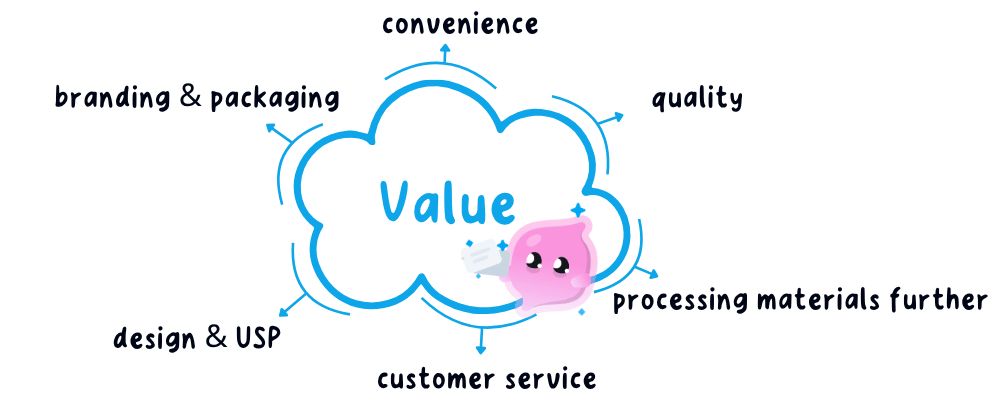
For GCSE Edexcel, focus on the five routes named in this article: convenience, branding, quality, design and a unique selling point. The diagram also shows other common ways a business may add value.
- Innocent sells a smoothie for around £2.75 when the fruit inside it costs a fraction of that.
- The convenience is that the fruit is already blended and chilled, ready to drink on the way to work.
- The branding is the friendly label and the promise of nothing but fruit, which shoppers trust enough to pay more for.
- A supermarket own-brand smoothie sitting next to it uses similar fruit and sells for about half the price.
- The price gap between the two is the added value the brand has created.
What a business gains from adding value
- Adding value changes what a business can charge, and that has three consequences worth knowing.
- A wider gap between price and material cost leaves more money to cover fixed costs, so the business breaks even on fewer sales.
- It lets a small firm compete without being the cheapest, which matters because a price war against a supermarket is one it cannot win.
- Customers who buy for the brand or the quality come back, so repeat sales cost less to win than new ones.
Added value sits behind much of Theme 2, so keep the detail of the design mix and pricing strategies for 2.2 and stay on the five routes here.
Where adding value fails to pay off
- Adding value is not free, and four things stop it working.
- It costs money up front: advertising, better packaging and staff training all have to be paid for before any extra revenue arrives.
- Better quality raises input costs: if the materials cost 80p more and customers will only pay 50p more, added value per unit has fallen.
- Customers have to notice and care: in a market where shoppers compare price alone, a better design earns nothing.
- Rivals copy it: a unique selling point stops being unique once a competitor offers the same thing, so the price premium fades.
- When household budgets tighten, customers trade down from branded goods to supermarket own-brands, which shows added value depends on the customer being willing as well as the business being clever.
- Calculate questions here give you a selling price and a materials cost, so subtract one from the other and label the answer in pounds.
- A correct figure earns the marks even without working, but write the subtraction anyway so a slip still shows the method.
- Then say what the number means, since "£2.95 per cup must cover rent and wages before any profit" is where the extra marks sit.
- On an "explain how this business adds value", name one of the five routes in Edexcel's own words and tie it to something in the source booklet.
- State the formula for added value.
- A sandwich sells for £4.20 and its ingredients cost £1.10, so how much value is added?
- Name the five ways Edexcel says a business can add value.
- Why is added value not the same as profit?
- Give one reason a unique selling point may stop adding value over time.
1.1.3c The role of entrepreneurship
The entrepreneur: the person who makes a business happen
Entrepreneur: the person who sets up and runs a business, organising its resources, making its decisions and carrying the risk of it failing.
- Edexcel gives the entrepreneur three roles, and exam questions come from all three: organising resources, making business decisions and taking risks.
- The three run together rather than in sequence, since a decision about which supplier to use is also a decision about how much risk to carry.
Organising resources: getting the right inputs in the right amounts
- Organising resources means gathering everything the business needs and combining it so the business can trade.
- Premises and materials: somewhere to trade from, plus the stock or raw materials the product is made of.
- People: the staff and the skills they bring, from a single part-time assistant upwards.
- Money and equipment: the cash to pay the bills before customers pay, and the machinery, vehicles and tills the work needs.
- Getting the amounts right matters as much as getting the resources at all, since too much stock ties up cash the business needs for its rent and may end up thrown away.
- Too few staff means customers queue and leave, so the sale is lost even though the product was there.
Where the money to buy those resources comes from is examined as sources of finance in 1.3.4.
Making business decisions: the choices nobody else will make
- In a small business there is no manager above the owner, so every decision that matters lands with them.
- What to sell and what to charge: which products to stock, which to drop when they stop paying, and a price high enough to cover costs but low enough that customers still come.
- Where to trade and who to employ: a high-street unit with passing customers and high rent or an online shop with lower costs and less visibility, and how many staff the takings can support.
- Whether to grow: taking on a second site or a larger order means spending before the extra revenue arrives.
- Start-up decisions are made quickly and with incomplete information, because waiting for certainty hands the opening to someone else.
- Each choice also closes another one off, since money spent on a delivery van is money not spent on advertising.
- Do not describe an entrepreneur as simply "someone who owns a business".
- A shareholder owns part of a business without organising anything or making any decisions.
- Use Edexcel's three roles, since the mark scheme is built around organising resources, making decisions and taking risks.
Taking risks: the role that cannot be handed to anyone else
- An entrepreneur can pay someone else to do the accounts or run the shop, but the loss still falls on them if it fails.
- The risk is what earns the reward, because the profit left after everyone else has been paid belongs to the owner.
- Staff are paid their wages and suppliers are paid for their stock whether the week was busy or quiet, so the owner is paid last and only if anything is left.
- Levi Roots was selling his Reggae Reggae Sauce before he appeared on Dragons' Den in 2007.
- He organised resources by winning £50,000 of investment and finding a manufacturer able to bottle the sauce in volume.
- He made decisions by giving up control of a share of the business in exchange for the money and contacts to reach supermarket shelves.
- He took the risk, since scaling from a market stall to a Sainsbury's listing meant committing to production runs before knowing whether shoppers would buy.
Judging which role decides whether an entrepreneur succeeds
- Which role matters most depends on the business. In a stock-heavy business, organising resources may be critical because too much cash can be tied up in inventory.
- In a fast-moving market, decision making may matter more; in an untested market, willingness to take risk may be decisive.
- Overall, taking risk gets the business started, but sound organisation and decisions are what make that risk sustainable.
- When a question asks about the role of an entrepreneur, pick one of the three roles and develop it rather than listing all three thinly.
- Show the role in action in the named business: not "she organises resources", but "she hired two part-time staff for Saturdays so the queue clears at the busiest hour".
- The mark most often dropped is the consequence, because answers name what the entrepreneur does and never say what it does for the business.
- On a justify or evaluate question, judge which role matters most for that particular firm and say why, rather than concluding that all three are important.
- Name the three roles of an entrepreneur.
- Give three kinds of resource an entrepreneur has to organise, with an example of each.
- Why does holding too much stock cause a problem for a small business?
- Why is the owner paid last out of the money the business takes?
- In an untested market, which of the three roles matters most, and why?
