Definition
Unincorporated business: a business with no separate legal identity from its owner, so in law the owner and the business are one and the same.
- The two unincorporated structures are the sole trader and the partnership, and between them they account for most UK businesses.
- Because there is no legal separation, the money the business owes is money the owner personally owes, which is unlimited liability.
Sole traders
Definition
Sole trader: a business owned and controlled by one person, who keeps all the profit and carries all the risk.
- Easy and cheap to set up: the owner registers with HMRC and can start trading within days, with low start-up costs.
- Greggs started this way in 1939, when John Gregg delivered eggs and yeast to homes around Newcastle by bicycle as a one-man business.
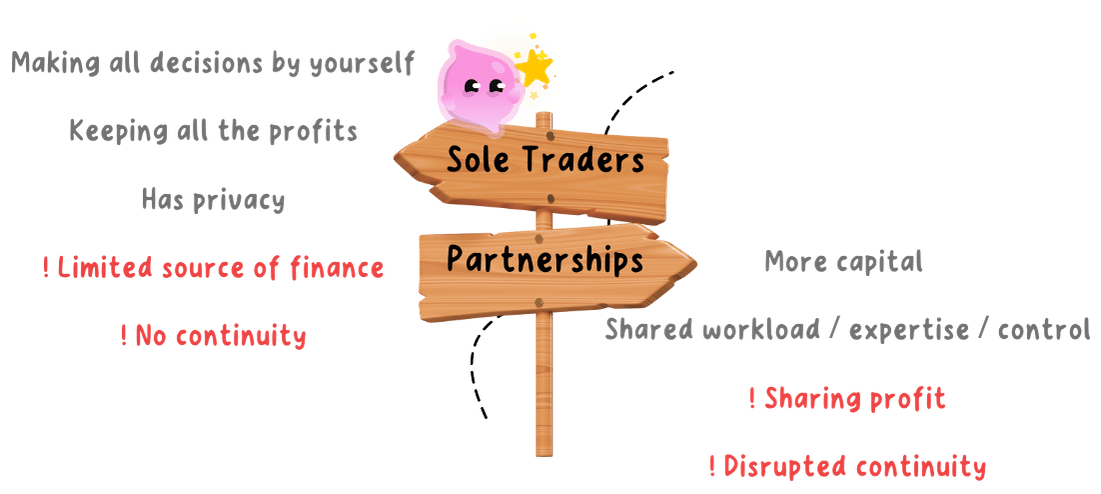
- Makes all the decisions: one person decides everything, so the business reacts quickly, but there is nobody to share the workload or challenge a bad decision.
- Keeps all the profit: there are no partners or shareholders to share it with, so every pound of profit after tax belongs to the owner.
- Flexible working hours: the owner sets their own hours, which is why this structure suits somebody fitting work around family commitments.
- Privacy: accounts are not published, so competitors cannot look up what the business earns.
- Limited sources of finance: a sole trader cannot sell shares, so money comes from savings, family, a bank loan, an overdraft or retained profit.
- Banks lend cautiously because the business owns few assets to offer as security.
- Unlimited liability: personal possessions such as the owner's car or home can be sold to pay business debts.
- No continuity: the business has no legal life of its own, so it ends when the owner retires, sells up or dies.
Common Mistake
- Do not write that a sole trader works on their own or has no employees.
- Sole means one owner, not one person in the building.
- A corner shop with four staff behind the till is still a sole trader if one person owns it.
Partnerships
Definition
Partnership: a business owned by two or more people who share the decisions, the profits and the risk.
Deed of partnership: a written agreement setting out what the partners have agreed between them.
- More capital: every partner can invest, so a partnership usually starts with more money than a sole trader could raise alone.
- Shared workload and expertise: partners bring different specialisms and can cover for each other, so the business can offer more than one person could.
- Shared control: decisions have to be agreed, which slows them down, and partners who disagree can stall the business with no boss to break the tie.
- Shared profit: profit is split between the partners, so each owner earns less from the same total than a sole trader would.
- Unlimited liability, shared: debts run up by one partner can be claimed from the others, which makes choosing a partner a financial decision as much as a personal one.
- Disrupted continuity: if a partner leaves or dies the partnership normally has to be dissolved and reformed, which can interrupt trading.
What a deed of partnership covers
- How profits are shared between the partners, and what salary each one takes.
- How much capital each partner has invested, and how liability is shared.
- Voting rights, and who decides important matters such as which products to sell.
- How the workload is divided, and the rules for admitting a new partner or for a partner retiring.
- A deed is not compulsory, but without one a disagreement over money has nothing to settle it.
Example
- A high street dental practice run by three dentists is a typical partnership, and most NHS GP surgeries are owned the same way, by the doctors who run them.
- Pooling their savings paid for equipment none of them could have afforded alone.
- Each brings a different specialism, so the practice offers more treatments than a single dentist could.
- If one partner borrows heavily against the practice and it fails, the other two can be pursued for the debt.
Deciding whether to take on a partner
- Ask first whether the partner brings capital, because a partner who invests money solves a finance problem that a bank loan would otherwise have to solve.
- A partner who brings no money is a much weaker case, because they take a share of the profit for doing work a paid employee could have done.
- Weigh the shared workload and specialist skills against slower decisions, possible conflict and the loss of sole control.
- Then judge it against how profitable the business already is, because giving away half of a healthy profit costs far more than giving away half of a struggling one.
Exam technique
- Short questions here include explain one detail that could be agreed between partners in a partnership, which is asking for a clause of the deed of partnership.
- The longest question asks you to recommend whether X should form a partnership with Y, and there you must actually decide rather than list both sides and stop.
- Look in the item for whether the proposed partner has money to invest, since that single fact usually decides the answer.
- Use the word unincorporated when a question asks what sole traders and partnerships have in common.
Self review
- What does unincorporated mean?
- Can a sole trader employ staff? Explain your answer.
- Give three details that could be set out in a deed of partnership.
- State two advantages of a partnership over a sole trader.
- Why does it matter whether a proposed partner can invest capital?
