4.4.1 Importance of training
What training is
Training: the process of teaching an employee the knowledge and skills they need to do their job well.
- Businesses train new starters, staff moving into a different role, and existing staff whose job changes because of new equipment, new products or new rules.
- Training is treated as an investment, because the business pays now and collects the benefit over the months and years that follow.
Higher productivity and better quality
- Increased productivity: a trained employee works faster, needs less supervision and repeats fewer mistakes, so the output produced by each worker rises.
- More output from the same wage bill lowers the labour cost of each unit, which lets the business hold its prices down or keep the difference as profit.
- High quality goods and services: staff who have been taught the correct method follow it, so fewer items come out faulty and fewer jobs have to be done twice.
- Less waste and fewer returns cut costs directly, and quality that customers can rely on protects the reputation the business sells on.
New technology and legal duties
- Dealing with changes in technology: new machinery, tills or software only pay for themselves if staff can use them properly, so training is what turns the purchase into extra output.
- Without training, staff avoid the new system or use only part of it, and the business falls behind rivals who did train their staff.
- Meeting legal duties: the Health and Safety at Work Act 1974 requires an employer to give staff the training they need to work safely. Trained staff then have fewer accidents, so fewer days are lost to injury and there is less risk of prosecution or a compensation claim.
- When JCB installs a new robotic welder, the supplier trains the operators before the line restarts, so the machine reaches full output in days rather than months.
- An untrained operator would run it slowly and risk damaging equipment that cost hundreds of thousands of pounds.
Motivation, staff retention and customer service
- Increased motivation: being trained shows the employee the business is prepared to spend money on them, and knowing how to do the job removes the stress of guessing.
- Staff retention: trained staff who can see a route to more skilled and better paid work are less likely to leave, so the business keeps the experience it has built up.
- Every leaver costs money to replace through advertising, interviewing and training a newcomer who works slowly at first, so keeping staff is a direct saving.
- Good customer service: staff trained in product knowledge and in handling complaints answer questions confidently and calm an unhappy customer instead of making the situation worse.
- Aldi trains checkout staff to scan quickly and to cover the whole store's routines, so shoppers queue for less time and come back.
- An assistant trained to answer a question about a product turns a browsing shopper into a paying one.
The costs of training
- Training costs money. Course fees, an outside trainer, materials and the wages of anyone covering the trainee all have to be paid before any benefit appears.
- Training costs time. While an employee is learning they produce less, or nothing at all, and any colleague teaching them produces less too.
- Trained staff can be poached. New skills, especially a recognised qualification, make an employee attractive to a competitor who can offer higher pay without having paid to train them.
- Not all training works. Training chosen without checking what staff actually need does not improve performance, so the money buys nothing.
The risk of a trained employee leaving is a reason to make staying attractive, through pay, promotion or a training agreement, not a reason to keep the workforce untrained.
- The usual instruction is explain the benefits of training employees for this business, so name a benefit and follow it through to output, costs, revenue or staff.
- Use the detail in the question, because a business installing new machinery needs the technology argument while a shop losing staff needs the retention argument.
- If the question mentions what training costs, say what the spending buys rather than only that training is expensive.
- Define training.
- Explain how training lowers the cost of making each unit.
- Why must a business train staff who use dangerous machinery?
- Name two costs or risks of training.
- How does training help a business keep its staff?
4.4.2 Methods of training
Induction training
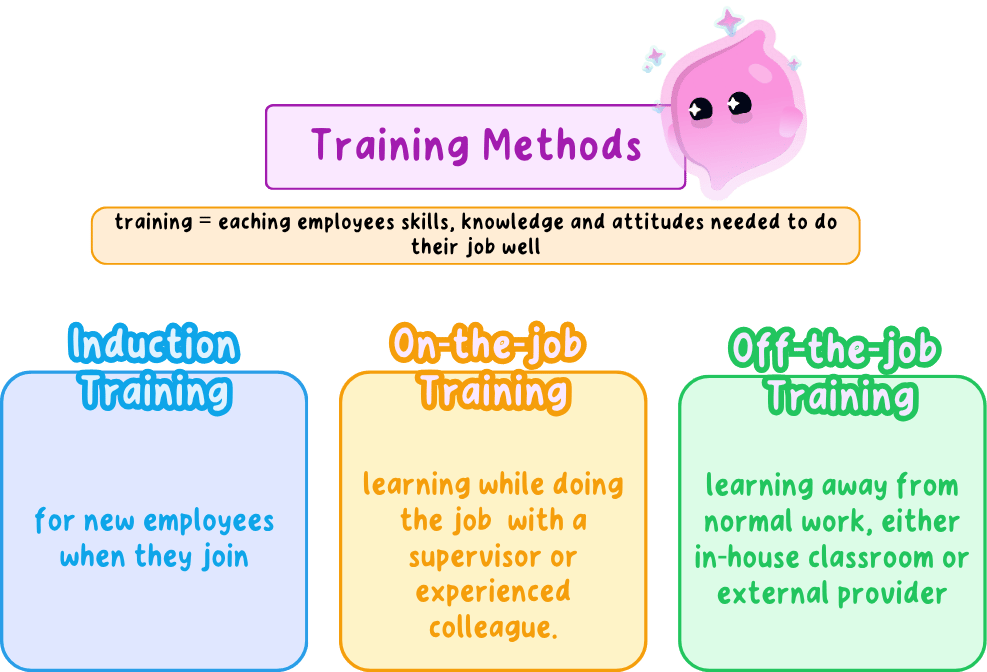
Induction training: the training given to an employee when they first start, to introduce them to the business and the way it works.
- Induction happens in the first days or weeks of a new job, which is what separates it from every other kind of training.
- A typical induction covers a tour of the workplace, the procedures and policies the employee has to follow, an introduction to the colleagues and managers they will work with, and health and safety, including fire exits and how to use equipment safely.
- It usually ends with the basics of the job itself, such as the till system, the paperwork or the software the employee will use every day.
Benefits of induction training
- The new starter reaches full speed sooner. Knowing where things are kept and how the systems work means less time spent asking, so the employee becomes productive in days rather than weeks.
- Fewer accidents and mistakes at the riskiest time: a new employee is most likely to hurt themselves or damage stock before they know the procedures, so covering safety and process on day one prevents both.
- Better retention: a starter who is welcomed, introduced to colleagues and told what is expected is far less likely to walk out in the first month.
- Losing a recruit early wastes everything already spent on hiring them, so a good induction protects the cost of recruitment.
- Less demand on managers: because the new employee knows who to ask and what the rules are, supervisors spend less time answering basic questions and can get on with their own work.
- A new Tesco colleague spends a first shift on a store tour, fire evacuation routes, the chilled goods procedure and till basics before serving on their own.
- By the end of the week they can work a shift with normal supervision, so the cost of the induction is quickly repaid.
On-the-job training
On-the-job training: training that takes place at the workplace while the employee carries out the real job, usually guided by an experienced colleague.
- Shadowing: the trainee watches an experienced worker do the job, then takes over the simpler parts of it while still being watched.
- Mentoring: a more experienced colleague is assigned to give advice and answer questions over weeks or months while the employee settles into the role.
- Coaching: a manager or specialist works through one particular skill with the employee, watching them do it and giving feedback until it is right.
- Whatever the form, real work is being produced while the learning happens, and the skills learned are the ones this business actually uses.
- The two types are told apart by where the training happens, not by what is taught: an employee learning at the till is being trained on the job, and the same skill taught at a college is off the job.
- So do not sort them by the content of the course, because either type can teach a skill that is specific to this business.
Off-the-job training
Off-the-job training: training that takes place away from the normal work position, either in a training room on site or with an outside provider such as a college or a training company, and often leading to a formal qualification.
- Common forms are a course at a college, often one day a week for an apprentice, a course run by an outside training company, a session at a specialist training centre, and training given by the supplier of new machinery at its own site.
- It is usually taught by a specialist and often leads to a recognised qualification, such as a food hygiene certificate, a first aid certificate or an engineering award.
- Because the employee is away from the queue, the phones and the production line, they can concentrate on learning a whole skill rather than picking pieces of it up between tasks.
Weighing on-the-job against off-the-job training, and deciding which suits a particular business, is the job of the next article.
- A frequent instruction is explain the benefits of induction training to this business, so say when it is given and what it covers before naming the benefit.
- Writing that induction improves skills does not separate it from any other training, so name the workplace tour, the procedures, the introductions and the health and safety.
- Check who is being trained, because induction only fits somebody who has just started.
- When you describe a method, use the specific label such as mentoring or a college day release rather than only the broad type.
- When is induction training given?
- Name three things an induction usually covers.
- Give two benefits of induction training to the business.
- What makes training on-the-job rather than off-the-job?
- Give one example of off-the-job training.
4.4.2b On the job and off the job training
Benefits of on-the-job training
On-the-job training: training at the workplace while the employee carries out the real job, usually guided by an experienced colleague.
- Cheaper: there are no course fees, no travel and no outside trainer to pay, because the teaching is done by staff already on the payroll.
- The trainee keeps producing. Work still comes out while the learning happens, so the business does not lose a whole day or week of that employee's output.
- Directly relevant: the employee learns on the exact machinery, systems and customers of this business, so nothing has to be adapted afterwards.
- Flexible: training can be fitted into quiet periods and paused when the shop or the line gets busy, which suits a business too small to spare anyone for a fixed course.
- A small independent bakery teaches a new starter to shape and prove dough alongside the owner in the quiet mid-afternoon, at no cost beyond the owner's time.
- The loaves made during the lesson are still sold, so the training pays for part of itself.
Drawbacks of on-the-job training
- The trainer stops doing their own job. An experienced employee teaching a newcomer produces less, so the business loses part of the output of two people rather than one.
- Bad habits are passed on. The trainee copies whatever the colleague does, including shortcuts that skip checks, and those habits then spread to the next new starter.
- Mistakes happen on real work. Errors made while learning can spoil stock, damage equipment or reach a customer, which can cost more than the training saved.
- Narrow skills and no qualification: the employee learns only how this business already does things, so no methods from outside come in and there is usually no certificate at the end.
On-the-job training is cheap rather than free, because the trainer's lost output and the trainee's mistakes are real costs that a strong answer names.
Benefits of off-the-job training
Off-the-job training: training that takes place away from the normal work position, either in a training room on site or with an outside provider such as a college or a training company, and often leading to a formal qualification.
- Expert tuition: a professional trainer teaches the correct and up-to-date method, so the employee is not learning one colleague's version of the job.
- Full concentration: away from the queue, the phones and the production line, the employee can learn a whole skill in one go instead of collecting fragments between tasks.
- Wider skills and outside ideas: learning alongside people from other businesses brings back methods this business has never tried.
- A recognised qualification: many off-the-job courses end in a certificate, such as food hygiene, first aid or a forklift licence, and some work cannot legally be done without one.
- A JCB apprentice spends one day a week at college working towards an engineering qualification, and returns with knowledge nobody on the shop floor could teach.
- JCB pays the fees and loses a day of the apprentice's output every week for the length of the course.
Drawbacks of off-the-job training
- Dearer: course fees, travel and sometimes accommodation are paid on top of the employee's normal pay, which a business short of cash may not be able to afford.
- Nothing is produced. The employee is away for the whole session, so output is lost and colleagues either cover the work or the business pays overtime.
- It may not fit this business. A general course teaches the standard method, which can differ from the firm's own equipment, software or procedures, so part of it is wasted.
- The employee becomes easier to poach. A recognised qualification makes staff attractive to rivals who can offer more pay without having paid for the training.
Choosing the right method
- The budget decides a great deal, because a small business with little spare cash usually has to train on the job, while a large business can spread course fees across many employees.
- The skill itself can settle the choice, because anything needing certification, such as first aid, food hygiene or driving a forklift, has to be taught off the job by a qualified provider.
- When new machinery arrives and nobody in-house knows how to use it, off-the-job training from the supplier is the only realistic choice, whatever it costs.
- For routines unique to the firm, such as its own till or stock system, on-the-job training is more relevant than any external course could be.
- The deciding question is usually what a mistake would cost, because where an error is dangerous or expensive the lost output of an off-the-job course is worth paying for, and where it is not, on-the-job training gives most of the benefit for a fraction of the cost.
- Many businesses use both, sending staff on a course for the underlying knowledge and then embedding it on the job, which is often the strongest recommendation to make.
- The wording here is usually analyse the benefits and drawbacks or recommend which method of training the business should use, and recommend means choosing one and saying why.
- Anchor every point to the business named in the question, because the fee for a college course matters far more to a corner shop than to Tesco.
- Finish by naming the factor that decided it, such as the cash available or the need for a certificate, rather than leaving the answer on the fence.
- Give two benefits of on-the-job training.
- Why is on-the-job training not really free?
- Give two drawbacks of off-the-job training.
- Name a skill that has to be trained off the job, and say why.
- Which method would you recommend for a small cafe teaching a new server its till system?
