1.1.1 Purpose and reasons for starting a business
What a business is
Business: an organisation that produces goods or supplies services to satisfy the needs and wants of customers.
- Every business, from a one-person window cleaner in Cardiff to a chain the size of Tesco, exists because somebody has a need or a want that is not being met.
- To meet it, the business brings together resources and turns them into a good or a service that customers are willing to pay for.
The five reasons a business is set up
- To produce goods: the business makes a physical product that customers take away and own.
- Warburtons bakes bread, JCB builds diggers, and a local joiner makes fitted kitchens.
- To supply services: the business carries out an activity for the customer rather than handing over an object.
- A hairdresser cuts hair, Barclays looks after money, and Spotify streams music.
- To distribute products: the business does not make anything itself, but moves goods from the producer to the customer.
- Wholesalers, shops, Amazon's warehouses and Deliveroo riders all exist because a product is worth nothing to a customer who cannot get hold of it.
- To fulfil a business opportunity: somebody notices a need that no existing business is meeting properly and sets up to meet it.
- To provide a good or service to benefit others: the aim is social rather than financial, so any surplus goes back into the cause instead of into an owner's pocket.
- Charity shops, community sports clubs and social enterprises are all set up for this reason.
- A Greggs shop shows four of the five reasons at once.
- It produces goods, because the sausage rolls and pasties are baked in the shop.
- It supplies a service, because part of what you pay for is being served in under a minute.
- It distributes products, because it puts food on high streets and in stations where commuters already are.
- It fulfilled an opportunity, because it spotted that people wanted hot food quickly and cheaply rather than a sit-down lunch.
Fulfilling a business opportunity: spotting the gap in the market
Gap in the market: a customer need or want that no existing business is currently satisfying, or is satisfying badly.
Business opportunity: a chance to earn revenue by supplying a good or service that customers want and are willing to pay for.
- A gap appears when customers are unhappy with what is on offer, when a new technology makes something possible, or when tastes change faster than existing firms react.
- Ben Francis started Gymshark in 2012 in Birmingham, screen-printing gym vests in his parents' garage, because young gym-goers could not buy fitted training kit that looked the way they wanted.
- Spotting a gap is not the same as filling it, because the business still has to organise the money, the stock, the staff and the selling.
- Do not treat every idea you like as a business opportunity.
- An opportunity only exists if enough customers want the product and are willing to pay a price that covers your costs.
Providing a good or service to benefit others
- In these organisations the person who pays and the person who benefits are often not the same, so the trading raises money that is then spent on somebody else.
- The Big Issue sells a magazine like any other publisher, but vendors keep a share of the cover price, so the trading exists to give people an income rather than to enrich shareholders.
- These organisations still have to cover their costs and still need customers who choose them over a rival, so being set up to benefit others does not make the money side stop mattering.
How not-for-profit organisations differ legally from a sole trader or a private limited company belongs to the business ownership topic.
- The question here is usually explain one reason why somebody may want to start a business.
- Use AQA's own wording for the reason and then carry it through to what the business actually did, because the phrase itself is the thing being tested.
- To fulfil a business opportunity, because they had spotted a gap that no other local business was filling.
- Say what customer need the named business spotted, not what the owner enjoyed doing, because enjoying the work is an objective of the entrepreneur rather than a reason the business exists.
- What is a business?
- Name the five reasons a business may be started.
- What is the difference between producing goods and distributing products?
- What is a gap in the market?
- What happens to the surplus of an organisation set up to benefit others?
1.1.1b Goods and services, needs and wants
Needs and wants
Need: a basic human requirement that a person must have, such as food, water, shelter, warmth and basic clothing.
Want: something a person would like to have but could manage without, such as a holiday, a takeaway or designer trainers.
- Everything a business sells is bought to satisfy either a need or a want, and businesses meeting needs tend to have steadier demand because customers keep buying whatever happens to their income.
- Wants are the first thing customers cut when money is tight, because nobody has to buy a meal out or a new phone this month.
- The same product can be a need for one customer and a want for another, so a car is a need for a district nurse driving between patients in rural Cumbria and a want for someone who lives ten minutes from a station.
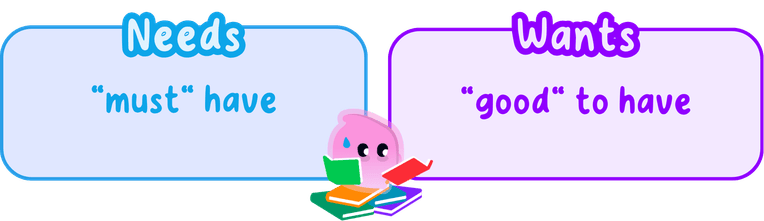
- Bread from a Tesco shelf meets a need, because the customer has to eat.
- A Nando's meal out meets a want, because the customer could have eaten at home for far less.
- Do not label expensive things wants and cheap things needs.
- A £1,200 boiler repair in January is a need, and a 99p chocolate bar is a want.
- What decides it is whether the customer could manage without the product, not the price on the label.
Goods and services
Good: a physical, tangible product a customer can touch and own, such as a loaf of bread or a laptop.
Service: an intangible action or activity carried out for a customer, such as a haircut, a bus journey or an insurance policy.
- A good is tangible, so it can be physically touched, stored in a warehouse and sold on second hand.
- A service is intangible, so it cannot be physically touched, cannot be stored for later and is produced at the moment the customer receives it.
- An unsold good can be discounted next week, whereas an empty seat on the 8am train from Manchester is revenue that cannot be recovered.
- Think of a good as a parcel and a service as a performance.
- The parcel exists whether or not you open it today, so it can sit on a shelf until somebody buys it.
- The performance only exists while it is happening, which is what intangible means.
Most businesses sell goods and services together
- Greggs sells a sausage roll, which is a good, and speed of service, which is a service.
- Currys sells a washing machine, which is a good, plus delivery, installation and a repair plan, which are services.
- The distinction belongs to the item, not to the business, so Currys is not a goods business or a services business but a business selling some of each, and you classify each item separately.
- Define a need and give one example.
- Define a want and give one example.
- What does intangible mean?
- Why can a service not be stored for later?
- Name one good and one service sold by the same business.
1.1.2 Factors of production and opportunity cost
The four factors of production
Factors of production: the four resources a business needs to produce anything, namely land, labour, capital and enterprise.
- Land is every natural resource the business uses, not just the ground it stands on.
- It includes the site of the shop or factory, farmland, fishing grounds, water, timber, oil and gas.
- Labour is the workforce needed to produce the product or service.
- It covers the bakers, drivers, shop assistants and managers, and its quality depends on skills and training.
- Capital is the equipment or machinery used to provide the goods or services.
- It includes ovens, delivery vans, tills, computers and the buildings themselves.
- Enterprise is organising the resources to take a risk and capitalise on a business opportunity.
- It is supplied by the entrepreneur, who decides what to produce and carries the loss if it goes wrong.
- All four are needed at once, so a bakery with a new oven but no baker sells nothing that morning, and the oven still has to be paid for.
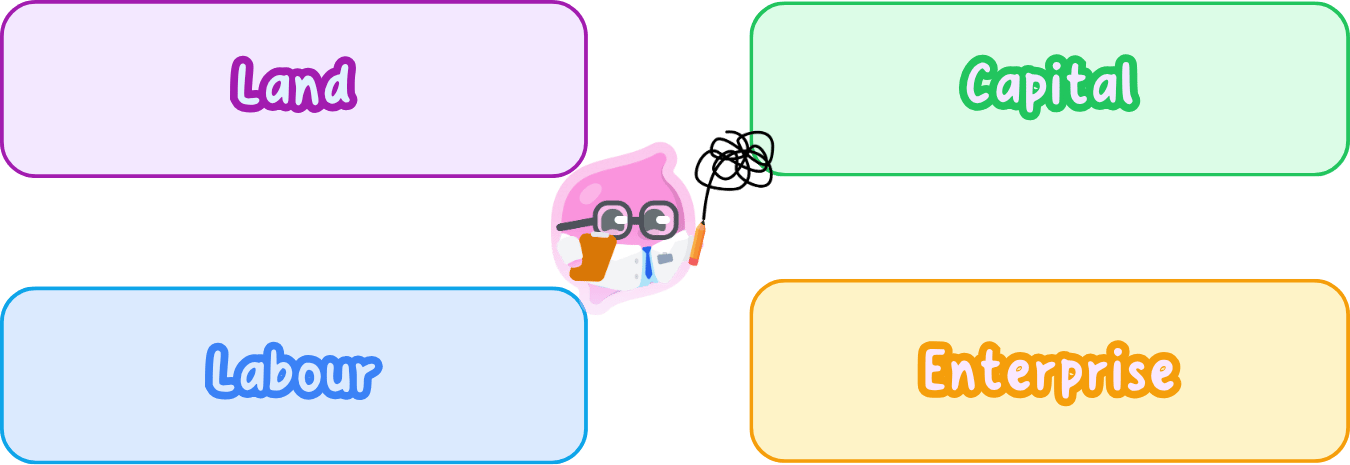
- An independent bakery in Stockport uses all four factors every day.
- Land: the shop unit it rents and the wheat grown by its flour supplier.
- Labour: the two bakers who start at 4am and the three staff who serve the queue.
- Capital: the £6,000 oven, the mixers and the display counter.
- Enterprise: the owner who put in her savings, chose the location and decided to open on Sundays.
Capital means equipment, never money
- Capital is the equipment, machinery, vehicles and buildings the business uses to produce.
- The money used to buy that equipment is finance, and it comes from savings, a bank loan or retained profit.
- Judge a resource by what it does, so a field is land, the tractor on it is capital, the farmer's work is labour, and the decision to open a farm shop is enterprise.
- Never write that capital is the money a business has, because capital is the equipment or machinery used to produce the goods or services.
- A paid manager is labour, not enterprise, because they earn a wage and do not risk their own money.
Opportunity cost: the next best alternative given up
Opportunity cost: the next best alternative that is given up when a choice is made.
- A business has a limited amount of money, time and space, so choosing to use a resource one way rules out using it another way.
- Opportunity cost is not the money spent, and this is the most common error on this topic.
- It is the one option the business sacrificed, so there is only ever one opportunity cost per decision, not a list.
- The Stockport bakery has £6,000 available and two realistic uses for it.
- Option A is a second oven, letting it bake around 20% more stock each morning.
- Option B is refitting the shopfront to pull in more passing trade.
- She buys the oven, so the opportunity cost is the shopfront refit, not the £6,000.
- The trade-off is real because she can only afford one, so the extra passing trade is the sacrifice she has made to raise output.
Opportunity cost at every size of business
- Opportunity cost applies at every size of business, because even Greggs has only a fixed budget for investment each year.
- If Greggs spends that budget opening new high street shops, the opportunity cost is the extra bakery and distribution capacity the same money would have bought, which would have lowered the cost of making each sausage roll.
- Factors of production come up as state two factors of production and as identify and explain two factors of production other than land.
- When the stem rules a factor out, check the ones you choose are not that factor in disguise, because the site of the shop is land even though it feels like part of the equipment.
- For opportunity cost, phrase your answer as the opportunity cost of X is Y, where Y is the named option that was sacrificed and never the sum of money.
- List the four factors of production.
- Explain what capital means, without using the word money.
- Is a delivery van land or capital, and why?
- Define opportunity cost in one sentence.
- A café spends £2,000 on new tables instead of a coffee machine. What is the opportunity cost?
1.1.3 Basic functions and types of business
The three sectors of production
Primary sector: businesses that extract raw materials from the earth or the sea.
Secondary sector: businesses that turn raw materials into finished or part-finished goods.
Tertiary sector: businesses that provide services to customers or to other businesses.
- Primary businesses take raw materials out of nature, and nothing else can happen until they do.
- UK examples include farming in Lincolnshire, fishing off the Cornish coast, quarrying, forestry, and North Sea oil and gas extraction.
- Secondary businesses process those raw materials into a finished product or a component another manufacturer uses.
- UK examples include Nissan building cars in Sunderland, JCB making diggers in Staffordshire, Warburtons baking bread, and firms making steel, cement and packaging.
- Tertiary businesses do not make anything physical, but provide a service to customers or to other firms.
- UK examples include Tesco, the NHS, Barclays, Deliveroo, hairdressers, hotels, insurance brokers and Netflix.
- Together the three form a chain of production, so a product usually passes through all three before it reaches you.

- Follow a loaf of bread from field to breakfast table.
- Primary: a Lincolnshire farm grows and harvests the wheat.
- Secondary: a mill turns the wheat into flour, and a bakery turns the flour into loaves.
- Tertiary: a haulage firm delivers the loaves and a Tesco store sells one to you.
- Each stage does something to the product the stage before it could not, which is why the loaf is worth more than the wheat that went into it.
Classifying a business by its main activity
- Most real businesses do more than one thing, so classify them by the activity that earns most of their revenue.
- A bakery that bakes bread and sells it over the counter is doing secondary work in the kitchen and tertiary work at the till.
- A few firms own more than one stage, so a Yorkshire farm that grows vegetables, makes chutney and sells both in its own farm shop operates in all three sectors.
- Do not put a shop in the secondary sector because it sells physical goods.
- Selling a product is a service, so retail is always tertiary even when the product is tangible.
- The secondary sector is about making or processing, not about handing over.
- Sectors are asked as identify one sector of production, as multiple choice, and as explain, using one business example, the meaning of the tertiary sector.
- Settle the sector on the verb, because extract is primary, process is secondary and provide a service is tertiary, whatever the business calls itself.
- Name the three sectors and give one UK example of each.
- Which sector does a fishing boat belong to, and which does the fishmonger belong to?
- Why is a supermarket tertiary even though it sells physical goods?
- What is the chain of production?
- How do you decide the sector of a business that both bakes and sells bread?
1.1.4 Enterprise and entrepreneurship
Enterprise and the entrepreneur
Enterprise: the skills involved in identifying a business opportunity and taking the risk of organising resources to pursue it.
Entrepreneur: the person who sets up and owns a business, taking the risk of doing so.
- Enterprise is one of the four factors of production, so it is a resource the business uses in the same way it uses labour or capital.
- An entrepreneur is the person who provides it, so enterprise is the activity and the entrepreneur is the person doing it.
- Enterprise is not the same as labour, because an employee sells their time for an agreed wage and is paid whatever happens to the profit, while the entrepreneur's own money is in the business.
- That is why a paid manager who runs a Tesco store is supplying labour, not enterprise, however many decisions they make in a day.
What an entrepreneur does
- Sets up the business: they start it, open it and own it, either outright or by holding shares in it.
- Spots the opportunity: they identify a gap in the market and bring a new idea to it.
- Organises the other factors of production: they find the premises, raise the money for equipment, and hire the staff.
- Nobody else does this at the start, so a new entrepreneur is usually doing the buying, the selling and the bookkeeping in the same week.
- Makes the decisions: what to sell, what to charge and who to hire are all their call, with no manager above them.
- Takes the risk: they put their own money in, keep the profit if customers buy, and absorb the loss if they do not.
- Ben Francis was 19 and working shifts at Pizza Hut when he started Gymshark in 2012.
- He spotted the opportunity, because young gym-goers could not buy fitted training kit that looked how they wanted.
- He supplied the enterprise, screen-printing vests in his parents' garage and reinvesting every sale in the next batch of stock.
- He took the risk, because unsold stock would have been his loss and nobody was paying him a wage to try.
- Do not write that an entrepreneur is somebody with a good idea.
- An idea costs nothing, and having one is not enterprise.
- Enterprise is acting on the idea by organising the resources and accepting the risk of losing money.
- What is meant by enterprise?
- How is an entrepreneur different from enterprise?
- Give three things an entrepreneur does when setting up a business.
- Why is a paid manager not supplying enterprise?
- Write a full description of what an entrepreneur is.
1.1.4b Characteristics of an entrepreneur
The characteristics of an entrepreneur
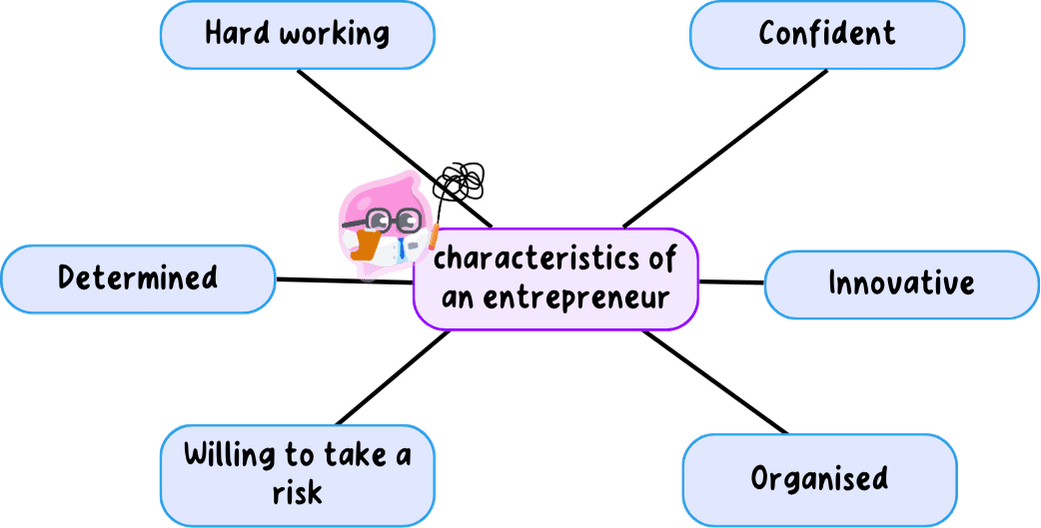
- Hard working: a new business has no other staff to fall back on, so the owner does the buying, the selling and the accounts.
- Early mornings and weekend work are normal, because the business earns nothing while the owner is not working.
- Innovative: they find a new product, or a better way of delivering an existing one, so customers have a reason to switch.
- Innovation does not have to mean inventing something, because opening on Sundays when every rival is shut is innovation too.
- Organised: they keep track of stock, staff rotas, supplier payments and cash at the same time.
- A business that runs out of stock or forgets a tax bill loses customers or money it did not need to lose.
- Willing to take a risk: they accept that their own savings, and often the salary from a previous job, could be lost.
- The risk is usually calculated rather than reckless, so a sensible owner researches demand and tests on a small scale first.
- Determined: setbacks are normal, so they keep going after a supplier lets them down or a bank refuses a loan.
- Confident: they convince customers to try an unknown business, suppliers to give them trade credit, and lenders to back them.
- Levi Roots pitched Reggae Reggae Sauce on Dragons' Den in 2007 and won £50,000 of investment.
- He showed innovation, because no major UK supermarket was selling a Caribbean jerk sauce with that identity behind it.
- He showed confidence, because he sold the idea by performing it rather than by handing over a spreadsheet.
- He showed hard work afterwards, because the sauce had to be produced at supermarket scale within months.
- A characteristic is what the entrepreneur is like, not what they want out of running the business.
- Being hard working is a characteristic, whereas wanting flexible working hours is an objective, and the two are asked about separately.
- The recurring stem is describe one characteristic of an entrepreneur, and it has appeared on both papers.
- Reach first for AQA's own four words: hard working, innovative, organised, willing to take a risk, and keep determined and confident as spares.
- Name four characteristics of an entrepreneur.
- Why does a new business owner need to be organised?
- Give one example of innovation that does not involve inventing a new product.
- What is the difference between a characteristic and an objective?
- What is the difference between a calculated risk and a reckless one?
1.1.4c Objectives of an entrepreneur
The six objectives of an entrepreneur
- To be their own boss: they want control over what the business does and how it does it, with no manager overruling them.
- This appeals most to people who have had decisions imposed on them at work that they disagreed with.
- To have flexible working hours: running your own business can mean choosing when you work, which suits people fitting work around children, study or caring.
- To pursue an interest: they turn something they already care about into a way of earning, such as a keen baker opening a cake business.
- Caring about the product also helps them keep going through the long unpaid hours at the start.
- To earn more money: an employee receives a wage, but an owner keeps the profit, so there is no ceiling on what a successful business can pay them.
- To identify a gap in the market: they have spotted a customer need nobody is meeting and want to be the one who meets it.
- This objective is the closest to a purely commercial one, because it starts from what customers want rather than from what the owner wants.
- Dissatisfaction with their current job: boredom, a poor manager, low pay or redundancy pushes somebody out of employment and into starting up.
- This is a push factor, because the person is moving away from something rather than towards something.
- Julie Deane started The Cambridge Satchel Company in 2008 with £600 at her kitchen table.
- Her objective was to earn more money for a specific purpose, because she wanted to pay school fees for her children.
- She also identified a gap in the market, because traditional leather satchels were no longer easy to buy in the UK.
- Most entrepreneurs have more than one objective at once, exactly as she did.
Financial and non-financial objectives
- Only one of the six, earning more money, is a financial objective, and the other five are non-financial.
- The two groups often pull against each other, because being your own boss usually means earning less at first, since the owner takes what is left after costs rather than a guaranteed wage.
- Flexible hours are often the first objective to slip, since a new owner tends to work longer and less predictable hours than they did as an employee.
- Do not assume being your own boss means an easier life.
- You answer to customers, suppliers and the bank instead of a manager, and none of them are more forgiving.
- Keep the entrepreneur's objectives separate from the business's objectives, because a question about one is not asking about the other.
- State four objectives an entrepreneur might have.
- Which of the six objectives is financial?
- What is meant by a push factor, and which objective is one?
- Explain why flexible working hours can be hard to achieve in a new business.
- Why is the entrepreneur's objective not the same thing as the business's objective?
1.1.5 Dynamic nature of business
The dynamic business environment
Dynamic business environment: the constantly changing conditions a business operates in, which it must respond to but largely cannot control.
- A business does not choose the conditions it trades in, because they are set by customers, rivals, governments and technology.
- A business that does not adapt loses customers gradually to a rival that did.
The four sources of change
- Technology: new products replace old ones and new ways of selling appear, so demand can fall away from a business that has done nothing wrong.
- Streaming removed the reason to buy CDs and DVDs, and HMV went into administration twice.
- New equipment can also cut the cost of making each unit, though it has to be paid for and staff have to be retrained to use it.
- The economic situation: interest rates, the level of employment and consumer incomes decide how much customers can afford to spend.
- When UK incomes were squeezed, Aldi and Greggs gained customers trading down while casual dining chains closed sites.
- Legislation: governments change the law on wages, health and safety and consumer rights, and businesses have to comply whether it suits them or not.
- A rise in the national living wage raises the wage bill directly, which hits retailers and care homes hardest.
- Environmental expectations: customers now judge a business on how it produces, not only on what it charges.
- UK supermarkets cut plastic packaging and introduced refill stations partly because shoppers expected it.
- Acting on this usually costs money in the short term, and the return comes as reputation and customer loyalty.
Each of these four forces is examined in its own right in Influences on business, so leave the detail of interest rates, exchange rates, employment law and sustainability to those articles.
How a business responds to change
- Monitor the environment, by watching competitors, customer feedback and rules that are coming, so the change is seen before it arrives rather than after sales have fallen.
- Adapt the product or the way it is sold, such as Greggs adding app ordering and delivery so customers could skip the lunchtime queue.
- Do not treat change as automatically bad news.
- The same force that destroyed HMV's market created Spotify's, so a change is a threat to one firm and an opportunity to another.
- Questions here are worded as explain one economic change that can affect a business or explain one way a rise in unemployment might affect a business.
- Name the change, then finish the chain with an effect on sales, costs or profit, because naming it alone leaves the answer hanging.
- A rise in unemployment means fewer people have an income to spend, so the business sells less.
- Name the four sources of change AQA expects you to know.
- Give one way technology can threaten a business and one way it can help.
- Explain one way a rise in unemployment affects a business.
- Give one example of a changing environmental expectation.
- State two things a business can do to respond to change.
