2.3.1 Interest rates
What an interest rate means for a business
Definition
Interest rate
The cost of borrowing money and the reward for saving it, expressed as a percentage of the amount over a period.
- The Bank of England sets the UK base rate, and banks such as Barclays set the rates they charge borrowers and pay savers in line with it.
- A change in the rate reaches a business along two routes, and a good answer picks the one that fits the business in front of you.
- The cost route: what the business itself pays on the money it has borrowed.
- The demand route: what its customers have left to spend once their own borrowing has been paid for.
Analogy
- Interest works like rent on money: a borrower pays rent for using the bank's money, and a saver collects rent for letting the bank use theirs.
- When the rate rises, the rent on money goes up for everyone who is borrowing, businesses and households alike.
The effect of a rate rise on a business that borrows
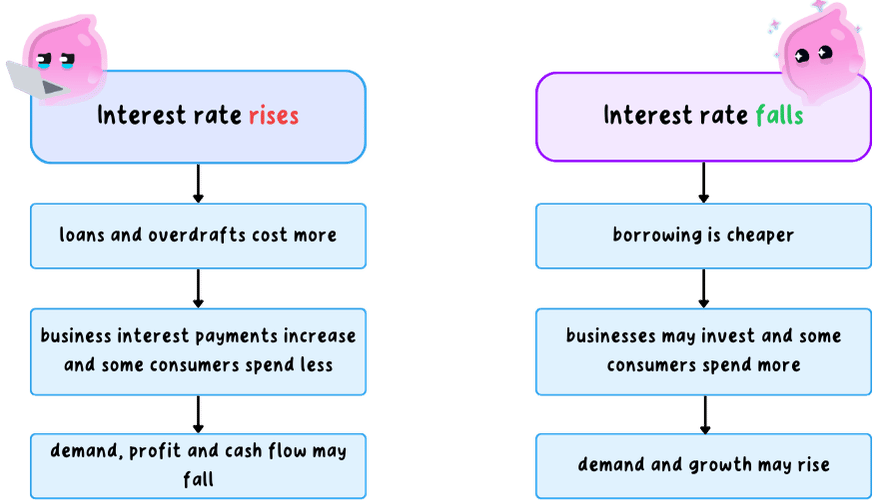
- An overdraft costs more: a business pays interest on however much it is overdrawn, so a rate rise increases that charge straight away.
- Loan and mortgage repayments rise: a business with a variable-rate loan or a commercial mortgage has to find more money each month for the same debt.
- Interest is a cost, so a bigger interest bill raises total costs and cuts profit even when sales have not changed at all.
- A business on a fixed-rate loan feels nothing until that deal ends, then borrows again at the new, higher rate.
- Borrowing to invest looks less attractive: a new shop, van or machine is only worth financing if the extra profit it earns beats the interest charged on the loan, so a rise turns borderline plans down.
- Postponed investment means the business grows more slowly, and the suppliers of that equipment lose the order.
Example
- An independent bakery with a £120,000 variable-rate loan from Barclays sees its monthly repayment rise after a rate increase, so its costs go up and its profit falls.
- The owner shelves the plan to borrow again for a second shop, because the interest on that second loan would now swallow most of the profit the shop was expected to make.
The effect of a rate rise on customer spending
- Customers with a mortgage or a credit card balance pay more interest each month, so they have less money left over.
- Consumer spending falls, so businesses selling to those households see demand and revenue drop.
- Businesses selling wants are hit hardest, because a television from Currys or a meal out at Nando's can be put off until money is easier, and items usually bought on credit are the first to be cancelled.
- Businesses selling needs hold up better, because customers still buy groceries from Tesco and bread from Warburtons whatever the rate does.
Common Mistake
- Do not mix up interest rates with inflation: interest is the cost of borrowing money, while inflation is a rise in the general level of prices.
- An answer that says shop prices have gone up is describing inflation, not the effect of a rate change.
When rates fall, and who gains from a rise
- A fall in the rate reverses both routes.
- Overdraft charges and variable loan repayments shrink, so costs fall and profit rises.
- Borrowing to expand becomes cheaper, so plans that were shelved go ahead.
- Customers with mortgages keep more of their pay, so demand recovers first for the wants they had cut.
- A rise is not bad news for every business: a business holding cash in the bank earns more interest on those savings, and a business with no borrowing avoids the cost route completely.
Note
Interest rates are one influence on what customers spend; the level of employment and the size of consumer incomes are the others, covered in 2.3.2.
Self review
- Which body sets the UK base rate?
- Why does a rate rise raise the costs of a business using an overdraft?
- Why does a business postpone buying new equipment when rates rise?
- Trace how a rate rise reaches the sales of a furniture retailer.
- Which business prefers a rate rise: one with a large loan, or one with cash in the bank?
2.3.2 Employment and consumer spending
The level of employment
Definition
Level of employment
How many people in the workforce have paid work.
Definition
Unemployment
When people who are able and willing to work cannot find a job.
Definition
Consumer spending
The total amount households spend on goods and services.
- The level of employment rises and falls over time, and a business feels the change in two separate places.
- In its sales: people in work have wages to spend, so the number of them decides how much consumer spending there is.
- In its staffing: the number of people looking for work decides how easily the business can fill a vacancy and what it has to pay.
- Those two effects usually pull in opposite directions, so the same change in employment can be good for a business in one place and awkward in the other.
When unemployment is low
- Consumer spending is high: more households are earning, so demand rises and most businesses take more revenue.
- Recruiting gets harder: fewer people are looking for work, so vacancies stay open longer and jobs are harder to fill.
- The business may have to advertise more widely, or take on less experienced staff and train them, which costs money and time.
- Wages get bid up: employers compete for the same small pool of workers, so pay rates rise and labour costs go up.
- Higher pay also has to be offered to existing staff to stop them leaving, so the cost applies to the whole workforce, not just new hires.
- For a business with many low-paid staff, that extra wage bill can cancel out much of the gain from higher sales.
Example
- When unemployment is low, a Nando's restaurant is busy but short-staffed, and ends up raising its hourly rate to fill shifts.
- It is competing for the same workers as Greggs and Deliveroo, so none of them can hold pay down for long.
When unemployment is high
- Consumer spending falls: fewer households have wages coming in, and those still in work often spend cautiously, so demand and sales drop.
- Recruiting gets easier: many applicants chase each vacancy, so a business fills jobs quickly and can pick from a stronger field.
- Pressure on wages eases, because staff are less able to move elsewhere for more money, so labour costs rise more slowly.
- A business facing falling sales often responds by cutting overtime, not replacing staff who leave, or trimming its product range.
How demand changes as incomes fluctuate
Definition
Disposable income
The money a household has left to spend or save after tax has been taken from its income.
- When incomes rise, spending on wants grows fastest: meals out, holidays, new electricals and branded goods.
- When incomes are squeezed, those same wants are cut first, because the purchase can be delayed or dropped without much difficulty.
- Demand for needs changes far less, because households still buy Tesco groceries and Warburtons bread whatever their income is doing.
- Customers trade down rather than stop buying: they move to cheaper shops and value ranges, so discounters and low-price food chains can gain customers while incomes are falling.
- Businesses react by changing what they offer, such as pushing a value range, adding cheaper pack sizes, or holding prices while incomes are tight.
Example
- As UK incomes were squeezed, Aldi won shoppers from higher-priced supermarkets and Greggs took sales from dearer lunch options.
- Over the same period casual dining chains closed branches, because a sit-down meal is exactly the sort of want households give up first.
Exam technique
When the question is about incomes, state whether the product is a need or a want before you predict what happens to demand.
Self review
- What does the level of employment measure?
- Give one gain and one problem for a café when unemployment falls.
- Why do wage costs tend to rise when unemployment is low?
- What is disposable income?
- Why does a discounter such as Aldi often gain when incomes are squeezed?