3.3.1 Consequences of quality issues
What customers expect from quality
Quality: a good or service that consistently meets the expectations of the customers it is aimed at, so that it is fit for purpose.
- Fit for purpose: the product does the job the customer bought it for, and keeps doing it for as long as they were led to expect.
- The same every time: consistency is what customers notice, so the tenth purchase has to match the first, and a business that is excellent on Monday and careless on Friday has a quality problem.
- Expectations in the production of goods: buyers expect the item to work, to be safe, to match its description and to be identical to the last one they bought.
- Expectations in the provision of services: customers expect the service to be reliable, delivered on time and handled by staff who know what they are doing, and because a service is produced in front of them it cannot be checked and put right before they receive it.
- Quality does not mean expensive or luxury, because it is judged against what the customer was promised.
- An Aldi own-label pizza and a Greggs sausage roll are high quality when they taste the same every time and match what shoppers expect for the price they paid.
- A £900 phone that arrives with a flickering screen is poor quality, however much it cost.
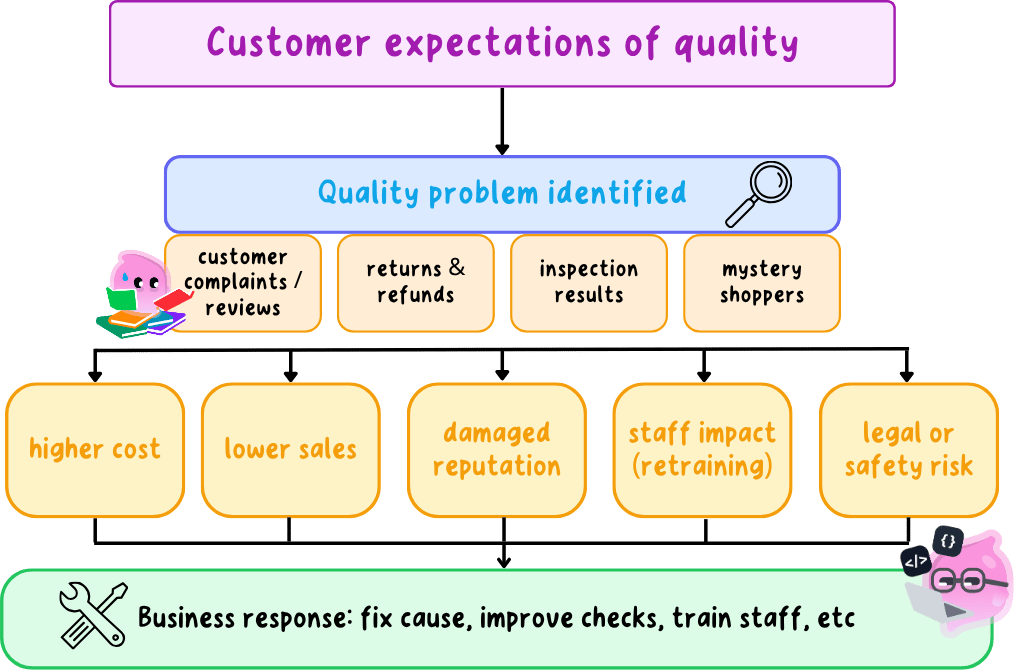
How a business identifies quality problems
- Customer complaints: complaints made in store, by phone or by email name the fault directly and show how often it is happening.
- Returns and refunds: goods sent back, refunded or repaired under guarantee prove that a fault got past the business's own checks and reached a customer.
- Online reviews and ratings: star ratings and written reviews on Google, Trustpilot or a retailer's own site expose problems that most customers never bother to report to the business.
- Failed inspections: items rejected during checks point to a fault in the materials, the machinery or the method before the goods ever leave the premises.
- Falling repeat business: when regular customers quietly stop ordering, there is a quality problem nobody has complained about, which is why sales figures matter as well as complaints.
- Currys records how many of each washing machine model come back within the guarantee period.
- One model returning far more often than the rest lets its buyers challenge the manufacturer before the fault reaches the review pages.
How a business measures quality
- Wastage and rework rate: the share of output scrapped or made a second time measures how much of production is going wrong.
- A bakery scraps 300 of the 12,000 loaves it makes in a week.
- That 2.5% is flour, labour and oven time the bakery has already paid for and thrown away, so halving it releases cash without selling one extra loaf.
- Return rate: returns as a percentage of items sold show whether faults are reaching customers, and tracking the figure product by product shows which line is at fault.
- Complaint numbers and satisfaction scores: counting complaints each week, or scoring survey answers out of ten, gives a figure for service quality where there is no physical item to inspect.
A quality figure means nothing on its own, so a 3% return rate has to be compared with the target, with last month or with a rival before anyone can act on it.
Consequences for customers and reputation
- Lost customers: a customer let down once switches to a rival and often never returns, so the loss is every future purchase they would have made, not only the sale that went wrong.
- Bad word of mouth: unhappy customers post reviews and photographs that reach thousands of people within hours, and a one-star review stays visible to every future shopper for years.
- Damage to the brand: the damage outlasts the fault itself, so a business can put the problem right in a week and still be losing sales because of it a year later.
- Lost contracts: a supermarket will drop a supplier whose deliveries keep failing its checks, taking a whole revenue stream with it.
- If one Greggs shop served undercooked sausage rolls, photographs and reviews would spread far beyond that single shop.
- Customers judge the whole brand, so a fault in one outlet costs sales in hundreds of others that did nothing wrong.
What poor quality costs the business
- Refunds and replacements: money already taken has to be handed back, or a second item supplied free, so the business pays twice to make one sale and often pays the return postage as well.
- Wasted materials and rework: a scrapped item destroys the materials, labour and machine time already spent on it, and reworking a fault uses those resources a second time on a unit that should have been finished.
- Product recalls: an unsafe or mislabelled product forces the business to trace owners and repair, replace or destroy goods it has already sold, which is expensive and very public.
- A car maker recalling one model pays to contact every owner, ship in parts and pay dealers to fit them, a bill far larger than the few pence per car a better component would have cost.
- Staff time: handling complaints, processing returns and hunting for the cause use hours that could have been spent producing and selling.
- Questions here usually read analyse the consequences for the business of poor quality, so take one consequence and follow it through to sales, costs or reputation rather than listing four.
- Choose the consequence that fits the business you are given, because a village café is hurt most by local reviews while a manufacturer is hurt most by a recall.
- Where the case gives a return rate or a wastage percentage, quote it and say what it costs that business, rather than describing the fault in words alone.
- What does quality mean in business?
- Why can a cheap product be a high quality product?
- Name three ways a business identifies quality problems.
- How is a wastage rate worked out, and what does it tell the owner?
- Give three costs a business faces when quality goes wrong.
3.3.2 Maintaining consistent quality (TQM)
Methods of maintaining consistent quality
- Clear standards: every job has a written specification covering size, weight, ingredients or the time a task should take, so staff know exactly what an acceptable result looks like.
- Training: staff are taught the standard and how to notice when their work is drifting away from it, which matters most in services where nothing can be checked before the customer receives it.
- Quality control by inspection: finished output, or a sample of it, is checked against the standard by inspectors before it leaves the business.
- Quality assurance: checks are built into every stage instead of the end, so each worker judges their own work against the standard before passing it on.
- Total quality management: responsibility for quality is given to every employee in the business, from the buyer choosing suppliers to the driver making the delivery.
What each of these methods costs, and whether that spending is repaid, belongs to the costs and benefits of maintaining quality.
Quality control and quality assurance
Quality control: checking finished output, or a sample of it, against an agreed standard, usually by inspectors at the end of production.
- Inspection stops most faulty goods reaching the customer, which protects the reputation of the business and keeps refunds down.
- By the time an inspector rejects an item the fault has already been made, so the materials, labour and machine time are already spent and the unit can only be scrapped or reworked.
- Inspecting a sample rather than everything keeps the cost down, but it means some faults still reach customers, and it tells nobody on the line why the fault happened.
- Quality assurance moves the checking into each stage, so a fault is caught where it happens rather than travelling to the end of the line inside a nearly finished product.
- On a Warburtons bread line, an inspector at the end can only reject loaves that are already baked, wrapped and worthless.
- A baker who checks the dough and the oven temperature at each stage stops the whole batch being ruined in the first place.
Total quality management
Total quality management (TQM): an approach in which every employee at every stage takes responsibility for quality, aiming to get the work right first time rather than relying on inspectors at the end.
- Quality is everyone's job. The person taking phone orders, the buyer choosing suppliers, the machine operator and the delivery driver are all responsible for the quality the customer finally receives.
- Right first time: faults are prevented at the stage they would occur instead of being found later, so there is nothing to scrap, refund or apologise for.
- Each stage serves the next. A worker treats the next person in the process as their customer and will not pass on work they know is below standard.
- Continuous improvement: the people who do the job suggest small changes to it, so the process keeps getting slightly better instead of standing still between crises.
- At Nissan Sunderland, assembly workers can stop the line when they spot a problem rather than letting a faulty car move to the next station.
- Stopping the line for a few minutes costs far less than stripping down hundreds of cars found faulty at the end of the shift.
Advantages to a business of using TQM
- Faults are caught where they occur. A problem spotted at the stage it happens is far cheaper to put right than the same problem found in a finished product or by a customer.
- Less waste and less rework: fewer items are scrapped or made a second time, so the cost of producing each good unit falls and materials stretch further.
- Quality is built in rather than inspected in. The business needs fewer separate inspectors, because the checking happens inside the work itself as it is done.
- Staff are more involved and better motivated. Being trusted to judge and improve their own work gives employees real responsibility, and workers who feel responsible take more care and stay longer.
- A reputation for consistency: fewer faulty items reach customers, so complaints and returns fall and buyers come back to a business they can rely on.
What TQM demands from the business
- Training for every employee: everyone has to learn the standard and how to check their own work against it, which costs money and takes people off the job while they learn.
- A change of culture: staff used to leaving quality to inspectors have to accept responsibility for it, managers have to accept being told about problems, and if one department or supplier ignores the system faulty work still enters the process.
- Time before the benefits show: the savings arrive only once the new habits are normal, so a business under pressure this month will see the cost long before the benefit.
Describing TQM as checking products at the end of production is the most common error, because that is quality control by inspection, while TQM means prevention at every stage by every employee.
- When a question says explain one advantage to the business of using total quality management, give one advantage and develop it, rather than naming three and explaining none.
- Develop it as a chain: every worker checks their own stage, fewer faulty units are completed, less is scrapped, so the cost of each good unit falls.
- Name the business and its product, so a bakery answer talks about dough and oven temperature while a garage answer talks about repairs signed off by the mechanic who did them.
- If you are asked what the business would have to do first, the answer is training and a change of culture, not buying equipment.
- Define total quality management in one sentence.
- How does quality assurance differ from quality control by inspection?
- What does getting it right first time mean on a production line?
- Give three advantages to a business of using TQM.
- Why can TQM take a long time before it saves a business money?
3.3.3 Costs and benefits of maintaining quality
The costs of maintaining quality
- Inspection and testing costs: inspectors have to be paid, testing equipment has to be bought and maintained, and output waits to be checked instead of being sold.
- Staff training: employees have to be taught the standard and how to check their own work against it, which costs the trainer's time and the output lost while they are away from the job.
- Training is a repeated cost rather than a one-off, because every new starter needs it and staff turnover in shops and restaurants is high.
- Better materials and better suppliers: higher-grade inputs and dependable suppliers charge more per unit, so the cost of making each item rises before anything has been sold.
- Slower production: checking at each stage means fewer units leave the factory each hour, so rent and machinery are spread over less output and the cost of each unit rises.
- Product recalls and compensation: when quality fails anyway, the business must trace and contact buyers, replace or repair goods already sold, and may have to compensate customers or a retailer for sales lost while the product is off the shelves.
- A food producer that finds an allergen missing from its label has to withdraw every pack from Tesco and Asda shelves at its own expense.
- The withdrawal costs far more than the extra checks on packaging would have done, which is why many firms treat quality spending as protection against a much larger bill.
The benefits of maintaining quality
- Additional sales: a product that does what it promises sells more, because satisfied customers buy again and recommend it to people the business never advertised to.
- Repeat custom and loyalty: keeping an existing customer costs far less than advertising to find a new one, and steady repeat orders let the business plan production and staffing with confidence.
- Image and reputation: a name for reliability attracts buyers who have never tried the product, and large retailers prefer to stock brands their shoppers already trust.
- A higher price: buyers will pay more for something they expect to last, which is how Dyson sells vacuum cleaners at several hundred pounds against rivals under £50, so the money spent on engineering and testing returns as a wider margin.
- Less waste and rework: getting the work right first time means fewer items scrapped, reworked or refunded, so part of the spending on quality pays for itself in lower costs.
- Maintaining quality does not mean going upmarket, so an Aldi own-label pizza needs the same spending on consistency as a premium brand does.
- A higher price is one possible benefit of maintaining quality rather than a definition of it, since a £900 phone sold with a fault is poor quality however expensive it is.
Quality in the provision of services
- A service is produced while the customer is present, so it cannot be inspected and put right before they experience it.
- The spending therefore goes on people rather than testing equipment: training, written procedures, supervision, and enough staff to give each customer proper attention.
- Consistency between staff and between branches is the hard part, because the same chain can feel excellent in one town and careless in the next.
- Putting a service failure right costs a refund or a free repeat, and the customer has already lived through the bad experience, which no refund erases.
- Premier Inn spends heavily on identical room layouts, cleaning checklists and staff training so that a room in Leeds matches a room in Bristol.
- That predictability is what customers are paying for, so the training budget protects the whole brand rather than one hotel.
Quality problems as a business grows
- More sites and more staff: the owner can no longer watch every job, so standards drift unless they are written down, trained and checked by somebody else.
- Outsourcing: paying another business to make the product or handle part of the work puts quality in somebody else's hands, and their priority is their own costs.
- A supplier that quietly swaps to cheaper materials protects its own margin, while the complaints land on the brand whose name is on the box.
- Franchising: each franchisee runs their own outlet, so the brand depends on people the franchisor does not employ and cannot supervise day to day.
- This is why franchise agreements set out exactly which ingredients, suppliers and procedures must be used, backed up by regular inspection visits.
How outsourcing and franchising work as methods of growth belongs to the business growth topic, so here you need only their effect on quality.
Weighing the costs against the benefits
- Nearly all of the cost is paid now while the extra sales and the reputation build over years, which is a real problem for a business that is short of cash today.
- The spending is repaid most clearly where a failure would be dangerous or highly public, such as food, medicines, cars or childcare, and where customers choose on trust rather than on price alone.
- Growth usually pushes the cost up, because work the owner once checked personally now has to be covered by written standards, supplier audits and inspection visits.
- The usual wording is evaluate whether the business should spend more on maintaining quality, which means you must actually decide, not set out both sides and stop.
- Base the decision on something in the case, such as how much cash the business has, what its customers are paying for, or whether it is about to franchise.
- The mistake students actually make is listing benefits only, as though quality were free, so always name what the business gives up to get it.
- Name four costs of maintaining quality.
- How does maintaining quality lead to additional sales?
- Why can maintaining quality let a business charge a higher price?
- Why is quality harder to control in a service than in a factory?
- Why do outsourcing and franchising put quality at risk?
