1.4.1 Main stakeholders of businesses
What a stakeholder is
Stakeholder: any individual or group with an interest in a business, or who is affected by what the business does.
- Having an interest means a business decision changes something that group cares about, such as its wages, the price it pays, the orders it receives or the traffic on its street.
- You do not have to own any part of a business to be a stakeholder in it, so a shopper buying a sausage roll and a resident living above the shop both count.
- Every business has stakeholders, whether it is a single market stall or Tesco plc, and one person can be a stakeholder in hundreds of businesses at once.
- One Greggs branch has the shareholders who own the company, the staff behind the counter, the customers queueing at eight in the morning, the bakery that supplies the pastry and the residents in the flats above.
- Each group is tied to the branch in a different way, through profit, pay, price, orders or noise.
The five main stakeholder groups
- Owners and shareholders: these are the people who put money into the business and own it, so a sole trader owns her whole café while the shareholders of Tesco plc each own a small slice of the company.
- They carry the risk, because they lose the money they invested if the business fails.
- Employees: these are the people who work for the business in return for pay, from the riders delivering for Deliveroo to the engineers building diggers at JCB.
- Customers: these are the people or organisations who buy the goods and services, so Currys sells to families buying a washing machine and also to firms buying laptops for staff.
- Suppliers: these are the businesses that sell the firm the materials, stock or services it needs, such as the flour mills that supply Warburtons.
- The local community: these are the residents, schools and other businesses near the site, such as the people of Sunderland living around the Nissan plant, and they are affected by jobs, traffic and noise even if they never buy anything from the firm.
Internal and external stakeholders
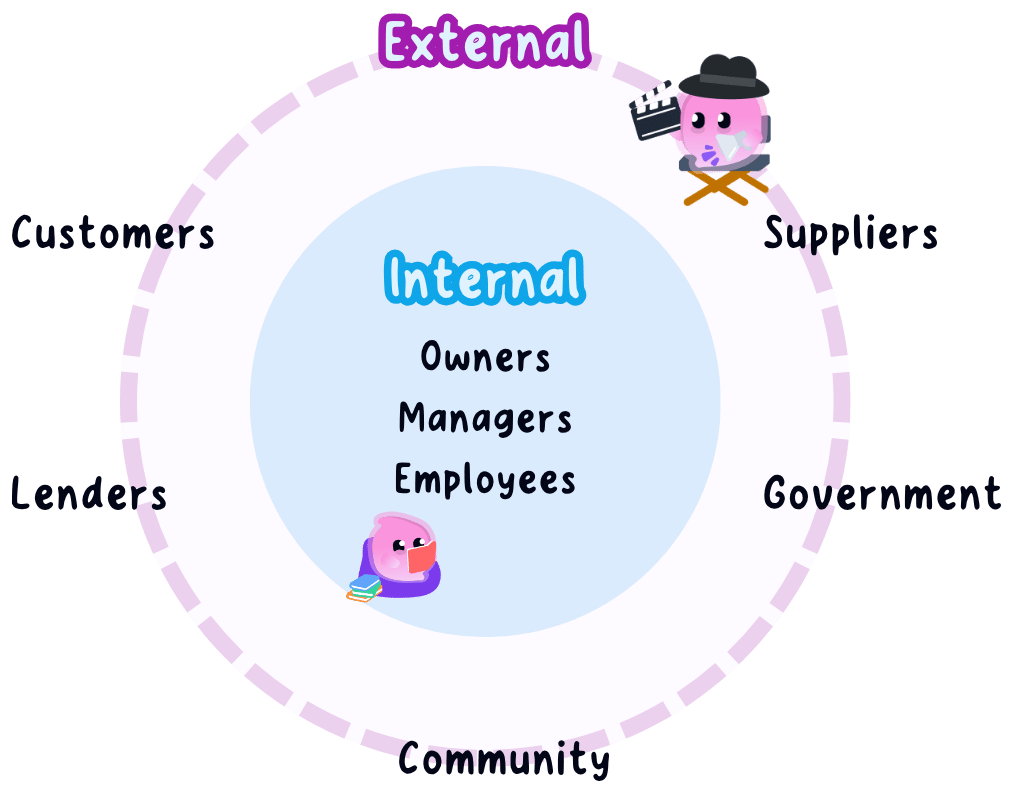
Internal stakeholder: a stakeholder inside the business, meaning its owners and its employees.
External stakeholder: a stakeholder outside the business, such as customers, suppliers and the local community.
- The test is one question: does this group own the business or work in it?
- Owners and employees answer yes, so they are internal, and customers, suppliers and the local community answer no, so they are external.
- The government is often added to the external list, because HMRC takes tax from the profits and the local council decides the planning applications.
- One person can hold two roles at once, such as a Greggs shop assistant who also owns shares in the company, so classify each role separately.
- Shareholder and stakeholder are not the same word: every shareholder is a stakeholder, but a customer or a supplier is a stakeholder without owning a single share.
- Dealing with a business every day does not make you internal, so a supplier who delivers to Tesco each morning is still an external stakeholder.
Spotting stakeholders in a case
- Work through the case asking who owns the business, who works in it, who buys from it, who sells to it and who lives near it, and name the exact group the text gives you.
- The same group carries different weight in different businesses, so the local community is a major stakeholder for a quarry or an airport and a minor one for an online-only retailer working from a small unit.
- This article only names the groups; what each one actually wants from the business is covered in the article on stakeholder objectives.
- How business activity affects those groups, and how they push back on the business, is covered in the article on the impact and influence of stakeholders.
- Identify one stakeholder questions want a named group from the case, so write "the residents living near the depot" rather than "stakeholders".
- State whether X is an internal or external stakeholder needs the label and the reason, and the reason is always whether the group owns the business or works in it.
- Pull the group out of the case rather than inventing one, so if the text mentions a haulage firm delivering stock, call that firm the supplier.
- What is a stakeholder?
- Name the five main stakeholder groups of a business.
- Which two groups are internal, and what makes them internal?
- Why is the local community a stakeholder in a factory even if nobody there buys from it?
- Why is every shareholder a stakeholder, but not every stakeholder a shareholder?
1.4.1b Objectives of stakeholders
What a stakeholder objective is
Stakeholder objective: what a particular stakeholder group wants to get out of the business.
- Each group judges the business against its own objective, which follows from the way that group is linked to the firm: owners have money in it, employees draw pay from it, suppliers sell to it, customers buy from it and residents live next to it.
- Objectives are not all financial, so the residents near a Tesco distribution centre are judging the number of lorries on their road rather than the size of the profit.
What owners and shareholders want
Dividend: a share of a company's profit paid out to its shareholders, usually once or twice a year.
- High dividend payments: shareholders want as large a share of the profit paid out to them as possible, because the dividend is the cash return on the money they risked.
- Dividends can only be paid out of profit, so this objective makes shareholders push for higher revenue and tighter control of costs such as wages.
- A rising value for their stake: a shareholder in Barclays also gains if the share price rises, so growth in the business matters as well as this year's payout.
- Profit as income: a sole trader takes the profit directly rather than as a dividend, so for the owner of a single barber's shop the profit is the household income.
- If a plc makes £800,000 profit and pays £300,000 of it out as dividends, the shareholders receive that £300,000 and the remaining £500,000 stays in the business.
- Shareholders who want a high dividend and directors who want to reinvest are both looking at the same £800,000.
What employees want
- Maximising pay: workers want the highest wage or salary they can get, because that pay is what covers their rent, bills and food.
- Pay is a cost to the business and an income to the worker, which is why the same wage rise is read in opposite ways by the two groups.
- Job security: employees want to know the job will still exist next year, so a permanent contract at the Nissan plant in Sunderland is worth more to a worker than a short-term one at the same rate.
- Good working conditions: this covers safe equipment, reasonable hours, proper breaks and being treated fairly by managers, and it is why warehouse staff care about targets as well as pay.
- A Deliveroo rider paid per delivery has all three objectives at once: a higher rate per drop, enough guaranteed work to rely on, and safe conditions on the road.
- Meeting one of the three does not satisfy the other two.
What customers and suppliers want
- Customers want quality and value for money. They want the product to work, to last and to be safe, at the lowest price they can find it, which is why Aldi shoppers compare a basket of branded goods against the same basket at Tesco.
- Customers also want choice and good service. A wide range, quick delivery, easy returns and staff who can answer a question all count, so a Currys customer judges the after-sales help as well as the price of the machine.
- Suppliers want prompt payment. Being paid within the agreed period, rather than being made to wait 90 days, is often a supplier's first objective.
- Late payment starves the supplier's cash flow, because it still has to pay its own staff and materials while it waits.
- Suppliers want regular repeat orders at a fair price. A steady contract lets a small bakery plan its own production and staffing, so it will accept a lower price per unit for a long-term order.
- Do not write that every stakeholder wants the business to make more profit, because employees are judging their payslip and residents are judging the lorries on their road.
- Match the objective to the exact group named, since a supplier's aim of being paid on time is nothing like a customer's aim of paying a low price.
What the local community wants
- Jobs for local people: a community wants the business to recruit nearby, because local wages are then spent in nearby shops and the area's unemployment falls.
- Minimising environmental impact: residents want as little pollution, noise, litter and waste as possible, so a community near a JCB factory cares about emissions from the site and what happens to its scrap.
- Traffic is part of this objective, since lorries arriving before six in the morning bring noise and congestion to streets that were quiet before.
- A business that supports the area: communities want firms to use local suppliers, sponsor local teams and keep buildings and car parks in good order rather than leaving an eyesore.
When a large depot opens on the edge of a town, the community's two objectives point in different directions: several hundred jobs is what it wanted, and several hundred lorry movements a day is not.
This article covers what each group wants; what happens when those wants pull against each other is stakeholder conflict, covered in the article on the impact and influence of stakeholders.
- Explain one objective of a named stakeholder needs two steps: name the objective, then say why that group values it, for example suppliers want prompt payment because they still have their own wages to pay while they wait.
- Use the objective the case actually raises, so if the text says staff have had no pay rise for two years, write about maximising pay rather than working conditions.
- The mistake to avoid is giving the business's own aims, such as survival, growth or market share, when the question asked what a stakeholder wants.
- What is a stakeholder objective?
- What is a dividend, and which stakeholder group wants it to be high?
- Give three objectives of employees.
- What two things does a supplier most want from a business it sells to?
- Name two things the local community wants a nearby business to keep low.
1.4.2 Impact and influence of stakeholders
The impact of business activity on stakeholders
- The first direction runs outwards from the business: what it decides to do lands on the groups around it, and each group feels a different part of the same decision.
- Cutting costs to protect profit: owners and shareholders keep more of the profit and customers may see lower prices, while employees face a pay freeze or redundancy and suppliers are pushed to accept less per unit.
- Raising prices: owners gain more revenue on every sale, while customers pay more for the same product and some of them switch to a rival.
- When Honda closed its Swindon car plant, around 3,000 employees lost their jobs, the parts firms that supplied the line lost their largest contract, and shops and cafés in the town lost the wages those workers used to spend there.
- The owner of the business was the one stakeholder that gained, because it stopped paying to run a plant it could not fill.
The influence stakeholders have on the business
- The second direction runs back into the business, because stakeholders are not passive and each group holds something the business needs.
- Owners and shareholders hold the capital, so they vote at the annual general meeting, press the directors for a bigger dividend, and can sell their shares or vote a director out.
- Employees hold the labour, so they negotiate over pay and hours, work to rule or strike through a trade union, or simply leave and take their training with them.
- Customers hold the revenue, so they switch to a rival, post one-star reviews, complain on social media or join a boycott.
- Suppliers hold the stock and materials, so they set the price and the credit terms, shorten the time allowed to pay, or refuse to supply at all.
- The local community holds the permission to be there, so residents object to planning applications, petition the council, take a campaign to the local paper and lobby their MP.
- How much influence a group actually has depends on two things: how badly the business needs what that group holds, and how easily the group can act together.
- One shopper walking out of Tesco changes nothing, while a hundred thousand shoppers signing a petition changes a policy, and a single supplier with the only factory making a part can dictate terms on its own.
- Sustained customer pressure over plastic waste pushed Tesco and other UK supermarkets to strip the plastic wrapping from loose fruit and vegetables, which meant new packaging specifications for their suppliers.
- No law forced the change; the risk of shoppers taking their trolleys elsewhere was enough.
How stakeholders change a business's objectives
- Stakeholder pressure works through costs and revenue, so employees winning a pay rise raise the wage bill and push a profit target out of reach, while customers switching to a rival cut revenue and turn an aim of growth into an aim of survival.
- Pressure can also add a whole new objective, so a firm that has lost a planning appeal to local objectors will set itself an aim on emissions, delivery hours or landscaping to get the next application through.
- One dominant stakeholder can reshape the objectives entirely, since a small bakery that supplies Greggs will plan its output, its opening hours and its quality standards around that single contract.
Stakeholder conflict
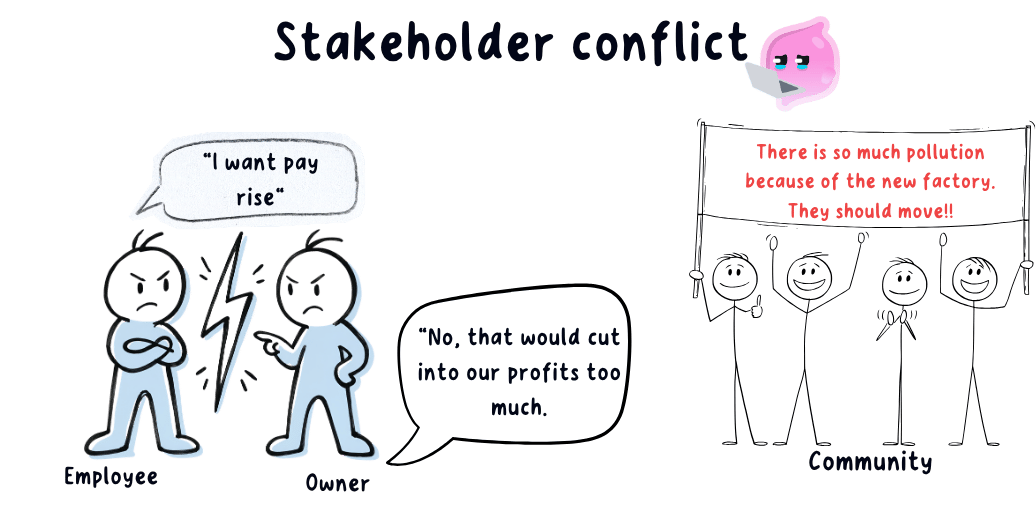
Stakeholder conflict: a situation where meeting one stakeholder group's objective makes it harder to meet another group's objective.
- Conflict happens because the business has one pot of money and one set of decisions, and the groups want that pot spent in different places.
- Owners against employees: wages are a cost, so every £1 added to the wage bill is £1 less profit available as dividend, which is why a pay claim and a dividend target cannot both be met in full.
- Customers against suppliers: customers want the lowest price, and the way a supermarket delivers it is by paying its growers and dairy farmers less per unit.
- Owners against the local community: owners want a bigger site, longer opening hours and earlier deliveries, and all three arrive on the residents' street as traffic and noise.
- Shareholders against the business's own future: profit paid out as dividends this year is profit not reinvested in new equipment, so a high payout can weaken the firm the employees rely on.
- A Tesco Extra opens on the edge of a market town: shoppers get lower prices and a far wider range, around 200 local people get jobs, and the farms that supply it get a large steady order.
- The same store adds several hundred car journeys a day to the ring road and pulls trade away from the butcher and greengrocer on the high street, some of whom close.
- Customers and employees want the store, part of the community does not, and the council granting permission has to choose between them.
Weighing up which stakeholder comes first
- Compare how many people are affected and how severely, because 200 new jobs set against slower traffic on a ring road is a different balance from 200 redundancies set against a small saving.
- Compare how long each effect lasts, since a redundancy can follow a worker for years while extra delivery noise can be fixed by changing the delivery times.
- Ask whether the business can function at all without that group, because a firm can usually survive unhappy neighbours but not customers who have all left or suppliers who have all stopped delivering.
- Businesses handle the clash in three ways: they prioritise the group they most depend on, they compromise by softening the loss for the others, and they communicate early so objections do not become a strike or a campaign.
- A compromise looks like phasing redundancies and paying for retraining, or banning deliveries before seven in the morning and planting a screen of trees along the boundary.
- Do not claim a conflict has been resolved when it has only been softened, because a business can compensate the losing group without giving it what it wanted.
- Do not write that a decision affects "all stakeholders" in the same way, since the whole point of conflict is that one group gains while another loses.
- Analyse the impact on one stakeholder group wants a chain rather than a list, so run action, then what changes for that group, then what that means for them.
- Discuss whether the business should is where conflict belongs: name the group that gains, name the group that loses, then say which matters more to this particular firm and why.
- What are the two directions in which a business and its stakeholders affect each other?
- Give two ways employees can influence the business they work for.
- How can a local community stop a business expanding on its site?
- Define stakeholder conflict, then explain why a supermarket cannot satisfy both its customers and its suppliers on price.
- Name three things a business can compare when deciding which stakeholder to put first.
