1.3.1 What are business aims and objectives
Aims and objectives
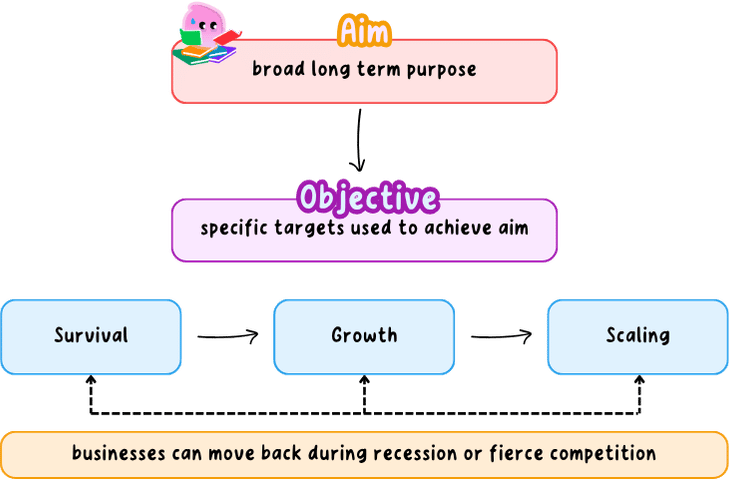
Aim: the long-term goal a business is working towards, stated in broad terms.
Objective: a specific target, with a figure and a deadline, set to move the business towards its aim.
- An aim is a destination. It says what the business wants to become or achieve over several years, without attaching a figure to it.
- Warburtons wanting to remain the UK's leading bakery brand is an aim, because it describes a position rather than a task.
- An objective is a task with a number on it. It names one thing to be achieved, states how much, and fixes a date by which it must be done.
- Increasing bread sales by 5 per cent by the end of the financial year is an objective, because on that date you could check whether it happened.
- The two are linked, not alternatives. The aim decides which objectives are worth setting, and the objectives are how the aim is reached.
- Writing "to make a profit" as an objective is the most common slip, because it carries no figure and no deadline.
- It becomes an objective when it reads "to make £40,000 profit in the year to 31 March".
How objectives sit beneath an aim
- One aim, several objectives: a business normally holds a single aim and sets several objectives underneath it, each covering a different part of the job.
- Greggs has the aim of remaining the UK's leading food-on-the-go retailer.
- Opening around 150 new shops in a year, growing evening sales and shortening queues at the till are three separate objectives that all serve that one aim.
- The timescales differ. An aim may stretch over five or ten years, while an objective usually covers anything from three months to two years.
- Objectives pass down the business. A company target is split into a figure for each department, and often into a figure for each site or team.
- A national sales target becomes a weekly takings figure for each individual shop, so the staff there know their share of it.
- A Tesco store manager is given a weekly sales figure that comes out of the company's annual target.
- The manager splits that figure between departments, so the bakery and the fresh produce aisle each hold their own weekly number.
- The company target and the aisle target are the same objective written at different levels of detail.
What makes an objective specific enough to use
- Name the exact thing to be achieved. "Do better" could mean sales, profit or service, so the objective has to say which one.
- Attach a figure. Without a number there is no way to tell afterwards whether the target was reached or missed.
- Fix a deadline. A date lets the business plan backwards from it and stops the target being pushed into next year whenever it is inconvenient.
- Keep it inside the resources the business actually has. A figure the cash, staff and equipment cannot deliver gets ignored rather than chased.
- "Improve customer service" cannot be acted on, because nobody knows what would count as having done it.
- "Cut the average wait at the till from four minutes to two minutes by September" names the measure, the size of the change and the date.
- The second version also points the manager at where the problem sits, which is staffing at busy times.
The purpose of setting objectives
- They turn an aim into work. An aim cannot be handed to a member of staff as an instruction, but an objective can.
- They give a figure to compare real performance against. At the end of the period the owner puts the actual result next to the target and can see the size of any gap, which is the only way to say whether the year was good or poor.
- They tell staff what the business is trying to do. A written target reaches every employee in the same words, so nobody has to guess what the owner wants.
- They help owners choose between options. Faced with two ways of spending £50,000, the owner picks the one that moves the business closer to the objective.
- How objectives are then used day to day, to guide decisions, coordinate departments and motivate staff, is covered in the article on the role of objectives in running a business.
- Why the objectives themselves differ between businesses and change over time is covered in the article on changing objectives.
- Explain the difference between an aim and an objective is the standard wording, and it wants one precise sentence on each plus a matched pair of examples taken from the same business.
- The mistake to avoid is writing an aim when an objective was asked for, which happens whenever your answer contains no number.
- What is the difference between an aim and an objective?
- Why can an aim on its own not tell you whether a business is on course?
- Name the three things an objective must contain to be specific enough to use.
- Rewrite "sell more sandwiches" as a usable objective.
- Give two reasons a business bothers to set objectives at all.
1.3.1b Main aims and objectives of businesses
Survival and profit maximisation
Survival: the objective of staying in business by covering costs and keeping enough cash to pay bills as they fall due.
Profit maximisation: the objective of making the largest possible gap between total revenue and total costs.
- Survival: the business is not chasing a large profit yet, only trying to take in enough money to keep the doors open.
- A new independent café sets this objective in its first year, when customer numbers are still unpredictable and the owner has borrowed to fit out the premises.
- An established firm returns to survival when trade collapses in a recession, because every other objective is only available to a business that is still trading.
- Profit maximisation: the business pushes revenue as high as it can and holds costs as low as it can, so the gap between the two is at its widest.
- It is pursued by raising the price where customers will still pay it, selling more units, or cutting costs such as wages, rent and materials.
- Profit pays the owner an income and leaves retained cash the business can spend on new equipment or new sites without borrowing.
- A new independent café with £4,000 of monthly costs sets an objective of taking £4,000 a month in its first year, and nothing more.
- Tesco, already secure, sets a higher profit figure each year and works towards it by growing sales while squeezing supplier prices.
- Both are financial objectives, but only one of them assumes the business will still be there next year.
Growth and market share
Growth: the objective of becoming a larger business, measured by revenue, outlets, staff or units sold.
Market share: the percentage of all sales in a market that goes to one business.
- Domestic growth means getting bigger inside the UK, which Greggs has done by opening shops in retail parks, supermarkets and petrol stations as well as on high streets.
- International growth means selling into other countries, which JCB does by exporting diggers built in Staffordshire.
- Selling abroad reaches customers the UK market cannot supply and spreads the risk, because a downturn in one country need not stop sales in another.
- Increasing market share means winning a bigger slice of the same market, which can only be done by taking customers from rivals.
- Aldi has taken grocery share from Tesco and Sainsbury's by holding prices down, and the larger share it now holds gives it more bargaining power over its own suppliers.
- Share can rise even while total sales fall, so it measures the business against its rivals rather than in absolute size.
Customer satisfaction
- The target is repeat custom. The business aims to meet customer needs well enough that buyers come back and recommend it, which is tracked through review scores, repeat orders and the number of complaints.
- Keeping a customer costs less than finding one. Satisfied customers return without being advertised to, so the business spends less on winning replacements for the buyers it has lost.
- A restaurant chain such as Nando's watches its online review scores closely, because a falling score cuts bookings before it shows up in the sales figures.
Social and ethical objectives
- Ethical objectives concern how the business treats people: paying suppliers a fair price, paying staff above the legal minimum, or refusing to buy from factories with poor working conditions.
- Social and environmental objectives concern the effect the business has on the wider world, such as cutting packaging waste, lowering emissions or reducing food waste.
- The National Trust exists to conserve historic places and open them to the public, so its objectives are written about conservation work and visitor numbers rather than profit for owners.
- A social enterprise trades like any other business but puts its surplus back into a social purpose instead of paying it out to owners.
- These objectives usually raise costs. Fair prices to suppliers and lower-waste packaging cost more than the cheapest option, so a business that sets them is accepting less profit in exchange for a stronger reputation.
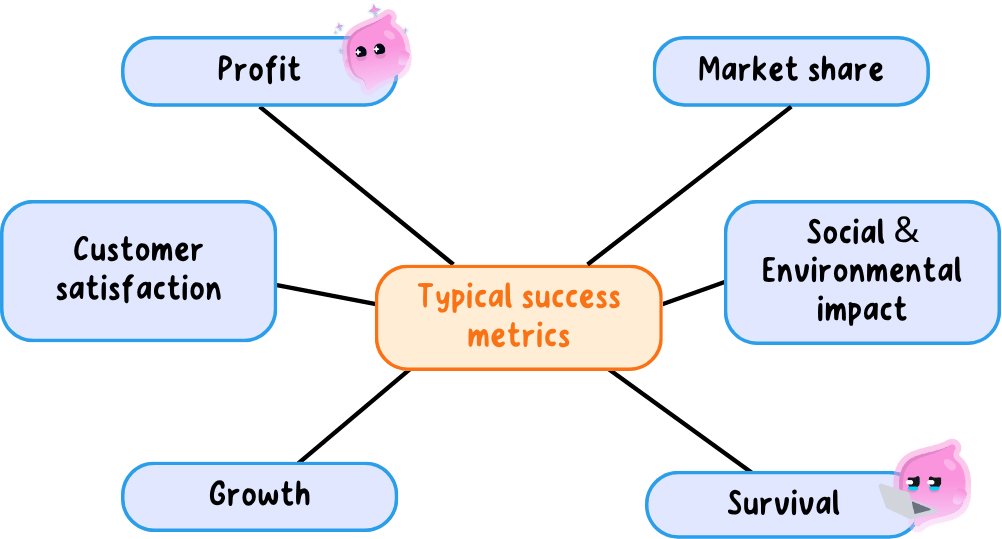
- Do not assume every organisation is trying to maximise profit.
- A charity, a social enterprise and a public-sector body such as the NHS set objectives about the service they deliver.
- They still have to cover their costs, because an organisation that runs out of cash closes whatever its purpose.
Shareholder value
Shareholder value: the return shareholders receive from a company, made up of dividends paid out of profit and a rise in the share price.
- This objective belongs to companies. It applies where the business is owned by shareholders, and it matters most in a plc such as Barclays whose shares are traded on the stock exchange.
- Shareholders gain in two ways. They receive a dividend, which is a share of the profit paid out in cash, and they gain if the share price rises above what they paid.
- It shapes what the directors do. Shareholders can sell their shares or vote directors out, so a board that delivers a poor return risks losing its jobs or seeing the company taken over.
- Identify one objective this business is likely to have is the usual wording, and the answer must name the objective and tie it to a clue in the case material such as the firm's age, size or type.
- Use the precise names, so write profit maximisation rather than "making money" and increasing market share rather than "getting bigger".
- The mistake to avoid is naming profit for a charity or a first-week start-up, when the material has already told you the business has a different priority.
- Why is survival the usual objective for a business in its first year?
- What is the difference between growth and increasing market share?
- Give one reason a UK business would set an international growth objective.
- Name the two ways a shareholder gains when a plc increases shareholder value.
- Name two social or ethical objectives a business might set, and say why each raises costs.
1.3.2 Role of objectives in running a business
Setting the direction of the business
- An objective tells everyone where the business is heading. Once the target is written down and circulated, every employee is working towards the same figure instead of their own idea of what matters.
- A shop assistant who knows the store is chasing a weekly takings target understands why the manager keeps pushing add-on sales at the till.
- It converts the owner's intention into something the organisation can act on. Wanting the business to do well is a private thought, while a target of 12,000 units by December can be handed to a production manager.
- It also tells staff what is not the priority. A business targeting survival is telling its managers to protect cash, which rules out spending on a project that would only pay off in five years.
Guiding decisions and allocating resources
- Each decision is tested against the objective. When managers face a choice, they take the option that moves the business closer to the target and reject the one that does not.
- A café with an objective to raise weekly revenue by 10 per cent extends its opening hours into the evening rather than closing early to save on wages.
- Money, staff and time are steered towards the objective. A firm chasing market share puts its budget into advertising and lower prices, while a firm chasing survival puts the same money into paying suppliers on time.
- The objective settles arguments about priorities. When two departments both want the same £20,000, the target decides which request is funded, so the choice is not left to whoever argues hardest.
- Greggs sets a target of opening around 150 new shops in a year.
- That one figure decides where the property budget goes, which regions the managers are told to search, and how many new staff have to be recruited and trained.
- A single target quietly organises hundreds of separate decisions that would otherwise be taken in isolation.
Coordinating the functional areas
- One shared objective aligns the departments. Marketing, finance, operations and human resources each plan their own work from the same target rather than from four different ideas of success.
- Marketing plans the campaign that will deliver the sales the target needs, and finance sets a budget that makes the target affordable.
- Operations arranges production and stock to meet those planned sales, and human resources recruits and trains the extra staff who will be needed.
- Without a shared objective the departments work against each other. Marketing can promise a next-day delivery that operations has no capacity to make, so the business loses the customers it has just paid to attract.
Motivating staff
- A target gives employees something definite to work towards. Sales staff given a monthly figure know exactly what counts as a good month, which an instruction to work hard never tells them.
- Hitting a target is a visible achievement. Staff can see they have done what was asked, and managers can reward it, so effort rises and productivity with it.
- It connects one person's work to the whole business. A warehouse worker who knows the company target depends on orders leaving the same day treats a late pick as something that matters.
- A target set too high does the opposite. Staff who believe the figure cannot be reached stop trying at all, so an objective only motivates while it stays within reach.
- An objective that staff have never been told about cannot motivate them or guide a single decision they take.
- Targets that are rewritten every few weeks have the same problem, because staff stop treating any of them as real.
Checking progress and correcting course
- A measurable objective gives managers something to compare results against. Each month the actual figure is put next to the target, and the gap between them is the size of the problem.
- A business £15,000 behind a £100,000 half-year sales target knows how far off course it is, not merely that something is wrong.
- This gives early warning. Spotting a shortfall part way through the year leaves time to cut costs, change the advertising or reprice, while the year can still be rescued.
- Missing a target starts a review. The business asks whether the target itself was unrealistic, whether the plan for reaching it was wrong, or whether something outside the business changed.
Using the objective at the end of the period to decide whether the business has actually succeeded is covered in the article on judging success.
- Explain how setting objectives helps this business is the usual wording, and each point needs a mechanism rather than a claim that objectives are useful.
- The mistake to avoid is defining aims and objectives when the question asked what they are used for.
- Name four ways a business uses its objectives while it is running day to day.
- How does a shared objective stop marketing and operations working against each other?
- Why does a target set too high reduce motivation instead of raising it?
- What can a manager do after spotting halfway through the year that a target will be missed?
- How does an objective tell staff what is not a priority?
1.3.3 Why objectives differ and change
Why objectives differ between businesses
- The size of the business: a small business sets objectives around steady income and staying open, because it has little cash to fall back on if a target is missed.
- A large business has reserves, borrowing power and spare staff, so it can chase growth, market share and expansion overseas at the same time.
- The level of competition faced: in a crowded market the objective is to defend sales and hold market share, because a customer who is unhappy can switch to a rival the same day.
- Aldi and Tesco both set market share objectives because they compete for the same weekly shop, while a village post office with no local rival can concentrate on covering its costs.
- The type of business: a business owned by shareholders is pushed towards profit and shareholder value, while a not-for-profit organisation has no owners to pay.
- The National Trust sets objectives about conservation work and visitor numbers, and a social enterprise puts its surplus back into its social purpose.
- A public-sector body such as the NHS sets objectives about waiting times and patients treated, because it is funded to deliver a service rather than to return a profit.
- What the owner personally wants: one café owner sets a target of five branches, while the owner next door wants a reliable income and free weekends, so two identical businesses hold different objectives.
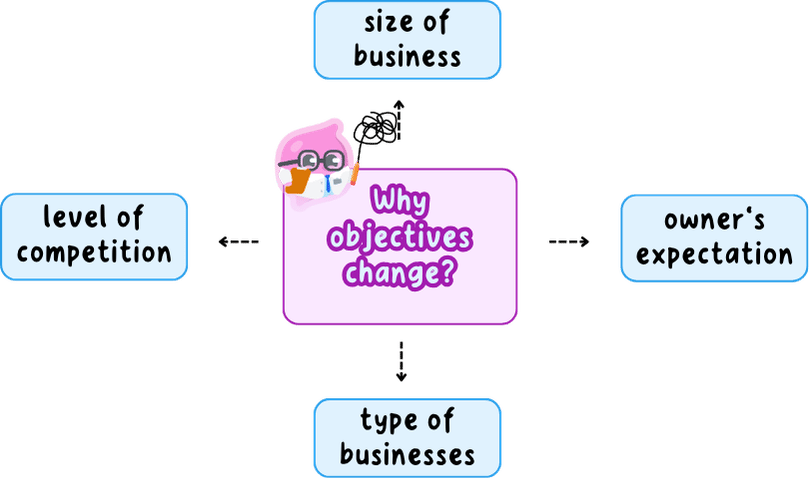
- A not-for-profit organisation still needs enough income to cover its costs, but any surplus goes to the mission instead of to owners.
- The owner's own reasons for starting a business, such as wanting independence or following an interest, are covered in the topic on the role of the entrepreneur.
Start-ups compared with larger established businesses
- A start-up has to survive before it can attempt anything else. It has few customers, an unproven product and limited cash, so its objectives are about covering costs and building a base of regular buyers.
- An established business has the resources to set more ambitious objectives. It also has shareholders and lenders who expect those objectives, so standing still is not treated as acceptable.
- Four objectives only appear once a business is established: becoming the dominant business in its market, expanding internationally, increasing shareholder value, and setting formal ethical and environmental targets.
- Becoming dominant means holding a larger share of the market than anyone else, so rivals have to react to the prices you set and suppliers accept the terms you offer. Tesco holds that position in UK groceries, which is why a price cut there forces the other supermarkets to answer it.
- Greggs could target 150 new shops in a year only because it already had the cash, the bakeries and the brand to fill them, which a single-site baker does not.
- The scale of the ambition differs as well as the objective itself. Growth for a start-up means one extra site or a first large customer within its own town or region, while an established business writes its targets around the whole national market and then other countries.
- Ethical and environmental targets are informal in a start-up. The owner decides them as they go, whereas a larger established business publishes targets such as cutting packaging waste and is then judged on whether it met them.
Why objectives change as a business evolves
- Reaching one objective releases the next. A start-up that has traded for two years and built regular customers no longer needs survival as a target, so it moves on to profit or growth.
- Getting bigger changes what the business can attempt. More cash and more staff make international expansion or a market share target realistic when neither was possible before.
- A change of ownership rewrites the objectives. A sole trader who sells up to a larger company inherits that company's growth and shareholder value targets, whatever the original owner wanted.
- Objectives are reviewed on a cycle. Most businesses set targets a year at a time and revise them when the year ends, so no set of objectives stays in place for long.
- A new restaurant spends year one aiming only to cover its rent, wages and food costs.
- Having survived, it targets £30,000 profit in year two and a second site by year four, so achieving one objective is what triggered a more ambitious one.
- A downturn then pushes it back to protecting cash, and the second site is shelved rather than cancelled.
Outside events that force objectives to change
- A recession pushes a business back towards survival. Customers spend less, revenue falls, and a firm that was chasing growth trims its product range, reduces staff and protects its cash instead.
- This happens to large established firms as readily as to small ones, so survival is not only a start-up objective.
- A strong new rival forces a switch to defending market share. As Aldi and Lidl expanded across the UK, the larger supermarkets moved from raising profit to cutting prices to hold on to their customers.
- New laws and new technology change what has to be targeted. A rise in the national living wage raises the wage bill, so a business sets a cost-cutting objective it did not need the year before.
- The threat of a takeover shifts the focus to shareholder value. Directors try to lift the share price so that shareholders keep faith in them and reject the offer.
- When conditions improve the objectives swing back. A business that returned to survival in a downturn moves back to growth once sales recover, and the cuts it made are reversed.
- Explain why this business's objectives might change is the usual wording, and the answer needs a trigger, then the new objective, then one action the business would now take.
- Read the case material for the age, size, type and competition of the business before you name any objective for it.
- The mistake to avoid is describing what an objective is, when the question asked why this particular business would change one.
- Name three reasons the objectives set by two businesses might differ.
- Why does a not-for-profit organisation not set profit maximisation as an objective?
- Give two objectives a larger established business might set that a start-up would not.
- How does a recession change the objectives of a business that was chasing growth?
- Why might the threat of a takeover shift a plc's focus to shareholder value?
1.3.4 Using objectives to judge success
Judging success against the objective the business set
- Success is a comparison. You put the actual result next to the target the business set itself and see whether the target was reached.
- A café that targeted 500 customers a week and now serves 550 has succeeded against that objective.
- Without an objective there is nothing to judge against. A business with no target can report what it did but cannot say whether that was good or poor, because it never said what good would look like.
- The size of the figure is not the point. A large number that fell short of its target is a failure, and a small number that beat its target is a success.
- A Greggs shop targets £8,000 of sales a week and takes £8,600, so against its own objective it has succeeded.
- A larger branch takes £12,000 a week but was targeting £15,000, so despite the bigger takings it has missed.
- Ranking the two shops by takings alone would give the wrong answer about which one performed.
Measuring success in ways other than profit
- Profit is the most common measure, and a business that set a profit target judges itself on whether that figure was reached.
- Customer satisfaction is measured by repeat custom, review scores and the number of complaints received, all of which can be counted month by month.
- Growth is measured by rising revenue, more outlets, more staff or more units sold than the year before.
- Survival is a measure in its own right, so a business still trading after three difficult years has succeeded against a survival objective even if it made no profit.
- Social and environmental impact is measured by figures such as tonnes of waste avoided, people helped or apprenticeships created.
- The National Trust judges itself on the buildings and land it has conserved and the visitors it has attracted, because those are the objectives it set.
- Market share shows performance against rivals, so a rising share means the business is winning customers its competitors have lost.
- A business sells £4,200,000 in a year in a market where every firm together sells £30,000,000.
- A 14 per cent share means 14p of every £1 spent in that market is spent with this business.
- The objective has only been met if that percentage is higher than it was last year, so the owner should compare it with the previous figure before claiming success.
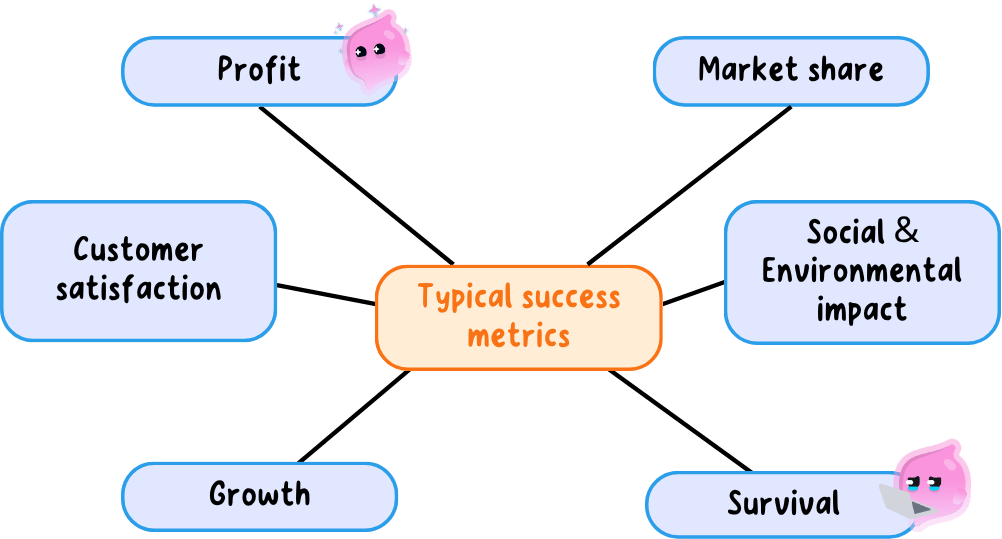
- Do not treat profit as the only measure of success.
- The correct yardstick is whichever objective that particular business set for itself.
Reading the same performance against different objectives
- A profitable business can still have failed. A firm that set out to increase market share but lost share to a rival has missed its objective, whatever its profit figure shows.
- A loss-making business can still have succeeded. A start-up whose objective was to survive its first year and is still trading has done what it set out to do.
- Monzo grew its customer numbers for several years while still making a loss, and at that stage it was judged on customers won rather than on profit.
- The measure has to match the objective. Judging a charity by profit, or a six-month-old start-up by market share, produces a verdict that says nothing about whether it did what it was trying to do.
- Different groups with an interest in the business also judge it by different measures, so an owner looks at profit while an employee looks at pay and job security.
- Those competing views are covered in the topic on stakeholders.
Deciding which measure to judge by
- Start with the objective the business itself set, because that is what its owners and managers were actually trying to achieve.
- Weigh the stage the business has reached. Survival is the fair measure for a first-year business, while a twenty-year-old plc should be judged on profit, market share and the return to its shareholders.
- Weigh the type of business. A charity or social enterprise has to be judged on its mission, because a profit for owners was never what it was set up to produce.
- Weigh the time period. A business can hit this year's profit target by cutting quality and then lose customers next year, so a single year's figure can point the wrong way.
- Use more than one measure where the evidence allows it. A business that grew revenue, held its market share and kept its review scores up has a stronger claim to success than one that only lifted profit.
- Do you think this business has been successful? Justify your answer is the wording here, and it wants a decision rather than a list of points on both sides.
- Name the objective the business set, take the target figure and the actual figure from the case material, then state plainly whether it was met.
- The mistake to avoid is judging every business by profit when the material has told you its objective was survival, growth or a social purpose.
- Against what should the success of a business be judged?
- Give three measures of success other than profit.
- How is market share calculated?
- Why can a business that made a loss still be judged a success?
- Why is one year's profit figure on its own a weak measure of success?
