4.3.1 Importance of motivation
What motivation means
Motivation
The willingness of an employee to work hard and work well for a business.
- Motivation comes from a mix of what the business gives the employee, such as pay, praise and responsibility, and how the employee feels about the work itself.
- Two employees with the same skills, doing the same job on the same equipment, can produce very different amounts of work, and the difference is usually motivation.
The financial and non-financial ways a business raises motivation are covered in the articles that follow; this one deals with why a motivated workforce is worth having.
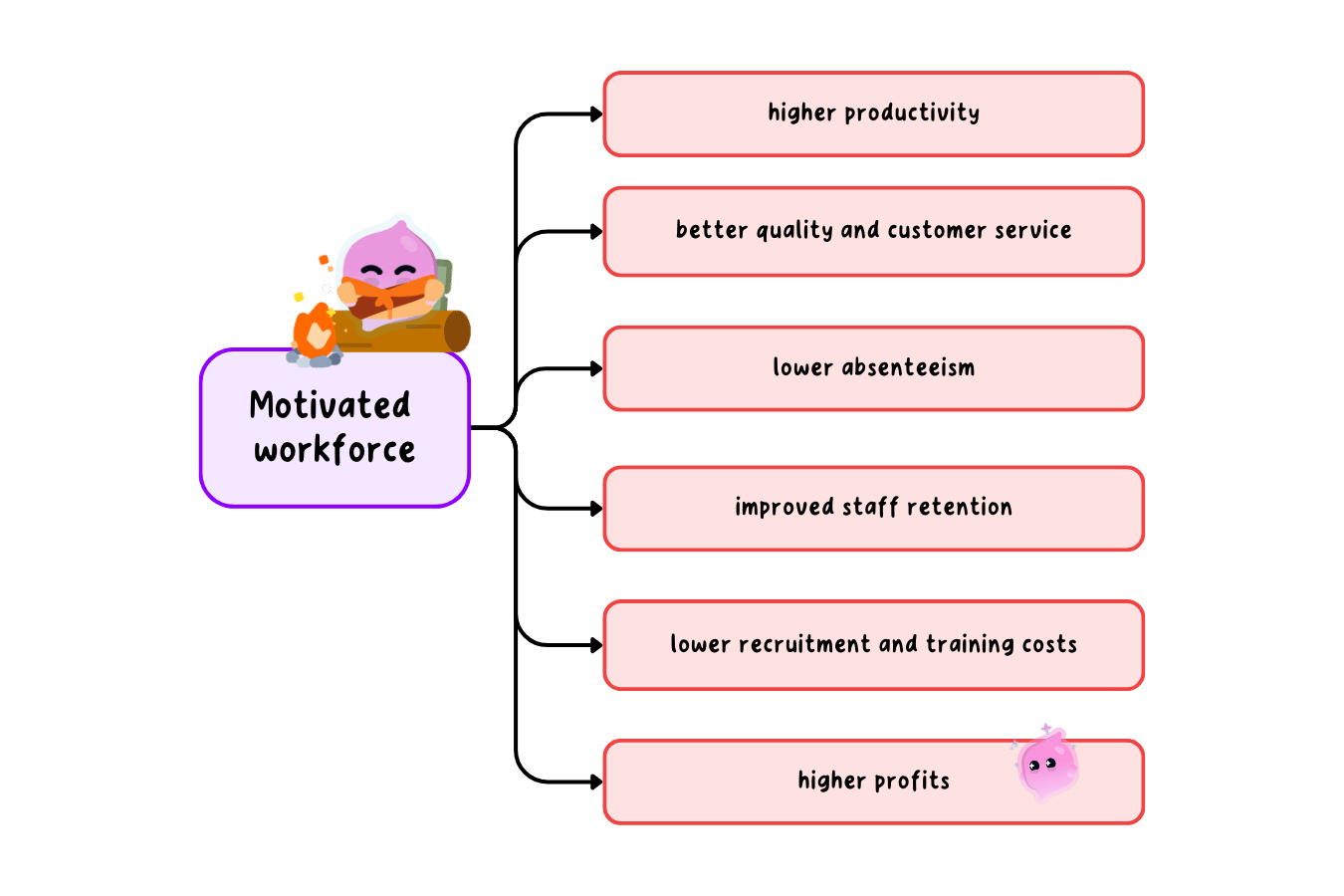
Higher productivity and better quality
Productivity
The output produced by each employee in a given period of time.
- Higher productivity: motivated staff work at a steadier pace, take fewer long breaks and waste less time, so each worker produces more.
- More output from the same wage bill lowers the cost of making each unit, so the business can cut prices to compete or keep the difference as profit.
- Better quality: staff who take pride in the job check their own work, spot faults early and follow the correct method.
- Fewer faulty items means less waste, fewer refunds and fewer hours spent putting mistakes right.
- On a Warburtons bakery line, a motivated operator notices a badly set slicer within minutes, so only a handful of loaves are wasted.
- An operator who has stopped caring lets the fault run for an hour, so hundreds of loaves are scrapped and the shift misses its order.
Better customer service and accepting change
- Better customer service: motivated staff greet customers, answer questions properly and sort problems out, so shoppers come back and recommend the business to others.
- Keeping an existing customer costs far less than winning a new one, so revenue rises without extra spending on advertising.
- More willing to accept change: staff who feel valued co-operate with a new till system, a new shift pattern or new machinery instead of resisting it.
- Resistance can hold a change up for months, so co-operation lets the business get the benefit of what it has bought much sooner.
- A motivated Greggs server keeps the queue moving at lunchtime and remembers what the regulars order, so more customers are served in the busiest hour.
- When a new ordering app arrives, the same server learns it quickly and shows customers how to use it rather than complaining about it.
Lower absenteeism and lower staff turnover
Absenteeism
The proportion of working days lost because employees are away from work.
Staff turnover
The proportion of employees who leave a business during a year and have to be replaced.
- Lower absenteeism: motivated staff take fewer unnecessary days off, so shifts are covered by the people trained to do them.
- Covering absence means paying overtime or bringing in agency staff, which raises labour costs without raising output.
- Lower staff turnover: employees who enjoy their work stay longer, so the business keeps the experience and product knowledge it has built up.
- Every leaver has to be replaced, which costs money in advertising the vacancy, interviewing and training the new starter, and the replacement works slowly at first.
Absenteeism and staff turnover are not the same thing, because absenteeism is staff being off work while turnover is staff leaving the business altogether.
- Define motivation in one sentence.
- How does higher motivation lower the cost of making each unit?
- Name two costs a business faces when staff turnover is high.
- Why does a motivated workforce accept change more readily?
- Why does covering absence raise a business's labour costs without raising its output?
4.3.2 Financial methods of motivation
What counts as a financial method
Financial method of motivation
A reward paid to the employee as money, namely a salary, a wage, commission or a share of profit.
- Financial methods work by giving the employee a reason to raise their effort, because the amount they are paid depends on the hours, the output or the sales they deliver.
- The method a business chooses depends on whether the employee's output can be counted, and on the behaviour it wants to encourage.
- A company car, a staff discount, gym membership or free lunches are fringe benefits, and they count as a non-financial method even though they cost the business money.
- Only money paid to the employee is financial: salary, wage, commission and profit sharing.
Salary and wage
Salary
A fixed amount of annual pay, divided into equal monthly payments, whatever hours are worked.
Wage
Pay based on the hours an employee works or the number of units they produce, usually paid weekly.
- Salary: a salaried employee knows exactly what arrives each month, which gives security and suits office and management roles where output cannot be counted item by item.
- The amount does not change however hard the employee works that month, so a salary on its own rewards staying in the job rather than raising effort.
- Wage: a wage paid at an hourly rate is simple to work out and lets the business match its pay to the hours it actually needs, such as extra weekend shifts.
- Overtime paid above the normal hourly rate persuades staff to work extra hours when demand is high, though it raises the cost of every hour worked.
- A wage can instead be paid for each item produced, known as a piece rate, which raises speed where output is easy to count but tempts staff to rush and let quality slip.
- A production supervisor at Nissan Sunderland is on a salary, because the job is to keep the line running rather than to produce a countable number of items.
- The extra staff brought into a Currys warehouse for the Christmas rush are on an hourly wage, so the cost stops the moment the extra work stops.
Commission
Commission
A payment to an employee worked out as a percentage of the value of what they sell.
- Because pay rises with every sale, a salesperson has a direct reason to chase leads, follow customers up and work late, which is why commission suits selling roles above all others.
- Income becomes unpredictable in quiet months, and staff may push customers into unsuitable purchases to earn the percentage, which costs the business repeat custom.
- An estate agent paid a percentage of each sale price earns far more from a £400,000 house than a £200,000 one, so the difficult viewing on a Sunday is still worth doing.
- The same agent has an incentive to talk a property up, so the firm has to check that the advice buyers receive stays honest.
Profit sharing
Profit sharing
A scheme in which employees receive a share of the profit the business makes, on top of their normal pay.
- Profit sharing ties every employee to the success of the whole business, so staff have a reason to care about waste, costs and customers beyond their own tasks, and to help colleagues rather than compete with them.
- It also suits a business that wants long-term loyalty, because the payout only arrives for people still there at the end of the year.
- One employee's daily effort has only a tiny effect on total profit, so the link between working harder and being paid more is weak.
- In a poor year there is nothing to share, so the reward staff have come to expect disappears at the moment morale is already low.
- Employees of the John Lewis Partnership are called partners and receive an annual share of profit, set as a percentage of their pay.
- That percentage falls in weak trading years, which shows profit sharing rewards loyalty but cannot promise a steady amount.
The limits of paying more
- A pay rise removes a complaint about pay, but the effect fades once the higher amount comes to feel normal, and money cannot make a repetitive job interesting, so an employee bored by the work stays bored on higher pay.
- Every financial method raises the wage bill, so the business has to be confident the extra output or extra sales more than cover the extra cost.
Where the real problem is boredom, being ignored or having no prospects, the non-financial methods in the next article fit better than more pay.
Match the method to the job described: commission for selling, a piece rate where output can be counted, a salary where it cannot.
- What is the difference between a wage and a salary?
- Which financial method suits a salesperson, and why?
- Give one drawback of paying a piece rate.
- Why can profit sharing fail to change what an employee does day to day?
- Is a staff discount a financial or a non-financial method?
4.3.3 Non-financial methods of motivation
How non-financial methods work
Non-financial method of motivation
A way of raising motivation that does not involve paying the employee more money.
- Non-financial methods change how the job feels and how the employee is treated, so they work on pride, interest and belonging rather than on the size of the pay packet.
- They matter because a pay rise cannot cure boredom, being ignored by a manager or having nothing to aim for, and most of them cost far less than raising the pay of the whole workforce.
- The four you need are the style of management, training, greater responsibility and fringe benefits.
Styles of management
- Democratic style: the manager consults staff, asks for their ideas and explains decisions, so employees feel their views count and take ownership of the way the work is organised.
- Consultation takes time, so it fits skilled staff and decisions that are not urgent rather than a problem that has to be solved in the next five minutes.
- Autocratic style: the manager gives instructions and expects them to be followed, which is quick and clear, but capable employees who are never asked their opinion feel ignored and stop offering ideas.
- Laissez-faire style: the manager sets the goal and leaves staff to decide how to reach it, which motivates experienced specialists who want to be trusted but leaves new staff unsure what to do.
- A Nando's restaurant manager who asks the team how to reorganise the Friday rota, then uses their suggestion, raises motivation at the cost of one conversation.
- The same manager still gives direct instructions during a fire drill, because some situations need one voice rather than a discussion.
Training as a motivator
- Being trained tells an employee the business is willing to spend money on them, which makes them feel valued rather than easily replaced.
- Training removes the stress of not knowing how to do part of the job, so the employee works with more confidence and gets more satisfaction from finishing the task properly.
- New skills open the way to promotion and better paid work, so training gives staff a reason to stay rather than look elsewhere.
Why businesses train and the methods they use belong to the training articles that follow, so here you only need the effect training has on motivation.
Greater responsibility
Delegation
When a manager passes a task, and the authority needed to carry it out, down to a subordinate, while the manager stays accountable for the result.
Job enrichment
Giving an employee more demanding tasks and more control over their work, so the job itself becomes more satisfying.
- Delegation: being trusted to run a task without being checked on shows the manager has confidence in the employee, and the employee gains skills that make them more useful to the business.
- Job enrichment: harder and more varied work brings a sense of achievement when it is finished, which extra pay for the same dull tasks cannot provide.
- Promotion: moving up to a role with more status and more responsibility rewards the effort an employee has already made and gives everybody below them something to aim for.
- Responsibility demotivates if it is handed over without training or support, because the employee feels set up to fail, and promotion only motivates while staff believe it is awarded fairly.
- An experienced server at a Greggs shop who is given responsibility for ordering stock and opening up has a reason to stay when a rival offers the same wage.
- If nobody shows them how the ordering system works, that same responsibility becomes a source of stress instead of pride.
Fringe benefits
Fringe benefits
Rewards given to employees on top of their pay that are not cash, such as a staff discount, a company car or private health cover.
- Common fringe benefits include a staff discount, free or subsidised meals, a company car, gym membership, private health cover, extra holiday and a pension above the legal minimum.
- They motivate by making staff feel looked after, and they help keep them, because leaving means giving up the benefit as well as the pay.
- Some cost the business very little compared with the value the employee places on them, such as a discount on goods the staff buy anyway.
- Benefits are quickly treated as a right rather than a reward, so their effect on day-to-day effort fades even while they still help the business hold on to staff.
Fringe benefits are a non-financial method even though they cost the business money, because the employee is not handed extra cash, so never list a company car alongside commission and profit sharing.
- Pick the method that fixes the problem described, such as job enrichment for a bored but capable worker, or a more democratic style where staff say their ideas are ignored.
- Avoid the answer that says the manager should be nicer to people, because it names neither a method nor a mechanism.
- Name four non-financial methods of motivation.
- How does a democratic style of management raise motivation?
- Why can training motivate an employee who is already well paid?
- What is the difference between delegation and promotion?
- Give one reason a fringe benefit may stop motivating over time.