2.5.1 Impact of legislation on business
Why the government passes business laws
Legislation: laws passed by Parliament that a business must obey, with penalties for any business that does not.
- Protecting employees: employment law and health and safety law set minimum standards for pay, fair treatment and working conditions that no employer is allowed to fall below.
- Protecting consumers: consumer law gives buyers rights over how a product is described and over what happens when it turns out to be faulty, so a seller cannot simply keep the money.
- Protecting the public: rules on safe premises, noise and waste protect people who are neither staff nor customers, such as households living near a factory or pedestrians passing a building site.
- Obeying the law is compulsory, not a choice, so a business cannot decide that compliance is too expensive and opt out.
- The same rules bind Tesco and a single independent shop, so competition between them stays fair.
- The wage laws and the Equality Act 2010 are covered in 2.5.2 Employment law.
- The Health and Safety at Work Act 1974 and consumer law on trade descriptions are covered in 2.5.3.
- You need only brief knowledge of what each law says, because questions are built around the effects on the business.
The effects of legislation on a business
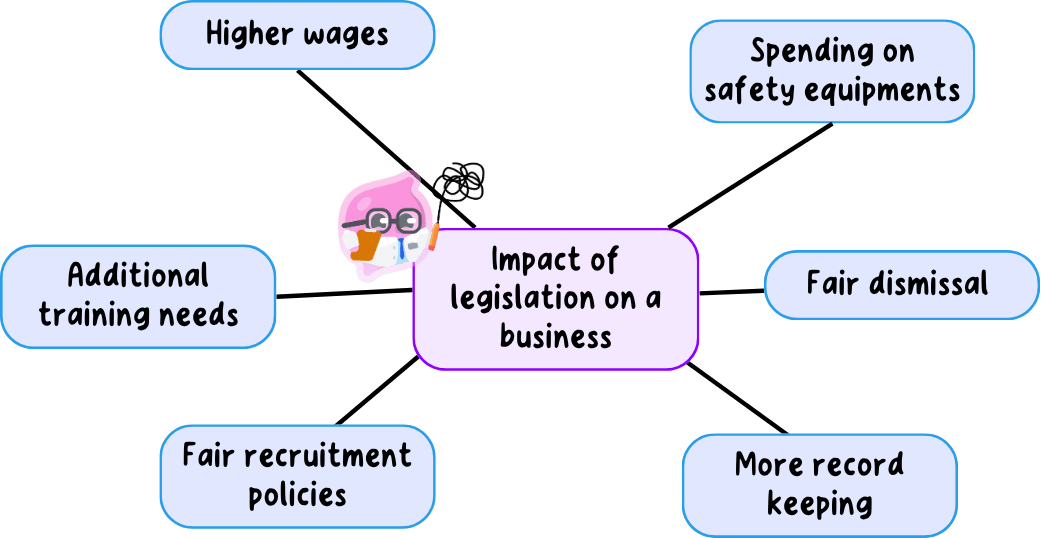
- Higher wage costs: a legal minimum hourly rate raises the wage bill of any business employing large numbers of low-paid staff, and the rate rises again most years.
- Spending on equipment and premises: safety law means paying for machine guards, protective clothing, fire equipment and repairs that an owner might otherwise put off.
- Training needs: staff have to be taught safe lifting, safe use of machinery and customers' refund rights, and managers have to be taught how to interview and promote fairly.
- Training time is paid time, so the business carries the trainer's fee and loses output while staff are away from the job.
- Changes to recruitment: adverts, shortlisting and interviews all have to be free of discrimination, so many firms ask every candidate the same set questions and write down why the successful one was chosen.
- More record keeping: contracts of employment, hours worked, pay rates, risk assessments and accident reports all have to be recorded and kept, which is somebody's paid time.
The benefits of providing a safe working environment
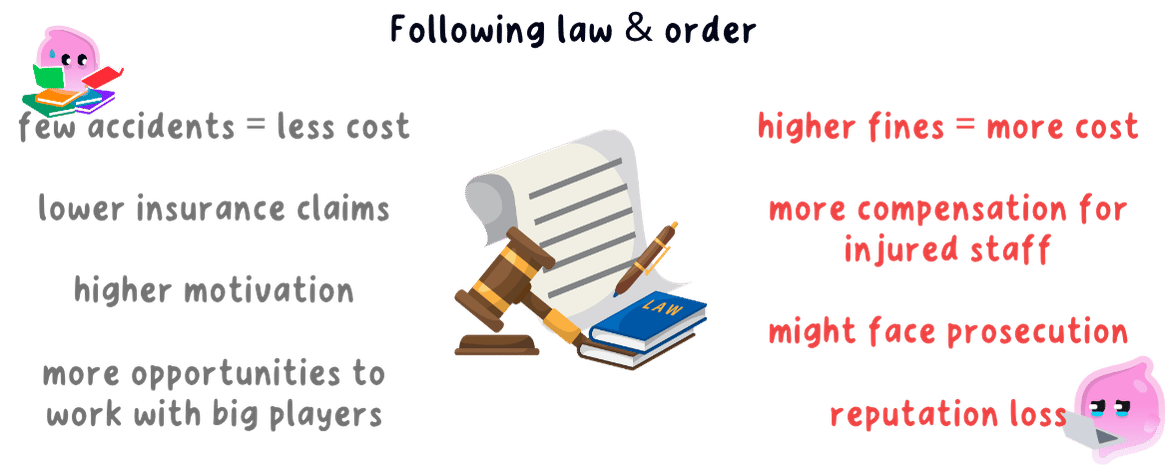
- Fewer accidents and less absence: a safe workplace means fewer injuries, so fewer days are lost and output keeps flowing instead of stopping while cover is arranged.
- Lower insurance and fewer claims: insurers charge lower premiums to a workplace with a clean accident record, and there are no compensation claims to settle.
- Better motivation and lower staff turnover: workers who can see that they are protected feel valued, so more of them stay and the business spends less on recruiting and training replacements.
- A record that wins work: large customers such as the NHS and JCB check a supplier's safety record before awarding a contract, so good practice brings in orders.
- Paying for safety is like servicing a delivery van: the yearly bill feels avoidable right up to the morning the engine fails.
- The service is a small predictable cost, while the breakdown costs a day of missed deliveries, a recovery charge and the repair anyway.
- Compliance works the same way, because the money saved by cutting corners is small next to the cost of one serious accident.
The consequences of failing to follow legislation
- Fines: a court or a regulator can fine the business, and for a serious safety breach the fine for a large firm can run into millions of pounds.
- Compensation: an injured worker, or a customer sold goods that were not as described, can claim compensation, which the business pays on top of any fine.
- Prosecution: owners and managers can be taken to court personally, and the most serious cases end in a prison sentence.
- Being stopped or shut down: an inspector can order dangerous work to stop, close premises such as a restaurant kitchen, or withdraw a licence, so the business earns nothing until it puts things right.
- Lost reputation: news of an unsafe factory, a discrimination case or a misleading advert drives customers away and makes good staff harder to recruit.
- Do not stop at "the business would be fined", because the question is what the fine, the closure or the lost customers do to its profit and its ability to keep trading.
- A fine is paid once, while a damaged reputation keeps costing the business customers and job applicants for years.
- This topic is usually examined as explain the impact of a change in the law on this business, so answer with effects on the business rather than with legal detail.
- Pick two or three named effects, such as a higher wage bill, paid training time or extra record keeping, and follow each one through to costs, output or reputation.
- The common mistake is to describe what a law says and stop there, which never answers a question about the business.
- Which three groups does business legislation set out to protect?
- Name three ways that obeying the law adds to a business's costs.
- Give two benefits to a business of providing a safe working environment.
- List four consequences a business can face for breaking the law.
2.5.2 Employment law
The national minimum wage and national living wage
National minimum wage: the lowest hourly rate an employer is allowed by law to pay a worker.
National living wage: the higher legal minimum hourly rate that applies to older workers.
- The rate is set by the government and reviewed every year, so a business has to budget for an increase each April.
- Older workers must be paid the higher national living wage rate, while younger workers and apprentices have their own lower legal minimums.
- Because it is a rate per hour, the total cost to the employer depends on hours worked as well as on the rate itself.
- Every employer is covered whatever its size, and each one must keep pay records proving that each worker received at least the legal rate.
- Retailers, care homes, cafes and cleaning companies employ many staff at or near the legal minimum, so every rise feeds straight into their costs.
- A care home paying 60 staff an extra 50p an hour for a 35-hour week adds 60×35×52×£0.50=£54,60060 \times 35 \times 52 \times \pounds0.50 = \pounds54{,}60060×35×52×£0.50=£54,600 to its wage bill for the year.
- Its fees are fixed by contracts with families and councils, so it often cannot pass the cost on and its profit falls instead.
How wage laws affect the business
- A higher wage bill: the effect is largest in labour-intensive businesses, where wages are the biggest single cost and most of the team is paid close to the minimum.
- Supervisors and experienced staff usually expect to stay above the minimum, so a rise pushes pay up further along the scale as well.
- Ways of covering the cost: a business can raise prices, cut hours and overtime, employ fewer staff, or invest in equipment such as the self-service tills now standard at Tesco.
- Cutting hours leaves the remaining team stretched, so service can get worse at the same moment prices go up.
- Better motivation: staff who feel fairly paid tend to work harder and treat customers better, which supports sales.
- Lower staff turnover: fewer people leave, so the business spends less on advertising jobs, interviewing and training replacements, and keeps more experienced staff.
- Underpaying is expensive. HMRC can order the employer to repay everything it owes, charge a penalty on top and publish the firm's name, which damages its reputation with customers and future recruits.
- Do not write that a wage rise always causes job losses, because a business may instead raise prices, accept a thinner margin or gain enough from better retention to cover it.
- The size of the effect depends on how much of the workforce sits at the legal minimum, so use that detail when the case gives it.
The Equality Act 2010
Equality Act 2010: the law that makes it unlawful to treat a person less favourably because of a characteristic such as age, sex, race, disability, religion or belief.
- It covers the whole working relationship: job adverts, interviews, pay, promotion, training, discipline and dismissal.
- Men and women doing the same job must be paid equally, so a business cannot justify a lower rate for one sex.
- An employer must make reasonable adjustments for disabled workers, such as adapted equipment, a ground-floor workstation or altered hours.
- Customers are protected as well, so a shop or restaurant cannot refuse to serve someone because of their race, religion or disability.
- A distribution firm advertises for a "young, energetic warehouse team" and turns down every applicant over 50.
- Both the wording and the decision discriminate on grounds of age, so a rejected applicant can bring a claim against the firm.
- Rewriting the advert around what the job actually needs, such as lifting to a stated weight, is lawful and widens the pool of applicants.
How the Equality Act affects the business
- Fair recruitment procedures: adverts have to be checked for wording that would put a group off, every candidate is asked the same questions, and the reason for choosing the successful one is written down.
- Training: interviewers and supervisors need training on what counts as discrimination and on how to deal with a complaint from a member of staff.
- Costs: training, workplace adjustments, extra record keeping and management time all have to be paid for out of profit.
- Benefits: hiring from the widest possible pool brings in better recruits, and a reputation as a fair employer improves morale, retention and how customers see the business.
- Consequences of a breach: a worker or applicant can take the business to an employment tribunal, which can order compensation, and the case brings legal costs and publicity that puts off customers and future applicants.
- Written notes on why a candidate was chosen protect the business, because they are the evidence it uses to answer a claim.
- Discrimination is often unintentional, which is why training and set procedures matter as much as good intentions.
- A frequent task is analyse the effect on this business of an increase in the national living wage, so work through the wage bill, then prices or profit, then hours and staffing.
- When the case gives staff numbers and hours, multiply the rise out so your answer is about this employer rather than employers in general.
- On the Equality Act 2010, write about recruitment, pay, promotion and training, because that is where the law changes what a business does.
- Do not drift into other statutes; the wage laws and the Equality Act 2010 are the employment laws you need.
- What is the difference between the national minimum wage and the national living wage?
- Which kind of business is hit hardest by a rise in the legal minimum hourly rate, and why?
- Name three areas of working life that the Equality Act 2010 applies to.
- What can happen to a business that discriminates against a job applicant?
- Give one way in which paying staff well can save a business money.
2.5.3 Health and safety and consumer law
The Health and Safety at Work Act 1974
Health and Safety at Work Act 1974: the law that requires an employer to protect the health and safety of everyone affected by its work, including staff, visitors and customers.
Risk assessment: a written check of what could cause harm in a workplace and of what the business will do to prevent it.
- A safe workplace: premises, machinery and working methods must all be safe, which means guarded machines, clear walkways, proper ventilation and equipment kept in working order.
- Training and supervision: staff must be shown how to lift safely, handle chemicals and food, and operate machinery, and new starters must be supervised until they can do it safely.
- Protective equipment: gloves, goggles, ear defenders, hard hats and high-visibility jackets have to be supplied by the employer, free of charge.
- Risk assessment and records: the business has to assess what could cause harm, write down what it will do about it, keep an accident book and provide first aid.
- Employees have duties too, since they must take reasonable care, follow their training and use the equipment they are given.
- At a JCB factory every new production worker is trained on the machine they will use, and guards are checked before a line starts up.
- The training days and the checks cost output, but one serious injury would stop the line, bring in an inspector and cost far more.
- A Greggs bakery faces the same duty in a different form, with slip-resistant floors, oven training and food handling rules.
How health and safety law affects the business
- Spending on equipment: guards, ventilation, protective clothing, fire equipment and regular maintenance all have to be bought and then replaced as they wear out.
- Paid training time: every new starter needs a safety induction and existing staff need refreshers, all of it paid time away from producing or selling.
- Record keeping: risk assessments, equipment checks and accident reports have to be written up and kept, so a manager spends time on paperwork rather than on output.
- Slower working: checks before a machine restarts, limits on how much one person may lift and compulsory breaks all reduce how much is produced in an hour.
- Fewer accidents and lower insurance: a good safety record means less absence, no compensation claims and a lower insurance premium, and staff who feel protected are more likely to stay.
- Consequences of a breach: an inspector from the Health and Safety Executive can order work to stop until a danger is fixed, and a serious breach brings a heavy fine, compensation for the injured worker and prosecution of the managers responsible.
The cost of meeting safety law falls hardest on businesses with dangerous work, such as factories, building firms and kitchens, and lightest on an office.
Consumer law and trade descriptions
Trade description: any claim a business makes about a product or service, which the law requires to be honest and accurate.
Fit for purpose: the product does the job a customer could reasonably expect it to do.
- Descriptions must be honest everywhere a customer sees them: adverts, packaging, labels, menus and online listings, including price claims such as "was £80, now £40".
- Goods and services must be of satisfactory quality and fit for purpose, so they have to work properly and last a reasonable time.
- When a product is faulty or was not as described, the customer has the right to a refund, a repair or a replacement.
- The seller is responsible, not the manufacturer, so the shop that took the customer's money is the one that has to put it right.
- If Currys lists a television as 4K and the panel is not, the description is false and every buyer can return it.
- A butcher labelling imported beef as British, or a cafe calling a bought-in cake "home-made", breaks the same rule.
- Currys deals with the refunds itself and then claims the cost back from its supplier.
How consumer law affects the business
- Checking every claim: adverts, labels and website listings have to be checked before they go out, which takes management time and sometimes paid legal advice.
- Staff training: shop and call centre staff need to know what a customer is entitled to, so that they neither refuse a lawful refund nor give away money the business does not owe.
- The cost of returns: refunds, replacements and return postage all cost money, and stock that comes back rarely sells again at full price.
- Tighter quality checks: because the seller carries the cost of faults, it inspects deliveries, keeps records of complaints and drops suppliers whose goods keep failing.
- Trust and repeat custom: honest descriptions and easy refunds bring customers back and earn recommendations, which is why many retailers give more than the law demands.
- Consequences of a breach: trading standards can investigate, a false description can lead to prosecution and a fine, customers can reclaim their money, and the publicity drives away trade the business had already won.
- Keep the two apart: health and safety law protects people at work, while consumer law protects people buying.
- Both act on the business in the same shape, which is spending on prevention now against fines, claims and lost customers later.
- A common wording is explain one effect on this business of meeting health and safety law, which wants one named cost or change in practice traced through to output, profit or staff.
- On consumer law, name the requirement, honest description or satisfactory quality, then the effect, checking adverts or paying for returns.
- Avoid the vague answer about "following the rules", which would fit any law and any business.
- What must an employer provide under the Health and Safety at Work Act 1974?
- Give two costs and two benefits to a business of meeting health and safety law.
- What does the law require of the descriptions a business gives its products?
- What is a customer entitled to when goods are faulty or not as described?
- Who has to put a faulty purchase right, the shop or the manufacturer?
