What motivation means
Definition
Motivation: the willingness of an employee to work hard and work well for a business.
- Motivation comes from a mix of what the business gives the employee, such as pay, praise and responsibility, and how the employee feels about the work itself.
- Two employees with the same skills, doing the same job on the same equipment, can produce very different amounts of work, and the difference is usually motivation.
Note
The financial and non-financial ways a business raises motivation are covered in the articles that follow; this one deals with why a motivated workforce is worth having.
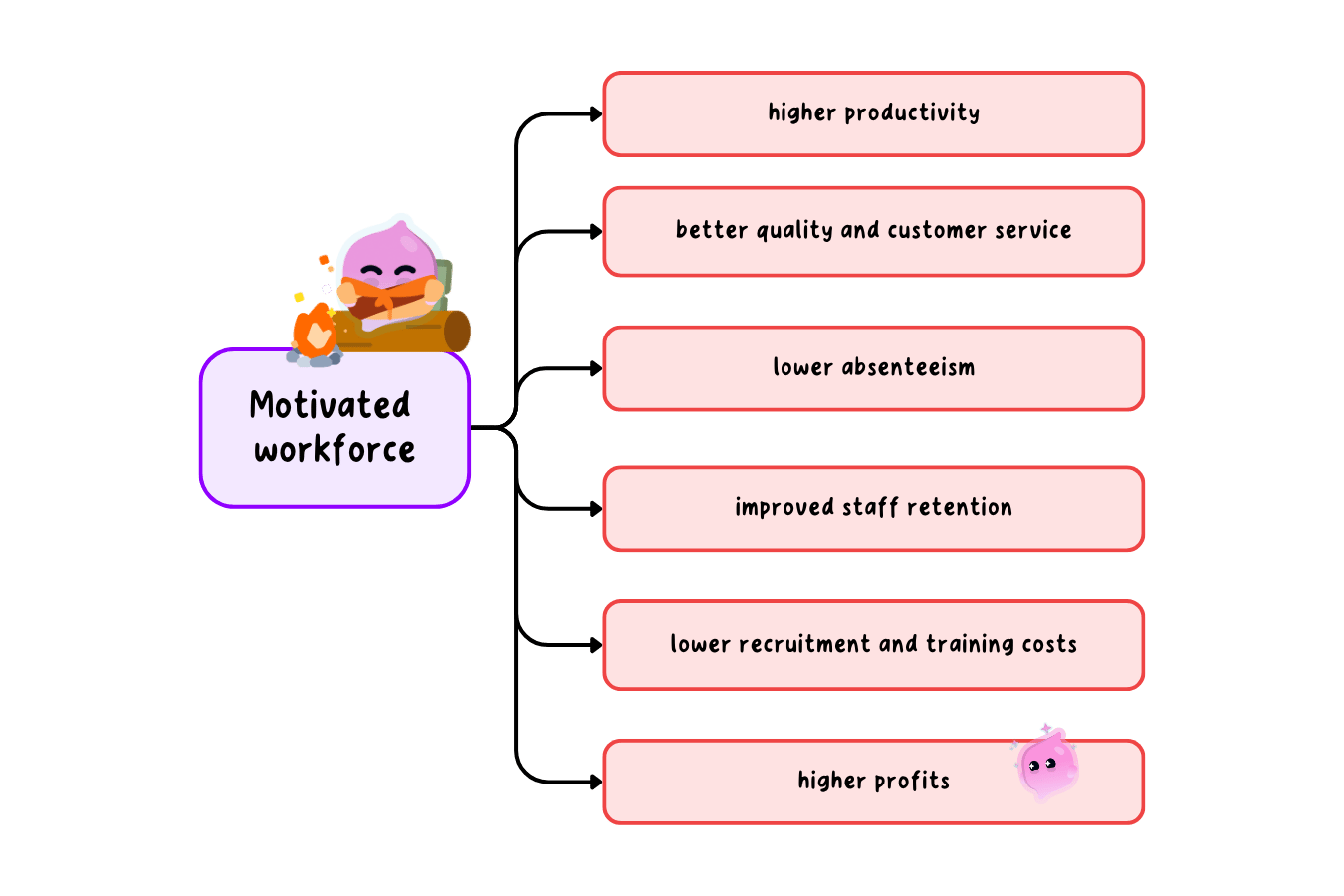
Higher productivity and better quality
Definition
Productivity: the output produced by each employee in a given period of time.
- Higher productivity: motivated staff work at a steadier pace, take fewer long breaks and waste less time, so each worker produces more.
- More output from the same wage bill lowers the cost of making each unit, so the business can cut prices to compete or keep the difference as profit.
- Better quality: staff who take pride in the job check their own work, spot faults early and follow the correct method.
- Fewer faulty items means less waste, fewer refunds and fewer hours spent putting mistakes right.
Example
- On a Warburtons bakery line, a motivated operator notices a badly set slicer within minutes, so only a handful of loaves are wasted.
- An operator who has stopped caring lets the fault run for an hour, so hundreds of loaves are scrapped and the shift misses its order.
Better customer service and accepting change
- Better customer service: motivated staff greet customers, answer questions properly and sort problems out, so shoppers come back and recommend the business to others.
- Keeping an existing customer costs far less than winning a new one, so revenue rises without extra spending on advertising.
- More willing to accept change: staff who feel valued co-operate with a new till system, a new shift pattern or new machinery instead of resisting it.
- Resistance can hold a change up for months, so co-operation lets the business get the benefit of what it has bought much sooner.
Example
- A motivated Greggs server keeps the queue moving at lunchtime and remembers what the regulars order, so more customers are served in the busiest hour.
- When a new ordering app arrives, the same server learns it quickly and shows customers how to use it rather than complaining about it.
Lower absenteeism and lower staff turnover
Definition
Absenteeism: the proportion of working days lost because employees are away from work.
Staff turnover: the proportion of employees who leave a business during a year and have to be replaced.
- Lower absenteeism: motivated staff take fewer unnecessary days off, so shifts are covered by the people trained to do them.
- Covering absence means paying overtime or bringing in agency staff, which raises labour costs without raising output.
- Lower staff turnover: employees who enjoy their work stay longer, so the business keeps the experience and product knowledge it has built up.
- Every leaver has to be replaced, which costs money in advertising the vacancy, interviewing and training the new starter, and the replacement works slowly at first.
Common Mistake
Absenteeism and staff turnover are not the same thing, because absenteeism is staff being off work while turnover is staff leaving the business altogether.
Exam technique
- The usual wording is explain the benefits to a business of having a motivated workforce, so name a benefit and then follow it through to output, costs or revenue.
- Use the precise terms productivity, absenteeism and staff turnover instead of writing that staff work better.
- If the question describes a business losing staff or constantly covering absence, quote that detail and link it back to motivation.
Self review
- Define motivation in one sentence.
- How does higher motivation lower the cost of making each unit?
- Name two costs a business faces when staff turnover is high.
- Why does a motivated workforce accept change more readily?
- Why does covering absence raise a business's labour costs without raising its output?
