1.7.1 Methods of expansion
The two routes to expansion
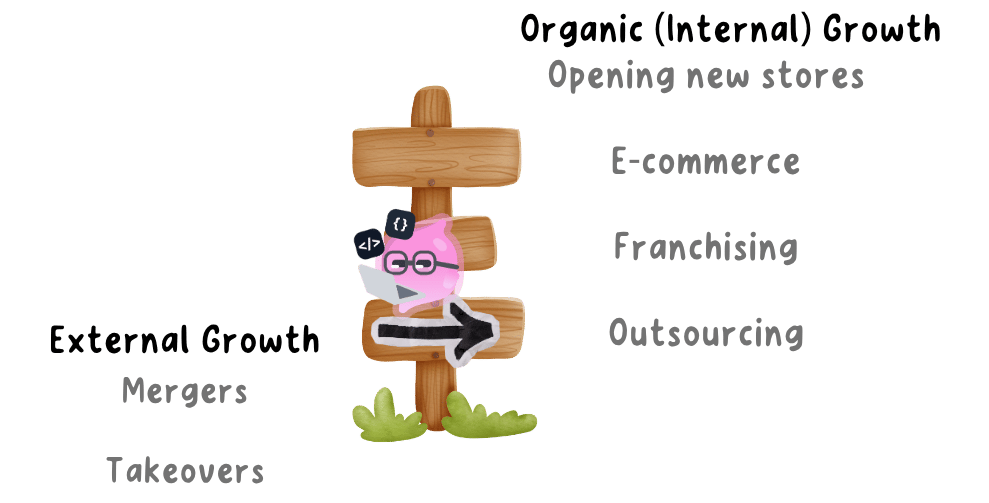
Organic growth: expansion that a business achieves using its own resources, such as opening new stores, selling online, franchising or outsourcing.
External growth: expansion achieved by combining with another business through a merger or a takeover.
- Organic growth, also called internal growth, is normally paid for out of retained profit or a loan, and it happens a step at a time.
- External growth is faster, because the other firm's shops, staff, customers and brand transfer at once, but it costs a large sum up front.
- The test is where the extra capacity comes from: building it yourself is organic growth, and buying it from someone else is external growth.
Opening new stores and e-commerce
- Opening new stores: the business rents or buys extra premises so that it can serve customers in new towns and cities.
- Benefit: it reaches customers who could never travel to the original shop, and the larger chain can buy stock in bigger volumes at a lower price per unit.
- Drawback: each store needs rent, fittings and staff before it takes a single pound, so it ties up a lot of cash, and a badly chosen site can lose money for years.
- Greggs has grown this way for years, adding shops on high streets, in retail parks and at petrol stations to reach more than 2,000 UK locations.
- E-commerce: the business sells through a website or an app, so it can take orders from the whole country, or from abroad, without opening a single extra shop.
- Benefit: it reaches a national or international market without paying rent or shop wages, and the site takes orders at any hour of the day.
- Drawback: it adds the cost of building the site, packing and delivery, customers can compare the price with a rival in seconds, and returns eat into the profit on each sale.
- Gymshark grew from a small operation into an international sportswear brand almost entirely by selling direct to customers online.
- A single farm shop in Devon wants to sell more of its cheese.
- Opening a second shop in Exeter costs £40,000 in rent and fittings and reaches shoppers in one more city.
- Setting up an online shop costs far less and reaches customers across the UK, so long as the cheese can be packed and delivered chilled.
Franchising and outsourcing
- Franchising: the business sells other people the right to trade under its brand name and use its products and systems, in return for a one-off fee and a share of the sales.
- Benefit: the franchisee pays for the premises and hires the staff, so the brand can add outlets quickly without funding each one, and it earns a fee plus a share of every outlet's sales.
- Drawback: the brand loses day-to-day control, because it depends on franchisees keeping standards up, and one poor outlet damages the name everywhere.
- Most McDonald's and Domino's outlets in the UK are run by franchisees, which is how both chains covered the country so fast.
- Outsourcing: the business pays another firm to carry out work it used to do itself, such as manufacturing, deliveries, payroll or customer service.
- Benefit: output can grow without buying more machinery or hiring more staff, because the supplier already has the capacity and the expertise.
- Drawback: quality and delivery times are no longer fully in the firm's hands, and a supplier that raises its prices or misses a deadline at Christmas damages the firm's reputation, not its own.
- An online clothing brand that outsources deliveries to Evri can handle a busy Christmas without buying vans or employing drivers.
- Franchising and outsourcing are still organic growth, because the business is expanding its own operation rather than buying another firm.
- Do not mix up the two sides of franchising: the franchisor grows the brand, and the franchisee is starting a business of its own.
Mergers and takeovers
Merger: when two businesses agree to join together to form one larger business.
Takeover: when one business buys enough of another business to gain control of it, whether or not the other business wants to be bought.
- Merger: an agreement between the two sets of owners, so the firms are usually of a similar size and the new business often trades under a combined name.
- Benefit: two sets of customers, premises and expertise combine at once, costs such as head office and advertising can be shared, and because the deal is agreed the staff are more willing to cooperate.
- Drawback: two different ways of working have to be blended, which brings clashes over how things are done, duplicated jobs and the redundancies that follow, and slower decisions while it is sorted out.
- Dixons and Carphone Warehouse merged in 2014 to form Dixons Carphone, putting electricals and mobile phones under one roof.
- Takeover: a purchase, so the buyer ends up owning the other business and can rename it, change its management or close parts of it.
- Benefit: it is the fastest route to growth, because market share, premises, staff and a known brand are bought in one go, and a competitor is removed from the market.
- Drawback: it is expensive, since the buyer usually has to pay more than the business is currently worth, and an unwanted takeover leaves resentful staff and customers who dislike the new owner.
- Kraft took over Cadbury in 2010 by buying more than half of its shares, which gave Kraft control of the Dairy Milk brand and Cadbury's factories.
- The word merger is often used loosely in the news for deals that are really takeovers, so look at who ends up in control.
- If one firm bought the other, it is a takeover, and if the two agreed to become one, it is a merger.
- The benefits and drawbacks above belong to each individual method, whereas what growing does to the business as a whole, including economies and diseconomies of scale, is covered in the article on the benefits and drawbacks of expansion.
- State one method of organic growth is only answered by new stores, e-commerce, franchising or outsourcing, so a merger or takeover here answers the wrong question.
- When asked to explain one method of expansion this business could use, pick the method the case study can actually afford and say how it would work for that firm.
- What is the difference between organic and external growth?
- Name the four methods of organic growth.
- Give one benefit and one drawback of franchising for the brand that sells the franchise.
- Give one benefit and one drawback of outsourcing.
- Explain the difference between a merger and a takeover, and give one drawback of each.
1.7.2 Benefits and drawbacks of expansion
Benefits of expansion
- Higher revenue: more stores, more online orders or more outlets mean more customers, and because revenue is price multiplied by quantity sold, selling to more people raises the money coming in.
- Economies of scale: a larger business buys in bulk at lower prices and spreads the cost of its equipment over far more units, so the average cost of making each unit falls.
- Lower unit costs let the business cut its price to attract customers, or keep the price the same and earn a wider profit margin on every sale.
- A larger market share: taking a bigger slice of total sales in the market gives the business more influence over prices and makes suppliers keener to keep its business.
- A stronger brand: a business with outlets in many towns, or a well used website, becomes better known and more trusted, which makes it easier to launch new products.
- Less risk from one market: a business trading in several towns or selling several product lines is not ruined if one shop has a bad year or one product goes out of fashion.
- Aldi has grown to around 1,000 UK stores, so it orders each product in enormous quantities.
- The low price it pays per item is what lets it undercut older, larger rivals and still make a profit on each sale.
- A single independent grocer buying the same products in dozens rather than millions cannot match those prices.
Drawbacks of expansion
- It needs finance. Premises, stock, equipment and staff have to be paid for before the extra sales arrive, and a loan to cover that adds interest to the costs every month.
- Cash can be overstretched. A business that expands faster than its cash allows can run short of money to pay suppliers and wages even while its sales are growing.
- It is harder to manage. An owner who knew every member of staff and every customer cannot do that across ten sites, so decisions have to be handed to managers who may not follow the original plan.
- Diseconomies of scale: past a certain size, weaker communication, poor coordination and lower motivation push the average cost of each unit back up.
- Quality can slip. Rushing output or relying on new staff and new suppliers can mean products that are less consistent, and customers notice the difference before the owner does.
- Staff and customers can be unsettled. After a takeover, two workforces with different ways of working have to combine, and jobs are often cut, which damages motivation.
- Growing sales does not automatically mean growing profit, because total costs rise with the business as well.
- A chain that doubles its revenue and more than doubles its rent, wages and interest ends up worse off than before.
Weighing up whether to expand
- Whether expansion pays off turns on whether the extra revenue arrives before the extra costs have to be paid.
- How it is financed matters. Expansion paid for from retained profit adds no interest, while expansion funded by a large loan raises fixed costs, so a dip in demand hurts far more.
- Speed matters. Opening one extra branch a year can be absorbed and learned from, while buying a rival with 40 branches has to be managed all at once.
- Evidence of demand matters. Market research showing customers in the new town or on the website makes the extra costs worth taking on, while expanding on a hunch risks empty premises.
- Management capacity matters. A business with experienced managers and good systems can run more sites without losing control, so the same expansion is riskier for a sole trader than for Tesco.
- The advantages and disadvantages of each separate method, opening new stores, e-commerce, franchising, outsourcing, mergers and takeovers, are set out method by method in the article on methods of expansion.
- Purchasing and technical economies of scale are explained in full in the article on economies of scale.
- The causes of diseconomies of scale are explained in the article that follows it.
- Give three benefits a business hopes to gain by expanding.
- Why can a business run short of cash while its sales are rising?
- Name the three things that push average unit costs back up as a business gets too large.
- Why does the way an expansion is financed change how risky it is?
- Explain why higher revenue does not always mean higher profit.
1.7.3 Economies of scale
Why growth lowers the cost of each unit
Economies of scale: the cost advantages a business gains as it grows, so that the average cost of each unit falls as output rises.
Average unit cost: the total cost of production divided by the number of units produced, in other words what it costs the business to make one unit.
- Growth spreads the fixed costs of the business, such as rent, machinery and management salaries, over a much larger number of units, so each unit carries a smaller share of them.
- At GCSE there are two types you need: purchasing economies and technical economies.
- The benefit of a lower unit cost is a choice: the business can cut its price and take sales from rivals, or hold the price and keep the saving as extra profit on every sale.
Calculating average unit cost
- The formula is average unit cost=total costoutput\text{average unit cost} = \frac{\text{total cost}}{\text{output}}average unit cost=outputtotal cost, and it is not given to you in the exam.
- A garden furniture maker has total costs of £120,000 a year and produces 10,000 planters, so average unit cost=£120,00010,000=£12\text{average unit cost} = \frac{\pounds120{,}000}{10{,}000} = \pounds12average unit cost=10,000£120,000=£12.
- Each planter costs £12 to make, so at a selling price of £20 the business keeps £8 per planter towards its profit.
- It then wins a contract with a garden centre chain, buys timber in bulk and runs its machinery all week, taking total costs to £200,000 and output to 25,000 planters, so average unit cost=£200,00025,000=£8\text{average unit cost} = \frac{\pounds200{,}000}{25{,}000} = \pounds8average unit cost=25,000£200,000=£8.
- The unit cost has fallen by £4, so at the same £20 price the business now keeps £12 per planter instead of £8, a much wider profit margin on every sale.
- Alternatively it could drop the price to £16 and still make £8 per planter, which would have been impossible at the old unit cost.
- A falling unit cost does not mean falling total costs, since total costs rose from £120,000 to £200,000 in this example.
- Economies of scale exist when total costs rise more slowly than output rises.
- Divide total cost by output, never the other way round, or the answer comes out as a number of units per pound and means nothing.
Purchasing economies of scale
- Purchasing economies, also called bulk-buying economies, come from ordering materials or stock in large quantities and paying less for each item.
- Suppliers offer the discount because one large order is cheaper for them to process and deliver than many small ones, and because they want to keep a big customer.
- Because materials are usually a variable cost, a lower price per item feeds straight through to a lower cost of making each unit.
- Tesco orders millions of tins of beans at a time and pays far less per tin than an independent corner shop ordering a few cases.
- That lower buying price is why the supermarket can put the tin on the shelf at a price the corner shop cannot match and still make a profit.
Technical economies of scale
- Technical economies come from using large-scale machinery and production methods that only make sense at high output.
- A machine is a fixed cost, so running it flat out spreads its price over far more units and cuts the cost per unit.
- A £500,000 machine costs £50 per unit if it makes 10,000 units, but £5 per unit if it makes 100,000.
- Large output also allows a production line where each worker or robot repeats one task, which is faster and wastes fewer materials than one person building the whole product.
- The Nissan plant in Sunderland builds hundreds of thousands of cars a year on an automated line, which is why its cost per car is far below that of a small specialist manufacturer.
- Purchasing economies are about what the business pays for the things it buys in.
- Technical economies are about the equipment and methods the business uses to produce.
- Unit costs do not fall for ever, and what happens when a business grows too large is covered in the article on diseconomies of scale.
- Calculate the average unit cost needs total cost divided by output, so check you are using total cost for the whole period and the output for that same period.
- If a question gives you two years of data, work out both unit costs and state the size of the fall, because the comparison is the point.
- Name the type of economy, purchasing or technical, and give the mechanism rather than writing that the business is bigger so costs are lower.
- Define economies of scale.
- State the formula for average unit cost.
- A firm has total costs of £90,000 and produces 15,000 units: what is its average unit cost?
- Explain how a purchasing economy lowers the cost of each unit.
- Why can total costs rise at the same time as unit costs fall?
1.7.4 Diseconomies of scale
What diseconomies of scale are
Diseconomies of scale: the cost disadvantages of becoming too large, where the average cost of each unit starts to rise as output rises.
- As a business grows, its average unit cost falls at first because of purchasing and technical economies of scale.
- Every business has a size beyond which it becomes harder to run, and past that point the extra output costs more per unit than it did before.
- The three causes you need are poor communication, problems coordinating the business, and reduced staff motivation, and all three come from the size of the organisation rather than from the product.
- The risk grows with expansion, so a business planning to double in size has to plan how it will be managed as well as how it will be paid for.
Average unit cost when a business grows too large
- The formula is the same one used for economies of scale, average unit cost=total costoutput\text{average unit cost} = \frac{\text{total cost}}{\text{output}}average unit cost=outputtotal cost, so the way to spot diseconomies is to work it out at two levels of output and compare.
- A factory producing 20,000 units has total costs of £60,000, so average unit cost=£60,00020,000=£3\text{average unit cost} = \frac{\pounds60{,}000}{20{,}000} = \pounds3average unit cost=20,000£60,000=£3, down from £4 when it produced only 10,000 units.
- It then doubles output again to 40,000 units, but needs three more layers of supervisors, a second site and overtime to fix mistakes, so total costs reach £160,000 and average unit cost=£160,00040,000=£4\text{average unit cost} = \frac{\pounds160{,}000}{40{,}000} = \pounds4average unit cost=40,000£160,000=£4.
- The £1 rise per unit means the last stage of growth has made the business less efficient, because each unit now costs a third more to make than it did at 20,000 units.
- If the selling price stays the same, that £1 comes straight out of the profit on every unit, so the firm has to raise its price, accept a thinner margin, or find the savings elsewhere.
- Diseconomies of scale do not mean total costs rise, because total costs rise whenever output rises.
- They mean total costs rise faster than output, which pushes the cost of each unit up.
- Always quote both unit cost figures when you explain that a firm is suffering diseconomies, since one figure on its own shows nothing.
Poor communication
- A large business has more layers of management and more sites, so an instruction from the top passes through several people before it reaches the staff who act on it.
- Messages arrive late or altered, so two departments work to different versions of the same plan, and the wrong stock, quantity or specification is produced.
- Putting those mistakes right costs materials, overtime and delivery charges, and every one of those pounds is spread across the units made, so the unit cost rises.
- Feedback also travels badly upwards, so a problem noticed on the shop floor in Cardiff can take weeks to reach the head office that could fix it.
Coordination problems
- Coordination means getting the parts of the business to work to the same plan at the same time, and that gets harder with every extra site, product line and shift.
- Two branches may order the same materials separately, or one factory runs short while another has too much stock sitting in a warehouse.
- To keep control the business hires more supervisors, managers and administrators, and their salaries add to total costs without adding a single extra unit of output.
- Tesco needs store managers, area managers, regional managers and distribution planners to keep thousands of shops stocked to the same plan, and every one of those salaries sits in total costs, whereas the independent grocer it competes with is coordinated by one owner for nothing.
- Time is lost too, as decisions wait for meetings between departments that a small business would settle in a conversation.
Reduced staff motivation
- In a large organisation an employee is one of thousands, rarely sees the owner or a senior manager, and cannot see how their own work affects the finished product.
- Motivation falls, so output per worker drops while the wage bill stays the same, which means each unit produced carries more labour cost than before.
- Poor motivation also shows up as more absence and higher labour turnover, and replacing and training new staff is an extra cost the business did not have when it was small.
- A single café owner works alongside four staff, spots a problem with a coffee machine at once and fixes the rota the same morning.
- The same owner with 30 cafés and 200 staff relies on area managers for that information and only hears about the machine when sales in one branch fall.
- The wasted trade and the area managers' salaries both push up the cost of every coffee sold.
- Explain one drawback of growth for this business is answered well by naming one cause, showing what goes wrong day to day, and ending at a higher average unit cost.
- Keep to the three causes on the specification and resist inventing others.
- The mistake to avoid is stopping at "the business becomes harder to manage" without saying why that costs money.
- Define diseconomies of scale.
- Name the three causes of diseconomies of scale.
- A firm's total costs are £160,000 at an output of 40,000 units: what is its average unit cost?
- How does poor communication in a large firm raise the cost of each unit?
- Why does hiring extra managers to keep control push up average unit cost?
