What ethical behaviour means
Definition
Business ethics: acting in ways that stakeholders consider fair and honest, even when a cheaper or easier option is available.
- Fair and honest is judged by stakeholders. Customers, workers, suppliers and the local community decide whether the firm's behaviour is acceptable, so what counts as ethical is set outside the business.
- Ethics goes beyond the law. The law is the minimum every firm must meet, such as paying at least the national minimum wage, while ethics asks what is fair rather than what is merely allowed.
- A choice can be legal but unethical. Delaying payment to a small supplier for 90 days breaks no law, but it can push that supplier into a cash shortage.
Common Mistake
- A firm that only meets its legal duties is complying with the law, not behaving ethically, because ethical behaviour is the part it chooses to do.
- Do not confuse ethics with the environment: pollution and waste belong to environmental considerations, while ethics is about fair and honest treatment of people.
Ways a business can behave ethically
Definition
Ethical sourcing: buying materials from suppliers that pay and treat their workers fairly, rather than automatically choosing the cheapest supplier.
- Paying suppliers a fair price: agreeing a price the grower or maker can live on, and settling invoices on the agreed date, keeps that supplier trading instead of squeezing it until it fails.
- Fair wages and conditions for its own staff: paying above the legal minimum, giving predictable hours instead of last-minute shifts, and keeping the workplace safe all go further than the law requires.
- Fair conditions along the supply chain: a UK firm can inspect the overseas factories that make its goods, refuse to use child labour, and drop suppliers whose buildings or hours are unsafe.
- Honest advertising and labelling: describing a product truthfully means not calling a drink "natural" when it is mostly syrup, and not printing a "was" price the item never really sold at.
- Honest treatment of customers: explaining what a contract costs in total, and refunding faults without argument, treats the customer as someone to keep rather than someone to catch out.
Example
- The Co-op sells its own-label bananas, tea and coffee on Fairtrade terms, so growers receive a guaranteed minimum price plus a premium for their community.
- Nationwide is an accredited Living Wage employer, paying every member of staff at least the voluntary real Living Wage rather than stopping at the legal minimum.
- Lush refuses ingredients tested on animals and names the suppliers it buys from, which is a sourcing decision rather than a legal duty.
Benefits of behaving ethically
- A reputation that attracts customers: shoppers who care how a product was made will choose the firm they trust, which brings sales a rival cannot copy by cutting prices.
- The chance to charge a premium price: a Fairtrade label gives customers a reason to accept a higher price, so the extra cost of ethical sourcing can be recovered rather than absorbed.
- Loyal customers and loyal staff: repeat buyers cost little to keep, and well-paid workers leave less often, which cuts what the firm spends on recruiting and training replacements.
- Protection against scandal: checking suppliers before a journalist does avoids the boycotts, lost contracts and falling share price that follow an exposed supply chain.
Example
- Boohoo was heavily criticised in 2020 over pay and conditions in the Leicester factories that supplied it, and its share price fell sharply as retailers reviewed whether to stock its brands.
- The cost of auditing those suppliers would have been small next to the sales and investor confidence lost afterwards.
Drawbacks of behaving ethically
- Higher costs, straight away: Fairtrade beans might add 10p to each cup of coffee, so a cafe selling 500 cups a day carries 500×£0.10=£50500 \times \pounds0.10 = \pounds50500×£0.10=£50 of extra cost every day before it sells anything more.
- Lower profit or higher prices: the firm either absorbs the cost and accepts a smaller profit margin, or passes it on and risks losing customers to cheaper rivals.
- Fewer suppliers to choose from, and a bill for checking them: ruling out factories that fail an inspection shrinks the list of possible suppliers, and someone still has to visit sites and read wage records.
- Promises are hard to keep. A firm that advertises its ethics is judged against that claim, so one bad supplier does more damage to it than to a rival that never made the promise.
Note
- Supply chains are long, so a UK retailer may know its direct supplier well but have little idea who that supplier subcontracts to.
- That is why the extra cost of ethical behaviour is certain while the reputation gain is not.
The trade-off between ethics and profit
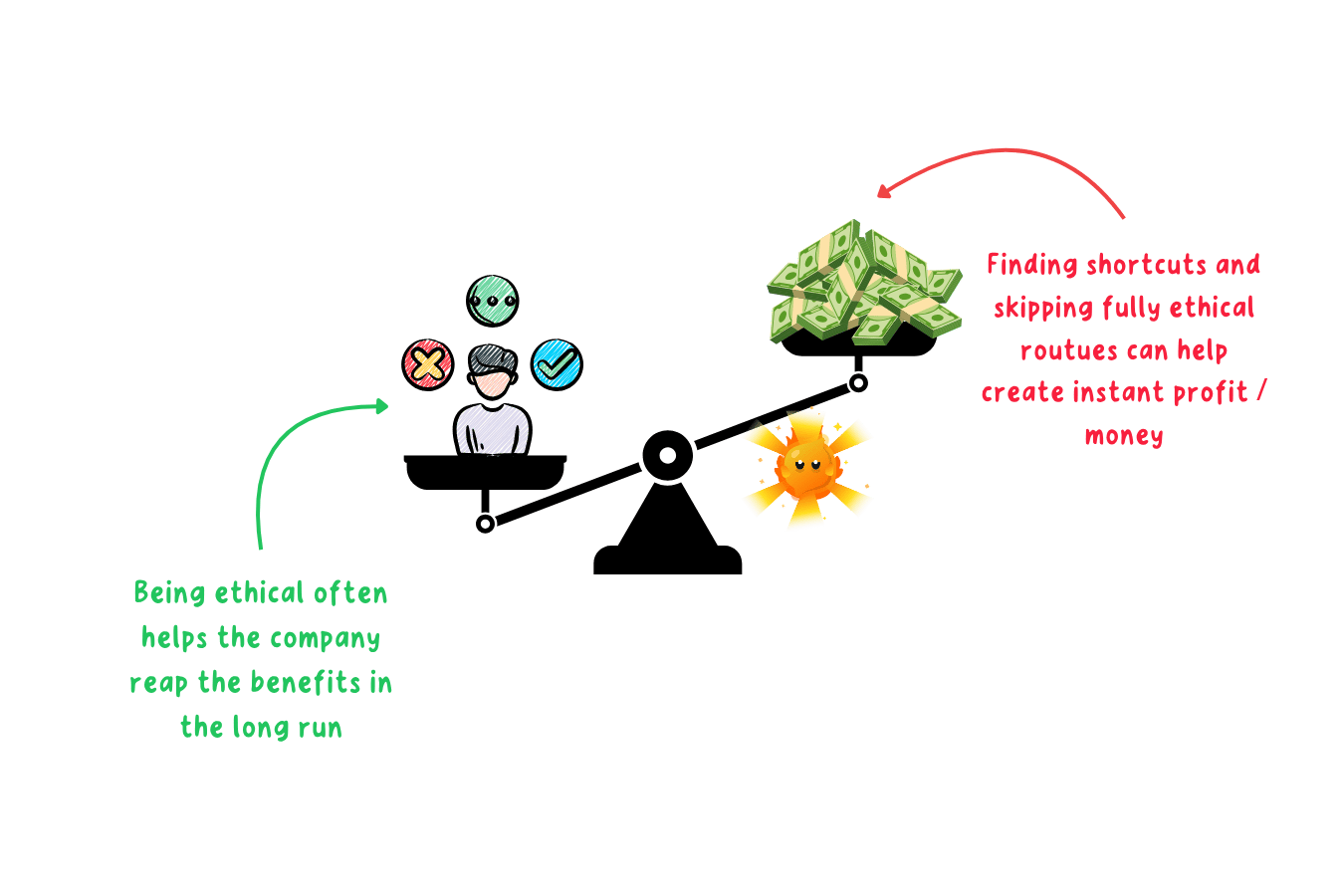
- The trade-off is that the fair choice normally costs more. Paying a supplier above the market price, or a worker above the legal minimum, raises costs, so some profit is given up to gain the fairer outcome.
- Timing decides how painful it feels. The higher costs land this month, while loyalty and reputation build over years, which is hard for a firm that is short of cash now.
- Whether customers will pay decides the outcome. If the target market values ethical sourcing enough to accept a higher price, profit can rise; if shoppers compare only price, the cost cannot be passed on.
- The behaviour has to be visible. Ethical sourcing nobody hears about brings the extra cost with none of the reputation gain, which is why firms put the certification on the packaging.
Exam technique
- When you are asked to analyse the trade-off between ethics and profit for this business, build one chain showing the cost and one showing the gain, then say which is bigger for this firm and why.
- Name the ethical practice precisely, because "being ethical" is too vague to develop, while "paying its cocoa growers a guaranteed minimum price" leads somewhere.
- The mistake students actually make is asserting that ethics always pays; whether the cost can be passed on depends on the target market.
Self review
- What does it mean for a business to behave ethically?
- Why can a decision be legal but still unethical?
- Give three ways a business can behave ethically towards suppliers or workers.
- State two benefits and two drawbacks of ethical behaviour.
- What decides whether the ethics and profit trade-off leans towards ethics?
