6.2.1 Importance of cash and cash flow
Why a business needs cash
Cash: the money a business has available immediately, in its till and its bank account, to spend today.
Cash flow: the movement of money into and out of a business over a period of time.
- Cash is what actually settles the bills that arrive on fixed dates: wages every week or month, supplier invoices within 30 days, rent on the quarter day, energy bills, VAT and loan instalments.
- None of those people can be paid with future profit, because a supplier wants money in its account rather than a promise about the year end.
- Cash flows in from sales, from customers settling invoices and from finance received, and flows out to stock, wages, overheads and repayments, so the business survives only if the timing of the two lines up.
- A Nando's restaurant takes cash and card payments the same day it serves customers, so money comes in before most of its bills go out.
- A shopfitting firm buys materials and pays fitters for six weeks before the customer is invoiced, so money goes out long before any comes in.
- The second business needs a far bigger cash cushion than the first, even if both are equally profitable.
The difference between cash and profit
- Profit measures what is left from revenue once total costs are taken off across a whole period, and it counts a sale from the moment it is made. Cash counts only money that has actually arrived, on the day it arrives.
- Brookvale Signs Ltd in Coventry invoiced £48,000 of work during March.
- £26,000 of that was paid on the day, and £22,000 went to business customers on 60-day terms.
- Its total costs of £41,000 were all paid in cash during the month.
Working out Brookvale's profit and its cash flow
| Brookvale Signs, March | Counted for profit £ | Counted as cash £ |
|---|---|---|
| Sales paid on the day | 26,000 | 26,000 |
| Sales on 60-day credit | 22,000 | 0 |
| Revenue, or cash in | 48,000 | 26,000 |
| Costs, all paid in cash | 41,000 | 41,000 |
| Result for March | 7,000 profit | -15,000 net cash flow |
- Read across the two columns and only one row differs: the £22,000 of credit sales counts in full for profit and counts as nothing for cash, and that single row is the whole gap between the two results.
- On paper March was a good month, because Brookvale earned £7,000 more than it spent and its owner can reasonably call the firm profitable.
- In cash terms March was a bad month, because £15,000 more left the bank than entered it.
- The £22,000 owed by credit customers is counted in the profit figure but will not arrive until May, so unless Brookvale had that £15,000 sitting in the bank already it cannot pay April's wages, even though it is trading profitably.
A profitable business can still run out of cash, because cash arrives when customers choose to pay while bills fall due on dates the business cannot move.
Consequences of cash flow problems
- Suppliers go unpaid, so deliveries stop, and a supplier that loses confidence withdraws trade credit and demands cash up front, which makes the shortage worse just when the business can least afford it.
- Wages are paid late or not at all, so skilled staff leave for employers who pay on time and the business cannot serve its remaining customers properly.
- Rent, energy bills and loan instalments are missed, so the landlord can end the lease and the bank can call in its loan and take the assets held as security.
- A business that cannot pay its debts as they fall due is insolvent, and creditors can force it to close. This can happen to a firm whose order book is full and whose profit figure is healthy, which is why running out of cash is one of the commonest reasons new businesses fail.
- Do not treat a cash flow problem as evidence that the business is unprofitable, because the two are separate diagnoses.
- If a case describes a firm with rising sales that cannot pay a bill, the problem is the timing of its cash, not the strength of its trading.
The effect of positive cash flow
- Positive cash flow means more cash comes in over a period than goes out, so the business ends it with more money in the bank than it started with.
- Every bill is settled on time, which keeps suppliers willing to deliver and often earns longer credit terms or an early-payment discount.
- A cash cushion absorbs shocks such as a broken-down oven or a quiet fortnight, so one bad event does not threaten the whole business.
- Spare cash lets the owner act on opportunities, such as buying a competitor's stock cheaply or taking a bulk discount, and it reduces how much has to be borrowed, which cuts interest costs.
Holding a very large amount of idle cash has its own cost, because that money is earning nothing while it sits in the account instead of buying stock or equipment.
How and why cash flow forecasts are constructed
- A cash flow forecast is a prediction of the cash expected to flow in and out over a future period, set out month by month so the owner can see the bank balance at the end of each month before it happens.
- It is built from evidence rather than guesswork: last year's sales for the same months, the orders already placed, the credit terms customers actually keep to, and bills the business already knows about such as rent, wages and an insurance renewal.
- The main reason for making one is warning, because seeing a shortage three months out gives the owner time to arrange an overdraft, chase debtors or delay a purchase, while discovering it on the day leaves no options.
- A bank will normally insist on seeing a forecast before granting a loan or an overdraft, because it shows whether the business can afford the repayments, and a start-up needs one to judge how much capital it must raise before opening.
- Once the months have passed the forecast becomes a target to check against, so the owner can see which estimates were wrong and correct the next one.
Completing and interpreting the figures inside a forecast, including net cash flow and the opening and closing balance, is covered in the next article.
- In one sentence, what is the difference between cash and profit?
- Using the table, which row is the reason Brookvale's profit and its cash flow point in opposite directions?
- What does insolvent mean?
- Give two consequences of cash flow problems and two effects of positive cash flow.
- Give two reasons a business constructs a cash flow forecast.
6.2.2 Completing and interpreting cash flow forecasts
What a cash flow forecast shows
Cash flow forecast: a prediction of the cash expected to flow into and out of a business over a future period, set out month by month.
Cash inflow: money the business expects to receive, such as cash sales, payments from credit customers, a loan paid into the account or the proceeds of selling an asset.
Cash outflow: money the business expects to pay out, such as payments for stock, wages, rent, energy bills and loan instalments.
- The forecast reduces all of those expected flows to one figure per month, the cash the business expects to be holding when that month ends.
- You are not expected to build an entire forecast from scratch.
- You are given one with gaps, asked to complete those sections, and asked to say what the completed figures mean for the business.
- Only two calculations are needed to fill any gap, and both are worth learning by heart because they are not supplied for you.
How the forecast is laid out
- There is one column for each month, running left to right in time order, so January sits to the left of February.
- The top group of rows lists each expected inflow separately, such as cash sales and payments from credit customers, and those rows are added to give total cash in for the month.
- The next group lists each expected payment, such as stock, wages, rent and insurance, and those rows are added to give total cash out.
- Beneath them come three single rows in a fixed order: net cash flow, then the opening balance, then the closing balance.
- The closing balance at the foot of one column is copied straight into the opening balance at the head of the next, which is what chains the months together.
Working out net cash flow and the closing balance
Thornbury Tools, a hardware shop in Bristol, has forecast the next three months. Its individual inflows and outflows have already been added up, so the table shows the totals.
| £ | January | February | March |
|---|---|---|---|
| Total cash in | 18,000 | 12,000 | 21,000 |
| Total cash out | 15,500 | 19,800 | 16,400 |
| Net cash flow | 2,500 | -7,800 | 4,600 |
| Opening balance | 4,000 | 6,500 | -1,300 |
| Closing balance | 6,500 | -1,300 | 3,300 |
- Work down one column at a time, taking the top two rows as given and calculating the bottom three.
- February is the heavy month, because the annual insurance and a large stock order both fall due then.
- These are the only two formulae you need, and neither is given to you in the exam.
- January: total cash in is £18,000 against total cash out of £15,500, and Thornbury Tools starts the year holding £4,000.
- January is comfortable, because £2,500 more came in than went out and the bank balance grows from £4,000 to £6,500.
- That £6,500 reappears at the top of the February column as its opening balance, which is what carries one month into the next.
- February: cash in drops to £12,000 while cash out jumps to £19,800, and the month opens on January's closing balance of £6,500.
- A closing balance of -£1,300 means Thornbury Tools expects to be £1,300 short, so it cannot pay all of February's bills from its own money.
- The January cushion of £6,500 absorbs most of the £7,800 gap but not all of it.
- The owner must arrange an overdraft, delay a payment or bring cash in sooner before February arrives.
- March: trade recovers to £21,000 in against £16,400 out, and the month opens on February's closing balance of -£1,300.
- Reading the closing balance row across the table tells the story in one line: £6,500, then -£1,300, then £3,300.
- The shortage was a one-month timing gap rather than a failing business, so a short overdraft covering February would have been enough, because the cash to repay it arrives in March.
- Adding a negative net cash flow makes the closing balance smaller, and losing the minus sign is the most common slip on these questions.
- One wrong balance corrupts every later month, because it is carried forward as the next opening balance, so check each figure before you use it again.
- A negative net cash flow is not a loss, because the forecast tracks the movement of cash rather than revenue against costs.
Filling in a missing figure
- Add an April column to the table above, with total cash in of £19,000, a closing balance of £5,000, and the opening balance of £3,300 carried down from March.
- The net cash flow and total cash out rows are blank, so rearrange the two formulae to fill them.
- April: rearranging the closing balance formula gives the net cash flow from the two balances you already have.
- With the net cash flow known, the same move on the other formula gives total cash out.
- April is forecast to add £1,700 to the bank on payments of £17,300, so the recovery that began in March continues and the balance climbs to £5,000.
- The owner can now plan the summer stock order knowing there is cash to fund part of it.
Interpreting the completed figures
- Read the two rows differently, because net cash flow describes only that month while the closing balance describes the position the business has reached overall.
- A month can have a negative net cash flow and still end with a positive closing balance, as long as the opening balance is large enough to absorb it, which Thornbury Tools came close to managing in February, where the £6,500 it opened with covered all but £1,300 of the £7,800 gap.
- A negative closing balance is the serious signal, because it means the business runs out of money that month and cannot pay its bills without finance from outside.
- One negative month between two positive ones points to a timing gap that an overdraft can bridge, while several negative months in a row point to a business spending more than it earns, which borrowing will not cure.
- Currys shows the same pattern on a far larger scale, because it buys and stores stock through the autumn for a Christmas the customers have not paid for yet, so its outflows run ahead of its inflows and the balance dips before December pulls it back up.
- Closing balances that shrink month after month are a warning even while they stay positive.
- The whole forecast rests on estimates, so an optimistic sales prediction can hide a shortage that arrives anyway.
What the business should actually do about a negative closing balance is covered in the article on solutions to cash flow problems.
When asked to interpret the forecast, name the month and quote the balance, so write that the closing balance falls to -£1,300 in February rather than that cash gets tight.
- State the formula for net cash flow and the formula for the closing balance.
- Where does a month's opening balance come from?
- If the opening balance is £800 and net cash flow is -£1,200, what is the closing balance?
- How do you find total cash out when you know total cash in and net cash flow?
- Using the table, why does March open on a negative figure?
6.2.2b Solutions to cash flow problems
Rescheduling payments
Rescheduling payments: changing when money moves rather than how much moves, by agreeing to pay suppliers later or by getting customers to pay sooner.
- Paying suppliers later: the business asks a supplier to extend its credit terms from 30 days to 60, or to split a large invoice across two months. It fixes a shortage immediately and costs no interest, but it spends goodwill: the supplier may refuse, withdraw its early-payment discount, or insist on cash up front in future, and a firm that pays late repeatedly can lose the credit it depends on.
- Bargaining power decides who can do this. Tesco is large enough to agree long payment terms with its suppliers, so it sells most of its stock before it pays for it, while a single corner shop on 30-day terms has no such room and has to ask as a favour.
- Getting customers to pay sooner: the business invoices the day a job finishes, telephones overdue debtors, and shortens the credit it offers from 60 days to 30. It pulls forward cash the business has already earned, which is the cheapest cash available, but chasing hard annoys customers and tighter terms can send them to a rival who offers easier ones.
- Thornbury Tools, a hardware shop in Bristol, forecasts February cash in of £12,000 and cash out of £19,800 on an opening balance of £6,500, which leaves a closing balance of -£1,300.
- Its supplier agrees to take £5,000 of the stock invoice in March instead, which cuts February's cash out to £14,800.
- February now ends with £3,700 in the bank instead of £1,300 short, so no overdraft is needed and no bill is missed.
- The £5,000 has not disappeared though, because March's cash out rises by that amount, so the shortage has been moved rather than removed, and it only works if March really does bring the £21,000 of takings the forecast predicts.
Reducing cash outflows
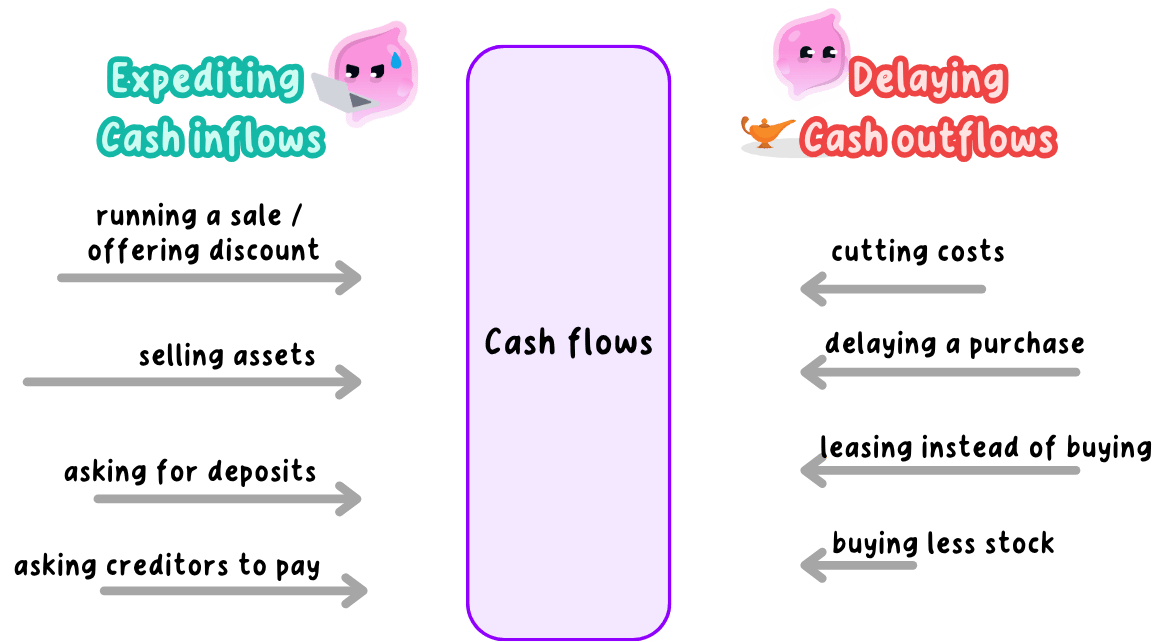
- Cutting costs: overtime, agency staff, advertising spend and any non-essential purchase can be stopped this month, which lowers outflows straight away and permanently rather than just delaying them. Cut into the wrong things and the damage lands later, because dropping advertising shrinks next quarter's sales and skipping maintenance turns a service into a breakdown.
- Delaying a purchase: a planned £8,000 van or shop refit can be postponed until the cash position recovers, which removes a large single outflow at no cost in interest. The business runs on older equipment for longer, so repair bills and downtime rise and any growth the purchase would have supported is put off.
- Leasing instead of buying: renting equipment for a monthly fee replaces one large payment with small predictable ones, so the business gets the machine without draining the bank. Over several years the total paid is higher than the purchase price and the business never owns the asset, so it cannot sell it later to raise cash.
- Buying stock in smaller batches: ordering weekly rather than monthly keeps cash in the account between deliveries instead of tied up on the shelves. Small orders lose the bulk discount, delivery charges rise, and a busy week can leave the shelves empty and the customer walking out.
- Ashby Joinery in Leicester needs a second spray booth costing £12,000 but is short of cash for the next two months.
- It leases the booth for £320 a month instead, so the workshop takes on the extra orders without a £12,000 outflow it cannot afford.
Increasing cash inflows
- Running a sale: discounting slow-moving stock converts goods sitting in the stockroom into cash within days, which is faster than any other route. Each item sold now earns less profit, and regular discounting trains customers to wait for the next sale, so a business that does it too often damages its normal prices.
- Offering a discount for early payment: taking 2 per cent off an invoice settled within 10 days gives credit customers a reason to pay weeks earlier than they otherwise would. The discount is revenue given away on money the business was going to receive anyway, so it is only worth it if the cash is genuinely needed now.
- Selling an unused asset: a spare van, an idle machine or surplus land can be sold for a lump sum with no borrowing and no repayments. The asset is gone permanently, a quick sale usually fetches less than it is worth, and the business has to buy or hire one again if trade picks up.
- Asking for deposits: taking 30 per cent up front on made-to-order work brings cash in before the materials are bought, which is how many kitchen fitters fund each job. Customers may refuse, or choose a competitor who asks for nothing until the work is finished.
- Do not offer "increase profit" or "sell more" as the solution to a cash flow problem, because bills are settled with cash and a sale on credit brings none in this month.
- Rapid growth can make cash flow worse before it makes it better, since the stock and wages for the extra orders are paid for weeks before the customers pay.
An overdraft or a new source of finance
Overdraft: an arrangement that lets a business spend more than it holds in its current account, up to an agreed limit, with interest charged only on the amount used.
- An overdraft is the natural fix for a short gap, because the business dips into it only on the days it is short and stops paying for it the moment customers' money lands. Nothing has to be cut, no supplier is upset and no customer notices.
- It is the dearest way to borrow per pound, there is usually an arrangement fee, and it is repayable on demand, so a bank that loses confidence can withdraw the facility exactly when the business needs it most.
- For a shortage lasting several months, a short-term bank loan, extra capital from the owners or money from family and friends is cheaper and more secure than sitting at an overdraft limit all year.
- Every borrowed pound becomes a future cash outflow with interest on top, so new finance buys time. A business that consistently pays out more cash than it collects has to fix its inflows or its outflows, because borrowing only postpones the day it runs out.
Choosing between the solutions
- Start by deciding whether the forecast shows one negative month between positive ones or a run of them, because a timing gap deserves an overdraft or a rescheduled invoice while a lasting shortage needs costs cut or prices raised.
- Check how fast each option delivers, since an overdraft can be arranged in days, a debtor can be chased this week, but selling premises or negotiating new terms takes months.
- Then ask which relationship the business can least afford to damage, because a firm with one specialist supplier should pay it on time and borrow instead, while a firm with a dozen interchangeable suppliers can negotiate harder.
- For Thornbury Tools the better answer is a small overdraft rather than delaying the supplier, because the gap is only £1,300 for a single month and March's takings repay it, so a few pounds of interest is a smaller price than risking the trade credit the shop relies on for the rest of the year.
- Give the two directions in which payments can be rescheduled.
- What does a business lose by delaying payments to its suppliers?
- Name three ways to reduce cash outflows and three ways to increase cash inflows.
- Why does an overdraft suit a one-month shortage better than a five-year loan?
- Why can new finance never cure a business that pays out more cash than it collects?
