1.6.1 Purpose of business planning
What a business plan is
Business plan: a written document that sets out the business idea, what the owner wants the business to achieve, and how it will be run and financed.
- A plan is usually written before the business starts trading, then updated as the business grows or as costs and customers change.
- It gathers the idea, the target market, the marketing mix, the people and premises, and the financial forecasts into one document, so the whole business can be judged at once.
- The plan is written by the owner or the entrepreneur, and it is read by people outside the business, most often a bank manager or an investor.
- You are never asked to write a full business plan for AQA, only to explain why one is written and what it does for the business.
- What goes inside each section of the plan is covered separately in the article on the sections of a business plan.
Why a business writes a plan
- To set up a new business: writing the plan forces the entrepreneur to answer the practical questions before any money is spent: who the customers are, what price they will pay, where the business will trade and what equipment it needs.
- Problems such as a supplier being too expensive or demand being seasonal show up on paper, where they cost nothing to fix, rather than in the first trading month.
- To raise finance: a bank or an investor will not hand over money on the strength of an idea, so the plan is the evidence that the business can repay a loan or produce a return.
- The financial forecasts matter most to a lender, because they show whether the business expects enough cash coming in each month to cover the repayments.
- To set objectives: the plan turns a vague ambition such as "do well" into targets the owner can measure, for example reaching £120,000 of sales in year one or opening a second branch within three years.
- To organise the functional areas: the plan states what marketing, operations, finance and human resources each have to do, and when, so the parts of the business fit together instead of pulling in different directions.
- If the plan promises a launch in April, marketing knows when to advertise, operations knows when stock must arrive and finance knows when the money for that stock is needed.
- Priya wants to open a bakery in Sheffield and asks Barclays for a £25,000 start-up loan.
- Her plan gives survey results from 200 local shoppers, the price of a loaf, the rent on the unit and a month-by-month forecast of cash coming in and going out.
- The bank agrees to lend because the forecast shows the quiet January trade is covered by savings held back for it.
Benefits of business planning
- Lower risk of failure: researching the market and the costs in advance means fewer surprises, so the business is less likely to run out of cash in its first year.
- Clear direction for staff: employees know what the business is trying to achieve and what their part of it must deliver, which cuts wasted effort and duplicated work.
- A reference point for monitoring: actual sales and costs can be compared against the forecast each month, so a shortfall is spotted while there is still time to cut spending or change price.
- Better decisions: with the market research and the costings written down, the owner chooses between options using evidence rather than instinct.
- Greggs plans each new shop opening in advance, setting the expected weekly sales for the site before the lease is signed.
- If a new shop takes far less than the plan expected, the company can review staffing and opening hours quickly instead of waiting for the year-end figures.
Drawbacks of business planning
- It takes time. Market research, costings and forecasts can take weeks, and for a sole trader that is time not spent selling or serving customers.
- It costs money. An owner who pays an accountant or a consultant to prepare the forecasts spends cash the new business can barely spare.
- It is built on forecasts. Sales and costs in the plan are estimates, and if the estimate of demand is too optimistic the whole plan, including the cash flow forecast, is wrong.
- It goes out of date. A new competitor, a rent rise or a change in what customers want can make a plan written six months ago describe a market that no longer exists.
- It can make the owner inflexible. Sticking to the written plan when sales show customers want something different means missing an opportunity the plan never predicted.
- A plan does not guarantee success, because it only sets out what the owner expects to happen.
- The value of a plan comes from using it to check progress and updating it, not from writing it once for the bank and filing it away.
- Explain one reason why a business writes a business plan needs a chain, so say the plan sets measurable objectives, which lets the owner compare actual sales with the target and act early if sales are low.
- The common mistake is describing what is inside a plan when the question asked why the plan is written, which answers a different question.
- What is a business plan?
- Name the four reasons a business creates a plan.
- Why does a bank want to see a plan before lending?
- How does a plan help the functional areas work together?
- Give two reasons a plan can turn out to be unreliable.
1.6.1b Sections of a business plan
The business idea and the objectives
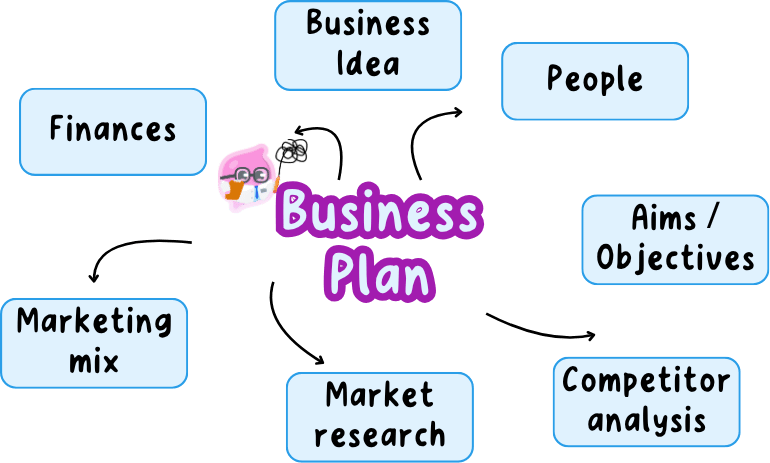
- A business plan is set out in sections, and each section answers a different question about the business.
- The business idea: this describes what the business will sell, whether it is a product or a service, and what makes it different from what customers can already buy.
- It also names the type of ownership, for example sole trader or private limited company, so a reader knows who is liable for the debts.
- Aims and objectives: the aim is the long-term goal, such as becoming the best known sandwich shop in the town, and the objectives are the measurable steps towards it.
- A start-up objective is often survival or breaking even, while an established business may set an objective for sales growth or market share.
- Objectives are written with a number and a date, for example £150,000 of sales by the end of year one, so progress can be checked.
The target market and market research
- The target market: this section describes the customers the business is aiming at by age, income, lifestyle or location, so the reader can see who is expected to buy.
- Market research: this gives the evidence that those customers exist, using primary research such as a survey of local shoppers and secondary research such as published data on the size of the market.
- It also names the main competitors and what they charge, which shows the owner understands what the business is up against.
- A plan for a bubble tea shop in Nottingham describes its target market as students and shoppers aged 16 to 25 within walking distance of the city centre.
- The research section reports that 180 of 250 students surveyed buy a hot or cold drink out at least twice a week.
- It names Costa and two independent cafés nearby and records that their drinks sell for £3.20 to £4.50.
The marketing mix
- Product: the plan lists what will be sold, the range on offer and any features that set it apart, such as gluten-free options.
- Price: the plan states what will be charged and how that compares with competitors, because the price drives the forecast of revenue later in the plan.
- Promotion: the plan says how customers will be told about the business, for example social media, leaflets or an opening offer, and what that will cost.
- Place: the plan explains where customers will buy, such as a high street unit, a market stall, a website or through a retailer like Currys.
- Here you only need to know that the four elements of the mix appear as a section of the plan.
- How the four elements are chosen and how they work together is covered in the articles on the marketing mix.
The people and the premises
- The people: the plan says how many staff are needed, what skills they must have, whether they are full time or part time, and what they will be paid.
- It also sets out the experience of the owner, because a lender is lending to a person as much as to an idea.
- The premises: the plan states where the business will operate, how big the site is and what the rent or purchase price will be.
- It lists the equipment and machinery the site needs, such as ovens, refrigeration or delivery vans, since these have to be paid for before trading starts.
The financial forecasts
Cash flow forecast: an estimate of the money expected to flow into and out of the business each month, showing the cash left at the end of every month.
- Forecast costs: the plan estimates what the business will have to pay out, separating costs that stay the same each month from costs that rise with output.
- Forecast revenue: the plan estimates the money coming in from sales, worked out from the planned price and the number of sales expected.
- Forecast profit: the plan shows the profit expected once the forecast costs are taken away from the forecast revenue, usually for the first year and often for three years.
- The cash flow forecast: this shows month by month whether the business will have enough cash to pay its bills, which is what a bank checks before agreeing a loan.
- Finance needed: the plan states how much money the owner is putting in, how much is being asked for, and where the rest will come from.
- Every figure in this section is a forecast, an estimate of the future, not a record of what the business has already earned.
- Saying that the plan shows the profit the business made is wrong, because a plan written before trading has no actual results in it.
- How costs, revenue and profit are calculated is covered in the article on basic financial terms and calculations.
- If you are asked to explain why one section is important to a bank, pick the cash flow forecast or the financial forecasts and say what the bank learns from them.
- Match the section to the business in the case study, for example premises and equipment matter more to a bakery than to an online reseller.
- The mistake to avoid is naming a section and stopping there when the question asked what the section contains.
- Name six sections of a business plan.
- What does the target market section describe?
- Which four elements appear in the marketing mix section?
- What does a cash flow forecast show?
- Why is every figure in the financial section an estimate?
1.6.2 Basic financial terms and calculations
Fixed costs and variable costs
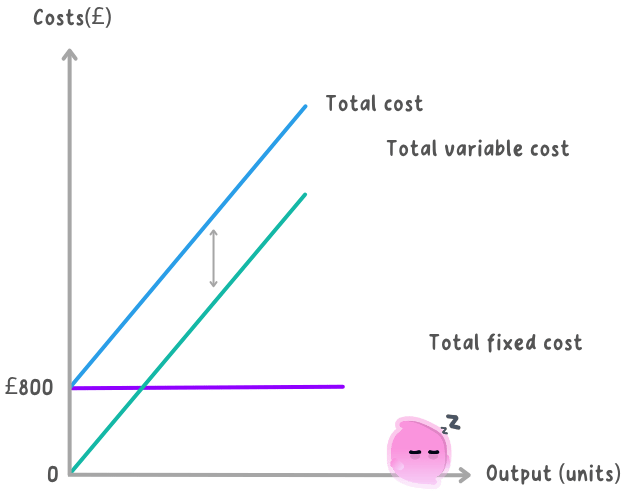
Fixed costs: costs that stay the same whatever the level of output, so they are paid even if the business sells nothing.
Variable costs: costs that rise as output rises and fall as output falls, because they are paid for each unit produced or sold.
Total costs: the fixed costs and the variable costs added together for a given level of output.
- Fixed costs include rent, business rates, insurance, salaries of permanent staff, loan interest and advertising booked for the year.
- Greggs pays the rent on a shop whether that shop sells 200 sausage rolls in a day or 800, so the rent is a fixed cost.
- Variable costs include raw materials, packaging, bought-in stock, delivery charges and wages paid by the hour or per item made.
- Flour, butter and boxes are variable costs for a bakery, because making twice as many cakes needs twice as much of each.
- The same type of cost can be fixed for one business and variable for another, so read the case study rather than guessing.
- A manager on an annual salary is a fixed cost, while a shop assistant paid £12 an hour only when the shop is busy is a variable cost.
- Maya runs a brownie stall on Leeds Kirkgate Market and sells boxes of brownies at £4 each.
- Her fixed costs are a £450 monthly pitch fee plus £50 insurance, giving £500 of fixed costs every month.
- Her ingredients and packaging cost £1.20 for every box, so that £1.20 is her variable cost per unit.
- These figures are used for every calculation in the rest of this article.
Calculating total costs
- The formula is total costs=fixed costs+variable costs\text{total costs} = \text{fixed costs} + \text{variable costs}total costs=fixed costs+variable costs, and this formula is not given to you in the exam, so learn it.
- Variable costs must be worked out for the output first, using variable costs=variable cost per unit×output\text{variable costs} = \text{variable cost per unit} \times \text{output}variable costs=variable cost per unit×output.
- In a busy month Maya sells 500 boxes, so her variable costs are scaled to that output first.
- Adding the £500 of fixed costs gives the total costs for that month.
- In a quiet month she sells only 150 boxes.
- The £1,100 is the amount Maya has to pay out in the busy month, so she must take at least £1,100 from customers before she keeps anything herself.
- In the quiet month total costs fell by £420 but not to zero, because the £500 pitch fee and insurance are still due even in a bad month.
- Check whether the figure you are given is the variable cost per unit or the total variable cost, because adding £1.20 to £500 instead of £600 makes the whole answer wrong.
- Multiply before you add, since the variable cost has to be scaled to output first.
Calculating revenue
Revenue: the total value of sales in a period, before any costs have been taken away, sometimes called sales revenue or turnover.
- The formula is revenue=price×quantity sold\text{revenue} = \text{price} \times \text{quantity sold}revenue=price×quantity sold, so revenue depends on both what you charge and how much you sell.
- In the busy month Maya sells 500 boxes at £4 each.
- In the quiet month she sells 150 boxes at the same price.
- The £2,000 is the money customers handed over, not money Maya has earned, because her ingredients and pitch fee still have to come out of it.
- Revenue fell by £1,400 between the two months, caused entirely by the drop in quantity sold rather than by any change in price.
- The £600 does not cover the £680 of total costs Maya faces that month, so the stall is losing money at that level of sales.
- Revenue is not profit, and this is the most common confusion in this topic.
- A business with £2,000 of revenue and £2,300 of total costs has plenty of sales and is still losing money.
- Never describe revenue as money the owner can keep or spend on herself.
Calculating profit and loss
Profit: the amount left over when total costs are taken away from revenue.
Loss: the shortfall when total costs are greater than revenue, so the business has not covered what it spent.
- The formula is profit=revenue−total costs\text{profit} = \text{revenue} - \text{total costs}profit=revenue−total costs, and the same subtraction gives the loss when the answer comes out negative.
- In the busy month Maya's revenue was £2,000 and her total costs were £1,100.
- In the quiet month her revenue was £600 and her total costs were £680.
- A negative answer is a loss, so the quiet month produced a loss of £80.
- The £900 is what the business has actually earned that month, so Maya can take it as income, keep it as a cash cushion for the winter, or reinvest it in a second stall.
- The loss means selling 150 boxes does not cover the stall's costs, so Maya must fund the £80 gap from savings, sell more boxes, raise the £4 price or find cheaper ingredients.
- Calculate the profit made by the business almost always needs two steps, so work out total costs first and then subtract them from revenue.
- If the answer is negative, label it as a loss in words rather than leaving a minus sign to speak for itself.
- When a question follows the calculation with explain what this figure shows, say what the owner can now do with the money or must now do about the shortfall.
- Give two examples of a fixed cost and two examples of a variable cost.
- State the formula for total costs and the formula for revenue.
- A café has fixed costs of £2,000 a month and variable costs of £1.50 per meal, and serves 1,000 meals: what are its total costs?
- If that café charges £9 a meal, does it make a profit or a loss, and how much?
- Why is a business with high revenue not necessarily profitable?
