Vaccines
Vaccine
A preparation containing dead, inactive or weakened pathogens, or their antigens, that produces immunity to a specific disease without causing it.
Vaccination
The giving of a vaccine so that lymphocytes produce antibodies and memory cells against a specific pathogen.
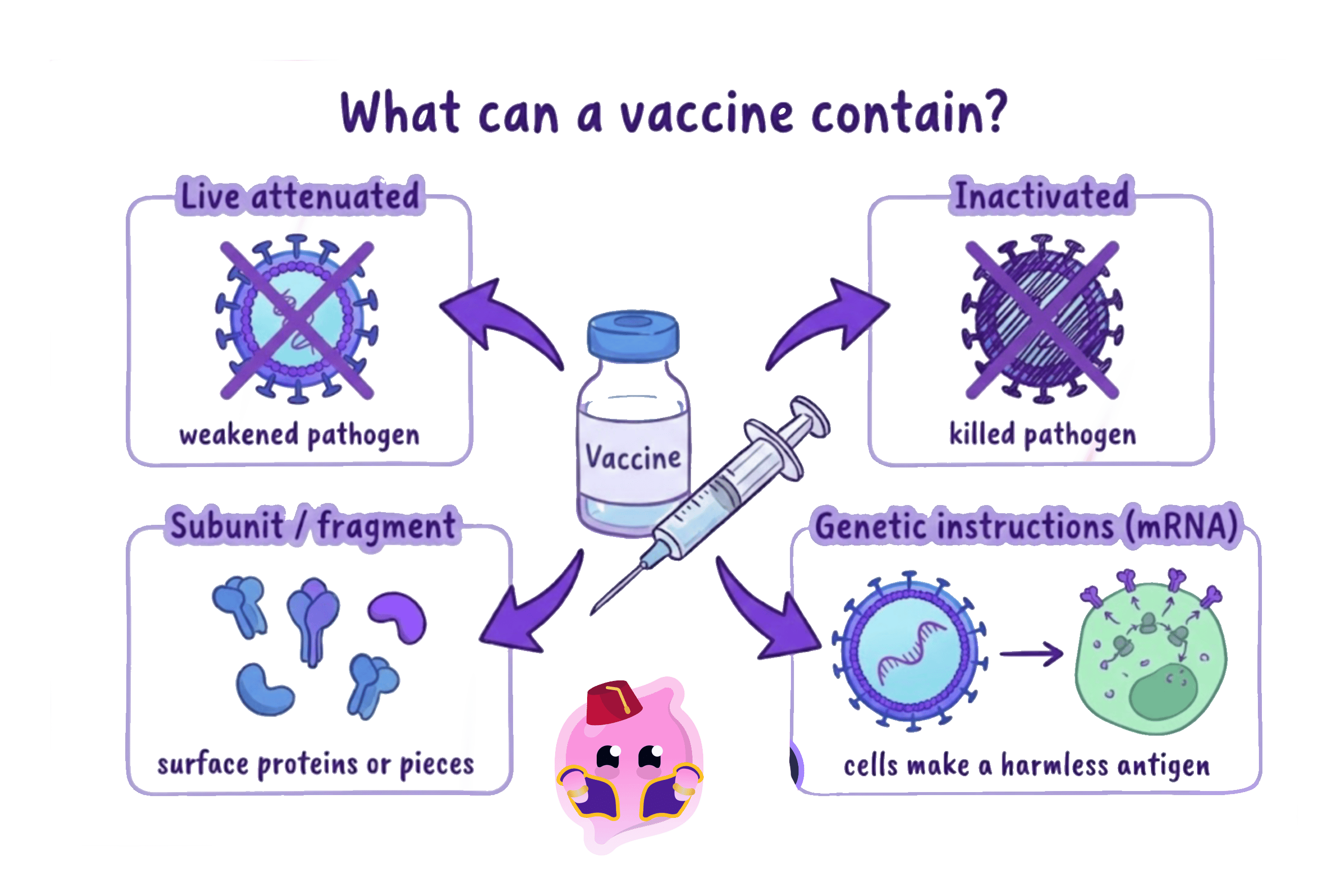
- A vaccine contains a harmless form of a pathogen that still carries the pathogen's antigens.
- The harmless form can be made in several different ways.
- Dead or inactivated pathogens, which cannot reproduce at all.
- Weakened pathogens, which can reproduce only very slowly and do not cause the disease in a healthy person.
- Fragments of the pathogen, such as its surface proteins, which carry the antigens without the rest of the pathogen.
- Genetic instructions for one antigen, which body cells use to make that antigen for a short time.
- Most vaccines are given by injection, although a few are given by mouth or as a nasal spray.
- Because the antigens have the same shape as those on the live pathogen, the immune system responds to the vaccine exactly as it would to a real infection.
- The vaccine cannot cause the disease, so the person gains protection without the risk of becoming seriously ill.
How vaccines prevent disease
Booster
A later dose of a vaccine that raises the number of memory cells against a pathogen again.
- A vaccine is given before the person meets the pathogen, so vaccination is a way of preventing disease rather than treating it.
- Vaccination works by starting the immune response in advance.
- The lymphocytes with antibodies complementary to the vaccine's antigens bind to them, divide and release antibodies.
- Some of the cloned lymphocytes become memory cells, which remain in the blood.
- If the live pathogen later enters the body, the memory cells recognise its antigens straight away.
- They produce the matching antibodies rapidly and in large amounts, in a secondary response.
- The pathogens are destroyed before they can cause symptoms, so the vaccinated person does not become ill.
- The number of memory cells can fall over the years, so some vaccines are followed by a booster dose that raises the number of memory cells again.
- In the UK the tetanus vaccine is given several times through childhood for this reason.
- A vaccine protects against one disease only, because the memory cells it produces recognise only the antigens in that vaccine.
- Some vaccines, such as the flu vaccine, must be changed every year, because the flu virus changes its antigens and last year's memory cells no longer match.
- Do not write that a vaccine contains antibodies, because it contains antigens and your own lymphocytes make the antibodies.
- Do not write that a vaccine cures a disease, because it is given in advance to prevent the disease.
Herd immunity
Herd immunity
The protection of unvaccinated individuals that results when so many members of a population are immune that a pathogen can no longer spread easily.
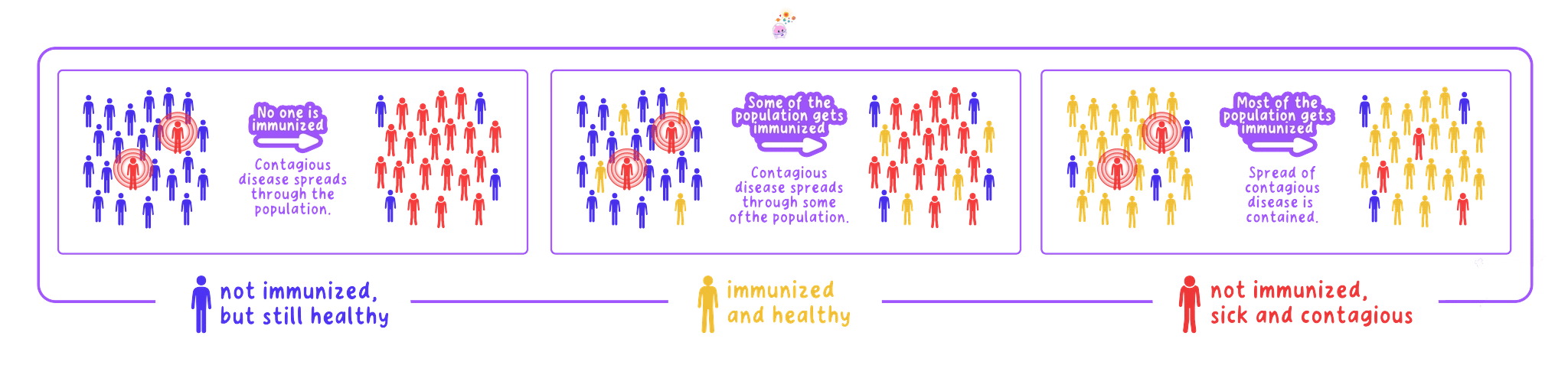
- A vaccinated person cannot carry and pass on the pathogen easily, because the pathogen is destroyed soon after it enters their body.
- When a high proportion of a population is vaccinated, a pathogen rarely finds an unvaccinated person to infect, so it cannot spread.
- This protects the few people who are not immune, and the effect is called herd immunity.
- Herd immunity protects people who cannot be vaccinated, such as babies too young for a vaccine, people having cancer treatment and people with a weakened immune system.
- The proportion needed depends on how easily the disease spreads, and for measles about 95%95\%95% of the population must be immune.
- If vaccination rates fall below this level, outbreaks return, as happened with measles in parts of the UK when fewer children received the MMR vaccine.
- Vaccination on a worldwide scale can eradicate a disease completely, and smallpox was declared eradicated in 198019801980 after a global vaccination programme.
Vaccination rates in a school
- A secondary school has 120012001200 pupils, and 110411041104 of them have had two doses of the MMR vaccine.
- The percentage vaccinated is 11041200×100=92%\dfrac{1104}{1200}\times100=92\%12001104×100=92%.
- This is below the 95%95\%95% needed for herd immunity against measles.
- A single pupil returning from a trip with measles could therefore spread it among the 969696 unvaccinated pupils.
- Raising the vaccination rate to 95%95\%95% would need 0.95×1200=11400.95\times1200=11400.95×1200=1140 vaccinated pupils, which is 363636 more than at present.
Benefits and risks of vaccination
- The decision to vaccinate every child routinely is made by weighing the benefits against the risks.
- The benefits are large and are felt by the whole population.
- Vaccinated children are protected from diseases such as measles, which can cause brain damage and death.
- Epidemics are prevented, and herd immunity protects those who cannot be vaccinated.
- Fewer people need hospital care, which reduces the cost to the NHS.
- The risks are small but real.
- Many people have mild side effects, such as a sore arm or a slight fever for a day or two.
- A very small number of people have a serious reaction, such as a severe allergic reaction to one of the ingredients.
- Vaccination does not guarantee protection, because a small number of people do not produce enough memory cells.
- Some people choose not to vaccinate their children for personal, religious or ethical reasons, which raises the question of whether individual choice or the protection of others should come first.
Antibiotics
Medicine
A substance given to prevent or treat a disease or to relieve its symptoms.
Antibiotic
A medicine that kills bacteria or stops their growth inside the body without harming human cells.
Bacterium
A single-celled prokaryotic microorganism with no nucleus, some species of which are pathogens.
- Medicines are used to treat a disease once a person is ill, or in some cases to prevent it.
- Antibiotics are medicines that kill bacteria inside the body or stop them growing and dividing.
- They work by damaging structures or processes found in bacterial cells but not in human cells, such as the bacterial cell wall, so they harm the bacteria without harming the patient's own cells.
- Penicillin, the first widely used antibiotic, works by stopping bacteria building their cell walls, so the bacteria burst.
- Different antibiotics work against different bacteria, so the doctor must choose one that will kill the particular bacterium causing the infection.
- Antibiotics have no effect on viruses, because viruses have no cell wall and reproduce inside the patient's own cells, where an antibiotic cannot reach them without harming the cell.
- Some painkillers, such as paracetamol, are also medicines, but they only relieve the symptoms and do not kill the pathogen.
- The overuse of antibiotics has allowed antibiotic-resistant bacteria to become common, so antibiotics are prescribed only for bacterial infections that need them, and the full course should be completed.
Antivirals
Antiviral
A medicine that slows or stops the reproduction of viruses inside the body.
Virus
A very small infectious particle made of genetic material inside a protein coat that can only reproduce inside a living host cell.
- Antivirals are medicines used to treat infections caused by viruses.
- They work by stopping the virus reproducing inside host cells, for example by blocking an enzyme the virus needs to copy itself.
- Antivirals are difficult to develop, because viruses use the host cell's own machinery, so a drug that stops the virus can easily damage the host cell too.
- Most antivirals slow down a viral infection rather than cure it, which gives the immune system more time to destroy the virus.
- People with HIV take a combination of antiviral drugs every day, which keeps the amount of virus in the blood so low that it does not develop into AIDS.
- Antivirals can also be used against flu in people at high risk, such as elderly people in a care home during an outbreak.
- Viruses change quickly, so an antiviral that works against one strain can stop working against a new one.
Antiseptics
Antiseptic
A chemical applied to the skin or other living tissue that kills microorganisms or stops their growth.
Disinfectant
A chemical used on non-living surfaces and objects to kill microorganisms.
- Antiseptics are chemicals applied to the outside of the body, on the skin or on a wound, that kill microorganisms or stop their growth.
- They are used to prevent infection rather than treat it, by reducing the number of pathogens before they enter the body.
- Alcohol hand gels used in hospitals and schools, and the solutions used to clean the skin before an injection or an operation, are examples of antiseptics.
- Antiseptics are too harmful to be swallowed or injected, so they cannot be used to treat an infection that is already inside the body.
- Disinfectants are similar chemicals used on non-living surfaces such as floors, worktops and surgical instruments, and they are too strong to use on skin.
- Regular hand washing and the use of antiseptic gels in hospitals have reduced the spread of infections from one patient to another.
- Do not write that antibiotics can be used to treat colds or flu, because these are caused by viruses and antibiotics have no effect on viruses.
- Do not confuse an antiseptic, which is used on living tissue, with a disinfectant, which is used on non-living surfaces.
Prevention and treatment questions
- Decide first whether the question is about preventing disease, which points to vaccines and antiseptics, or treating it, which points to antibiotics and antivirals.
- Match the medicine to the type of pathogen, so bacterial infections are treated with antibiotics and viral infections with antivirals.
- When explaining how a vaccine works, go all the way to the end of the chain and say that memory cells destroy the pathogen before symptoms develop.
- In an evaluation of routine vaccination, give at least one benefit to the individual, one benefit to the population and one risk, then make a judgement.
- Describe what a vaccine contains and explain why it cannot cause the disease.
- Explain how vaccination prevents a person becoming ill when they later meet the live pathogen.
- Explain how herd immunity protects a baby who is too young to be vaccinated.
- Explain why antibiotics cannot be used to treat a viral infection.
- State one difference between how an antiseptic and an antibiotic are used.
