Reading the human genome
Definition
Genome
The genome is the complete genetic material of an organism.
Definition
Human Genome Project
The Human Genome Project was an international research programme that worked out the complete sequence of bases in human DNA.
- The human genome is the complete set of genetic material in a human cell.
- The Human Genome Project worked out the order of the bases in human DNA and was declared complete in 200320032003.
- Scientists from several countries, including a large team in the UK, shared the work and made the results freely available to researchers everywhere.
- The project found that the human genome contains around 20 00020\,00020000 genes that code for proteins.
- Since then, reading a genome has become much faster and cheaper, so a person's whole genome can now be sequenced in a few days.
- Comparing the genomes of many people shows which alleles are more common in people who have a particular disease.
- This allows scientists to link particular alleles to an increased risk of disease, and to find out how different alleles affect the way the body responds to drugs.
- In England, the 100,000 Genomes Project sequenced the genomes of NHS patients with rare diseases and cancers to find the genetic causes of their conditions.
Predicting the likelihood of disease
Definition
Genetic testing
Genetic testing is the analysis of a person's DNA to find out whether they carry particular alleles.
Definition
Allele
An allele is an alternative version of a gene.
- Genetic testing analyses a person's DNA to see whether they carry alleles linked to a disease.
- For a disorder caused by a single faulty allele, such as cystic fibrosis or Huntington's disease, a test can show whether a person has the disorder or carries the allele.
- For most common diseases, such as heart disease, type 2 diabetes and many cancers, a test can show only an increased risk, because these diseases also depend on many other genes and on lifestyle.
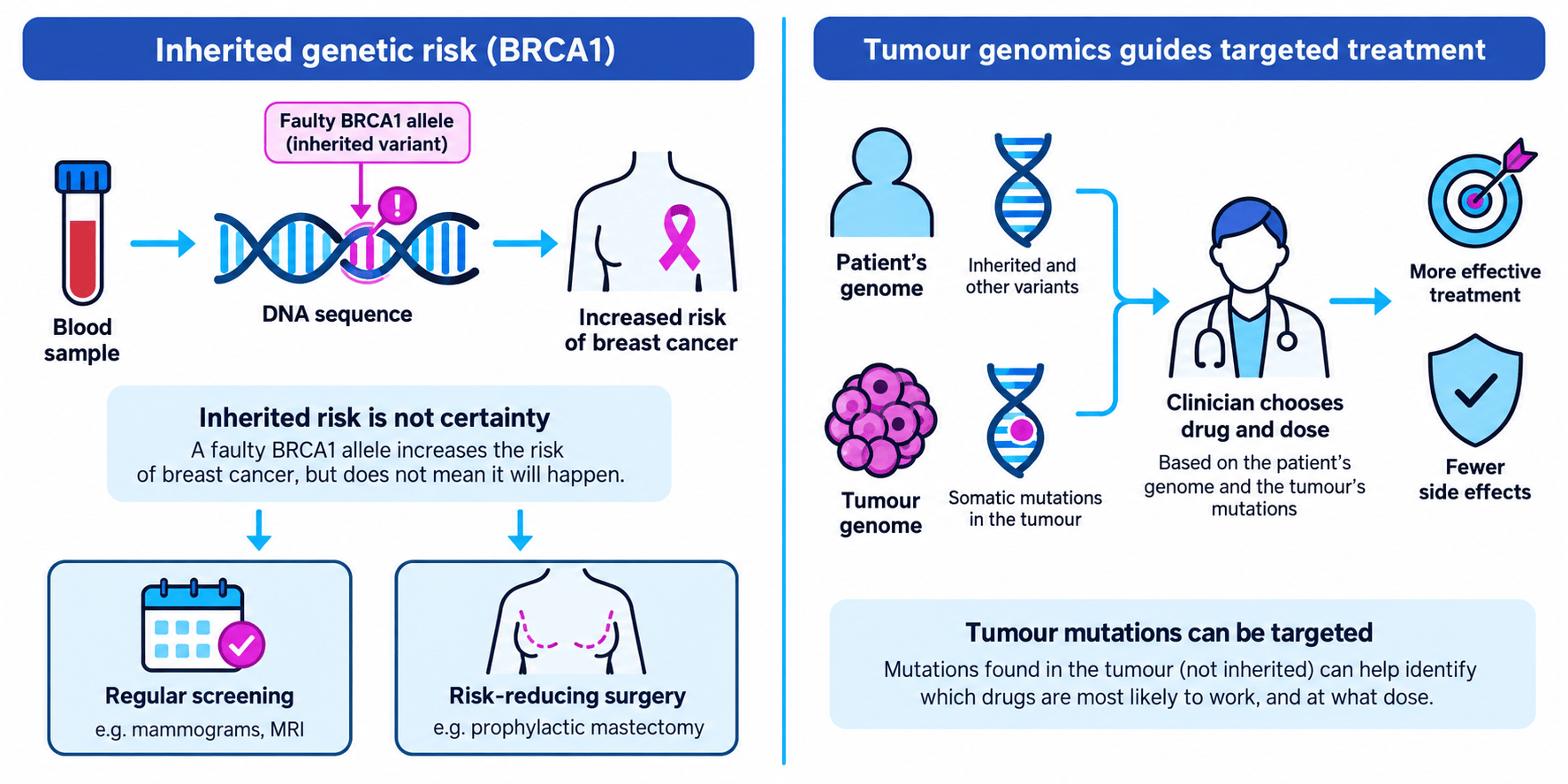
- For example, women who carry a faulty BRCA1 or BRCA2 allele have a much higher chance of developing breast cancer or ovarian cancer during their lives.
- Knowing about an increased risk allows a person to act early.
- They can have more frequent screening, such as regular scans, so that a disease is found and treated at an early stage.
- They can make lifestyle changes, such as stopping smoking or losing weight, that lower their overall risk.
- Some women with a faulty BRCA1 allele choose surgery to remove their breasts or ovaries before cancer can develop.
- Couples who carry a faulty allele can find out the chance that their children will inherit a genetic disorder.
Drugs targeted to the genome
Definition
Personalised medicine
Personalised medicine is the choice of drug and dose for a patient based on the alleles in their genome.
- People respond differently to the same drug, partly because they carry different alleles.
- Some alleles code for liver enzymes that break down drugs faster or more slowly than usual.
- A person who breaks a drug down quickly may need a higher dose for it to work.
- A person who breaks a drug down slowly may suffer harmful side effects from a normal dose.
- Testing a patient's genome before treatment lets a doctor choose the drug and dose most likely to work for them with the fewest side effects.
- This approach is called personalised medicine.
- Cancer cells carry their own mutations, so reading the genome of a tumour shows which drug is most likely to attack it.
- Some breast cancers have cells with extra copies of a gene called HER2, and a drug that targets the protein made by this gene works only on these cancers.
- Knowing which genes are involved in a disease also helps scientists design new drugs that act on the proteins those genes produce.
Problems and concerns
- A genetic test for a common disease gives a probability rather than a certainty, so a person told they have a high risk may never develop the disease, while a person told they have a low risk still might.
- Learning about a high risk of a disease that cannot be prevented or cured, such as Huntington's disease, can cause great anxiety.
- Genetic information about one person also reveals information about their relatives, who may not want to know it.
- There are concerns that insurance companies or employers could treat people unfairly if they had access to their genetic information.
- Genome data must be stored securely, because it is personal and cannot be changed if it is leaked.
- Genetic testing and targeted drugs are expensive, so they may not be available to everyone who could benefit.
- The effects of many alleles are not yet understood, so some test results are difficult to interpret.
Example
Testing for a faulty BRCA1 allele
- A woman's mother and aunt both developed breast cancer before the age of 505050, so her doctor refers her for genetic testing.
- A blood sample is taken, and DNA from her white blood cells is analysed for faulty versions of the BRCA1 and BRCA2 genes.
- The test shows that she carries a faulty BRCA1 allele, which greatly increases her lifetime chance of breast cancer compared with women who do not carry it.
- The result does not mean she will certainly develop cancer, so she is offered regular breast scans from a younger age than usual to find any tumour early.
- She is also offered surgery to reduce her risk, and she must weigh the benefit of a much lower risk against the effects of a major operation.
- Her sisters and her children may also carry the allele, so the result raises the question of whether, and how, to tell them.
Exam technique
Discussing the genome in medicine
- Organise your answer around the two main uses, predicting the likelihood of disease and targeting drugs to a person's genome.
- Explain how each use helps the patient, such as early screening for a person at high risk or a drug dose chosen to avoid side effects.
- Include at least one problem, such as a test giving only a probability or genetic information being misused by insurers.
- When a disease is influenced by many genes and the environment, say that a test shows a risk rather than a certainty.
Common Mistake
Do not claim that reading a person's genome shows exactly which diseases they will get, because most diseases depend on many genes and on lifestyle.
Self review
- What did the Human Genome Project achieve?
- Explain why a genetic test for heart disease can show only an increased risk.
- Give two ways a person could use the knowledge that they carry a faulty BRCA1 allele.
- Explain how a person's alleles can affect the dose of a drug they need.
- Give two concerns about genetic testing.