2.2.1 Exchange surfaces and surface area : volume ratio
Surface area to volume ratio
Surface area to volume ratio
The surface area to volume ratio is the total surface area of an organism divided by its volume.
- Every substance an organism needs has to cross a surface to get in, and every waste substance has to cross a surface to get out.
- The amount of surface available for that exchange is the surface area, and the amount of living material that has to be supplied is the volume.
- The surface area to volume ratio sets one against the other and is written SA:V\text{SA}:\text{V}SA:V.
- When an organism grows larger its surface area increases with the square of its length while its volume increases with the cube of its length.
- For a cube of side lll the surface area is 6l26l^{2}6l2 and the volume is l3l^{3}l3, so the ratio is 6l2l3=6l\dfrac{6l^{2}}{l^{3}}=\dfrac{6}{l}l36l2=l6.
- That expression gets smaller as lll gets bigger, which is why a small organism has a large ratio and a large organism has a small ratio.
- A large ratio means there is a great deal of surface serving each unit of living material, so substances can be supplied across that surface quickly enough.
- A small ratio means there is very little surface serving each unit of living material, so the outer surface on its own cannot supply the cells inside.
- Shape matters as well as size, because a flattened or folded body has a larger ratio than a compact body of the same volume.
- That is why a flatworm can be several centimetres long and still survive without a transport system, since it is only a fraction of a millimetre thick.
Calculating the ratio
- Work out the total surface area first by adding the area of every exposed face.
- A cube of side lll has six identical faces of area l2l^{2}l2, so its surface area is 6l26l^{2}6l2.
- A cuboid of sides aaa, bbb and ccc has surface area 2(ab+ac+bc)2(ab+ac+bc)2(ab+ac+bc).
- Work out the volume next, which is l3l^{3}l3 for a cube and abcabcabc for a cuboid.
- Divide one by the other using ratio=surface areavolume\text{ratio}=\dfrac{\text{surface area}}{\text{volume}}ratio=volumesurface area
- Give the answer either as a single number or in the form n:1n:1n:1, so a value of 333 is written 3:13:13:1.
- Both quantities must use the same length unit, because an area in cm2\text{cm}^{2}cm2 divided by a volume in mm3\text{mm}^{3}mm3 gives a meaningless figure.
- Comparing two organisms only works when both ratios are worked out the same way round and in the same units.
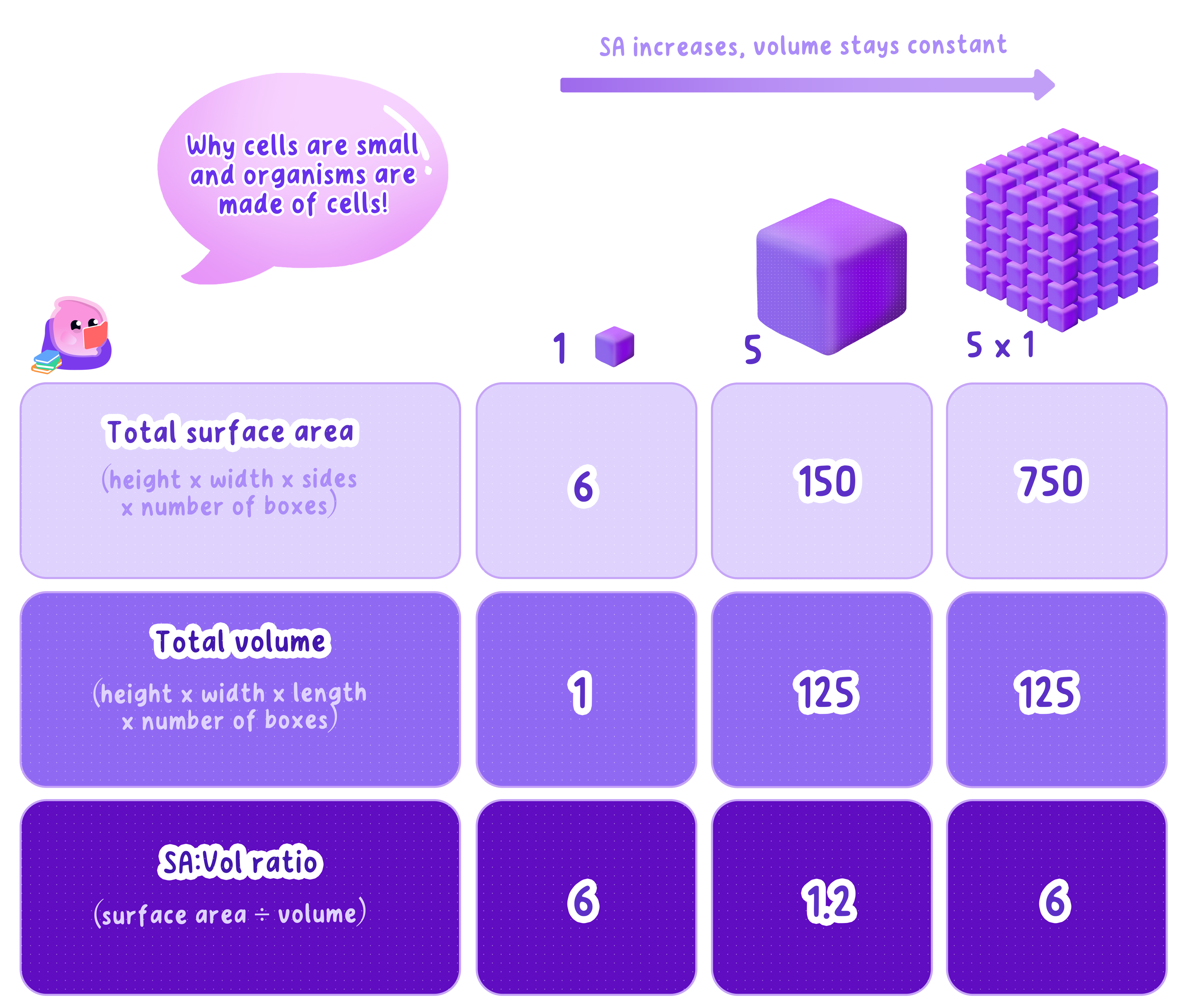
Comparing two cubes
- A small cube has sides of 1 cm1\ \text{cm}1 cm and a larger cube has sides of 3 cm3\ \text{cm}3 cm.
- Small cube surface area: 6×(1)2=6 cm26\times(1)^{2}=6\ \text{cm}^{2}6×(1)2=6 cm2.
- Small cube volume: (1)3=1 cm3(1)^{3}=1\ \text{cm}^{3}(1)3=1 cm3.
- Small cube ratio: 61=6\dfrac{6}{1}=616=6, written 6:16:16:1.
- Large cube surface area: 6×(3)2=54 cm26\times(3)^{2}=54\ \text{cm}^{2}6×(3)2=54 cm2.
- Large cube volume: (3)3=27 cm3(3)^{3}=27\ \text{cm}^{3}(3)3=27 cm3.
- Large cube ratio: 5427=2\dfrac{54}{27}=22754=2, written 2:12:12:1.
- The larger cube has the smaller ratio, so each unit of its volume is served by only a third as much surface.
The effect of a flattened shape
- A flat block measures 4 cm4\ \text{cm}4 cm by 2 cm2\ \text{cm}2 cm by 1 cm1\ \text{cm}1 cm.
- Surface area: 2[(4×2)+(4×1)+(2×1)]=2(8+4+2)=28 cm22\big[(4\times2)+(4\times1)+(2\times1)\big]=2(8+4+2)=28\ \text{cm}^{2}2[(4×2)+(4×1)+(2×1)]=2(8+4+2)=28 cm2.
- Volume: 4×2×1=8 cm34\times2\times1=8\ \text{cm}^{3}4×2×1=8 cm3.
- Ratio: 288=3.5\dfrac{28}{8}=3.5828=3.5, written 3.5:13.5:13.5:1.
- A cube holding the same 8 cm38\ \text{cm}^{3}8 cm3 has sides of 2 cm2\ \text{cm}2 cm and a ratio of 248=3\dfrac{24}{8}=3824=3.
- Flattening the same volume raises the ratio from 3:13:13:1 to 3.5:13.5:13.5:1, which is the principle behind every flattened exchange surface.
Setting out a ratio calculation
- Write the surface area and the volume on separate lines before dividing, because each figure carries its own mark even if the division goes wrong.
- Find the area of one face and multiply by six rather than adding six separate figures, which is where most arithmetic slips happen.
- Answer in the form the question asks for, either a decimal or n:1n:1n:1, and never divide volume by surface area.
- When two organisms are compared, state which ratio is larger and then say what that means for the rate of exchange, because the explanation is where the second mark sits.
Why diffusion alone is not enough
Diffusion distance
The diffusion distance is the distance a particle has to travel by diffusion between an exchange surface and the cell that uses it.
Concentration gradient
A concentration gradient is the difference in the concentration of a substance between two regions.
- Diffusion moves particles down a concentration gradient and needs no energy from the organism.
- Diffusion is fast when the surface area is large, when the gradient is steep and when the diffusion distance is short.
- The time diffusion takes rises far more steeply than the distance, so doubling the distance more than doubles the time.
- In a single-celled organism such as an amoeba, no part of the cytoplasm is more than a fraction of a millimetre from the surface, so oxygen reaches every part in a moment.
- In a large animal the innermost cells sit tens of centimetres from the body surface, and diffusion over that distance would take days rather than seconds.
- A large organism also has far more respiring cells, so its total demand for oxygen and glucose is much greater.
- Demand rises with volume while supply across the outer surface rises only with surface area, so demand outgrows supply as size increases.
- Waste products build up for the same reason, because carbon dioxide and urea also have to travel further to reach a surface where they can leave.
- That mismatch is why a multicellular organism needs specialised exchange surfaces and a transport system rather than relying on its outer surface.
Modelling diffusion with agar cubes
- Aim: to investigate how the surface area to volume ratio of a block affects the time a substance takes to diffuse right through it, using agar cubes cut to different sizes.
- Apparatus: a block of agar containing dilute sodium hydroxide and phenolphthalein indicator, a white tile, a scalpel, a 30 cm30\ \text{cm}30 cm ruler, three beakers, dilute hydrochloric acid, a measuring cylinder, forceps, a spatula, a stopclock, paper towel, gloves and eye protection.
- Variables: the side length of the cube, and so its surface area to volume ratio, is the independent variable; the time for the pink colour to disappear completely is the dependent variable; the acid concentration, the volume of acid, the temperature, the agar batch and the cube shape are controlled.
- Method, preparing the cubes:
- Lay the agar block on a white tile. It is pink throughout because the sodium hydroxide inside it has turned the phenolphthalein pink.
- Measure and cut cubes of side 1 cm1\ \text{cm}1 cm, 2 cm2\ \text{cm}2 cm and 3 cm3\ \text{cm}3 cm, drawing the scalpel away from your fingers.
- Check all three sides of each cube against the ruler, because a block that is not truly cubic no longer has the ratio you calculated.
- Blot each cube on paper towel so that surface liquid does not dilute the acid.
- Method, running the investigation:
- Measure the same volume of dilute hydrochloric acid into each beaker, enough to cover the largest cube completely.
- Lower one cube into each beaker with forceps at the same moment and start the stopclock.
- Acid diffuses inwards through the agar, neutralises the sodium hydroxide and turns the jelly colourless from the outside in.
- Lift each cube out with a spatula the moment the last trace of pink at its centre vanishes, and record that time.
- Cut a finished cube in half to confirm that no pink core remains, since the centre of a large cube is hard to judge from the outside.
- Repeat the whole run at least three times for each size and calculate a mean time.
- Results: the 1 cm1\ \text{cm}1 cm cube turns colourless first and the 3 cm3\ \text{cm}3 cm cube last, so the block with the largest surface area to volume ratio is penetrated fully in the shortest time.
- Maths: the ratios from 6l2l3\dfrac{6l^{2}}{l^{3}}l36l2 are 6:16:16:1, 3:13:13:1 and 2:12:12:1; calculate a rate as 1mean time\dfrac{1}{\text{mean time}}mean time1 and plot rate against ratio to show a positive correlation.
- Watch out: cubes cut inaccurately, different volumes of acid, cubes entering the acid at different moments and an endpoint judged by eye are the main sources of error, and all three cubes must come from the same agar batch.
- Safety: wear eye protection and gloves, cut on a tile away from your fingers, treat the acid and the sodium hydroxide as irritants and rinse any splash off the skin at once.
Features of an efficient exchange surface
Exchange surface
An exchange surface is a surface across which substances pass between an organism and its surroundings.
- A large surface area lets more particles cross at the same time, and it is produced by folding, branching or flattening the surface.
- A thin surface, usually a single layer of flattened cells, keeps the diffusion distance short so particles cross in seconds.
- A steep concentration gradient is maintained by keeping the medium moving on one side and the blood moving on the other.
- A good blood supply carries absorbed substances away and delivers waste substances, which is what stops the gradient falling to zero.
- A moist surface lets gases dissolve before they diffuse across the membrane.
- In the lungs the alveoli provide the area, their walls are one cell thick and capillaries are pressed directly against them.
- In the small intestine the villi and microvilli fold the lining into a vast area for absorbing digested food.
- In a fish the gill filaments are stacked into thin plates washed continuously by water flowing in the opposite direction to the blood.
- In a plant the root hair cells push the root surface out into the soil, and the air spaces inside a leaf give a large moist surface for gas exchange.
- Do not say a large organism has a large surface area to volume ratio, because its surface area is large but its volume is larger still, so the ratio is small.
- Do not divide volume by surface area, since the ratio always has surface area on top.
- Do not confuse surface area with surface area to volume ratio, because an elephant has an enormous surface area and a tiny ratio.
- Do not offer a thick surface as an adaptation for exchange, because a short diffusion distance requires the surface to be thin.
The need for a transport system
Transport system
A transport system is a network of vessels that carries substances between an organism's exchange surfaces and its cells.
- An exchange surface brings substances into the body, but those substances still have to reach cells that may be a long way off.
- A transport system carries them in a moving liquid, so the long part of the journey is covered by mass flow rather than by diffusion.
- Mass flow moves substances many thousands of times faster than diffusion over the same distance.
- In a mammal that system is the circulatory system, which pumps blood through vessels that pass within a fraction of a millimetre of almost every cell.
- The final short step out of a vessel and into a cell is still made by diffusion, but the distance is now tiny, so it takes only a moment.
- In a flowering plant the transport tissues are the xylem and the phloem, which run continuously through the roots, stem and leaves.
- Every transport system therefore does two jobs: it moves substances quickly over long distances and it delivers them close enough for diffusion to finish the journey.
- State what happens to the surface area to volume ratio of an organism as it grows larger, and explain why.
- Calculate the surface area to volume ratio of a cube of side 2 cm2\ \text{cm}2 cm.
- Explain why a single-celled organism can survive by diffusion across its surface but a mammal cannot.
- List four features that make an exchange surface efficient and give the reason for each.
- Explain why a multicellular organism needs a transport system as well as exchange surfaces.
2.2.2 Substances transported in organisms
Substances that must be transported
Transport system
A transport system is a network of vessels that carries substances between an organism's exchange surfaces and its cells.
- Every cell in a large organism needs a steady supply of raw materials and a steady removal of the waste its reactions produce.
- The substances a transport system moves in an animal are oxygen, carbon dioxide, water, dissolved food molecules, mineral ions and urea.
- Each one is carried between an exchange surface, where it enters or leaves the body, and the cells that use or produce it.
- Some are carried in solution in the liquid part of the blood, and oxygen is carried bound to a protein inside a specialised cell.
- The direction each substance travels depends on where it enters the body and where it is needed, so oxygen and food travel inwards while carbon dioxide and urea travel outwards.
- The quantity of each substance an organism moves depends on what that organism requires, so an active mammal shifts far more oxygen and glucose per kilogram than a slow-moving one.
Oxygen and carbon dioxide
- Oxygen is needed by every respiring cell because aerobic respiration releases far more energy from glucose than anaerobic respiration does.
- Oxygen enters the body across the lungs, diffusing from the air in the air sacs into the blood in the capillaries wrapped around them.
- It is then carried to the respiring tissues, where it diffuses out of the blood and into the cells.
- Carbon dioxide is the waste product of aerobic respiration and travels in the opposite direction, from the tissues to the lungs.
- Carbon dioxide has to be removed because it dissolves in water to form a weak acid, and a build-up would lower the pH of the blood and damage enzymes.
- Most of it is carried dissolved in the liquid part of the blood as hydrogencarbonate ions, and it diffuses out into the air in the lungs and is breathed out.
- A plant transports these two gases very little, because the air spaces inside its leaves and stem reach almost every cell directly.
Water
- Water is the solvent in which every other transported substance dissolves, so nothing else can be carried without it.
- Cytoplasm is mostly water, and the chemical reactions of a cell take place between substances dissolved in it.
- In a mammal water is absorbed from the small intestine and the large intestine and carried in the blood to every tissue.
- Water also spreads heat around the body, which is how a warm-blooded animal keeps a steady internal temperature.
- In a plant water is absorbed by the roots, carried up to the leaves and used as a raw material for photosynthesis.
- Water inside plant cells also presses outwards on the cell walls, and that pressure is what holds a soft young stem upright.
Dissolved food molecules
- Large food molecules cannot be transported, so digestion breaks them into small soluble molecules that dissolve and travel in the blood.
- Starch is digested to glucose, which every cell needs as the fuel for respiration.
- Proteins are digested to amino acids, which cells reassemble into the particular proteins they need for growth and repair.
- Lipids are digested to fatty acids and glycerol, which are used to build membranes and are stored as an energy reserve.
- These products are absorbed across the wall of the small intestine and carried away in the blood, glucose and amino acids straight into the capillaries of the villi.
- A plant makes its own glucose in the leaves and moves it as sucrose, together with amino acids, to wherever it is used or stored.
Mineral ions
Mineral ion
A mineral ion is a dissolved inorganic ion, such as nitrate or magnesium, that an organism absorbs and uses to build essential molecules.
- Mineral ions are needed in small quantities but are essential, because without them particular molecules cannot be built at all.
- In a mammal, iron ions are needed to make haemoglobin, so a shortage lowers the amount of oxygen the blood can carry.
- Calcium ions and phosphate ions are needed to build bone and teeth, and calcium ions are also needed for muscles to contract and blood to clot.
- Sodium ions and potassium ions carry the electrical signals along nerve cells.
- Mineral ions are absorbed in the intestine, dissolve in the liquid part of the blood and are carried to wherever they are needed.
- A plant takes its mineral ions from the soil solution, and nitrate ions are needed to turn glucose into amino acids and so into protein.
- A plant short of nitrate ions grows poorly and stays small, and a plant short of magnesium ions cannot make chlorophyll and its leaves turn yellow.
Urea
Urea
Urea is the nitrogen-containing waste substance made in the liver from excess amino acids and removed from the blood by the kidneys.
- Amino acids cannot be stored, so any the body does not need are broken down in the liver.
- The nitrogen-containing part is removed and converted first to ammonia, which is highly toxic, and then to the far less toxic urea.
- Urea dissolves in the liquid part of the blood and is carried from the liver to the kidneys.
- The kidneys filter it out of the blood and it leaves the body dissolved in urine.
- Urea must be transported continuously because a rising concentration in the blood would poison the tissues.
- A plant makes no urea, because it takes in only the nitrogen it needs as nitrate ions rather than eating protein it must break down.
Matching supply to demand
- The quantity of each substance an organism has to transport depends on how fast its cells are respiring.
- A resting mammal respires slowly, so oxygen and glucose are delivered at a modest rate and carbon dioxide is removed at a modest rate.
- During hard exercise the muscles respire many times faster, so all three rates rise together.
- The body meets that demand by breathing faster and more deeply and by making the heart beat faster and more strongly.
- A sprinting animal reaches a point where oxygen cannot be delivered fast enough, and the muscles then respire anaerobically for a short time.
- That limit on delivery is why an all-out sprint can be held for only a short burst, whatever the animal.
Working out a delivery rate
- A resting person uses 250 cm3250\ \text{cm}^{3}250 cm3 of oxygen each minute and during exercise uses 2000 cm32000\ \text{cm}^{3}2000 cm3 each minute.
- The increase is 2000−250=1750 cm32000-250=1750\ \text{cm}^{3}2000−250=1750 cm3 per minute.
- As a factor, 2000250=8\dfrac{2000}{250}=82502000=8, so oxygen is being delivered eight times faster.
- Carbon dioxide is produced at close to the same rate during aerobic respiration, so it must also be removed about eight times faster.
- The transport system meets that demand mainly by increasing the volume of blood pumped each minute.
Substances transported in plants
- A plant transports water and mineral ions upwards from the roots to the leaves.
- It transports dissolved sugars and amino acids from the leaves to the roots, the growing tips, the flowers and the fruits.
- The two routes are separate tissues running side by side, and each carries its load in one characteristic direction.
- Gases are the exception, because oxygen and carbon dioxide move through the air spaces between the cells rather than through a transport tissue.
Naming a substance and its job
- Name the substance precisely, so write glucose or amino acids rather than food, and urea rather than waste.
- Give the journey as a from and a to, such as from the small intestine to the liver, because a direction usually carries its own mark.
- Add the reason the organism requires it, since a question asking about requirements wants the use as well as the name.
- Say which mineral ion you mean, because nitrate and magnesium have completely different uses and a general answer earns nothing.
- Do not confuse urea with urine, because urea is the dissolved waste substance and urine is the liquid that carries it out of the body.
- Do not write that food is carried in the blood, because only small soluble products of digestion can be transported.
- Do not say plants transport carbon dioxide to their leaves, because it reaches the cells through the air spaces inside the leaf.
- Do not state that urea is made in the kidneys, because the liver makes it and the kidneys only remove it.
- List the six substances transported around the body and state the direction each one travels.
- Explain why carbon dioxide has to be removed from the tissues.
- Name the three groups of small soluble molecules produced by digestion and give one use of each.
- State where urea is made, where it is removed and why it must be transported.
- Give one mineral ion needed by a mammal and one needed by a plant, and state what each is used for.
2.2.3 The human circulatory system
The double circulatory system
Double circulatory system
A double circulatory system is a circulation in which blood passes through the heart twice for every complete circuit of the body.
Pulmonary circulation
The pulmonary circulation is the loop of vessels that carries blood from the heart to the lungs and back to the heart.
Systemic circulation
The systemic circulation is the loop of vessels that carries blood from the heart to the rest of the body and back to the heart.
- The human circulatory system is made of the heart, the blood vessels and the blood they carry.
- It is a closed system, which means the blood stays inside vessels the whole way round instead of washing freely through the body cavity.
- It is also a double system, because blood passes through the heart twice for every complete circuit of the body.
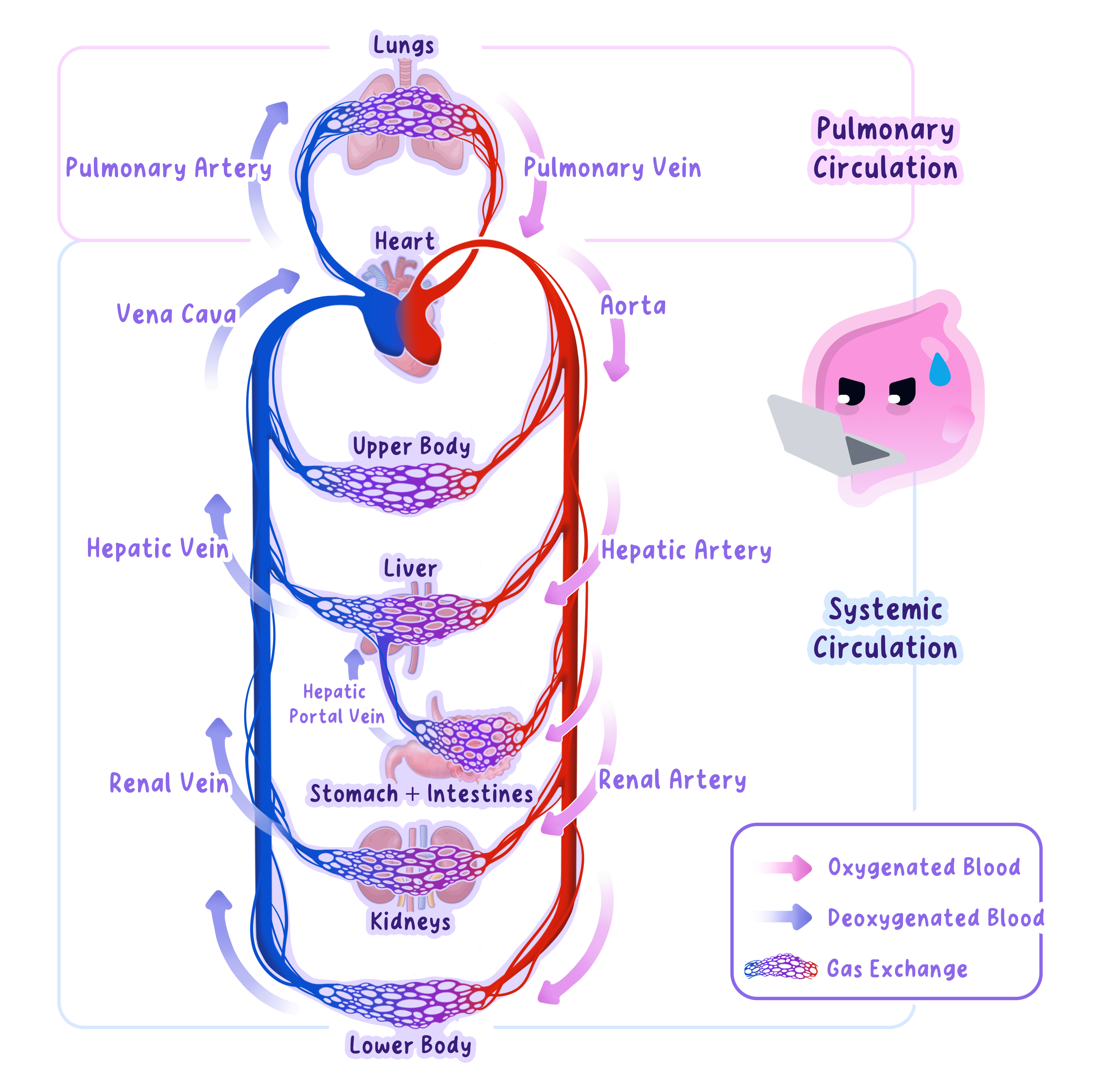
- The first circuit is the pulmonary circulation, which runs from the right side of the heart to the lungs and back to the left side.
- The second circuit is the systemic circulation, which runs from the left side of the heart to the rest of the body and back to the right side.
- The two circuits are joined in series, so all the blood leaving the lungs passes through the heart again before it goes anywhere else.
- The right side of the heart handles only deoxygenated blood and the left side handles only oxygenated blood, and the two never mix.
- Keeping them apart means the blood sent to the tissues is always fully loaded with oxygen.
Why a mammal needs two circuits
- Blood loses a great deal of pressure while it is squeezed through the narrow capillaries of an organ.
- In a single circulatory system, such as a fish has, blood passes through the heart only once per circuit and travels straight from the gill capillaries to the body.
- By the time it leaves the gills its pressure is already low, so it flows slowly to the rest of the body.
- A double system returns the blood to the heart after the lungs, and the left side raises its pressure again before it is sent to the body.
- That second push makes the blood flow much faster, so oxygen and glucose are delivered and carbon dioxide removed at a much higher rate.
- Mammals need that higher rate because they are warm-blooded and respire quickly all the time in order to keep their body temperature steady.
- The pulmonary circuit is kept at a lower pressure than the systemic circuit, because the thin walls of the lung capillaries would be damaged by a high pressure.
- A double system therefore gives each circuit the pressure that suits it, which a single system cannot do.
The arrangement of the main vessels
Coronary artery
A coronary artery is one of the vessels that branches from the base of the aorta and supplies the heart muscle itself with blood.
- Deoxygenated blood returns from the body in the vena cava and enters the right atrium.
- It passes into the right ventricle and is pumped out through the pulmonary artery to the lungs.
- Oxygenated blood returns from the lungs in the pulmonary vein and enters the left atrium.
- It passes into the left ventricle and is pumped out through the aorta to the rest of the body.
- The pulmonary artery and the pulmonary vein are the two exceptions to the usual rule, because this artery carries deoxygenated blood and this vein carries oxygenated blood.
- The naming rule that always holds is the direction of travel, so an artery leaves the heart and a vein returns to it whatever blood it carries.
- Branches of the aorta carry blood to each organ, so the hepatic artery supplies the liver and the renal artery supplies the kidneys.
- Blood leaves those organs in the matching veins, the hepatic vein and the renal vein, which join the vena cava.
- Blood carrying absorbed food from the small intestine travels to the liver in the hepatic portal vein, so the liver can adjust the glucose and amino acid levels before that blood reaches the rest of the body.
- The coronary arteries branch from the base of the aorta and supply the heart muscle itself, which cannot take oxygen from the blood passing through its chambers.
- Within every organ the artery divides into narrower and narrower vessels until it becomes a network of capillaries, where exchange with the cells takes place.
- Those capillaries then join up into wider and wider vessels that become the vein leaving the organ.
Tracing a red blood cell from the toe to the brain
- The cell leaves the capillaries of the toe and travels back in veins that join the vena cava.
- It enters the right atrium, then the right ventricle, and is pumped into the pulmonary artery.
- In the lung capillaries it picks up oxygen and gives up carbon dioxide.
- It returns in the pulmonary vein to the left atrium, passes into the left ventricle and is pumped into the aorta.
- A branch of the aorta carries it up to the head and into the capillaries of the brain.
- The cell has passed through the heart twice on that one journey, which is what makes the circulation a double one.
Working with the gas exchange system
Alveolus
An alveolus is one of the microscopic air sacs in the lung across which oxygen and carbon dioxide are exchanged between the air and the blood.
- The circulatory system and the gas exchange system meet at the alveoli, and neither system is any use without the other.
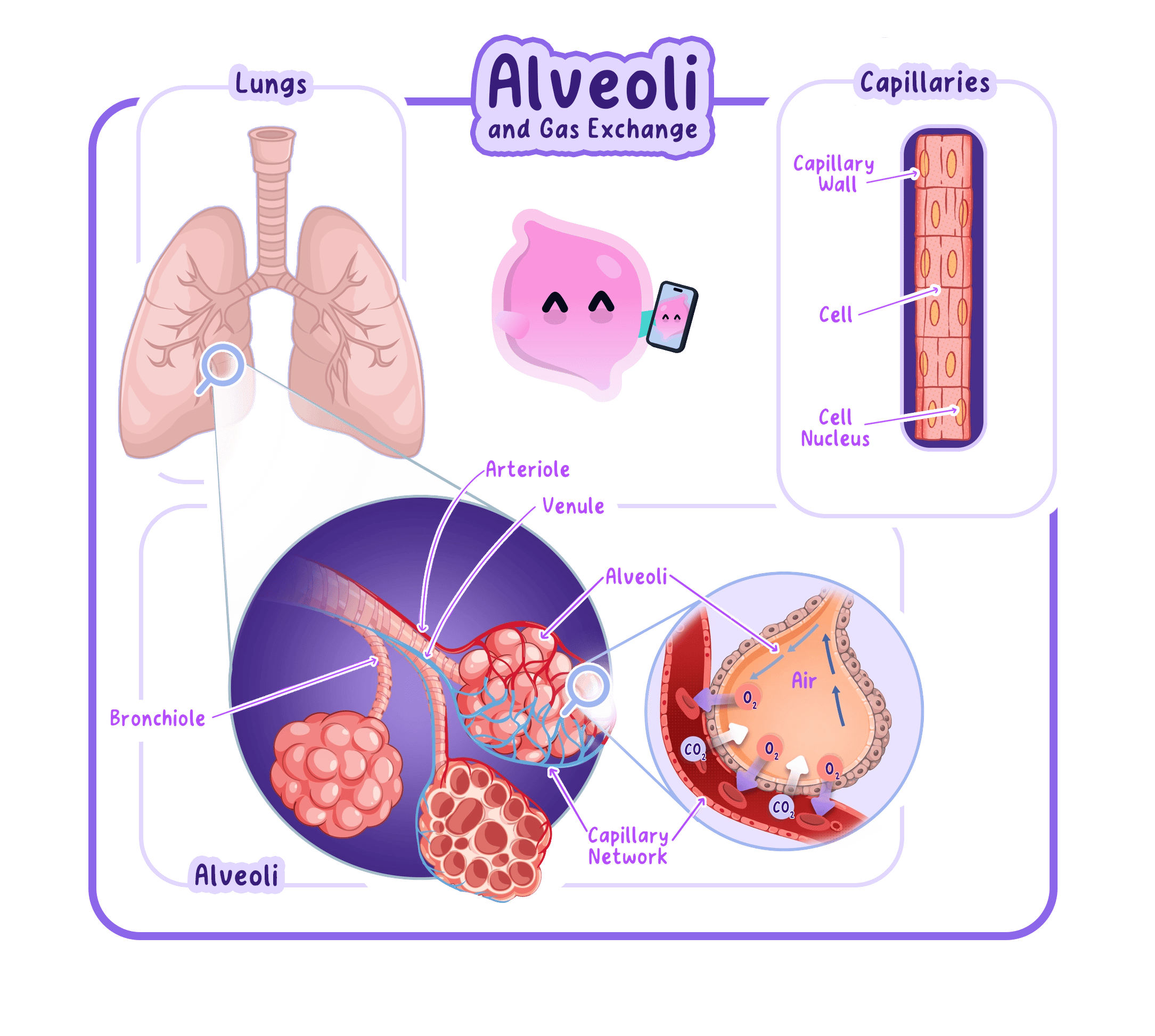
- Air is drawn down the trachea, along the bronchi and bronchioles, and into the millions of alveoli that fill each lung.
- Each alveolus is wrapped in a dense network of capillaries carrying blood from the pulmonary artery.
- That blood has a low oxygen concentration and a high carbon dioxide concentration, because it has just come back from the respiring tissues.
- Oxygen therefore diffuses from the air in the alveolus into the blood, and carbon dioxide diffuses from the blood into the air.
- The circulation keeps that exchange going by carrying oxygenated blood away, which stops the concentrations on the two sides becoming equal.
- Breathing does the same job on the other side, refreshing the air in the alveoli so its oxygen concentration stays high.
- Between them the two systems hold a steep concentration gradient across a wall only two cells thick, which is why exchange is so rapid.
Describing a route through the circulation
- Name every structure in order and do not skip the chambers, because a route question is marked on the sequence.
- Say right or left for each chamber, since atrium on its own does not identify which side of the heart you mean.
- When you are asked why the system is double, give the pressure reason and then the consequence, so that the higher pressure produces a faster flow and a higher delivery rate.
- Remember that a heart diagram is drawn as though you are looking at the person facing you, so the right side of the heart appears on the left of the page.
- Do not say arteries always carry oxygenated blood, because the pulmonary artery carries deoxygenated blood to the lungs.
- Do not describe the double circulation as blood going round the body twice, because it is the heart that blood passes through twice.
- Do not write that the heart muscle gets its oxygen from the blood inside the chambers, because it is supplied by the coronary arteries.
- Do not say oxygenated and deoxygenated blood mix in the heart, because the two sides are completely separated.
- Explain what is meant by a double circulatory system.
- Give two advantages a double circulation has over the single circulation of a fish.
- Name the vessel that carries blood from the heart to the lungs and the vessel that returns it.
- Describe the route a red blood cell takes from the vena cava to the aorta.
- Explain how blood flow at the alveoli keeps the concentration gradient for oxygen steep.
2.2.4 The heart and blood vessels
Structure of the heart
Cardiac muscle
Cardiac muscle is the muscle tissue of the heart wall, which contracts and relaxes rhythmically throughout life without becoming fatigued.
Atrium
An atrium is one of the two upper chambers of the heart, which receives blood returning to the heart from a vein.
Ventricle
A ventricle is one of the two lower chambers of the heart, which pumps blood out of the heart into an artery.
Septum
The septum is the wall of muscle that separates the right and left sides of the heart.
- The heart is a double pump built almost entirely from cardiac muscle, a tissue that contracts and relaxes rhythmically for a lifetime without becoming fatigued.
- It has four chambers: a right atrium and a right ventricle on one side, and a left atrium and a left ventricle on the other.
- The septum is a solid wall of muscle down the middle that keeps oxygenated and deoxygenated blood completely separate.
- The atria have thin walls because they only push blood a few centimetres down into the ventricles below them.
- The ventricles have much thicker walls because they have to generate enough pressure to drive blood out of the heart altogether.
- The right ventricle wall is moderately thick because it pumps only as far as the lungs, which sit alongside the heart.
- Its pressure is deliberately kept low, because the thin capillary walls in the lungs would burst under a high pressure.
- The left ventricle wall is the thickest of all, roughly three times the thickness of the right, because it pumps blood all the way round the body.
- More muscle produces a more forceful contraction, which produces a higher blood pressure and so a faster flow to the tissues.
- Four vessels are attached at the top: the vena cava into the right atrium, the pulmonary artery out of the right ventricle, the pulmonary vein into the left atrium and the aorta out of the left ventricle.
- The cardiac muscle itself is supplied with oxygen and glucose by the coronary arteries that run across the outside of the heart.
The valves of the heart
Atrioventricular valve
An atrioventricular valve is a valve between an atrium and a ventricle that stops blood flowing back into the atrium when the ventricle contracts.
Semilunar valve
A semilunar valve is a valve at the base of the aorta or the pulmonary artery that stops blood flowing back into the ventricle when it relaxes.
- A valve is a flap of tissue that opens in one direction only, so blood can pass forwards but cannot slip back.
- Each valve opens when the pressure behind it is higher than the pressure in front of it, and snaps shut when that difference reverses.
- The atrioventricular valves sit between each atrium and the ventricle below it.
- The one on the right has three flaps and is called the tricuspid valve.
- The one on the left has two flaps and is called the bicuspid valve, or the mitral valve.
- Both are anchored to the ventricle wall by tough tendons that stop the flaps turning inside out when the ventricle contracts hard.
- The semilunar valves sit at the base of the aorta and the base of the pulmonary artery, each made of three half-moon pockets.
- They stop blood that has just been forced into an artery falling back into the ventricle as it relaxes.
- Without valves the heart would push blood back and forth in the same place and no net flow would leave it.
How one heartbeat works
- Blood flows into the two atria from the vena cava and the pulmonary vein while the heart is relaxed.
- Both atria then contract together, raising the pressure inside them so the atrioventricular valves are pushed open.
- Blood passes down into the ventricles, which fill and stretch.
- Both ventricles then contract, and the pressure inside them rises sharply.
- That pressure forces the atrioventricular valves shut and forces the semilunar valves open.
- Blood is driven out of the right ventricle into the pulmonary artery and out of the left ventricle into the aorta.
- The ventricles then relax, the pressure inside them falls below the pressure in the arteries and the semilunar valves close.
- The two sets of valves closing are what produce the two sounds of a heartbeat.
Dissecting a mammalian heart
- Aim: to examine the outside and inside of a mammalian heart and relate the thickness of each chamber wall and the position of each valve to the job that chamber does.
- Apparatus: a fresh or fully defrosted sheep or pig heart, a dissecting board or tray, a scalpel, blunt-nosed scissors, forceps, a blunt seeker, a ruler, paper towel, disposable gloves, eye protection, disinfectant and a sealed bag for waste.
- Variables: this is an observational dissection rather than a fair test, so there is no independent variable, and comparability comes from following the same sequence of cuts and measuring each wall at the same height.
- Method, examining the outside:
- Put on gloves and eye protection and work on a board covered with paper towel.
- Rinse the heart and blot it dry, because surface blood hides the vessels.
- Find the front by the diagonal groove running across the surface, and follow the coronary arteries lying in that groove.
- Squeeze each side gently between finger and thumb. The left side feels distinctly firmer because its wall is thicker.
- Identify the vessels at the top: the aorta is the thickest and springs back when squeezed, the pulmonary artery lies in front of it, and the vena cava and pulmonary vein have thin, floppy walls.
- Slide a blunt seeker into each vessel to find which chamber it opens into, rather than naming it from its position alone.
- Method, opening the chambers:
- Cut down the wall of the right ventricle from the pulmonary artery towards the point of the heart, using scissors so the blade does not slice the structures inside.
- Fold the flap back and find the three-flapped tricuspid valve and the tough white tendons anchoring it to the muscle.
- Make the matching cut on the left side, from the aorta down towards the point, and find the two-flapped bicuspid valve.
- Measure the thickness of each ventricle wall with a ruler at the same height and record both values in millimetres.
- Look into the base of the aorta for the three half-moon pockets of the semilunar valve, and pour a little water down the aorta to watch them fill and close.
- Trace the septum between the two ventricles and confirm that no opening passes through it.
- Results: the left ventricle wall is the thickest, the right ventricle wall is thinner and the atria walls are thinnest of all, which matches how far each chamber has to pump blood.
- Maths: express the two ventricle measurements as a ratio, so a left wall of 12 mm12\ \text{mm}12 mm against a right wall of 4 mm4\ \text{mm}4 mm gives 124=3\dfrac{12}{4}=3412=3, written 3:13:13:1.
- Watch out: cutting with a scalpel inside the heart destroys the valve flaps, a partly frozen heart cannot be opened cleanly, and the heart's own right side lies on your left when the front of it faces you.
- Safety: wear gloves and eye protection, cut away from your fingers on a board, treat the heart as a source of bacteria, seal the waste in the bag provided, and disinfect the instruments, the board and your hands afterwards.
Arteries
Artery
An artery is a blood vessel that carries blood away from the heart.
Lumen
The lumen is the central space inside a blood vessel through which the blood flows.
- An artery carries blood away from the heart, and that blood leaves at high pressure in surges.
- The wall is thick so that it can withstand that pressure without bursting.
- The wall contains a great deal of muscle and elastic fibres, so it stretches as each surge arrives and recoils afterwards.
- That stretching and recoil smooths the flow between beats and keeps the blood moving forwards, and it is what you feel as a pulse.
- The lumen is narrow compared with the thickness of the wall, which helps to keep the pressure high.
- An artery has no valves along its length, because the pressure behind the blood is high enough to keep it flowing one way.
Veins
Vein
A vein is a blood vessel that carries blood towards the heart.
- A vein carries blood back towards the heart, and by this stage the blood is at low pressure and flowing steadily rather than in surges.
- The wall is thin with little muscle or elastic tissue, because there is no high pressure to resist.
- The lumen is wide, which reduces the resistance to flow so that low-pressure blood still returns quickly.
- Veins contain valves along their length, which is the clearest structural difference from an artery.
- Those valves stop blood flowing backwards, which matters most in the legs where blood has to travel upwards against gravity.
- Many veins run between skeletal muscles, and each time those muscles contract they squeeze the vein and push blood on towards the heart.
Capillaries
Capillary
A capillary is a blood vessel with a wall one cell thick across which substances are exchanged between the blood and the surrounding tissue.
- A capillary links the smallest arteries to the smallest veins and is the only vessel where substances are actually exchanged with the tissues.
- Its wall is one cell thick, giving the shortest possible diffusion distance between the blood and the surrounding cells.
- Its lumen is so narrow that red blood cells pass through in single file, which presses them against the wall and shortens the distance further.
- Capillaries are extremely numerous and branch through every tissue, so no cell is far from a supply.
- That branching also gives a very large total surface area for exchange.
- Blood flows slowly through a capillary bed, which allows time for diffusion to take place.
- The wall is also slightly leaky, so plasma can seep out to bathe the tissues and white blood cells can squeeze through it.
Identifying a vessel from a cross-section
- A cross-section shows a vessel whose outside diameter is 4.0 mm4.0\ \text{mm}4.0 mm and whose lumen diameter is 1.0 mm1.0\ \text{mm}1.0 mm.
- The total wall thickness is 4.0−1.0=3.0 mm4.0-1.0=3.0\ \text{mm}4.0−1.0=3.0 mm, so each side of the wall is 1.5 mm1.5\ \text{mm}1.5 mm thick.
- The wall on each side is therefore 1.51.51.5 times the width of the lumen.
- A thick wall around a narrow lumen identifies the vessel as an artery.
- A vein of the same outside diameter would show a wall well under 0.5 mm0.5\ \text{mm}0.5 mm thick and a lumen filling most of the vessel.
Explaining an adaptation of a vessel
- Name the feature, then say what it does, because a feature on its own scores nothing on an explain question.
- Use comparative words when two vessels are compared, so write thicker wall and narrower lumen rather than thick wall and narrow lumen.
- Link the thickness of a ventricle wall to the distance blood is pumped, not to the volume of blood, since distance is the reason the left wall is thicker.
- For any valve question, say which way blood is prevented from moving, because backflow is the word the answer turns on.
- Do not say the left ventricle pumps more blood than the right, because both pump the same volume and the left simply pumps it at a higher pressure.
- Do not write that valves pump blood, because they are flaps moved by pressure and it is the muscle that does the pumping.
- Do not describe capillaries as having thick walls or valves, because a one-cell-thick wall is the whole point of them.
- Do not label the tricuspid valve on the left of the heart, because three flaps go with the right side and two flaps with the left.
- Name the four chambers of the heart and the vessel attached to each.
- Explain why the wall of the left ventricle is thicker than the wall of the right ventricle.
- State where the atrioventricular valves and the semilunar valves are found and what each prevents.
- Compare an artery and a vein in terms of wall thickness, lumen diameter and the presence of valves.
- Explain two ways in which a capillary is adapted for the exchange of substances.
2.2.5 Red blood cells and plasma
What blood is made of
- Blood is a tissue, because it is a group of cells working together, but its cells are carried in a liquid rather than held in a solid block.
- Just over half of blood by volume is plasma, and the rest is made up of cells and cell fragments.
- The four components are plasma, red blood cells, white blood cells and platelets.
- Red blood cells and plasma are the two components that carry out the transport work of the blood.
- Red blood cells vastly outnumber the others, which is why whole blood looks red rather than straw-coloured.
- All of them are made in the bone marrow, the soft tissue inside the larger bones.
How a red blood cell is built
Red blood cell
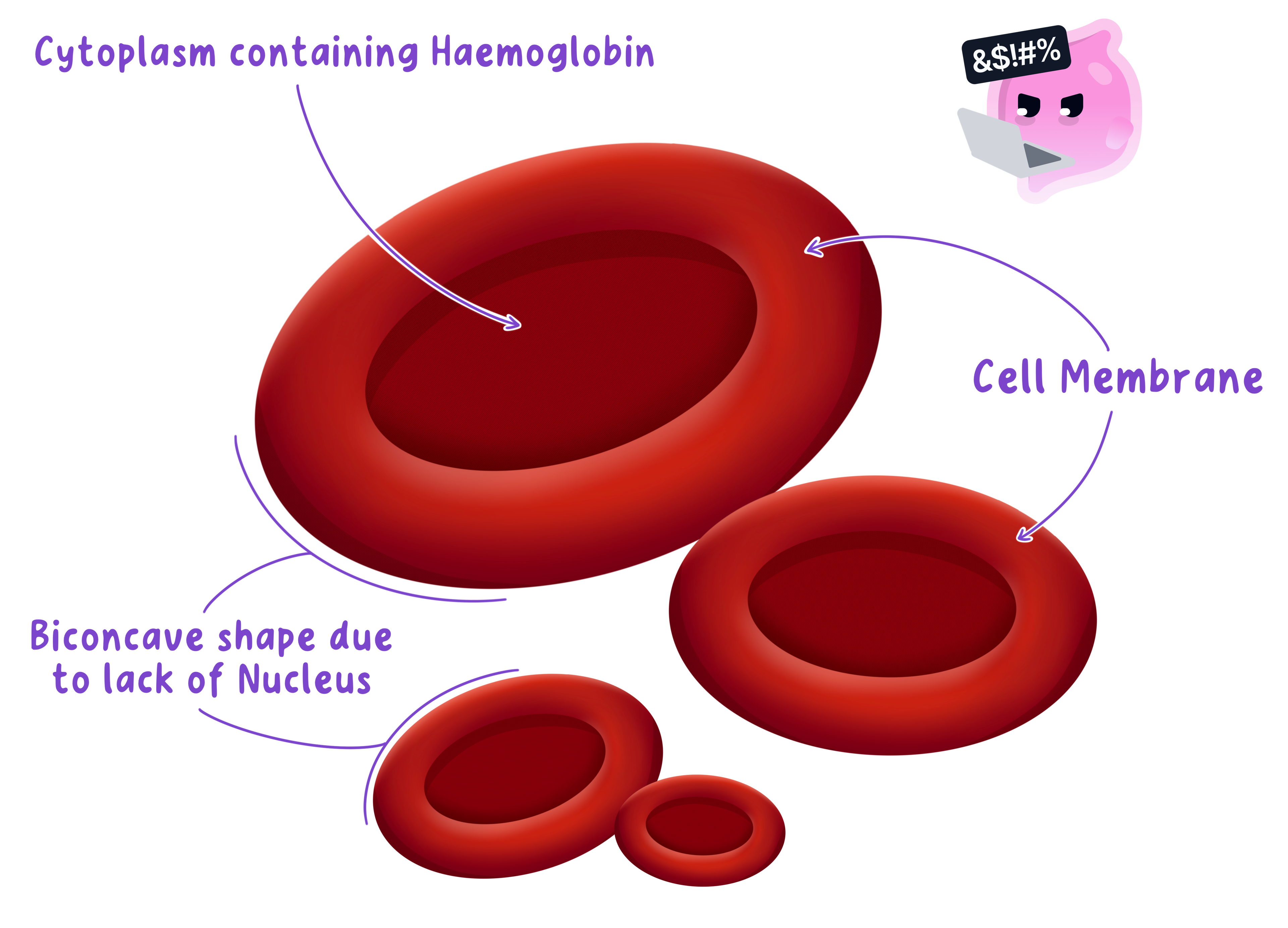
A red blood cell is a biconcave blood cell with no nucleus that is packed with haemoglobin and carries oxygen from the lungs to respiring tissues.
Haemoglobin
Haemoglobin is the red, iron-containing protein inside red blood cells that binds oxygen reversibly.
- A red blood cell has no nucleus, which frees the whole of the inside of the cell for carrying oxygen.
- That space is filled with haemoglobin, so a single cell holds hundreds of millions of these oxygen-binding molecules.
- The cell is a biconcave disc, which means it is dented inwards on both flat faces.
- That shape gives a larger surface area than a sphere of the same volume, so oxygen can diffuse in and out over a bigger area.
- It also makes the cell thin through the middle, so no haemoglobin molecule sits far from the surface and the diffusion distance stays short.
- The cell is small, roughly 7 μm7\ \mu\text{m}7 μm across, and flexible, so it can bend and squeeze single file along a capillary narrower than itself.
- Being pressed against the capillary wall as it passes shortens the distance oxygen has to diffuse to reach the tissue.
- Having no nucleus means the cell cannot repair itself or divide, so it survives only about three months and is replaced continuously.
Carrying oxygen
Oxyhaemoglobin
Oxyhaemoglobin is the bright red compound formed when haemoglobin binds oxygen in the lungs.
- Oxygen dissolves only slightly in water, so plasma on its own could not carry enough of it to keep a mammal alive.
- Haemoglobin solves that problem by binding oxygen instead of dissolving it, which raises the amount blood can carry many times over.
- In the lungs the oxygen concentration is high, so haemoglobin binds oxygen and becomes bright red oxyhaemoglobin.
- The reaction is written as haemoglobin+oxygen⇌oxyhaemoglobin\text{haemoglobin}+\text{oxygen}\rightleftharpoons\text{oxyhaemoglobin}haemoglobin+oxygen⇌oxyhaemoglobin
- The double arrow matters, because the binding is reversible and the oxygen has to be released again.
- In a respiring tissue the oxygen concentration is low, so oxyhaemoglobin breaks apart and releases oxygen into the cells.
- The blood turns the darker red of deoxygenated blood as it does so.
- Each haemoglobin molecule contains iron, which is why a shortage of iron in the diet lowers how much oxygen the blood can carry and leaves a person tired and short of breath.
Comparing oxygen carried in plasma and in red blood cells
- Each 100 cm3100\ \text{cm}^{3}100 cm3 of blood carries about 0.3 cm30.3\ \text{cm}^{3}0.3 cm3 of oxygen dissolved in the plasma and about 20.0 cm320.0\ \text{cm}^{3}20.0 cm3 bound to haemoglobin.
- The total is 0.3+20.0=20.3 cm30.3+20.0=20.3\ \text{cm}^{3}0.3+20.0=20.3 cm3.
- The percentage carried by haemoglobin is 20.020.3×100=98.5%\dfrac{20.0}{20.3}\times100=98.5\%20.320.0×100=98.5%.
- Haemoglobin therefore raises the oxygen-carrying capacity of blood by a factor of about 20.30.3=68\dfrac{20.3}{0.3}=680.320.3=68.
- Almost all the oxygen in the blood is therefore travelling inside red blood cells rather than dissolved in the plasma.
What plasma carries
Plasma
Plasma is the straw-coloured liquid part of the blood in which the blood cells, platelets and dissolved substances are carried.
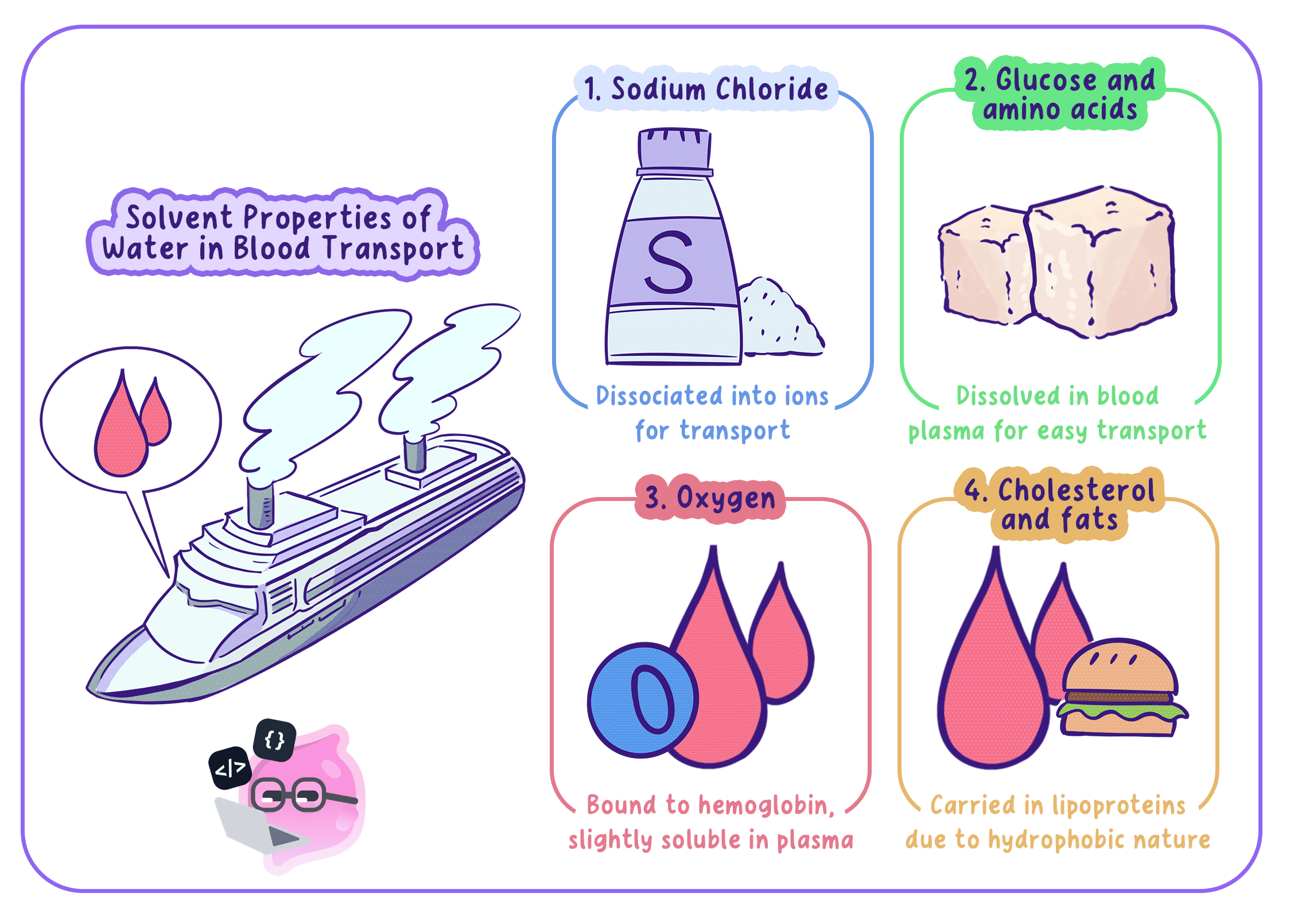
- Plasma is about nine-tenths water, and water is an excellent solvent, so a great many substances dissolve in it and travel together.
- Being a liquid, plasma can be pumped, so everything dissolved in it is carried by mass flow rather than relying on diffusion.
- Plasma carries carbon dioxide from the respiring tissues to the lungs, mostly as hydrogencarbonate ions.
- It carries urea from the liver to the kidneys.
- It carries the soluble products of digestion, such as glucose and amino acids, from the small intestine to the liver and then to every tissue.
- It carries mineral ions, hormones, antibodies and the proteins that make blood clot.
- It also carries the blood cells and the platelets themselves, which are suspended in it rather than dissolved.
- Plasma distributes heat as well as substances, moving warmth from busy organs such as the liver and the muscles to cooler parts of the body.
- Because water needs a great deal of energy to change temperature, plasma can absorb heat without the body temperature swinging about.
The other cells in the blood
White blood cell
A white blood cell is a blood cell with a nucleus that defends the body against pathogens.
Platelet
A platelet is a fragment of a cell in the blood that helps blood to clot at a wound.
- White blood cells are larger than red blood cells and, unlike them, each one keeps its nucleus.
- They defend the body against pathogens rather than transporting substances, so they are not adapted for carrying oxygen.
- Some engulf and digest pathogens, while lymphocytes produce antibodies that stick pathogens together.
- Because a white blood cell can change shape, it can squeeze out through a capillary wall and reach an infection in the surrounding tissue.
- Platelets are small fragments of larger cells and have no nucleus of their own.
- They gather at a wound and trigger the reactions that turn a soluble plasma protein into a mesh of insoluble fibres, and that mesh traps red blood cells to form a clot.
- A clot stops blood loss and seals the skin against pathogens while the wound heals.
Examining a prepared blood smear
- Aim: to view a prepared, stained blood smear under a light microscope and compare the shape, size and number of red and white blood cells.
- Apparatus: a light microscope with ×4\times4×4, ×10\times10×10 and ×40\times40×40 objectives, a commercially prepared and stained blood smear slide, lens tissue, a sharp pencil, a ruler and plain paper.
- Variables: this is an observational study, so there is no independent variable, and the counts are made comparable by using the same slide, the same magnification and fields of the same thickness.
- Method, focusing the slide:
- Clip the prepared slide to the stage with the smear centred over the hole and the ×4\times4×4 objective in place.
- Watch from the side while the coarse focus brings the objective close to the slide, then look down the eyepiece and focus upwards until the smear appears as a pink haze.
- Move up to ×10\times10×10 and then ×40\times40×40, using the fine focus only so the objective cannot be driven into the glass.
- Close the iris diaphragm slightly until the cell outlines look crisp rather than washed out.
- Track across the slide to the thin part of the smear where the cells lie in a single layer, because piled-up cells cannot be counted.
- Method, observing and recording:
- Find the red blood cells, which appear as small pink discs with a paler centre because the biconcave dip lets more light through the middle.
- Find the white blood cells, which are much larger and are easy to spot because the stain colours their nucleus dark purple.
- Count the red cells and the white cells in one whole field of view, then move to a fresh field and repeat for at least three fields.
- Draw a small group of cells with single unbroken pencil lines and no shading, and label a red blood cell, its pale centre and the nucleus of a white blood cell.
- Write the eyepiece and objective magnifications beside the drawing.
- Results: red blood cells outnumber white blood cells by several hundred to one, they carry no nucleus, and each is roughly a third of the diameter of a white blood cell.
- Maths: calculate the mean count of each cell type per field and give the answer as a ratio of red to white cells; total magnification is the eyepiece value multiplied by the objective value, so ×10\times10×10 with ×40\times40×40 gives ×400\times400×400.
- Watch out: counting in a thick region double counts stacked cells, focusing downwards at ×40\times40×40 cracks the slide, and only commercially prepared slides may be used because nobody should make a smear from their own blood.
- Safety: handle slides by their edges because the glass edges are sharp, carry the microscope with one hand under the base, and report a broken slide straight away rather than clearing it yourself.
Explaining a red blood cell adaptation
- Pair every feature with what it achieves, so no nucleus is followed by more room for haemoglobin and so more oxygen carried.
- Use the word biconcave rather than describing the shape loosely, because it is the term the mark scheme looks for.
- Give both consequences of the biconcave shape, the larger surface area and the shorter diffusion distance, since they are separate marking points.
- When a question asks about plasma, name the actual substances carried rather than writing nutrients and waste, because a general answer earns nothing.
- Do not write that red blood cells have no organelles at all, because the point being tested is that they have no nucleus.
- Do not say haemoglobin dissolves oxygen, because it binds oxygen and forms oxyhaemoglobin.
- Do not confuse plasma with platelets, because plasma is the liquid and platelets are cell fragments floating in it.
- Do not state that plasma carries oxygen around the body, because almost all of it travels bound to haemoglobin.
- Give three ways a red blood cell is adapted to carry oxygen and state what each adaptation achieves.
- Write the word equation for the reversible reaction between haemoglobin and oxygen.
- Explain why oxyhaemoglobin releases its oxygen in a respiring muscle but not in the lungs.
- Name four substances carried by plasma and state where each is going.
- Explain why plasma can transport substances that would take far too long to reach a tissue by diffusion.
2.2.6 Uptake of water and mineral ions by plants
The root hair cell
Root hair cell
A root hair cell is an epidermal cell of a root with a long, narrow extension that absorbs water and mineral ions from the soil.
- A plant takes in all its water and all its mineral ions through the roots, not through the leaves.
- The absorbing surface is the epidermis, the single outer layer of cells covering the root.
- Many of those epidermal cells grow a long, narrow extension out into the soil, and a cell with such an extension is a root hair cell.
- The hair is an outgrowth of one cell, so it has no cross wall and no nucleus of its own.
- The long, thin shape gives a very large surface area, so a great many water molecules and ions can enter at the same time.
- It also pushes between the soil particles into gaps a smooth root surface could never reach, so it touches far more of the water film clinging to those particles.
- The wall and the membrane are thin, which keeps the diffusion distance for water and ions extremely short.
- The cell contains many mitochondria, because moving mineral ions inwards needs a continuous supply of energy from respiration.
- It has a large permanent vacuole holding cell sap, a concentrated solution of sugars and salts that keeps the inside of the cell more concentrated than the soil water.
- It has no chloroplasts, because it lives underground where there is no light to photosynthesise with.
- Root hairs are found only in a band a few millimetres behind the growing tip, and each one lives for a matter of days before being replaced as the root grows on into fresh soil.
How much surface area a root hair adds
- Treat one root hair as a cylinder of length l=0.50 mml=0.50\ \text{mm}l=0.50 mm and diameter d=0.010 mmd=0.010\ \text{mm}d=0.010 mm.
- The curved surface area of a cylinder is A=πdlA=\pi d lA=πdl.
- Substituting gives A=π×0.010×0.50=0.0157 mm2A=\pi\times0.010\times0.50=0.0157\ \text{mm}^{2}A=π×0.010×0.50=0.0157 mm2 for a single hair.
- A square millimetre of root epidermis carries roughly 200200200 hairs, adding 200×0.0157=3.14 mm2200\times0.0157=3.14\ \text{mm}^{2}200×0.0157=3.14 mm2.
- The absorbing area of that patch rises from 1 mm21\ \text{mm}^{2}1 mm2 to about 4.1 mm24.1\ \text{mm}^{2}4.1 mm2, roughly four times as much surface from the same volume of root.
Taking up water by osmosis
Osmosis
Osmosis is the net movement of water molecules from a dilute solution to a concentrated solution through a partially permeable membrane.
Partially permeable membrane
A partially permeable membrane is a membrane that allows small molecules such as water to pass through it but not larger dissolved particles.
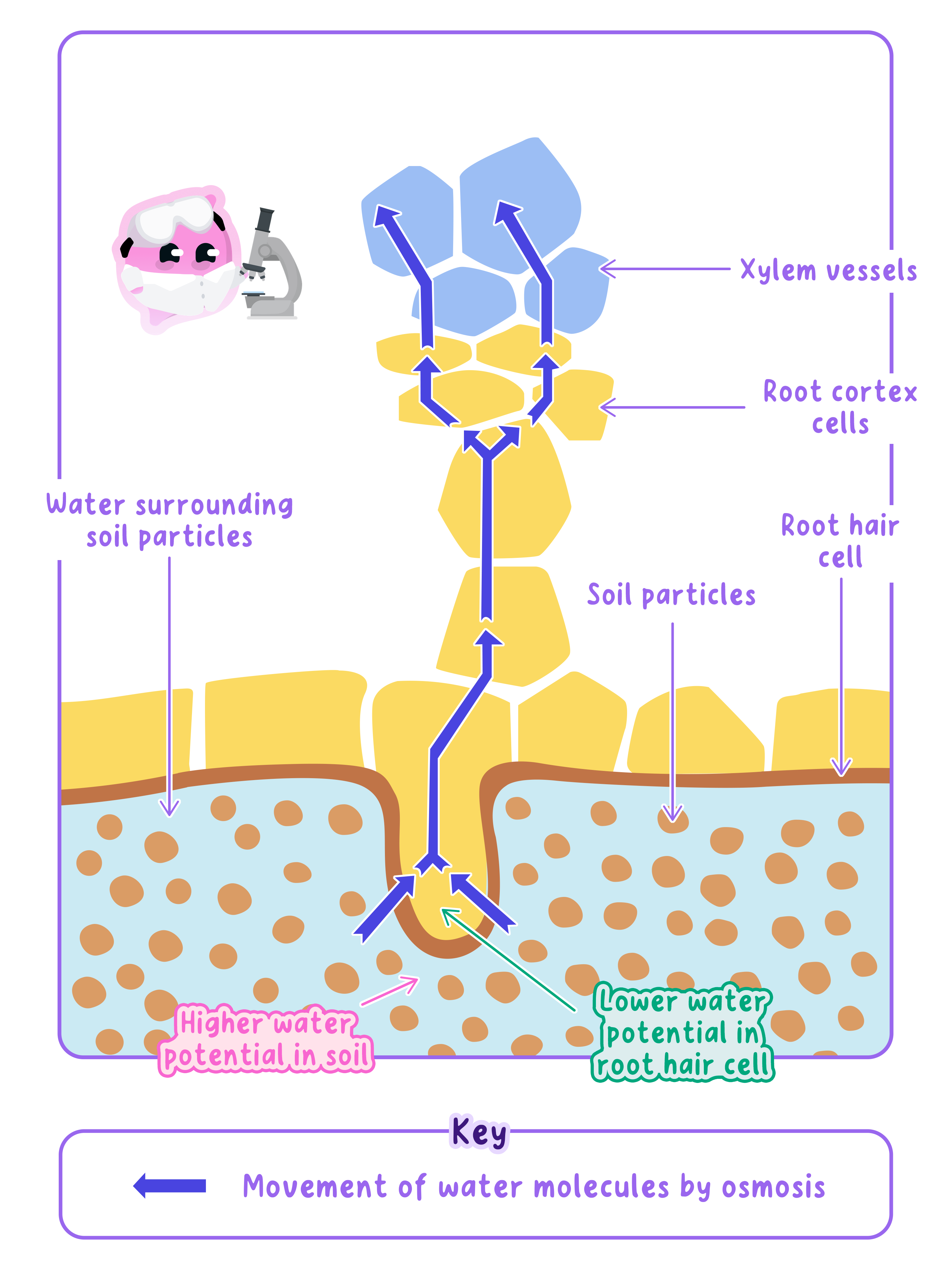
- Soil water is a very dilute solution, so it has a high concentration of water molecules and only a trace of dissolved salts.
- The cell sap inside the root hair cell is a concentrated solution, so it has a lower concentration of water molecules.
- The cell membrane is partially permeable, so water molecules can pass through it but the dissolved solutes largely cannot.
- Water therefore moves into the cell by osmosis, down a water potential gradient from the dilute soil solution to the concentrated cell sap.
- Osmosis is a passive process, so it needs no energy from respiration.
- Water then passes from that cell into the next along the same kind of gradient, moving steadily across the root towards the centre.
- The gradient is maintained because water is drawn out of the centre of the root and up the stem, so the cells nearer the middle never become saturated.
- Uptake slows and then stops if the soil dries out or is heavily salted, because the soil solution becomes as concentrated as the cell sap and the gradient disappears.
- In very salty soil water moves out of the root cells instead of in, which is why a plant watered with sea water dies.
Taking up mineral ions by active transport
Active transport
Active transport is the movement of a substance against its concentration gradient using energy released by respiration.
Concentration gradient
A concentration gradient is the difference in the concentration of a substance between two regions.
- Mineral ions such as nitrate, magnesium and potassium are present in the soil solution at very low concentrations.
- Their concentration inside the root hair cell is already higher than their concentration outside it.
- Diffusion would therefore move them out of the cell rather than in, because diffusion only runs down a concentration gradient.
- The cell instead uses active transport, which moves ions against the gradient, from the lower concentration to the higher one.
- Carrier proteins in the cell membrane pick up a particular ion on the outside, change shape and release it on the inside.
- That change of shape needs energy released by respiration, which is why the cell is packed with mitochondria.
- Each carrier protein handles one kind of ion, so the plant can take up the particular ions it needs and leave the rest.
- Anything that stops respiration therefore stops mineral uptake, so a waterlogged soil with no oxygen leaves a plant short of nitrate even though the nitrate is there.
- Water uptake and ion uptake happen through the same cell at the same time, but by two different processes, one passive and one requiring energy.
Growing and examining root hairs
- Aim: to germinate cress or radish seeds, find the root hairs on the young roots and examine them under a light microscope, relating the shape of a root hair cell to its job of absorbing water and mineral ions.
- Apparatus: cress or radish seeds, a Petri dish, filter paper, distilled water in a dropping pipette, forceps, a scalpel, a white tile, microscope slides, cover slips, a mounted needle, dilute methylene blue or iodine solution, filter paper for blotting, a light microscope, a ruler, a sharp pencil and eye protection.
- Variables: this is an observational study, so there is no independent variable, and the seedlings are all grown at the same temperature on paper kept equally damp so their roots reach a comparable stage.
- Method, growing the seedlings:
- Line a Petri dish with filter paper and wet it with distilled water until it is damp all over but not flooded.
- Space about twenty seeds across the paper so their roots will not tangle, put the lid on and leave the dish in a warm place for three or four days.
- Add water each day to keep the paper damp, because a root that dries out even briefly loses its hairs.
- Method, preparing the slide:
- Lift a seedling with forceps by holding the seed, never the root, so the hairs are not torn away.
- Hold the root against a dark background: the hairs show as a white fuzz in a band a few millimetres behind the tip, with the tip itself and the older root both bare.
- Cut about 1 cm1\ \text{cm}1 cm of root that includes the band, and lay it in a drop of water in the centre of a slide.
- Hold a cover slip at about 45∘45^{\circ}45∘ on a mounted needle and lower it slowly so the water spreads sideways and the air is driven out.
- If the hairs are hard to see, place a drop of dilute stain at one edge of the cover slip and draw it underneath with filter paper touched to the opposite edge.
- Method, viewing and recording:
- Focus at low power first, find the band of hairs, then move to ×10\times10×10 and ×40\times40×40 using the fine focus only.
- Trace one hair back to the epidermal cell it grows from, to confirm it is an outgrowth of a single cell rather than a separate cell.
- Estimate the length of several hairs against the width of the field of view and record the range.
- Draw one root hair cell with single unbroken pencil lines and label the cell wall, the cell membrane, the cytoplasm, the vacuole and the nucleus.
- Results: the hairs appear only in a band behind the growing tip, each is many times longer than it is wide, and together they turn a smooth root surface into a dense fringe reaching between the soil particles.
- Maths: estimate the extra surface a single hair provides from the curved surface of a cylinder, A=πdlA=\pi d lA=πdl, then multiply by the number of hairs counted in one field of view.
- Watch out: seedlings pulled from soil arrive with their hairs already stripped off, a root left on the bench shrivels within minutes, and pressing on the cover slip crushes the hairs flat against the root.
- Safety: wear eye protection, cut on a tile away from your fingers, treat the stains as chemicals that mark skin and clothing, and wash your hands after handling seeds and damp paper.
Answering on uptake by roots
- Name the process before describing it, so write osmosis for water and active transport for mineral ions, because the two are marked separately.
- State the direction relative to the gradient, so water moves down a gradient and ions move against one.
- Mention energy from respiration whenever active transport is involved, since that is the point separating it from diffusion.
- For a structure question, pair each feature of the cell with the process it serves, so many mitochondria goes with active transport and a large surface area goes with faster uptake.
- Do not say mineral ions enter by osmosis, because osmosis moves water only.
- Do not describe osmosis as needing energy, because it is passive and only active transport requires energy from respiration.
- Do not call a root hair a separate cell, because it is a long extension of one epidermal cell.
- Do not write that water moves from a high concentration to a low concentration without saying concentration of what, because in osmosis it is the concentration of water that matters.
- Give three features of a root hair cell and state how each one helps it absorb substances.
- Explain how water moves from the soil into a root hair cell.
- Explain why mineral ions cannot be taken up by diffusion.
- State why a root hair cell contains a large number of mitochondria.
- Predict what happens to water uptake when a plant is watered with a concentrated salt solution, and explain why.
2.2.7 Transpiration and translocation
Transpiration
Transpiration
Transpiration is the loss of water vapour from the leaves and stems of a plant, mainly through the stomata.
Transpiration stream
The transpiration stream is the continuous flow of water up the xylem from the roots to the leaves that replaces the water lost by transpiration.
- Water travels up a plant in a continuous stream, and almost all of it leaves again as vapour from the leaves.
- Inside a leaf the cells are loosely packed with air spaces between them, and every cell surface facing those spaces is wet.
- Water evaporates from those wet cell walls, so the air spaces fill with water vapour.
- The air inside the leaf therefore holds far more water vapour than the air outside it.
- Water vapour then diffuses out through the stomata down that concentration gradient, and this loss is transpiration.
- Transpiration is therefore two steps: evaporation inside the leaf, then diffusion out of it.
- As water leaves a mesophyll cell, that cell draws replacement water from the cell next to it, and so on back to the nearest xylem vessel.
- That pull is passed all the way down the water in the xylem to the roots, producing the transpiration stream.
- The column of water holds together because water molecules attract one another, an effect called cohesion, so pulling at the top drags the whole column upwards.
- The plant spends no energy on this, because the energy that drives the evaporation comes from the sun.
- Transpiration is useful as well as unavoidable: it delivers water for photosynthesis, carries dissolved mineral ions up to the leaves, cools the leaf as water evaporates, and keeps cells firm with water so soft stems stay upright.
Stomata and guard cells
Stoma
A stoma is a pore in the epidermis of a leaf through which gases enter and leave and water vapour is lost.
Guard cell
A guard cell is one of a pair of sausage-shaped cells that changes shape to open or close a stoma.
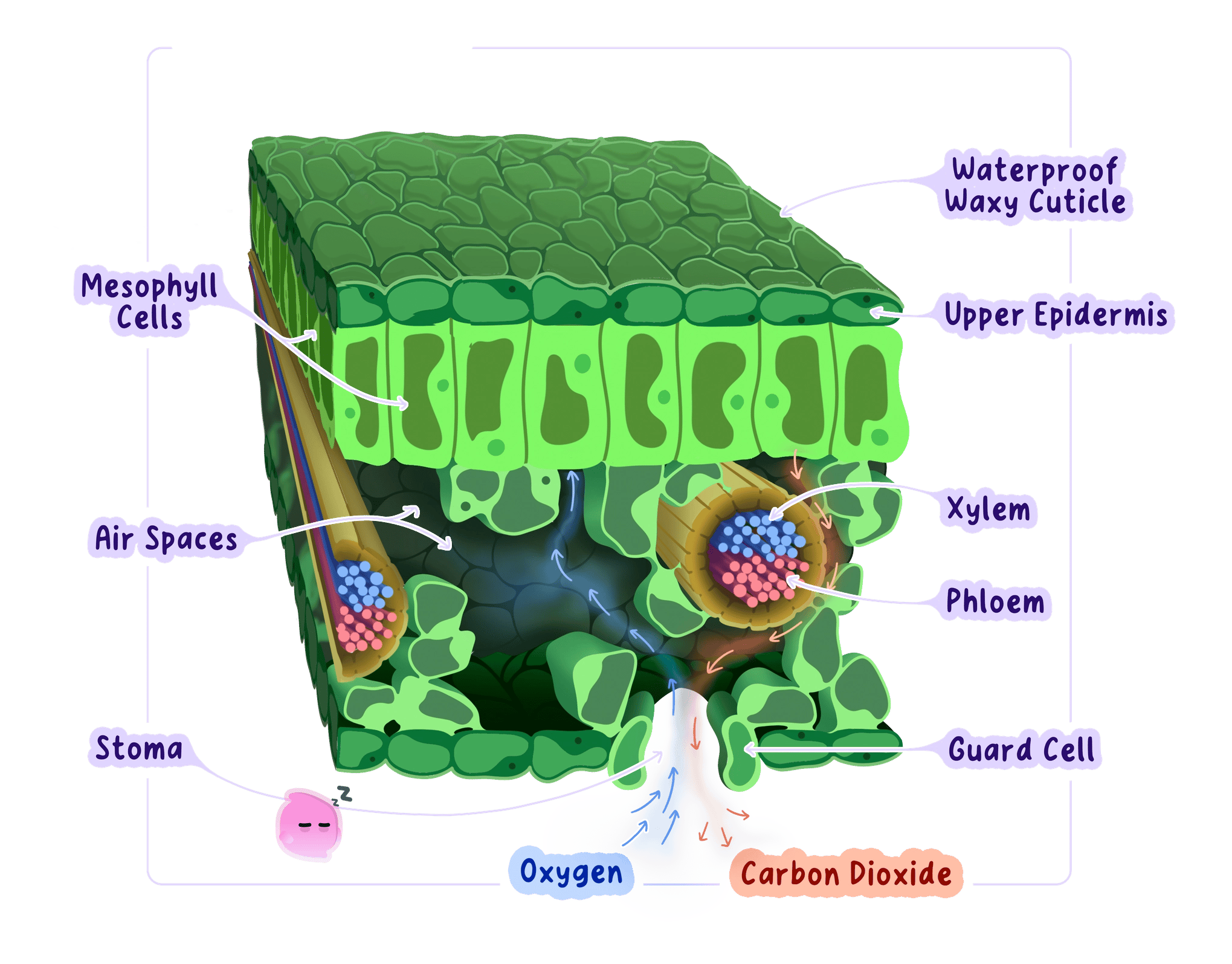
- A leaf is covered by a waxy cuticle that is waterproof, so gases and water vapour cannot pass freely through the surface.
- The stomata are the controlled openings through it, and the singular of the word is stoma.
- Each stoma is a pore held between two sausage-shaped guard cells.
- Carbon dioxide diffuses in through the open pore for photosynthesis, oxygen diffuses out, and water vapour is lost at the same time.
- Most stomata are on the lower surface of a broad leaf, which is shaded and cooler, so less water evaporates than would be lost from the hot upper surface.
- Guard cells are the only epidermal cells of a leaf that contain chloroplasts, and they photosynthesise in the light.
- The wall of a guard cell is thicker on the side facing the pore and thinner on the outer side, and that uneven thickness is what makes the pore open.
Opening and closing a stoma
- In the light the guard cells take in water by osmosis and become turgid, which means swollen and firm.
- The thin outer wall stretches more easily than the thick inner wall, so each cell curves away from the pore.
- The two cells bow apart and the stoma opens, letting carbon dioxide in while the plant is photosynthesising.
- In the dark the guard cells lose water, become flaccid and straighten, so the two cells meet and the stoma closes.
- Closing at night costs the plant nothing, because there is no photosynthesis in the dark and so no need for carbon dioxide.
- Stomata also close during the day when the plant is short of water, which saves the plant even though photosynthesis stops.
The cost of opening the stomata
- A plant cannot let carbon dioxide in without letting water vapour out, because both use the same pore.
- Transpiration is therefore an unavoidable consequence of gas exchange rather than a process the plant carries out on purpose.
- Keeping the stomata open maximises photosynthesis but risks losing water faster than the roots can replace it.
- Closing them saves water but starves the leaf of carbon dioxide, so photosynthesis and growth stop.
- Guard cells settle that compromise minute by minute, opening the pores when water is plentiful and shutting them when it is not.
Taking a stomatal peel from a leaf
- Aim: to take an impression of a leaf surface with clear nail varnish, view the stomata and guard cells under a light microscope, and compare the number of stomata on the upper and lower surfaces.
- Apparatus: a broad-leaved plant such as a busy Lizzie or a laurel, clear nail varnish, transparent sticky tape, forceps, microscope slides, a light microscope, a stage micrometer or a transparent ruler, a stopclock, a sharp pencil and eye protection.
- Variables: the leaf surface, upper or lower, is the independent variable; the number of stomata in one field of view is the dependent variable; the same leaf, the same plant, the same magnification, the same field size and the same counting rule are controlled.
- Method, making the peel:
- Choose a healthy, fully expanded leaf and leave it attached to the plant, because a picked leaf begins to wilt and its stomata close.
- Paint a patch of clear nail varnish about 1 cm1\ \text{cm}1 cm square on the lower surface, keeping clear of the thick midrib.
- Time about ten minutes and check that the patch is completely dry and no longer tacky before touching it.
- Press a piece of clear sticky tape firmly over the dried patch, then peel the tape off in one steady movement so the varnish film comes with it.
- Stick the tape flat on a slide, film side upwards, smoothing out air bubbles with a finger.
- Repeat the whole process on the upper surface of the same leaf and label both slides clearly.
- Method, counting the stomata:
- Focus at low power to find the film, then move to ×40\times40×40 using the fine focus only.
- Each stoma shows as a small slit between two curved guard cells, set among the irregular jigsaw outlines of the other epidermal cells.
- Count every stoma in one whole field of view, counting those touching two chosen edges of the field and ignoring those touching the other two.
- Move to a fresh field of view and repeat for at least five fields on each surface.
- Draw a single stoma with its two guard cells, labelling the pore, the thick inner wall, the thin outer wall and the chloroplasts.
- Results: a typical broad leaf shows many stomata on the lower surface and very few on the upper surface, which fits the pattern of losing less water from the cooler, shaded side.
- Maths: calculate the mean count per field for each surface, measure the field diameter with a stage micrometer, find the field area from A=πr2A=\pi r^{2}A=πr2, then give the density as stomata per square millimetre using density=mean countfield area\text{density}=\dfrac{\text{mean count}}{\text{field area}}density=field areamean count.
- Watch out: varnish peeled before it is dry tears and shows nothing, an air bubble under the tape puts part of the film out of focus, a peel taken over the midrib gives an unrepresentative count, and the two surfaces cannot be compared unless the same edge rule is used every time.
- Safety: wear eye protection, use the nail varnish in a well ventilated room because its solvent vapour is flammable and irritating, keep it well away from any flame, and wash your hands afterwards.
Translocation
Translocation
Translocation is the movement of dissolved sugars and amino acids through the phloem from a source to a sink.
Source
A source is a part of a plant that makes or releases sugars into the phloem, such as a photosynthesising leaf.
Sink
A sink is a part of a plant that removes sugars from the phloem in order to use them or store them, such as a growing root tip.
- Photosynthesis makes glucose in the leaves, but every other part of the plant needs it too.
- Glucose is converted to sucrose for the journey, because sucrose is soluble but far less reactive, so it can be moved without being used up on the way.
- The movement of sucrose and amino acids through the phloem is called translocation.
- It runs from a source, where sugars are loaded in, to a sink, where they are taken out.
- A photosynthesising leaf is the usual source, and growing root tips, flowers, developing fruits and storage organs are the usual sinks.
- At a sink the sugar is respired for energy, built into cellulose for new cell walls, or stored as insoluble starch.
- Translocation moves in either direction, upwards to a growing shoot and downwards to a root, depending on where the sinks are at the time.
- The same part can switch role through the year, so a potato tuber is a sink while it is filling in summer and a source when it sprouts in spring.
- Loading sugar into the phloem needs energy from respiration, so translocation is an active process, unlike transpiration.
- That is why translocation slows or stops when a plant is starved of oxygen, while the transpiration stream keeps flowing.
Keeping the two processes apart
- Say what is being moved before you say where, because transpiration moves water and translocation moves dissolved food.
- Give both steps when describing transpiration, so evaporation from the cell surfaces inside the leaf and then diffusion out through the stomata.
- Use the words source and sink for translocation, and name a real example of each so the answer is not left general.
- State that translocation needs energy and transpiration does not, because that contrast is a common two-mark question on its own.
- Do not describe transpiration as the movement of water up the plant, because that is the transpiration stream and transpiration itself is the loss of water vapour.
- Do not write that water is lost through the stomata by evaporation, because it evaporates inside the leaf and then diffuses out.
- Do not say translocation only travels downwards, because sugars move to whichever parts are acting as sinks.
- Do not say guard cells open the stoma by contracting like a muscle, because they open it by taking in water and becoming turgid.
- Describe the two steps by which water is lost from a leaf during transpiration.
- Explain how a guard cell changes shape to open a stoma.
- State why most stomata are found on the lower surface of a leaf.
- Define translocation and give one example of a source and one of a sink.
- Explain why a plant cannot photosynthesise quickly without also losing water.
2.2.8 Xylem and phloem
Xylem
Xylem
Xylem is the plant tissue made of dead, hollow, lignified vessels that carries water and mineral ions from the roots to the leaves.
Lignin
Lignin is the hard, waterproof substance laid down in xylem walls that strengthens them and stops them collapsing.
- Xylem carries water and dissolved mineral ions from the roots to the stem and leaves, and it carries them in one direction only, upwards.
- A xylem vessel begins as a column of living cells, which then die and lose their cytoplasm, nucleus and organelles.
- The end walls between them break down completely, so the whole column becomes one continuous hollow tube running the length of the plant.
- An empty tube with no cross walls offers almost no resistance, so water flows through it far faster than it could pass from cell to cell.
- The walls are thickened with lignin, laid down in rings and spirals along the inside of the tube.
- Water in the xylem is under tension because it is being pulled from above, so without that thickening the tube would collapse inwards like a drinking straw sucked too hard.
- Lignin is also waterproof, so water is not lost sideways on the way up.
- Gaps in the thickening called pits let water leave the vessel where it is needed, at the roots and in the leaves.
- The tubes are narrow, which helps the column of water hold together as it is pulled upwards.
- Because it is dead and hollow, xylem uses no energy at all, and the pull that drives the flow comes from evaporation at the leaves.
- Lignified xylem also gives the plant support, and the accumulated xylem of a tree trunk is what we call wood.
Phloem
Phloem
Phloem is the living plant tissue made of sieve tubes and companion cells that carries dissolved sugars and amino acids around the plant.
Sieve tube element
A sieve tube element is one of the living phloem cells joined end to end by perforated sieve plates to form a continuous tube.
Companion cell
A companion cell is a cell alongside a sieve tube element that supplies the energy needed to move sugars through the phloem.
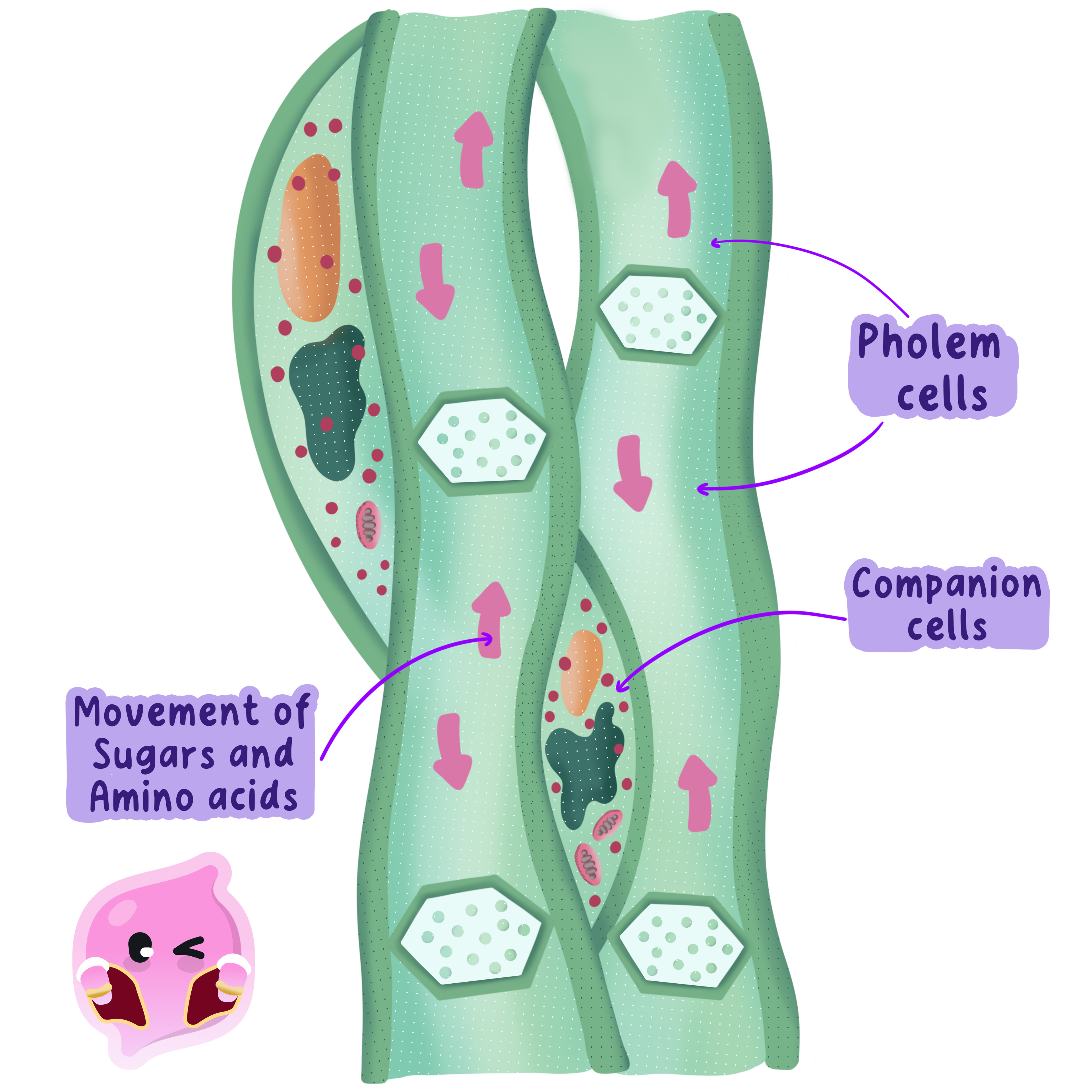
- Phloem carries dissolved sugars and amino acids, and it carries them in both directions, to whichever parts of the plant need them.
- Unlike xylem, phloem is made of living cells, because moving sugars requires energy.
- The transport cells are sieve tube elements, joined end to end into a long tube.
- Their end walls are not removed but perforated with pores, forming sieve plates that let the sugary sap flow from one cell into the next.
- A sieve tube element loses most of its contents, including its nucleus, leaving only a thin layer of cytoplasm around the edge so the tube stays as clear as possible.
- With no nucleus it cannot control itself, so each one is paired with a companion cell lying alongside it.
- The companion cell keeps its nucleus and is packed with mitochondria, so it supplies the energy that loads sugar into the tube.
- The two are linked by fine strands of cytoplasm through the wall between them, so materials pass freely from one to the other.
- Phloem walls carry no lignin, which is why phloem gives the plant no support and why it can be crushed easily.
Where the two tissues lie in the plant
Vascular bundle
A vascular bundle is a strand of xylem and phloem running together through a root, stem or leaf.
- Xylem and phloem run side by side through the whole plant in strands called vascular bundles.
- Running together means water reaches the sugar-loading cells and the two systems can exchange water between them along the way.
- In a root the vascular tissue lies in the centre, which anchors the root against the pull of the plant being tugged upwards.
- In a stem the bundles are arranged in a ring near the outside, where they resist bending in the same way as the walls of a tube.
- In each stem bundle the xylem lies on the inside and the phloem on the outside.
- In a leaf the bundles form the midrib and the network of veins, which carry water out to the mesophyll and carry sugars away from it.
- The veins branch finely enough that no photosynthesising cell is far from a supply, and they also stiffen the thin blade of the leaf.
- Because the phloem sits outside the xylem in a stem, stripping a ring of bark from a tree removes the phloem and starves the roots while the leaves still receive water.
Tracing the xylem with a dye
- Aim: to stand a cut stem in coloured dye so the xylem is stained, then cut and examine sections to show where the vascular bundles lie and how the xylem is arranged inside them.
- Apparatus: fresh celery stalks with their leaves attached or white carnations, a beaker, red food dye or eosin solution, a scalpel, a white tile, a ruler, a stopclock, forceps, microscope slides, cover slips, a mounted needle, a dropping pipette, a light microscope, paper towel and eye protection.
- Variables: the time the stem spends in the dye is the independent variable and the height the colour reaches is the dependent variable, with stalk thickness, dye concentration, temperature, light intensity and air movement all kept the same.
- Method, staining the stem:
- Half fill a beaker with water and add enough dye to colour it strongly.
- Cut about 2 cm2\ \text{cm}2 cm off the base of the stalk while it is held under water, working on a tile and drawing the blade away from your fingers.
- Cutting under water matters, because a bubble drawn into a vessel in air breaks the column of water and the dye then stops rising.
- Stand the freshly cut stalk in the dye with its leaves still on, and start the stopclock.
- Leave it somewhere bright and airy, because faster transpiration pulls the dye up faster.
- Measure how far the colour has travelled up the stalk every ten minutes, holding the ruler against the outside from the surface of the dye.
- Method, cutting and viewing sections:
- After about an hour, lift the stalk out, blot it and cut a clean transverse slice a few centimetres above the base.
- Look at the cut face with the naked eye: the dye shows as a ring of small coloured dots, and each dot is the xylem inside one vascular bundle.
- Cut the thinnest freehand transverse sections you can manage and float them in a drop of water on a slide.
- Lower a cover slip at about 45∘45^{\circ}45∘ on a mounted needle so the water spreads and the air is driven out.
- Focus at low power, then move to ×10\times10×10 and ×40\times40×40 with the fine focus only, and identify the dyed xylem, the paler phloem outside it and the packing tissue around both.
- Cut a longitudinal section as well, in which the dyed xylem appears as long unbroken coloured lines rather than dots.
- Results: only a ring of small bundles takes up the dye, which shows water travels in narrow separate channels rather than through the whole stem, and the unbroken lines in longitudinal section show those channels are continuous tubes.
- Maths: calculate the rate of rise using rate=distancetime\text{rate}=\dfrac{\text{distance}}{\text{time}}rate=timedistance then plot distance against time, where a straight line through the origin shows a steady rate.
- Watch out: a stem cut in air draws in a bubble and stops taking up dye, a stalk with its leaves removed transports far less, sections cut too thickly stack cells on top of one another and cannot be focused, and a stalk left in dye overnight stains everything and hides the pattern.
- Safety: wear eye protection, cut on a tile away from your fingers with a sharp blade, treat eosin and food dye as chemicals that stain skin and clothing, and wash your hands and the bench afterwards.
Calculating the rate the dye rises
- The dye reaches 18 mm18\ \text{mm}18 mm up a celery stalk after 101010 minutes and 54 mm54\ \text{mm}54 mm after 303030 minutes.
- The distance travelled in that interval is 54−18=36 mm54-18=36\ \text{mm}54−18=36 mm.
- The time taken is 30−10=2030-10=2030−10=20 minutes.
- The rate is 3620=1.8 mm per minute\dfrac{36}{20}=1.8\ \text{mm per minute}2036=1.8 mm per minute.
- Since 1810\dfrac{18}{10}1018 also gives 1.81.81.8, the rate has stayed constant, so a graph of distance against time is a straight line through the origin.
Comparing xylem and phloem in an answer
- Match each feature to the job it does, so hollow dead tubes go with fast unresisted water flow and living cells with companion cells go with sugar loading.
- Write about the same feature on both sides when you compare, so dead against living and no end walls against perforated sieve plates.
- Give lignin two credits by mentioning both what it does, preventing collapse and keeping the tube waterproof, and where it is, in the xylem wall.
- State the direction of travel for each tissue, since one way up for xylem and either way for phloem is a routine marking point.
- Do not say xylem cells are alive, because they are dead and empty, which is exactly what lets water flow freely.
- Do not write that phloem has no end walls, because it keeps them and they are perforated into sieve plates.
- Do not describe xylem as pumping water, because the pull comes from evaporation at the leaves and the tissue itself uses no energy.
- Do not confuse the companion cell with the sieve tube element, because the sugar travels in the sieve tube and the companion cell supplies the energy.
- Give three features of a xylem vessel and state how each helps it carry water.
- Explain why xylem vessels are thickened with lignin.
- Describe the structure of a sieve tube element and state what a sieve plate does.
- Explain why phloem needs companion cells but xylem needs no living cells at all.
- State where the vascular bundles are found in a root and in a stem, and give one advantage of each arrangement.
2.2.9 Environmental factors and water uptake
Water uptake and transpiration rate
Transpiration rate
The transpiration rate is the volume of water a plant loses as vapour in a given time.
- Water is pulled up a plant because water is being lost from the leaves, so anything that changes the rate of loss changes the rate of uptake at the roots.
- Over ninety-nine parts in a hundred of the water a plant takes in is lost again as vapour, and only a trace is used in photosynthesis.
- Water uptake is therefore treated as a good measure of the transpiration rate, although the two are not exactly equal.
- Every environmental factor works through one of two routes: it changes how fast water evaporates inside the leaf, or it changes how steep the concentration gradient of water vapour is between the leaf and the air outside.
- A third route exists only for light, which also changes how many stomata are open and so how much escape route there is.
- The rate is calculated as a volume of water taken up divided by the time taken, so rate=volume of water taken uptime\text{rate}=\dfrac{\text{volume of water taken up}}{\text{time}}rate=timevolume of water taken up
- Rates are usually given in cm3\text{cm}^{3}cm3 per minute or cm3\text{cm}^{3}cm3 per hour, and a rate can also be worked out from a distance moved along a scale of known cross-sectional area.
Light intensity
- Increasing the light intensity increases the rate of water uptake.
- Light causes the guard cells to become turgid, so the stomata open.
- Open stomata give a larger total area for water vapour to diffuse out through, so more escapes each second.
- In the dark the stomata close, so transpiration falls to a trickle through the waxy cuticle and water uptake almost stops.
- Brighter light is usually warmer light as well, so a lamp placed close to a shoot raises the temperature at the same time and the two effects add together.
- Once every stoma is fully open, raising the light intensity further has little extra effect, so a graph of rate against light intensity levels off.
Air movement
- Increasing the air movement increases the rate of water uptake.
- In still air the water vapour leaving the stomata collects just outside them as a layer of damp air.
- That damp layer makes the concentration of water vapour outside the leaf almost as high as inside it, so the gradient becomes shallow and diffusion slows.
- Moving air blows that layer away and replaces it with drier air.
- The gradient is therefore kept steep, and water vapour keeps diffusing out quickly.
- A gentle breeze produces a large increase, while making an already windy day windier produces much less extra effect, because the damp layer has already gone.
- In very strong wind some plants close their stomata to protect themselves from drying out, and the rate then falls again.
Temperature
- Increasing the temperature increases the rate of water uptake.
- Warmer water molecules have more kinetic energy, so more of them have enough energy to escape from the wet cell walls into the air spaces.
- Evaporation inside the leaf therefore speeds up and the air spaces hold more water vapour.
- That raises the concentration inside the leaf, which steepens the gradient out through the stomata.
- Warmer molecules also diffuse faster once they are in the air, so they move away from the pore more quickly.
- All three effects push in the same direction, which is why temperature usually has the largest effect of any single factor.
- At very high temperatures a plant short of water closes its stomata, and the rate then falls even though it is hot.
Humidity
Humidity
Humidity is the amount of water vapour present in the air.
- Increasing the humidity decreases the rate of water uptake, which makes it the one factor here that works in the opposite direction.
- Humid air already holds a great deal of water vapour, so the concentration outside the leaf is close to the concentration inside it.
- The gradient across the stomata is therefore shallow, and water vapour diffuses out slowly.
- In dry air the outside concentration is very low, the gradient is steep and vapour leaves quickly.
- Covering a plant with a clear plastic bag traps the vapour it releases, raises the humidity around it and slows its water loss, which is why a cutting is kept in a bag while it grows roots.
When uptake cannot keep up
Wilting
Wilting is the drooping of a plant's leaves and stems that happens when water is lost faster than the roots can take it up.
- On a hot, bright, windy day water can be lost from the leaves faster than the roots can pull it out of the soil.
- The cells then lose water, the pressure inside them falls and they stop pressing outwards against their walls.
- A soft stem is held upright by that pressure, so once it is lost the plant droops and wilts.
- Wilting reduces further loss, because the drooping leaves hang together and shade one another and the stomata close.
- Closing the stomata also stops carbon dioxide entering, so photosynthesis and growth stop while the plant is wilted.
- A wilted plant recovers when it is watered, unless it has been left so long that the cells are damaged beyond repair.
Comparing rates in still and moving air
- In still air a leafy shoot takes up 1.2 cm31.2\ \text{cm}^{3}1.2 cm3 of water in 303030 minutes.
- Its rate is 1.230=0.040 cm3 per minute\dfrac{1.2}{30}=0.040\ \text{cm}^{3}\text{ per minute}301.2=0.040 cm3 per minute.
- With a fan running, the same shoot takes up 3.0 cm33.0\ \text{cm}^{3}3.0 cm3 in 303030 minutes.
- Its rate is now 3.030=0.10 cm3 per minute\dfrac{3.0}{30}=0.10\ \text{cm}^{3}\text{ per minute}303.0=0.10 cm3 per minute.
- The percentage increase is 0.10−0.0400.040×100=150%\dfrac{0.10-0.040}{0.040}\times100=150\%0.0400.10−0.040×100=150%.
- Moving air more than doubles the rate because it strips away the layer of damp air outside the stomata and keeps the gradient steep.
Explaining the effect of a factor
- Give the direction of the change first, so state that the rate increases or decreases before explaining anything.
- Then name the mechanism, which will be evaporation, the concentration gradient or the opening of the stomata.
- Use the phrase concentration gradient of water vapour rather than just gradient, because the marking point names the substance.
- Quote figures from the table or graph when asked to describe a trend, and calculate the change rather than saying it went up a lot.
- Watch for the factor that reverses the pattern, since humidity lowers the rate while light, air movement and temperature all raise it.
- Do not write that wind blows the water out of the leaf, because it removes the damp air outside and steepens the gradient.
- Do not say heat makes the stomata open, because light does that and heat speeds up evaporation instead.
- Do not say humidity increases water loss, because damp air makes the gradient shallower and slows it down.
- Do not claim the rate rises without limit as light gets brighter, because it levels off once all the stomata are open.
- Explain why the rate of water uptake is used as a measure of the transpiration rate.
- Explain how increasing the light intensity increases the rate of water uptake.
- Explain, in terms of the concentration gradient, why a breeze increases water loss from a leaf.
- Give two separate reasons why a rise in temperature increases the rate of transpiration.
- A shoot takes up 0.8 cm30.8\ \text{cm}^{3}0.8 cm3 of water in 202020 minutes. Calculate the rate in cm3\text{cm}^{3}cm3 per hour.
2.2.10 Using a potometer
What a potometer measures
Potometer
A potometer is an apparatus that measures the rate at which a leafy shoot takes up water, used as an estimate of its transpiration rate.
Transpiration rate
The transpiration rate is the volume of water a plant loses as vapour in a given time.
- Water vapour leaving a leaf cannot be seen or collected easily, so transpiration is measured indirectly by measuring how much water the plant takes in.
- A potometer does exactly that, by holding a cut leafy shoot in a sealed column of water and watching that column move.
- The simplest form is a bubble potometer: a shoot sealed into rubber tubing that is joined to a horizontal capillary tube marked with a scale.
- A single air bubble is introduced into the capillary tube, and as the shoot draws water up, the bubble is pulled along behind it.
- The distance the bubble travels in a given time is therefore a direct measure of the volume of water the shoot has taken up.
- A reservoir with a tap, or a syringe, is fitted so the bubble can be pushed back to the start of the scale for the next reading.
- The whole apparatus has to be airtight and watertight, because any leak lets the bubble move for reasons that have nothing to do with the plant.
- Strictly it measures water uptake rather than water loss, because a small amount of the water taken in is used in photosynthesis and held inside the cells.
- That difference is under one part in a hundred, so uptake is treated as a good estimate of the transpiration rate.
Calculating the rate of water uptake
- When only a comparison between conditions is needed, the rate can be quoted straight from the scale as rate=distance movedtime\text{rate}=\dfrac{\text{distance moved}}{\text{time}}rate=timedistance moved
- That gives an answer in millimetres per minute, which is enough to say which condition produced faster uptake.
- For a true volume, the bubble sweeps out a cylinder of capillary tube, so the volume taken up is V=πr2dV=\pi r^{2}dV=πr2d
- In that equation rrr is the internal radius of the capillary tube and ddd is the distance the bubble has moved.
- The rate of water uptake is then rate=Vt\text{rate}=\dfrac{V}{t}rate=tV usually written in mm3\text{mm}^{3}mm3 per minute or converted to cm3\text{cm}^{3}cm3 per hour.
- The conversion needed is 1 cm3=1000 mm31\ \text{cm}^{3}=1000\ \text{mm}^{3}1 cm3=1000 mm3, and both lengths in the volume equation must be in the same unit before multiplying.
- Comparing two shoots fairly means dividing by the total leaf area, because a shoot with more leaves will always take up more water.
Rate of uptake from a bubble reading
- A bubble travels 60 mm60\ \text{mm}60 mm in 5.05.05.0 minutes along a capillary tube of internal radius 0.50 mm0.50\ \text{mm}0.50 mm.
- The volume of water taken up is V=πr2dV=\pi r^{2}dV=πr2d.
- Substituting gives V=π×(0.50)2×60=π×0.25×60=47.1 mm3V=\pi\times(0.50)^{2}\times60=\pi\times0.25\times60=47.1\ \text{mm}^{3}V=π×(0.50)2×60=π×0.25×60=47.1 mm3.
- The rate is 47.15.0=9.4 mm3 per minute\dfrac{47.1}{5.0}=9.4\ \text{mm}^{3}\text{ per minute}5.047.1=9.4 mm3 per minute.
- Over an hour that is 9.4×60=564 mm39.4\times60=564\ \text{mm}^{3}9.4×60=564 mm3, which converts to 5641000=0.56 cm3 per hour\dfrac{564}{1000}=0.56\ \text{cm}^{3}\text{ per hour}1000564=0.56 cm3 per hour.
Investigating water uptake with a bubble potometer
- Aim: to set up a simple potometer and use it to compare the rate of water uptake by a leafy shoot in still air, in moving air, in bright light and at a raised temperature.
- Apparatus: a bubble potometer with a scaled capillary tube, rubber tubing and a reservoir tap or syringe, a leafy shoot, a large bowl of water, a scalpel, a white tile, petroleum jelly, a stopclock, a fan, a bench lamp, a thermometer, a ruler, paper towel and eye protection.
- Variables: the environmental factor being changed is the independent variable and the rate of water uptake is the dependent variable, while the same shoot, the same number and area of leaves, the settling time, the time interval and every factor not being tested are controlled.
- Method, assembling the potometer:
- Fill the whole potometer with water while holding it under the surface of the bowl, working every air bubble out of the capillary tube and the rubber tubing.
- Cut the shoot from the plant under water with a sharp scalpel, and make the cut at a slant so a larger area of xylem is exposed.
- Keep the cut end under water at all times, because an air bubble drawn into the xylem breaks the water column and the shoot then takes up nothing.
- Push the stem firmly into the rubber tubing while both are still submerged, then lift the assembled apparatus out and dry the outside.
- Seal the joint between the stem and the tubing with petroleum jelly so that no air leaks in and no water escapes.
- Blot the leaves dry, because water sitting on a leaf surface evaporates and makes the reading too high.
- Method, taking readings:
- Leave the shoot for about five minutes so that its rate of uptake becomes steady before any reading is taken.
- Lift the open end of the capillary tube out of its beaker for a moment to draw a single air bubble in, then return it to the water.
- Line the bubble up with a mark on the scale and start the stopclock.
- Record the distance the bubble travels in a fixed time such as five minutes, reading the same edge of the bubble each time.
- Open the reservoir tap or press the syringe to push the bubble back to the start, then repeat twice more and take a mean.
- Method, changing one factor at a time:
- For air movement, set a fan a fixed distance away on a low setting and leave everything else unchanged.
- For light intensity, move a bench lamp to set distances and place a glass tank of water between the lamp and the shoot so the lamp does not also heat it.
- For temperature, move the whole apparatus into a warmer or cooler room and record the temperature with a thermometer beside the shoot.
- For humidity, enclose the shoot loosely in a clear plastic bag and leave it long enough for the air inside to become damp.
- Allow five minutes for the shoot to settle after every change before taking the next set of readings.
- Results: the bubble moves fastest with the fan running and under bright light, more slowly in still air at room temperature, and slowest inside the plastic bag or in a cool dark place.
- Maths: convert each mean distance to a volume with V=πr2dV=\pi r^{2}dV=πr2d, divide by the time for a rate, and plot rate against the factor being changed; strip the leaves afterwards, draw round them on squared paper and divide each rate by the total leaf area to compare different shoots fairly.
- Watch out: a leaking joint, a stem cut in air, wet leaves, a shoot that has not settled and a lamp that heats as well as lights are the usual causes of unreliable readings, and the bubble must be reset to the same starting mark before every repeat.
- Safety: wear eye protection, cut on a tile away from your fingers, keep water well clear of the lamp and any electrical socket, and handle the glass capillary tube carefully because it snaps easily.
Measuring water loss as a change in mass
Percentage change in mass
The percentage change in mass is the change in the mass of a sample expressed as a percentage of its starting mass.
- A second way to follow transpiration is to weigh the plant, because water leaving as vapour makes the plant lighter.
- A whole potted plant is used with its pot and soil sealed inside a plastic bag, so the only water leaving is the water lost through the leaves.
- The plant is weighed on a balance at the start and at set intervals, and each mass is recorded to the same number of decimal places.
- The change in mass is the final mass minus the starting mass, so a loss of water gives a negative value.
- Because plants differ in size, results are compared as a percentage change in mass rather than as a raw number of grams.
- The equation is percentage change=change in massstarting mass×100\text{percentage change}=\dfrac{\text{change in mass}}{\text{starting mass}}\times100percentage change=starting masschange in mass×100
- The same equation is used for a percentage gain, and the sign of the answer says which has happened.
- The mass method is simpler to set up than a potometer but far less sensitive, so it needs hours rather than minutes to give a measurable change.
Percentage loss of mass by a shoot
- A sealed leafy shoot has a mass of 24.0 g24.0\ \text{g}24.0 g at the start and 21.6 g21.6\ \text{g}21.6 g after two hours.
- The change in mass is 21.6−24.0=−2.4 g21.6-24.0=-2.4\ \text{g}21.6−24.0=−2.4 g.
- The percentage change is −2.424.0×100=−10.0%\dfrac{-2.4}{24.0}\times100=-10.0\%24.0−2.4×100=−10.0%, which is a 10.0%10.0\%10.0% loss.
- The rate of loss is 2.42.0=1.2 g per hour\dfrac{2.4}{2.0}=1.2\ \text{g per hour}2.02.4=1.2 g per hour.
- A second shoot losing 1.2 g1.2\ \text{g}1.2 g from a starting mass of 8.0 g8.0\ \text{g}8.0 g has lost 15.0%15.0\%15.0%, so it is transpiring faster for its size even though it lost fewer grams.
Answering potometer questions
- Write water uptake rather than water loss when describing what the apparatus measures, because that distinction is regularly worth a mark.
- Name a control variable precisely, so temperature held constant beats keeping conditions the same.
- Show the equation before substituting in a rate or percentage calculation, since the working carries credit even when the arithmetic slips.
- Give a percentage change with its sign or with the word loss, because a bare number does not say which way the mass moved.
- For an improvement question, name the change and then its effect, such as cutting the stem under water so no air bubble enters the xylem.
- Do not say a potometer measures the rate of transpiration directly, because it measures uptake and some of that water stays in the plant.
- Do not divide by the final mass when calculating a percentage change, because the starting mass is always the denominator.
- Do not change two conditions at once, because a fan that also cools the shoot leaves you unable to say which factor caused the change.
- Do not forget to convert units before using V=πr2dV=\pi r^{2}dV=πr2d, because a radius in millimetres with a distance in centimetres gives an answer out by a factor of ten.
- Describe how a bubble potometer is used to measure the rate of water uptake by a leafy shoot.
- Explain why the shoot must be cut under water and why the joints must be sealed.
- A bubble moves 45 mm45\ \text{mm}45 mm in 3.03.03.0 minutes along a tube of radius 0.40 mm0.40\ \text{mm}0.40 mm. Calculate the rate of uptake in mm3\text{mm}^{3}mm3 per minute.
- A plant falls from 50.0 g50.0\ \text{g}50.0 g to 47.5 g47.5\ \text{g}47.5 g. Calculate the percentage change in mass.
- Give two control variables you would keep constant when comparing the rate of uptake in still and moving air.
