2.1.1 Transport across cell membranes
The cell membrane
Cell membrane
The partially permeable barrier that surrounds the cytoplasm of a cell and controls which substances enter and leave it.
Partially permeable membrane
A membrane that lets small molecules such as water pass through it but holds back larger molecules.
- Every cell is surrounded by a cell membrane, a thin layer that separates the cytoplasm from the surroundings.
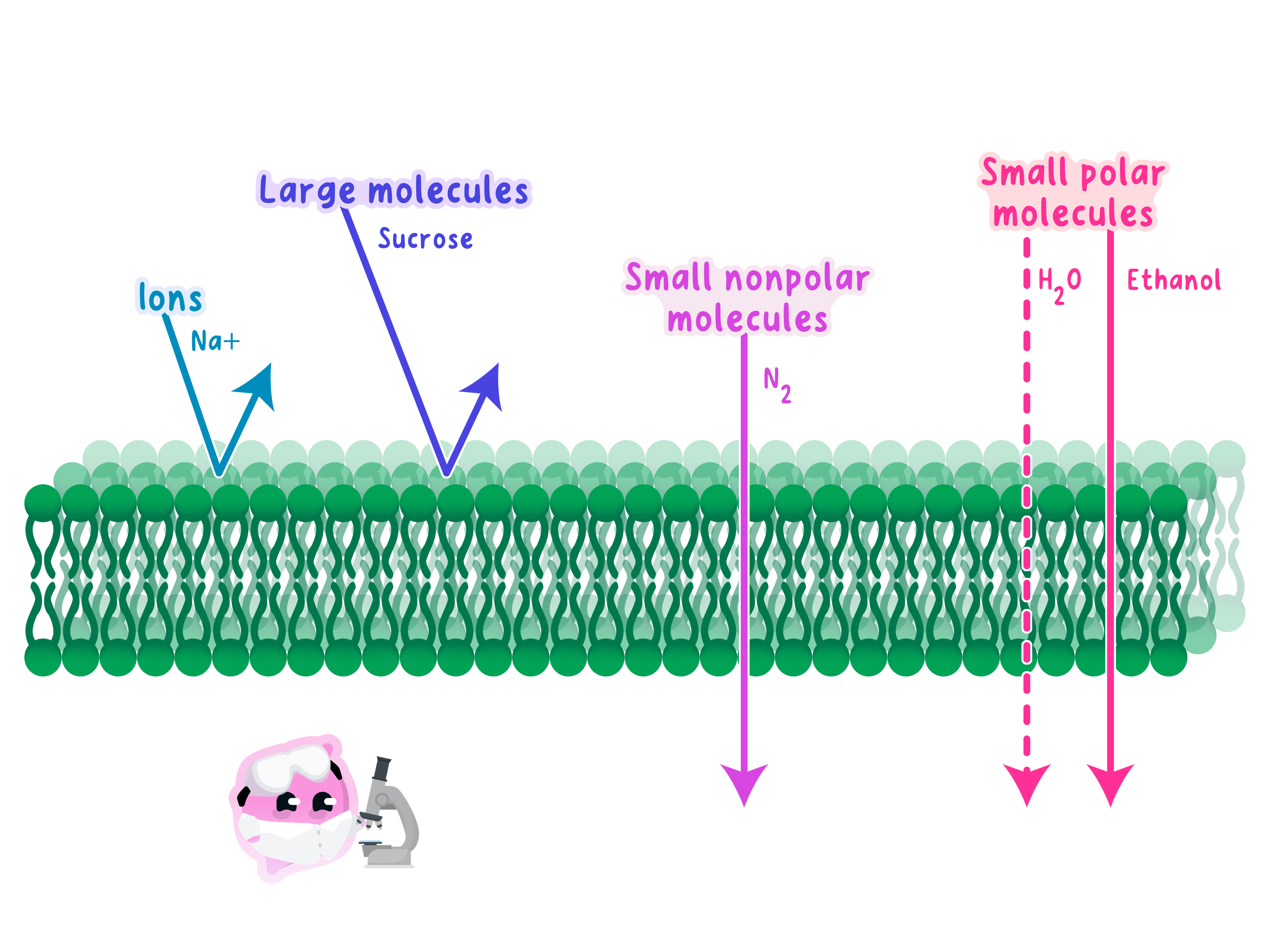
- The membrane is partially permeable, so some substances cross it freely while others cannot cross at all.
- Small molecules such as oxygen, carbon dioxide, water, glucose and urea are able to cross it.
- Large molecules such as starch and protein are too big to pass through.
- Charged particles such as mineral ions cross only through protein channels or carrier proteins built into the membrane.
- Three processes move substances across the membrane: diffusion, osmosis and active transport.
- Diffusion and osmosis are passive, which means the cell supplies no energy from respiration to make them happen.
- Active transport is the only one of the three that uses energy released by respiration.
Diffusion
Diffusion
The net movement of particles from a region of higher concentration to a region of lower concentration, down a concentration gradient, caused by the random movement of the particles.
Concentration gradient
The difference in the concentration of a substance between two regions.
- Every particle in a gas or a solution has kinetic energy, so it is always moving.
- Particles collide with one another and bounce off in new directions, so each individual particle moves at random.
- Where particles are crowded together, more of them happen to move away from that region than move into it.
- The overall result is a net movement from the region of higher concentration to the region of lower concentration.
- The difference in concentration between the two regions is the concentration gradient, and particles diffuse down the gradient.
- Diffusion is passive because the movement comes from the kinetic energy the particles already have, not from respiration.
- Net movement stops once the particles are evenly spread out, although the particles themselves never stop moving.
- A steeper concentration gradient increases the rate of diffusion, because the difference between the two regions is greater.
- A higher temperature increases the rate of diffusion, because the particles gain kinetic energy and move faster.
Substances moved by diffusion
- Oxygen diffuses from the blood into a respiring cell, because respiration inside the cell keeps the oxygen concentration there low.
- Carbon dioxide diffuses out of a respiring cell into the blood, because respiration keeps the carbon dioxide concentration inside the cell high.
- Glucose and amino acids diffuse from the small intestine into the blood while their concentration in the gut is higher than in the blood.
- Urea, made in the liver, diffuses out of liver cells into the blood plasma.
- In a leaf, carbon dioxide diffuses in through the stomata and oxygen diffuses out while photosynthesis is taking place.
- The direction is set only by the concentration gradient, so the same substance can move into a cell at one time and out of it at another.
Osmosis
Osmosis
The net movement of water molecules through a partially permeable membrane from a region of higher water potential to a region of lower water potential.
Water potential
A measure of how free the water molecules in a solution are to move, which is highest in pure water and falls as more solute is dissolved.
- Osmosis moves water only, and it happens only across a partially permeable membrane.
- A dilute solution contains many water molecules and little dissolved solute, so it has a high water potential.
- A concentrated solution contains fewer water molecules and more dissolved solute, so it has a low water potential.
- Water molecules are small enough to pass through the membrane, but the dissolved solute molecules are too large to follow them.
- Water molecules cross the membrane in both directions, but more cross from the dilute solution to the concentrated solution.
- The net movement of water is therefore from a region of higher water potential to a region of lower water potential.
- Osmosis is passive, so the cell uses no energy from respiration to move the water.
- Net movement stops when the water potential is the same on both sides of the membrane.
Osmosis in animal and plant cells
Turgid
Describing a plant cell that has gained water by osmosis until its vacuole and cytoplasm press the cell membrane firmly against the cell wall.
Plasmolysis
The pulling away of the cell membrane from the cell wall that happens when a plant cell loses so much water by osmosis that its vacuole and cytoplasm shrink.
- An animal cell placed in a dilute solution gains water by osmosis and swells.
- An animal cell has no cell wall, so nothing resists the pressure of the water entering it.
- A red blood cell placed in pure water takes in so much water that the membrane splits, which is called lysis.
- An animal cell placed in a concentrated solution loses water by osmosis, shrinks and develops a wrinkled surface.
- A plant cell placed in a dilute solution gains water, and the swollen vacuole pushes the cytoplasm and cell membrane hard against the cell wall.
- The cell is then turgid, and the pressure of many turgid cells is what holds a stem upright and keeps leaves spread out.
- The rigid cellulose cell wall resists that pressure, which is why a plant cell does not burst in pure water.
- A plant cell placed in a concentrated solution loses water, the vacuole shrinks and the cell becomes flaccid, so the plant wilts.
- If enough water is lost, the cell membrane pulls away from the cell wall and the cell is plasmolysed.
Osmosis in potato chips
- Aim: to investigate how the concentration of a sucrose solution affects the mass of potato tissue placed in it.
- Apparatus: one large potato, a cork borer of fixed diameter, a white tile, a scalpel, a ruler, six labelled boiling tubes in a rack, sucrose solutions of 0.00.00.0, 0.20.20.2, 0.40.40.4, 0.60.60.6, 0.80.80.8 and 1.0 mol dm−31.0\ \text{mol dm}^{-3}1.0 mol dm−3, a balance reading to 0.01 g0.01\ \text{g}0.01 g, forceps, paper towels, a marker pen and a stopclock.
- Variables: sucrose concentration is the independent variable, percentage change in mass is the dependent variable, and the potato used, the chip length, the chip diameter, the volume of solution, the temperature and the time in solution are all controlled.
- Method, preparing the chips:
- Push the cork borer through a single potato several times so that every cylinder has the same diameter, and take them all from the same potato so their starting water potential matches.
- Trim each cylinder on the white tile to exactly the same length, for example 40 mm40\ \text{mm}40 mm, and cut away any skin.
- Roll each chip once between two paper towels to remove surface liquid, then measure its mass to 0.01 g0.01\ \text{g}0.01 g and record it as the initial mass.
- Method, setting up:
- Label one boiling tube for each concentration and pour the same volume, for example 20 cm320\ \text{cm}^{3}20 cm3, into each one.
- Lower one chip into each tube with forceps so that it is completely covered, then start the stopclock.
- Leave every tube for the same time, typically 303030 minutes or overnight, standing in the same place so the temperature is the same for all of them.
- Method, measuring:
- Lift each chip out with forceps and blot it in exactly the same way, one roll between two fresh paper towels, because liquid left on the surface adds mass that never entered the cells.
- Reweigh each chip to 0.01 g0.01\ \text{g}0.01 g and record the value as the final mass.
- Use at least three chips at each concentration and calculate a mean percentage change in mass.
- What you see: a chip from the most dilute solution comes out longer, firm and heavier, while a chip from the most concentrated solution comes out shorter, floppy enough to bend between your fingers, and lighter.
- Maths: calculate percentage change in mass using change in massinitial mass×100\dfrac{\text{change in mass}}{\text{initial mass}}\times100initial masschange in mass×100, then plot percentage change on the vertical axis against concentration on the horizontal axis and draw a line of best fit.
- Reading the graph: the concentration at which the line of best fit crosses zero change is the concentration whose water potential equals that of the potato cells, because no net osmosis happens there.
- Watch out: use percentage change rather than change in mass, so that chips with slightly different starting masses can be compared fairly.
- Safety: cut on a white tile with the blade moving away from your fingers, and carry the cork borer with the sharp end pointing down.
Percentage change in mass
- A potato chip has a mass of 3.20 g3.20\ \text{g}3.20 g before it is placed in a 0.2 mol dm−30.2\ \text{mol dm}^{-3}0.2 mol dm−3 sucrose solution.
- After 303030 minutes the blotted chip has a mass of 3.44 g3.44\ \text{g}3.44 g.
- The change in mass is 3.44−3.20=+0.24 g3.44-3.20=+0.24\ \text{g}3.44−3.20=+0.24 g.
- Percentage change in mass =change in massinitial mass×100=\dfrac{\text{change in mass}}{\text{initial mass}}\times100=initial masschange in mass×100.
- Substituting gives 0.243.20×100=+7.5%\dfrac{0.24}{3.20}\times100=+7.5\%3.200.24×100=+7.5%.
- The mass increased, so water moved into the cells by osmosis, which means the sucrose solution had a higher water potential than the potato cells.
Active transport
Active transport
The movement of a substance across a cell membrane against its concentration gradient, using carrier proteins and energy released by respiration.
Carrier protein
A protein in a cell membrane that binds one particular substance and changes shape to carry it across the membrane.
- Active transport moves a substance against its concentration gradient, from where it is less concentrated to where it is more concentrated.
- The substance is carried by a carrier protein that spans the cell membrane.
- The substance binds to a site on the carrier protein that only its own shape fits.
- The carrier protein then changes shape and releases the substance on the other side of the membrane.
- Changing shape requires energy, and that energy is released by respiration in the mitochondria.
- Cells that carry out a great deal of active transport, such as root hair cells, contain large numbers of mitochondria.
- Active transport slows and then stops if respiration stops, for example when the oxygen supply to the cell is cut off.
- Mineral ions such as nitrate ions are taken into root hair cells from soil water, even though the soil water is far more dilute than the cell.
- Glucose is absorbed from the small intestine into the blood by active transport once the concentration in the gut has fallen below the concentration in the blood.
Comparing the three processes
- Diffusion moves any small molecule or dissolved substance down its concentration gradient and uses no energy from respiration.
- Osmosis moves water only, across a partially permeable membrane, from higher to lower water potential, and uses no energy from respiration.
- Active transport moves a substance against its concentration gradient using carrier proteins and energy from respiration.
- Only active transport can move a substance from a lower concentration to a higher concentration.
- Only osmosis is restricted to water and to a partially permeable membrane.
- All three supply a cell with the substances it needs and carry away the waste it produces.
Writing about transport
- Name the substance and both concentrations, for example that oxygen moves from the alveolus, where its concentration is higher, into the blood, where it is lower.
- Use the words net movement and down the concentration gradient in a diffusion answer, because the mark is often for one of those phrases.
- Write partially permeable in an osmosis answer rather than permeable or semi-permeable.
- State that active transport uses energy from respiration, since the word energy on its own is rarely enough for the mark.
- You are expected to use the term water potential but never to calculate it.
- Keep the plus or minus sign on a percentage change in mass, because the sign is what shows the direction of osmosis.
- Do not write that diffusion needs no energy at all, because it uses the kinetic energy of the particles themselves; what it needs no energy from is respiration.
- Do not define osmosis as water moving from a high concentration to a low concentration without saying concentration of what.
- Do not claim a plant cell bursts in pure water, because the cellulose cell wall resists the pressure.
- Do not confuse flaccid with plasmolysed; a flaccid cell has lost water, while a plasmolysed cell has lost so much that the membrane has pulled away from the wall.
- Do not pair the initial mass of one chip with the final mass of another when you calculate a percentage change.
- Do not describe root hair cells taking up mineral ions by diffusion, because the ions move from dilute soil water into a more concentrated cell.
- Define diffusion and explain what a concentration gradient is.
- Explain why diffusion and osmosis are described as passive.
- Define osmosis using the term water potential.
- Describe what happens to a red blood cell and to a plant cell placed in pure water.
- Explain how a root hair cell takes up nitrate ions from soil water that is more dilute than the cell.
- Calculate the percentage change in mass of a chip whose mass falls from 4.00 g4.00\ \text{g}4.00 g to 3.60 g3.60\ \text{g}3.60 g.
2.1.2 Mitosis and the cell cycle
The cell cycle
Cell cycle
The repeating sequence of events in which a cell grows, replicates its DNA, grows again and then divides to give two genetically identical daughter cells.
- Body cells divide by repeating a fixed sequence of events called the cell cycle.
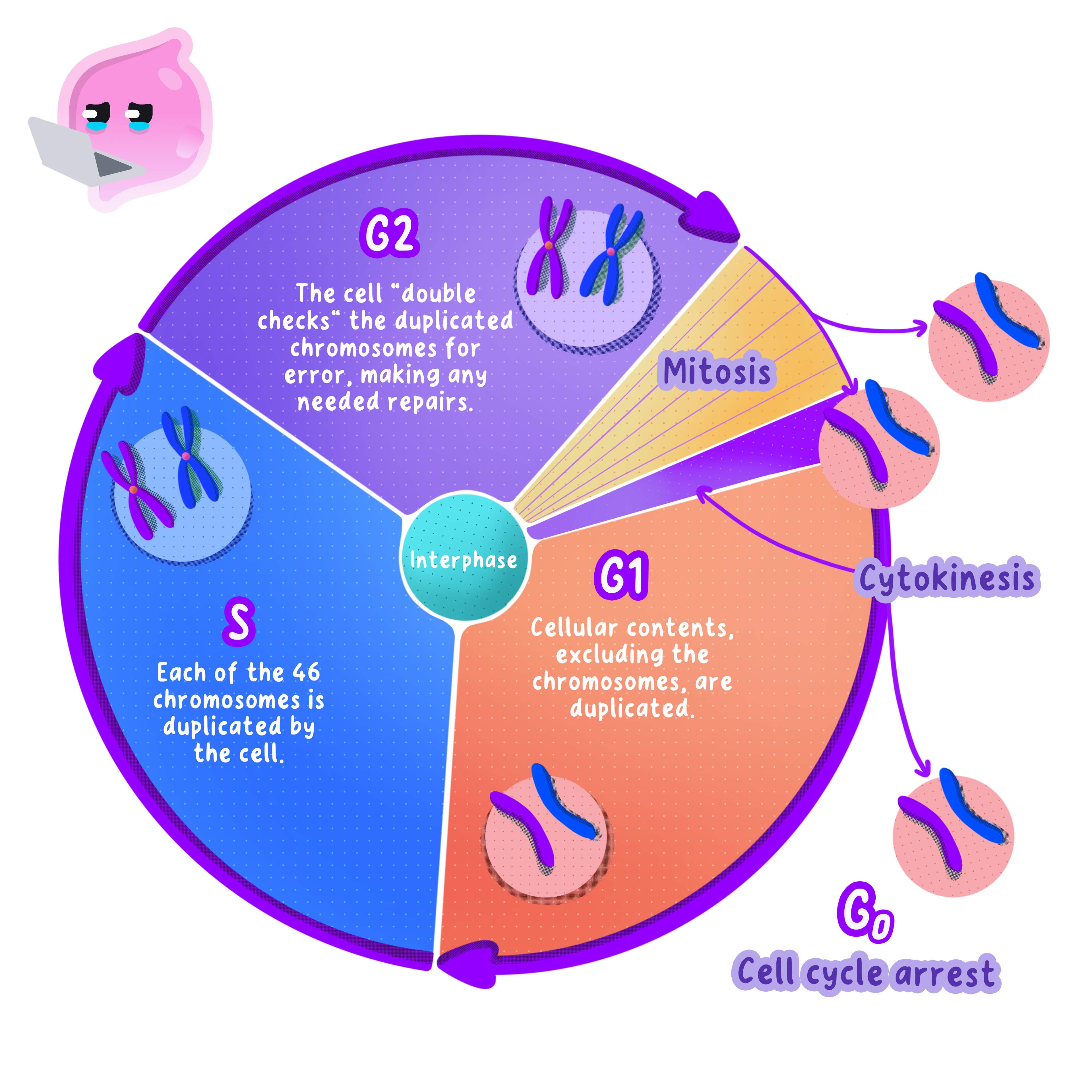
- The cycle runs in four steps: cell growth, DNA replication, more cell growth and then movement of the chromosomes as the cell divides.
- In the first step the cell grows and builds more sub-cellular structures, including extra mitochondria and ribosomes.
- In the second step every chromosome is copied, so the cell holds two identical copies of each one.
- In the third step the cell grows again and checks the copied DNA before committing to division.
- In the final step the copied chromosomes are moved to opposite ends of the cell during mitosis, and the cell then splits in two.
- One turn of the cycle produces two genetically identical daughter cells from one parent cell.
- How long a cycle takes depends on the cell: a cell lining the small intestine completes one in roughly 242424 hours, while a mature nerve cell may never divide again.
Interphase
Interphase
The stage of the cell cycle before division, in which the cell grows, replicates its DNA and makes extra sub-cellular structures.
- The first three steps of the cycle together are called interphase, and interphase takes up most of the cycle.
- The cell increases in size, so each daughter cell will be large enough to work normally.
- Extra mitochondria are made so that both daughter cells can release enough energy by respiration.
- Extra ribosomes are made so that both daughter cells can build the proteins they need.
- DNA replication copies every chromosome exactly, which is what allows both daughter cells to end up with identical genetic information.
- Under a microscope an interphase nucleus looks like an evenly stained blob, because the DNA is still unwound and no separate chromosomes can be picked out.
Chromosomes and chromatids
Chromosome
A chromosome is a structure made of a long DNA molecule associated with proteins that carries many genes.
Sister chromatids
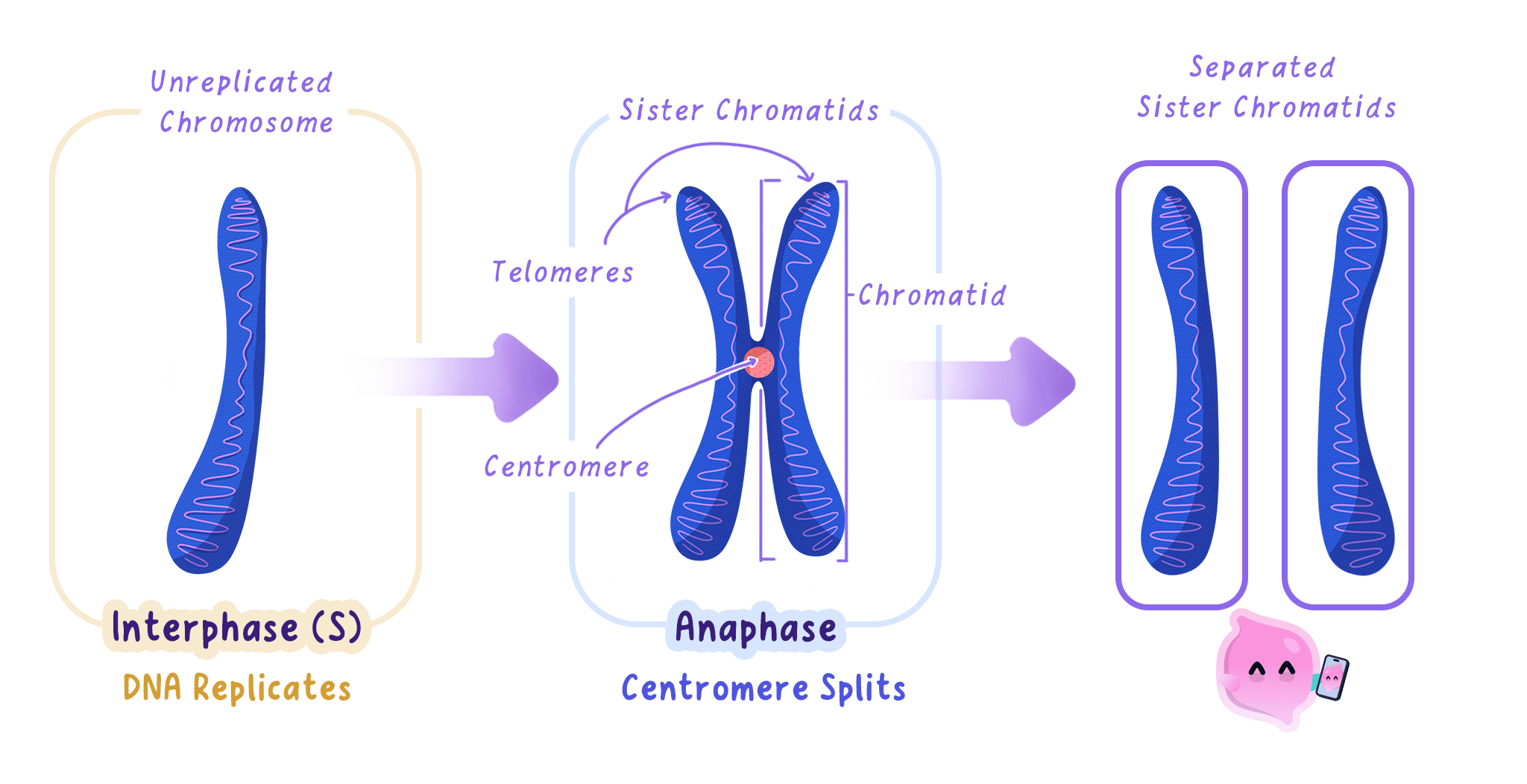
The two identical copies of a chromosome made during DNA replication, joined to each other at the centromere.
- A chromosome is a long molecule of DNA coiled around proteins, and it carries many genes.
- A human body cell contains 464646 chromosomes, arranged as 232323 pairs.
- During DNA replication each chromosome is copied to give two identical copies.
- The two copies stay joined at a narrow point called the centromere, and together they are called sister chromatids.
- A chromosome becomes visible only when it coils up tightly at the start of mitosis, which is why the familiar X shape is seen then and not during interphase.
Mitosis
Mitosis
Mitosis is the stage of the cell cycle in which the nucleus divides to produce two nuclei with identical sets of chromosomes.
- Mitosis is the stage in which the nucleus divides, and it runs through four phases: prophase, metaphase, anaphase and telophase.
- In prophase the chromosomes coil up until they are short and thick enough to be seen, and the membrane around the nucleus breaks down.
- Protein threads called spindle fibres form and stretch across the cell from one end to the other.
- In metaphase the chromosomes line up in a single row across the middle of the cell, and a spindle fibre attaches to the centromere of each one.
- In anaphase the spindle fibres shorten and pull the two sister chromatids of each chromosome apart, to opposite ends of the cell.
- Each separated chromatid now counts as a chromosome in its own right, so each end of the cell holds one complete set.
- In telophase a new nuclear membrane forms around each group of chromosomes, giving two nuclei, and the chromosomes uncoil again.
Cytokinesis
Cytokinesis
The final stage of the cell cycle, in which the cytoplasm and cell membrane divide to form two separate daughter cells.
- Once the nucleus has divided, the cytoplasm and cell membrane divide as well.
- In an animal cell the membrane pinches inwards around the middle until the cell is cut in two.
- In a plant cell a new cell wall and membrane are built across the middle instead, because the rigid wall cannot pinch inwards.
- The mitochondria, ribosomes and other structures built during interphase are shared between the two new cells.
- The result is two daughter cells, each holding a full set of chromosomes identical to those of the parent cell.
Why mitosis matters
- Mitosis increases the number of cells, which is how a multicellular organism grows.
- Mitosis repairs damaged tissue, for example when skin cells divide to close a cut.
- Mitosis replaces cells that wear out, such as the lining of the small intestine, which is renewed every few days.
- In plants, mitosis in the root and shoot tips is what makes roots and stems longer.
- Because every daughter cell is genetically identical, every body cell of an organism carries the same genetic information.
- For the same reason, mitosis on its own cannot produce genetic variation.
Observing mitosis in root tip cells
- Aim: to prepare a stained squash of a growing root tip and identify cells in the phases of mitosis.
- Apparatus: garlic cloves or onion bulbs grown over water, a watch glass, forceps, a scalpel, a white tile, 1 mol dm−31\ \text{mol dm}^{-3}1 mol dm−3 hydrochloric acid, a water bath at 60 ∘C60\ ^{\circ}\text{C}60 ∘C, distilled water, toluidine blue or acetic orcein stain, a microscope slide and cover slip, a mounted needle, filter paper, a pencil with a rubber end and a light microscope.
- Method, growing the roots:
- Suspend a garlic clove or onion bulb so that its flat base just touches the surface of the water in a beaker.
- Leave it at room temperature for three to five days, until the new roots are 222 to 3 cm3\ \text{cm}3 cm long.
- Method, preparing the slide:
- Cut off the final 5 mm5\ \text{mm}5 mm of a root with a scalpel on a white tile, because the dividing cells sit in the meristem just behind the root cap.
- Place the tip in a watch glass with a few drops of 1 mol dm−31\ \text{mol dm}^{-3}1 mol dm−3 hydrochloric acid and warm it at 60 ∘C60\ ^{\circ}\text{C}60 ∘C for about five minutes, which breaks down the pectin holding the cells together so they can later be spread out.
- Rinse the tip in distilled water and blot it, so the acid stops acting and does not spoil the stain.
- Transfer the tip to a slide, add a few drops of toluidine blue or acetic orcein and leave it for about two minutes, because the stain binds to DNA and makes the chromosomes show up dark against the pale cytoplasm.
- Lower a cover slip onto the tip with a mounted needle, one edge first, so that no air bubbles are trapped.
- Cover the slide with filter paper and press straight down with your thumb or the rubber end of a pencil, without twisting, to squash the tip into a single layer of cells that light can pass through.
- Method, viewing:
- Start on the lowest power objective and find the region where the cells are small, square and densely stained.
- Switch to a higher power objective and refocus with the fine adjustment only.
- What you see: most cells show one plain dark nucleus and are in interphase, while a smaller number show dark thread-like chromosomes, some lined up across the middle and some being drawn towards the ends.
- Maths: count at least 100100100 cells and calculate the mitotic index using number of cells in mitosistotal number of cells×100\dfrac{\text{number of cells in mitosis}}{\text{total number of cells}}\times100total number of cellsnumber of cells in mitosis×100.
- Watch out: press vertically and never twist the cover slip, because twisting tears the cells apart and breaks up the chromosomes you are trying to count.
- Safety: hydrochloric acid is an irritant, so wear eye protection and wash any splashes off at once, and cut away from your fingers on a tile.
Calculating a mitotic index
- A student counts 120120120 cells in one field of view of a stained root tip squash.
- Of those, 181818 cells show visible chromosomes and are therefore in mitosis.
- Mitotic index =number of cells in mitosistotal number of cells×100=\dfrac{\text{number of cells in mitosis}}{\text{total number of cells}}\times100=total number of cellsnumber of cells in mitosis×100.
- Substituting gives 18120×100=15%\dfrac{18}{120}\times100=15\%12018×100=15%.
- The other 85%85\%85% of the cells are in interphase, which confirms that interphase takes up most of the cell cycle.
- If one full cycle lasts 202020 hours, mitosis lasts about 0.15×20=3.00.15\times20=3.00.15×20=3.0 hours.
Describing the cell cycle
- Give the steps of the cycle in order and say what happens in each, because a list of names on its own rarely scores.
- Write genetically identical rather than the same, since the mark is for the genetic point.
- Say that the DNA is replicated before mitosis begins, not during it.
- Describe anaphase as chromatids being pulled apart by spindle fibres, and name the centromere as the point they attach to.
- Give a mitotic index as a percentage unless the question asks for a decimal, and show the division before you multiply by 100100100.
- Do not say the chromosome number halves in mitosis, because each daughter cell receives a full set.
- Do not confuse mitosis with meiosis; mitosis gives two identical cells with a full set of chromosomes, while meiosis gives four non-identical sex cells with half a set.
- Do not describe chromosomes as being split down the middle, because the two chromatids are separated whole.
- Do not call the whole cell cycle mitosis, because mitosis is only the stage in which the nucleus divides.
- Do not expect to see chromosomes in an interphase cell, because the DNA is still unwound at that point.
- Name the steps of the cell cycle in order and say what happens in each.
- Explain why the DNA must be replicated before the cell divides.
- Describe what happens to the chromosomes in metaphase and in anaphase.
- Explain how the two daughter cells compare with the parent cell.
- Calculate the mitotic index of a root tip in which 242424 of 150150150 counted cells are in mitosis.
2.1.3 Importance of cell differentiation
Cell differentiation
Differentiation
The process by which an unspecialised cell develops the structures and shape it needs to carry out one particular function.
Specialised cell
A cell whose structure is adapted so that it carries out one particular function efficiently.
- Every cell in a multicellular organism starts out unspecialised, with no particular job to do.
- Differentiation is the process that turns an unspecialised cell into a specialised cell.
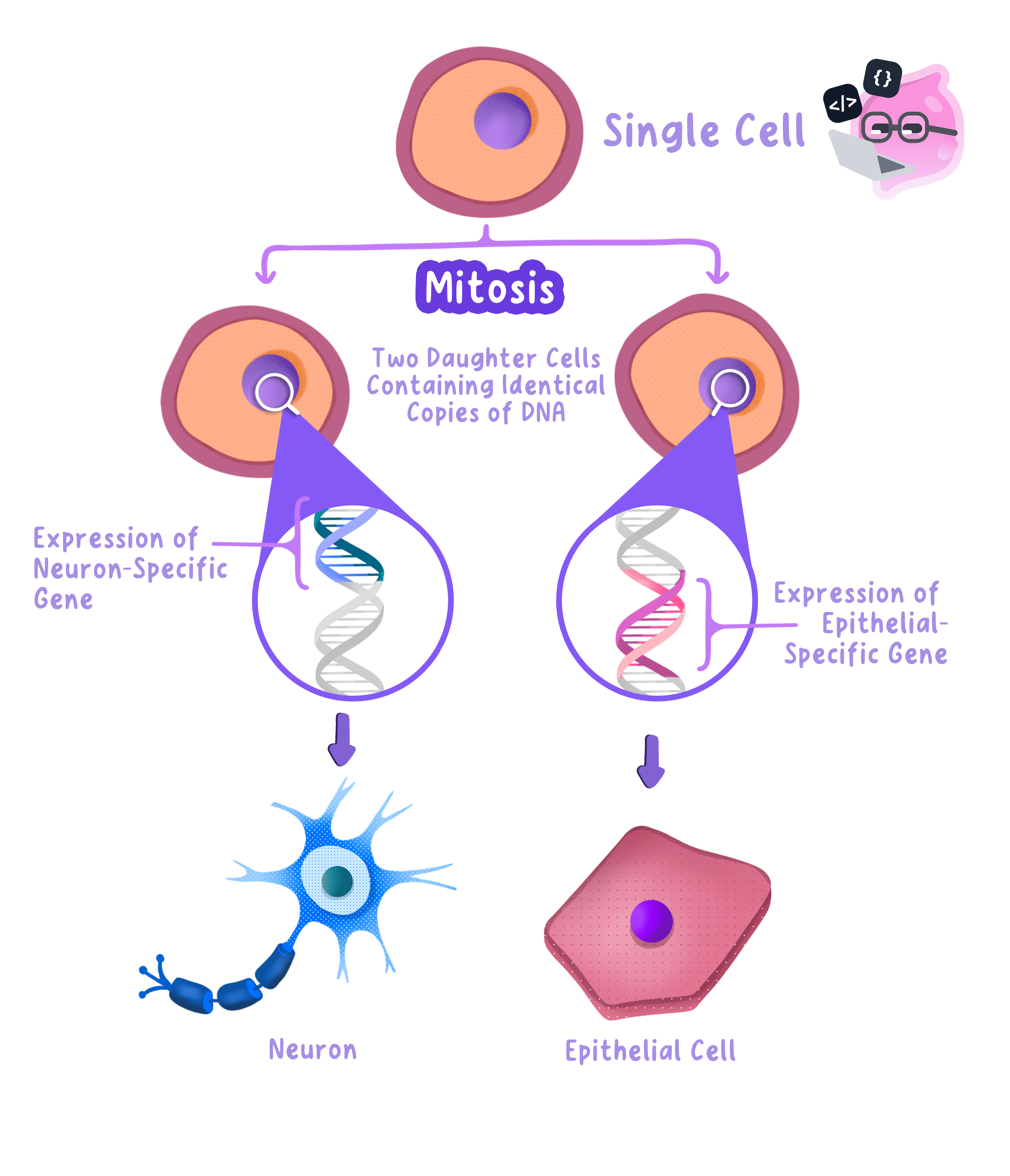
- All the body cells of one organism carry the same genes, because they were all produced from a single fertilised egg cell by mitosis.
- Cells end up different because only some of those genes are switched on in each cell type, and the rest stay switched off.
- The proteins built from the genes that are switched on determine the cell's structure and what it is able to do.
- As a cell differentiates it changes shape and builds the sub-cellular structures its job requires, such as extra mitochondria or extra chloroplasts.
- A cell divides first and differentiates afterwards, so cell division and differentiation are two separate processes.
- In most animal cells the change cannot be undone; once a cell has specialised it stays that type for the rest of its life.
Why specialised cells make organisms more efficient
Tissue
A group of specialised cells of similar type working together to carry out a shared function.
- An unspecialised cell has to carry out every process at once, and does none of them particularly well.
- A specialised cell carries out one job, so its whole structure can be shaped around that single job.
- Sharing the work between different cell types is called division of labour, and it means each process is carried out faster and more effectively than one cell could manage alone.
- Cells of the same type group together into a tissue, different tissues combine into an organ, and organs work together in an organ system.
- Muscle cells form muscle tissue, muscle tissue helps form the heart, and the heart works with the blood vessels as the circulatory system.
- This organisation allows an organism to grow large, because whole regions of the body can be given over to one task.
- Differentiation is therefore what makes complex multicellular life possible, since a large organism cannot rely on every cell doing everything.
Specialised animal cells
- A red blood cell is a biconcave disc with no nucleus, so there is more room for haemoglobin and a larger surface area for absorbing oxygen.
- A sperm cell has a tail for swimming, many mitochondria to release the energy that swimming needs, and an enzyme-filled acrosome that digests a path through the membrane of the egg cell.
- A nerve cell is extremely long and has branched endings, so it carries electrical impulses over long distances and connects to many other cells.
- A muscle cell contains protein fibres that slide over one another to shorten the cell, and many mitochondria to supply the energy for contraction.
- A ciliated epithelial cell carries hair-like cilia on its surface that beat together to sweep mucus and trapped dirt out of the airways.

Specialised plant cells
- A root hair cell has a long, thin extension that greatly increases the surface area touching soil water, and many mitochondria to power the uptake of mineral ions.
- A xylem vessel is a hollow tube of dead cells with no end walls and with walls strengthened by lignin, so water flows up it freely and the tube does not collapse.
- A phloem sieve tube keeps its end walls but they are perforated with pores, so dissolved sugars can pass from one cell to the next.
- A palisade mesophyll cell is tall, box-shaped and packed with chloroplasts, and sits near the upper surface of the leaf where the light is strongest.
- A guard cell is kidney-shaped and works in a pair to open and close a stoma, which controls gas exchange and water loss.
- In every one of these cells the shape and the sub-cellular structures follow directly from the job the cell has to do.
When cells differentiate
- In animals, most cells differentiate at an early stage of development, while the embryo is still forming.
- Once an animal is mature, cell division is used mainly to repair damage and replace worn-out cells rather than to produce new cell types.
- In plants, many cells keep the ability to differentiate throughout the plant's life.
- This is why a plant can go on producing new roots, shoots and leaves for as long as it is alive.
- It is also why a cutting taken from a plant can grow into a whole new plant, while a piece cut from an animal cannot.
Examining specialised cells
- Aim: to observe a range of specialised cells with a light microscope and link the features you can see to the job each cell does.
- Apparatus: a light microscope, prepared slides of a blood smear, ciliated epithelium, striated muscle and a transverse section through a leaf, an onion bulb, forceps, a scalpel, a white tile, slides and cover slips, iodine solution, a mounted needle and paper towel.
- Method, viewing the prepared slides:
- Start each slide on the lowest power objective, find a clear patch of tissue, then move to a higher power and refocus with the fine adjustment only.
- Close the diaphragm slightly for the pale unstained slides, because faint outlines show up better in less light.
- For each slide write down one feature you can actually see and the job it does, such as the dark fringe of cilia along one edge of an epithelial cell.
- Method, preparing your own slide of plant cells:
- Snap an onion scale in half and peel a single layer of epidermis from the inner surface with forceps, so the tissue is one cell thick and light can pass through it.
- Lay the piece out flat in a drop of water on a slide, taking care that it does not fold back on itself.
- Add one drop of iodine solution, which stains the nucleus of each cell so it can be picked out from the cytoplasm.
- Lower the cover slip from one edge with a mounted needle to keep air bubbles out, then blot the excess liquid away.
- What you see: red blood cells appear as pale pink discs with a lighter centre and no nucleus, ciliated cells carry a dark fringe along one edge, muscle fibres are long with faint stripes, palisade cells in the leaf section are tall and crowded with green chloroplasts near the upper surface, and onion epidermis cells are brick-shaped with a clear wall and a single stained nucleus.
- Recording: draw only what you can see, using clean single lines and no shading, label each structure with a ruled straight line, and write down the magnification you used.
- Watch out: an air bubble has a thick black rim and a bright centre, and is easily mistaken for a cell.
- Safety: iodine solution stains skin and clothing, and the scalpel should always be drawn away from your fingers on a tile.
Linking structure to function
- A cell from the lining of the small intestine is covered in thousands of tiny folds and contains an unusually large number of mitochondria.
- The folds increase the surface area of the cell membrane.
- A larger surface area means more digested food molecules can be absorbed in the same time.
- The mitochondria release energy by respiration.
- That energy powers active transport, which lets the cell take in glucose even once the concentration in the gut has fallen below the concentration inside the cell.
- A full answer therefore names the feature, states what it does and links it to the job of the cell.
Explaining a specialised cell
- Name the feature, say what it does, then link it to the cell's job, because a feature listed on its own is a description and not an explanation.
- Write surface area rather than bigger, and follow it with what the larger surface area is used for.
- When you mention mitochondria, say that they release energy by respiration and then say what that energy is used for in this particular cell.
- Explain differentiation as different genes being switched on, never as a cell gaining or losing genes.
- If a question shows you an unfamiliar cell, work from its shape and its sub-cellular structures rather than trying to recall it.
- Do not say a specialised cell has different genes from other body cells; it has the same genes with a different set of them switched on.
- Do not describe a mature red blood cell as having a small nucleus, because it has no nucleus at all.
- Do not confuse a cell with a tissue; a tissue is a group of similar cells working together.
- Do not write that every plant cell can still differentiate, because the ability is kept only in certain regions of the plant.
- Do not treat differentiation and cell division as the same process, because a cell divides first and differentiates afterwards.
- Define differentiation and explain how cells with identical genes end up different from one another.
- Explain why specialised cells make an organism more efficient.
- Describe two features of a red blood cell and give the function of each.
- Describe how a root hair cell and a palisade mesophyll cell are each adapted to their job.
- State one difference between animals and plants in when their cells differentiate.
2.1.4 Stem cells
Stem cells
Stem cell
An undifferentiated cell that can divide to make more cells of the same kind and can differentiate into specialised cells.
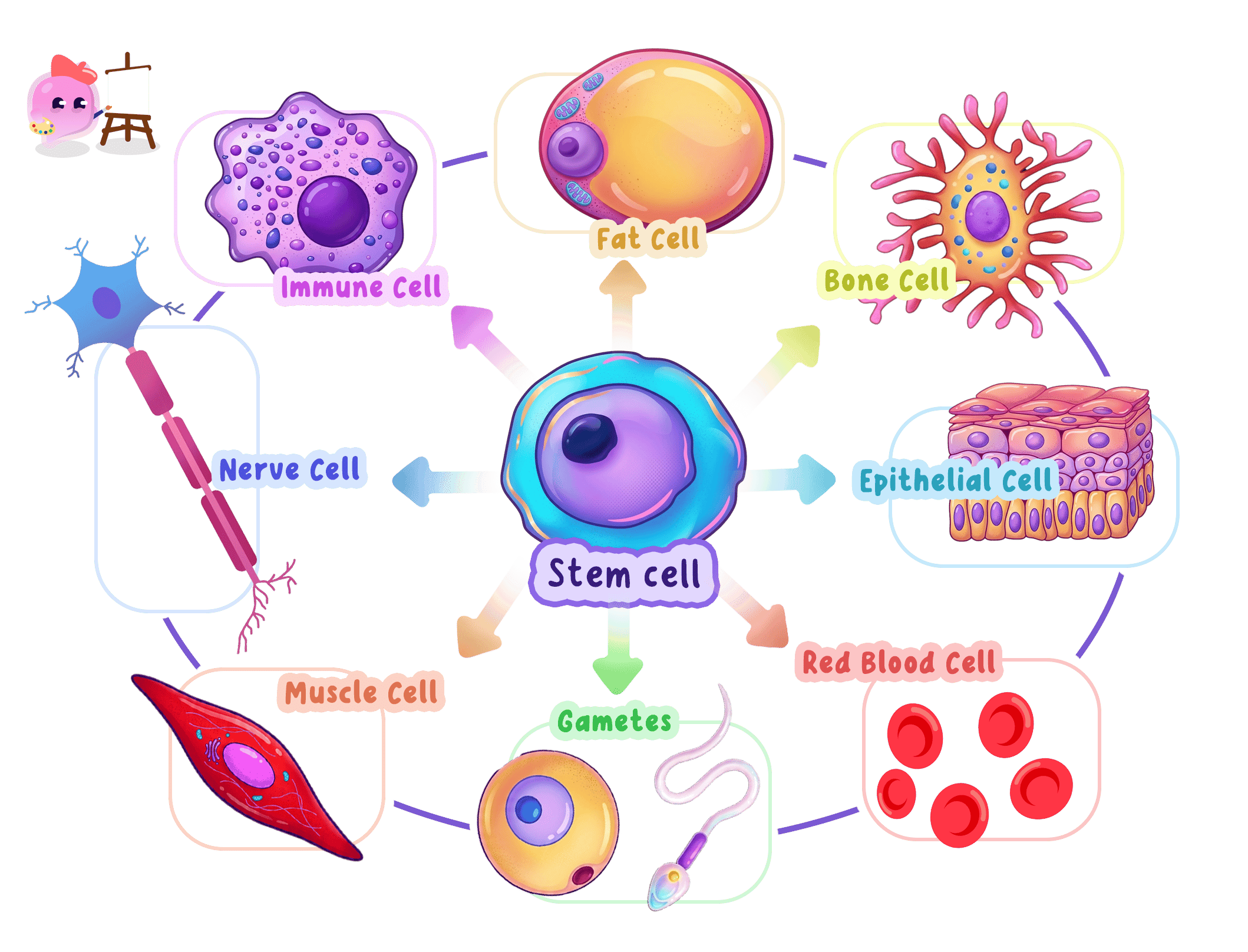
- A stem cell is undifferentiated, which means it has not developed the features of any particular cell type.
- Two abilities define a stem cell: it can divide by mitosis to make more cells like itself, and it can differentiate into specialised cells.
- Dividing to produce more stem cells keeps a supply available for the organism to draw on later.
- Differentiating works the same way as in any other cell: a different set of genes is switched on for each cell type produced.
- Animals have stem cells in early embryos and in a few adult tissues, and plants have them in tissues called meristems.
- The range of cell types a stem cell can produce depends on where it comes from.
Embryonic stem cells
Embryonic stem cell
A stem cell taken from an early embryo that can differentiate into any type of cell in the body.
- In animals, stem cells are present in the early embryo, from the first few divisions of a fertilised egg cell onwards.
- About five days after fertilisation the embryo is a hollow ball of cells, and the stem cells lie in a cluster inside it.
- Embryonic stem cells can differentiate into any type of cell found in the body.
- Their function is to produce every cell type the growing organism needs, so they drive the development of the whole animal from a single cell.
- They divide rapidly, which is how an embryo builds up the huge number of cells a body needs.
- As development continues the cells commit to particular tissues and lose the ability to become any cell type.
Adult stem cells
Adult stem cell
A stem cell found in certain tissues of a fully developed animal that can differentiate into only a limited range of cell types.
- Adult stem cells are present in certain tissues of a fully grown animal, most importantly in the bone marrow.
- Bone marrow stem cells divide and then differentiate into the different types of blood cell, including red blood cells and white blood cells.
- They are also found in the skin, where they replace the surface cells rubbed away every day, and in the lining of the small intestine, which is renewed every few days.
- Their function is growth and repair: they replace cells that are worn out, damaged or lost.
- Adult stem cells can differentiate into only a limited range of cell types, usually the types found in the tissue they came from.
- A stem cell from bone marrow can become a red blood cell or a white blood cell, but it cannot become a nerve cell.
Differences between embryonic and adult stem cells
- Embryonic stem cells come from an early embryo, while adult stem cells come from tissues of a fully developed animal.
- Embryonic stem cells can form any type of cell, while adult stem cells can form only a limited range of types.
- Embryonic stem cells exist only during early development, while adult stem cells remain in the body throughout life.
- Embryonic stem cells divide rapidly and in large numbers, while adult stem cells are present in small numbers and divide more slowly.
- Embryonic stem cells build the whole organism, while adult stem cells maintain and repair tissues that already exist.
Meristems in plants
Meristem
A region of a plant, found at the tips of roots and shoots, in which cells divide and can differentiate into any type of plant cell throughout the plant's life.
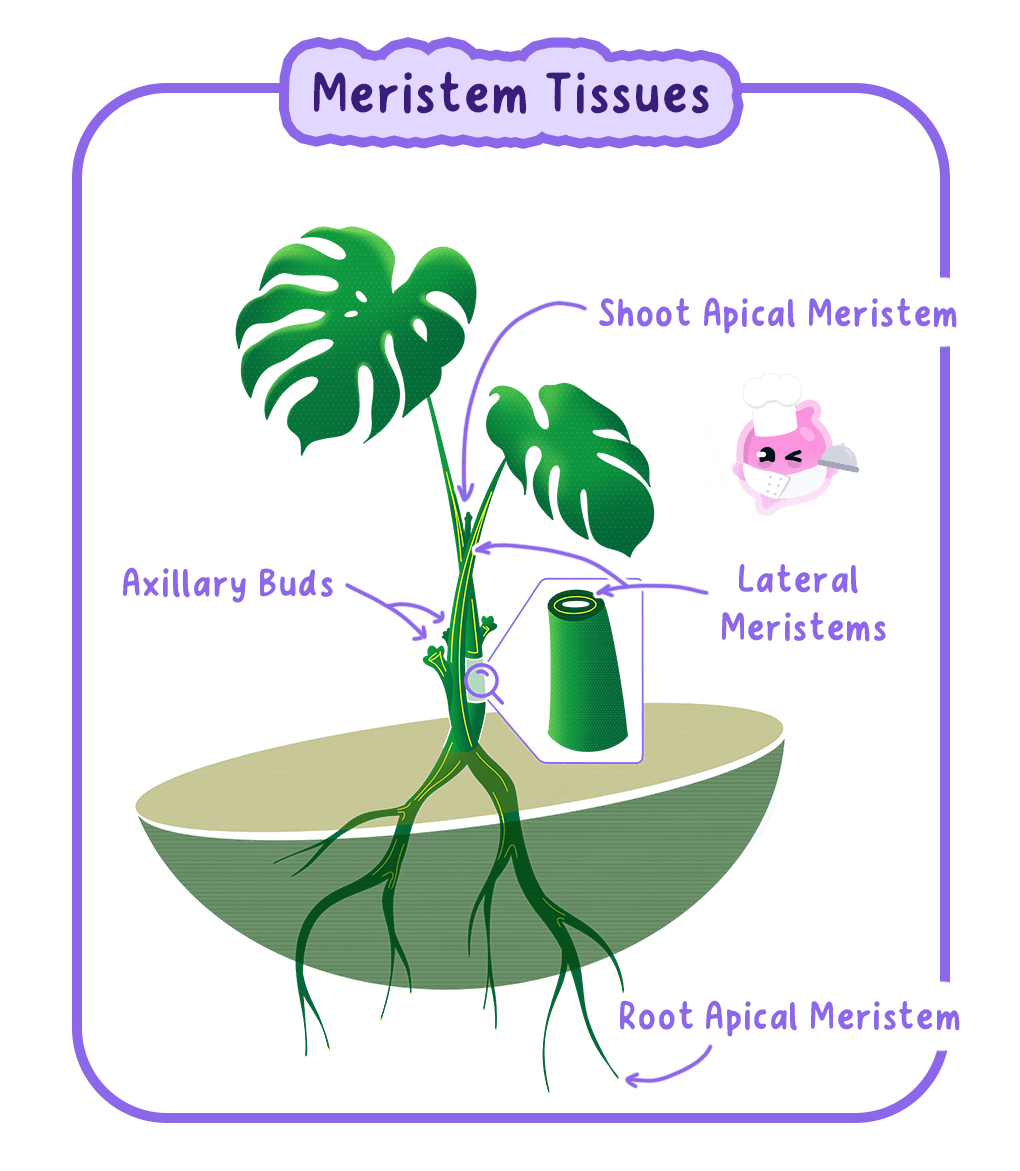
- Plant stem cells are found in tissues called meristems.
- Meristems sit at the tips of roots and shoots, and in a ring of tissue called the cambium inside stems and roots.
- Meristem cells divide by mitosis throughout the whole life of the plant, which is why a plant never stops being able to grow.
- Cells produced at a root tip or shoot tip first grow longer, and this pushes the tip further into the soil or up towards the light.
- Meristem cells can differentiate into any type of plant cell, including xylem vessels, phloem sieve tubes, palisade cells and root hair cells.
- Cambium cells differentiate into new xylem and phloem, which is what makes a stem or root grow thicker.
- Because meristem cells keep this ability, a small piece of meristem tissue can be grown into a complete new plant that is genetically identical to the parent, a clone.
Cloning cauliflower from meristem tissue
- Aim: to grow genetically identical plantlets from small pieces of cauliflower meristem tissue.
- Apparatus: a fresh cauliflower, a scalpel, forceps, a white tile, a sterilising solution such as dilute bleach, sterile distilled water, universal bottles of sterile agar growth medium containing nutrients and plant hormones, a Bunsen burner, ethanol for flaming the instruments, a marker pen and a warm, well-lit place at about 25 ∘C25\ ^{\circ}\text{C}25 ∘C.
- Method, working cleanly:
- Wipe the bench with disinfectant and wash your hands, because a single bacterial or fungal spore will grow far faster than the plant tissue and take over the medium.
- Dip the scalpel and forceps in ethanol, pass them briefly through the Bunsen flame and let them cool before touching any tissue.
- Method, preparing the tissue:
- Cut small florets about 5 mm5\ \text{mm}5 mm across from the surface of the cauliflower head, because the tip of each floret is a shoot meristem full of undifferentiated cells.
- Leave the florets in sterilising solution for about 151515 minutes to kill the microorganisms living on their surface.
- Rinse them three times in sterile distilled water, since any sterilising solution left behind would kill the plant tissue as well.
- Method, growing them on:
- Lift each floret with sterile forceps, stand it upright on the surface of the agar growth medium and replace the cap immediately.
- Label each bottle, then leave them closed at about 25 ∘C25\ ^{\circ}\text{C}25 ∘C in the light for several weeks.
- Why it works: the meristem cells are undifferentiated, so the hormones in the medium make them divide and then differentiate into roots and shoots.
- What you see: a successful explant swells, turns green and pushes out fine white roots and a tiny shoot, while a contaminated one grows fuzzy mould or a cloudy film and has to be discarded without opening it.
- Results: every plantlet produced is a clone of the parent cauliflower, so all of them carry identical genes.
- Watch out: keep every bottle closed except during the transfer itself, because most failures come from contamination rather than from the tissue.
- Safety: bleach is corrosive, so wear eye protection and gloves, tie hair back near the Bunsen flame, and never return a lit instrument to the ethanol.
Answering on stem cells
- Define a stem cell using both of its abilities, since an answer that only says it can turn into other cells usually loses a mark.
- Use the word undifferentiated when you describe what a stem cell is.
- Give both the location and the range of cell types when a question asks you to compare embryonic and adult stem cells.
- Name meristem as the tissue and the root tip or shoot tip as the place when a question asks where plant stem cells are found.
- In a comparison, write about both sides in one sentence, such as embryonic stem cells forming any cell type while adult stem cells form only a limited range.
- Do not describe a stem cell as one that has already specialised, because a stem cell is undifferentiated.
- Do not say adult stem cells are found in every tissue, because they are present only in certain tissues such as bone marrow and skin.
- Do not claim adult stem cells can form any type of cell; only embryonic stem cells and plant meristem cells can do that.
- Do not use the word meristem for animal tissue, because meristems are found only in plants.
- Do not confuse an embryonic stem cell with a fertilised egg cell, because the stem cells appear only after the egg has divided several times.
- Give the two abilities that define a stem cell.
- State where embryonic stem cells and adult stem cells are each found in an animal.
- Describe the function of the adult stem cells in bone marrow.
- Explain two differences between embryonic and adult stem cells.
- Describe where meristems are found and what the cells in them are able to do.
