Cutting the gene out of the DNA
Restriction enzyme
A restriction enzyme is an enzyme that cuts DNA at one specific sequence of bases.
Sticky end
A sticky end is the short length of unpaired bases left at the edge of a piece of DNA that has been cut by a restriction enzyme.
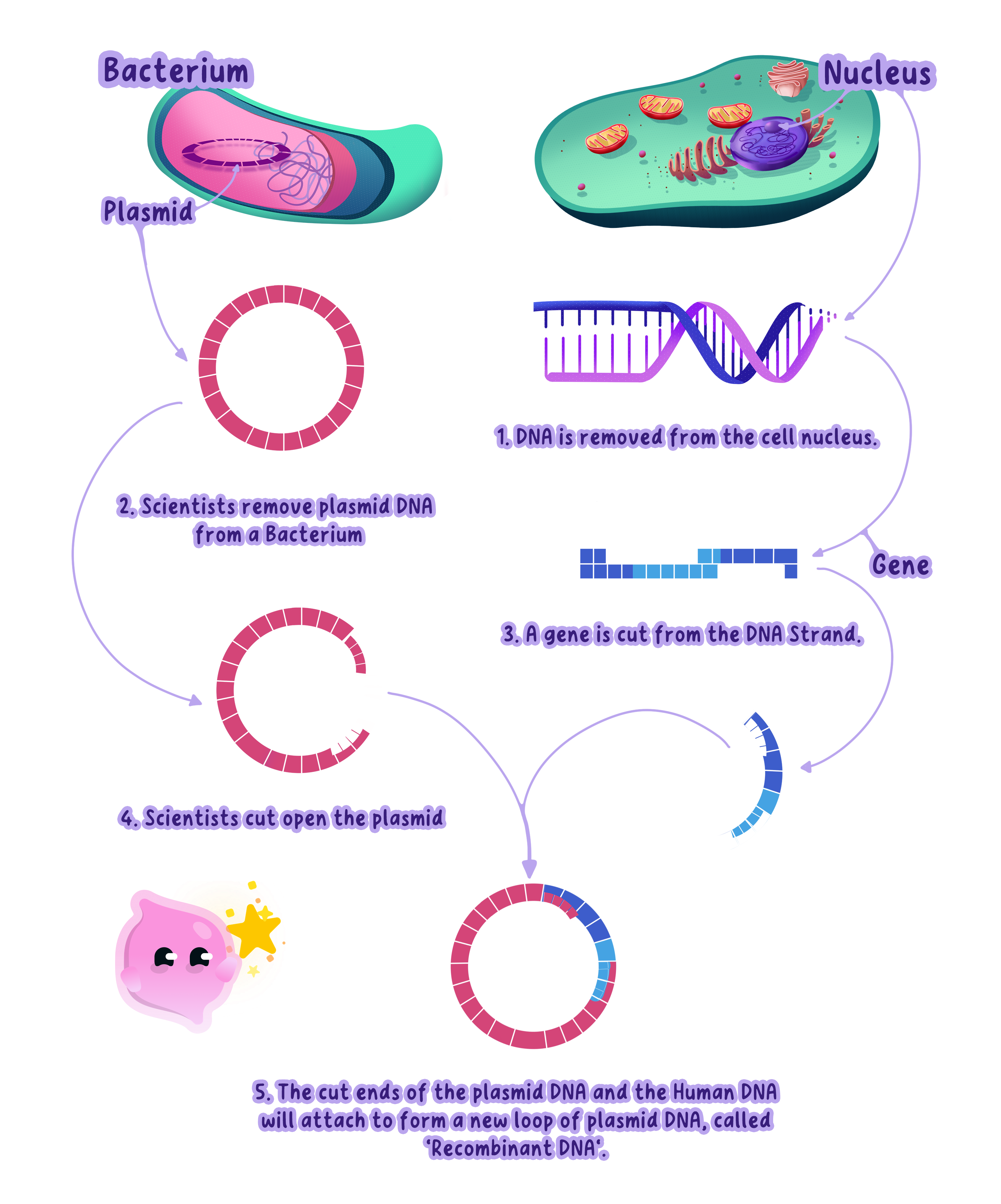
- The first step is to find which chromosome carries the required gene and where along that chromosome it lies, so that the correct length of DNA is taken.
- A restriction enzyme is then used to cut the DNA, and each restriction enzyme cuts only where it finds one specific sequence of bases called its recognition site.
- Because the enzyme cuts at a fixed sequence, the same gene is cut out in the same place every time, which is what makes the process repeatable.
- The cut is staggered, so the two strands of the double helix are cut a few bases apart rather than straight across.
- That leaves a short length of unpaired bases on each end of the cut piece, and these are the sticky ends.
- Sticky ends matter because unpaired bases can form hydrogen bonds with a complementary set of unpaired bases, so the gene can later be fitted into another piece of DNA.
Cutting open the vector
Vector
A vector is a piece of DNA, usually a plasmid or a virus, that is used to carry a gene into a host cell.
Plasmid
A plasmid is a small circular loop of DNA in a bacterial cell that is separate from the main bacterial chromosome.
- A vector is a piece of DNA used to carry a gene into a host cell, and the two vectors used are plasmids and viruses.
- A plasmid is a small circular loop of DNA found in a bacterial cell, separate from the single large bacterial chromosome.
- Plasmids are convenient vectors because they are small, they are easy to take out of and put back into bacteria, and they are copied by the bacterium along with its own DNA.
- A virus can be used instead, because a virus naturally injects its own genetic material into a host cell, and the required gene is carried in with it.
- The plasmid is cut open using the same restriction enzyme that was used to cut out the gene.
- Using the same enzyme is essential, because it leaves sticky ends on the plasmid whose unpaired bases are complementary to those on the gene, so the two fit together and no other fragment does.
Joining the gene into the vector
DNA ligase
DNA ligase is an enzyme that joins two pieces of DNA together by sealing the gaps in their sugar-phosphate backbones.
Recombinant DNA
Recombinant DNA is a single DNA molecule made by joining together DNA from two different organisms.
- The cut gene and the cut plasmid are mixed, and the sticky ends pair up by complementary base pairing, with adenine pairing to thymine and cytosine pairing to guanine.
- Base pairing alone holds the pieces together only weakly, because the sugar-phosphate backbone of each strand is still broken.
- DNA ligase is added, and this enzyme seals those breaks so the gene becomes a permanent part of the circular plasmid.
- The result is recombinant DNA, a single molecule made from the DNA of two different organisms.
- Do not swap the two enzymes, because a restriction enzyme cuts DNA and DNA ligase joins it.
- Do not write that a different restriction enzyme is used on the plasmid, since the sticky ends would not be complementary and the gene would not fit.
Transferring the plasmid into host bacteria
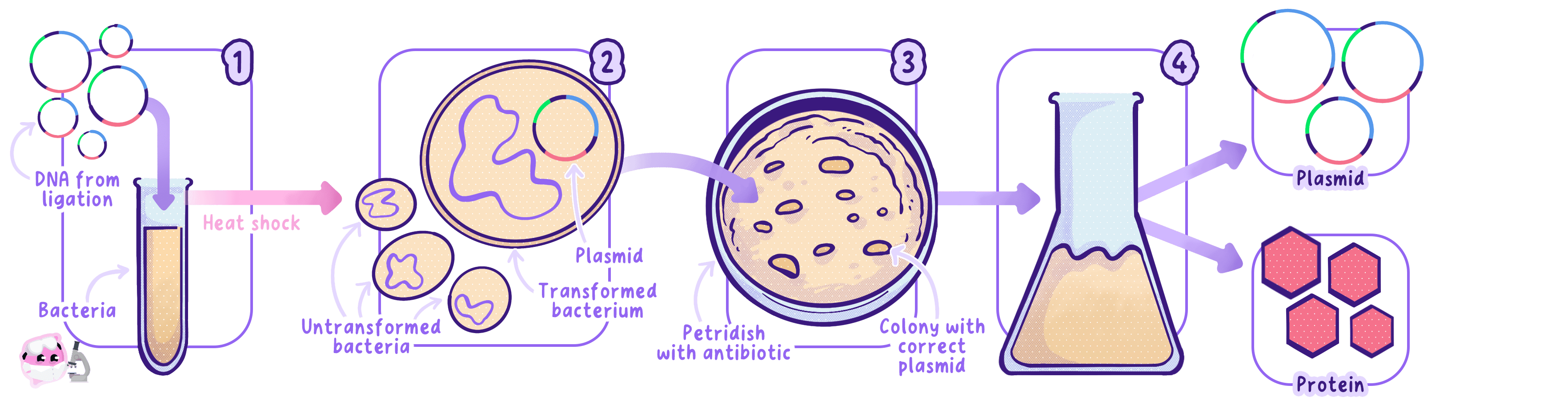
- The recombinant plasmids are mixed with host bacteria in a solution containing calcium ions, which makes the bacterial cell membrane more permeable.
- The mixture is given a brief heat shock, and some of the bacteria take a plasmid in through the membrane, which is called transformation.
- Only a small proportion of the bacteria take up a plasmid, so the mixture contains transformed and untransformed cells together.
- Bacteria are used as hosts because they reproduce roughly every twenty minutes, so a few transformed cells become millions within a day, each carrying a copy of the gene.
Selecting the bacteria that took up the gene
Marker gene
A marker gene is a gene added to a vector, such as one for antibiotic resistance, that allows the host cells which have taken up the vector to be identified.
- A marker gene is added to the plasmid alongside the required gene before the transfer, and the marker used is usually a gene for resistance to a named antibiotic.
- Every bacterium that takes up the plasmid therefore takes up the resistance gene as well, so it can survive that antibiotic while untransformed bacteria cannot.
- All of the bacteria are spread over agar that contains the antibiotic, and the plates are left in a warm incubator.
- Untransformed bacteria are killed by the antibiotic, while transformed bacteria divide repeatedly and each one grows into a visible colony.
- Every colony that appears is therefore a clone of cells carrying the required gene, and those colonies are the ones taken forward.
- The selected bacteria are then grown in large numbers and the protein they make is collected and purified.
Finding the proportion of transformed bacteria
- A technician spreads 400040004000 bacterial cells onto agar containing the antibiotic and incubates the plate.
- After incubation, 525252 colonies have grown, and each colony grew from one transformed cell.
- The proportion transformed is 524000\dfrac{52}{4000}400052.
- As a percentage this is 524000×100=1.3%\dfrac{52}{4000}\times100=1.3\%400052×100=1.3%.
- The low percentage is why the selection step is needed, since the great majority of the cells did not take up a plasmid.
Transferring genes into plants and animals
- For a plant, the gene is usually carried in by a bacterium that naturally inserts part of its plasmid into plant cells, or it is fired into the cells on tiny metal particles.
- A single transformed plant cell is then grown in a nutrient medium into a whole plant, and every cell of that plant carries the gene.
- For an animal, the gene is inserted into a fertilised egg cell at a very early stage, before the cells have begun to specialise.
- Because the modified cell divides by mitosis to form the whole organism, every cell receives a copy of the gene and the characteristic appears throughout the body.
- A gene inserted into an adult organism would only be present in the cells that received it, so the whole organism would not show the characteristic.
Answering questions on the steps of genetic engineering
- Give the steps in order, since the mark scheme for a describe question usually requires cut, insert, transfer, select and grow in that sequence.
- Name the enzymes rather than describing them, so write restriction enzyme and DNA ligase in full.
- Say that the same restriction enzyme is used on the gene and on the plasmid, because that word alone often carries a mark.
- When explaining the antibiotic resistance marker, say what happens to both groups of bacteria, since the mark is for the untransformed cells dying as well as the transformed ones surviving.
- Name the enzyme that cuts out the required gene and state what it recognises.
- Explain what sticky ends are and why they are useful.
- Explain why the same restriction enzyme must be used to cut the gene and to cut the plasmid.
- Name the enzyme that joins the gene into the vector and state what it does to the DNA.
- Describe how bacteria that have taken up the plasmid are identified using a marker gene.
- Explain why a gene must be inserted into a fertilised egg cell rather than into an adult animal.
