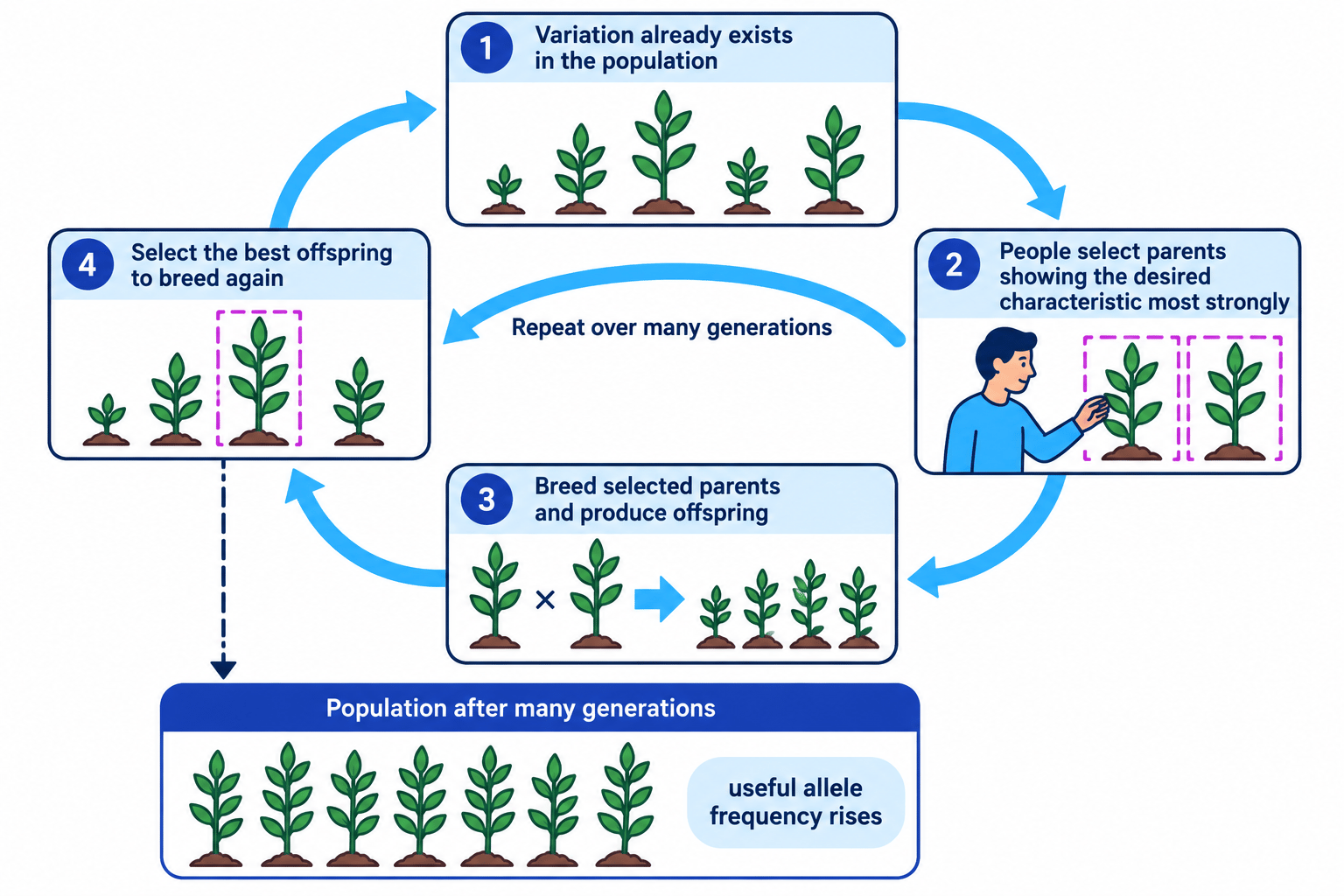
How selective breeding works
Definition
Selective breeding
Selective breeding is choosing the organisms that show a desired characteristic and breeding them together over many generations so that the characteristic becomes more common in the population.
- Selective breeding is choosing the organisms that show a desired characteristic and breeding them together over many generations so that the characteristic becomes more common in the population.
- It is also called artificial selection, because the choice of which individuals reproduce is made by people rather than by the environment.
- The characteristic must already be present as variation within the population, since breeding can only work with alleles that some individuals already carry.
- The first step is to choose, from a varied population, the individuals that show the desired characteristic most strongly.
- The second step is to breed those chosen individuals together, so that their alleles are brought together in the offspring.
- The third step is to examine the offspring, keep only those that show the characteristic most strongly, and breed from those.
- Those steps are repeated over many generations, and each round raises the proportion of individuals carrying the alleles for the characteristic.
- The frequency of the useful alleles in the population therefore rises while the frequency of the alternative alleles falls, which is why the whole population changes and not just a few individuals.
- Selective breeding is slow, because one round takes a full generation, and it cannot bring in an allele that no member of the species carries.
Note
In natural selection the environment decides which individuals survive to breed, while in selective breeding a farmer or breeder makes that decision, and the mechanism of inheritance is the same in both.
Common Mistake
- Do not write that selective breeding creates a new characteristic.
- It increases how common an existing characteristic is, by choosing which parents pass their alleles on.
Selective breeding of crop plants
- Growers select the plants with the best version of a characteristic and sow the seed from those plants to raise the next generation.
- Higher yield is the characteristic selected most often, so cereals have been bred to produce more grains per ear and more ears per plant.
- Disease resistance is selected by growing a crop where a disease is present and breeding only from the plants that stay healthy.
- Drought and salt tolerance are selected so that a crop can be grown where water is scarce or where soil contains salt.
- Larger or sweeter fruit and a longer shelf life are selected in fruit and vegetable crops so that more of the harvest reaches the shop in good condition.
- Shorter, stiffer stems are selected in wheat so that the plant puts less of its biomass into the stalk and is less likely to be flattened by wind and rain.
- Plants are convenient to breed selectively because one plant produces very many seeds, generations are short, and many varieties can be grown side by side and compared in one season.
Example
One wild plant, many vegetables
- Wild brassica is a coastal plant with small leaves, a thin stem and a loose head of flowers.
- Growers who repeatedly chose and re-sowed the plants with the tightest leaf buds produced the cabbage, while those who chose the largest side buds produced Brussels sprouts.
- Choosing the plants with the largest flower heads produced broccoli and cauliflower, choosing the largest leaves produced kale, and choosing the thickest stems produced kohlrabi.
- Every one of those vegetables belongs to the same species, which shows how far a population can be changed by repeatedly selecting different parts of the same plant.
Selective breeding of farm animals
- Farmers choose the animals with the best version of a characteristic, mate them together, and then breed from the best of their offspring.
- Milk yield is selected in dairy cattle, so modern dairy cows produce several times as much milk each year as the cattle they were bred from.
- Meat production is selected in beef cattle, sheep and pigs, choosing animals that grow quickly and lay down more muscle for each kilogram of feed eaten.
- Egg number is selected in hens, and wool quality in sheep, by keeping the birds and sheep that produce most and breeding from them.
- Disease resistance and a calm temperament are selected as well, because healthy animals that are easy to handle are cheaper and safer to keep.
- A characteristic that appears in only one sex can still be selected, and a bull is judged by the milk yields of his daughters rather than by anything that can be measured in the bull himself.
- Animal breeding is much slower than plant breeding, because a cow produces roughly one calf a year and takes about two years to reach breeding age, so a noticeable change takes decades.
Example
Raising the milk yield of a dairy herd
- A herd has a mean milk yield of 5200 litres5200\ \text{litres}5200 litres per cow per year, and the farmer breeds only from the cows above that mean.
- After several generations of this selection the mean yield of the herd is 7800 litres7800\ \text{litres}7800 litres per cow per year.
- The increase is 7800−5200=2600 litres7800-5200=2600\ \text{litres}7800−5200=2600 litres per cow per year.
- The percentage increase is 26005200×100=50%\dfrac{2600}{5200}\times100=50\%52002600×100=50%.
Impacts of selective breeding
Definition
Gene pool
A gene pool is all of the alleles present in all of the individuals of a population.
Definition
Inbreeding
Inbreeding is breeding between closely related individuals, which raises the chance that offspring inherit two copies of the same harmful recessive allele.
- The benefit is more food from the same land and the same number of animals, which lowers the cost of food and supports the food supply of a growing population.
- A selectively bred crop is also uniform, so it ripens together and can be harvested by machine in one pass.
- The cost is a loss of variation, because each generation only a few individuals are allowed to breed and the alleles carried by the rest are lost from the population.
- The gene pool, which is all the alleles present in the population, therefore becomes smaller with every generation of selection.
- Breeding from close relatives is called inbreeding, and it raises the chance that an offspring inherits two copies of the same harmful recessive allele, so the disorder that allele causes appears.
- A population with little variation is also vulnerable as a whole, because if a new pathogen or a change in conditions harms one individual it is likely to harm every individual in the same way.
- There may be no allele left anywhere in the population to breed a resistant variety from, so the breeder has to look for one in a wild relative or in a stored collection of older varieties.
- Selecting hard for one characteristic can also harm the animal, and cattle bred for very high milk yields are more prone to lameness and udder infection, while dogs bred for a flattened face have difficulty breathing.
- Breeders reduce these problems by keeping records of relatedness, by crossing in unrelated individuals from time to time, and by maintaining rare breeds and older varieties as a store of alleles.
Exam technique
Answering questions on selective breeding
- Describe the process as a repeated cycle, and say that the selection and breeding are repeated over many generations, since the word generations is usually needed for the mark.
- Use the word allele when explaining the loss of variation, because answers written only in terms of characteristics rarely gain the explanation mark.
- When the question says explain the impact, give a benefit and a problem, as questions on this point almost always expect both sides.
- Name the characteristic being selected rather than writing that the animal is better, so write higher milk yield or resistance to a named disease.
Self review
- Describe the repeating steps of selective breeding.
- Explain why a characteristic must already exist in a population before it can be selected for.
- Name three characteristics that are selected for in crop plants and three that are selected for in farm animals.
- Explain why selective breeding of cattle takes far longer than selective breeding of wheat.
- Explain, using the word allele, why selective breeding reduces variation in a population.
- Give two problems that can follow from the reduced variation caused by selective breeding.