The endocrine system
Definition
Endocrine system
The system of glands that coordinates and controls body processes by secreting hormones into the blood.
Definition
Endocrine gland
A gland that secretes hormones directly into the blood rather than releasing them through a duct.
- The endocrine system is the set of glands that controls body processes by releasing chemicals into the bloodstream.
- An endocrine gland has no duct, so the chemical it makes passes straight out of the gland cells into the capillaries running through the gland.
- That is what separates an endocrine gland from an exocrine gland such as a salivary gland, which releases its product down a tube.
- The chemicals released by endocrine glands are hormones, and the blood then distributes them around the whole body.
- Because the blood reaches every organ, a single gland can control organs that lie a long way from it.
- Endocrine control suits processes that must be held steady or changed gradually, such as growth, development, and the concentration of substances dissolved in the blood.
How hormones reach their target
Definition
Hormone
A chemical messenger secreted by an endocrine gland into the blood and carried to a target organ, where it causes an effect.
Definition
Target organ
The organ that a particular hormone acts on, because its cells carry receptors with a shape complementary to that hormone.
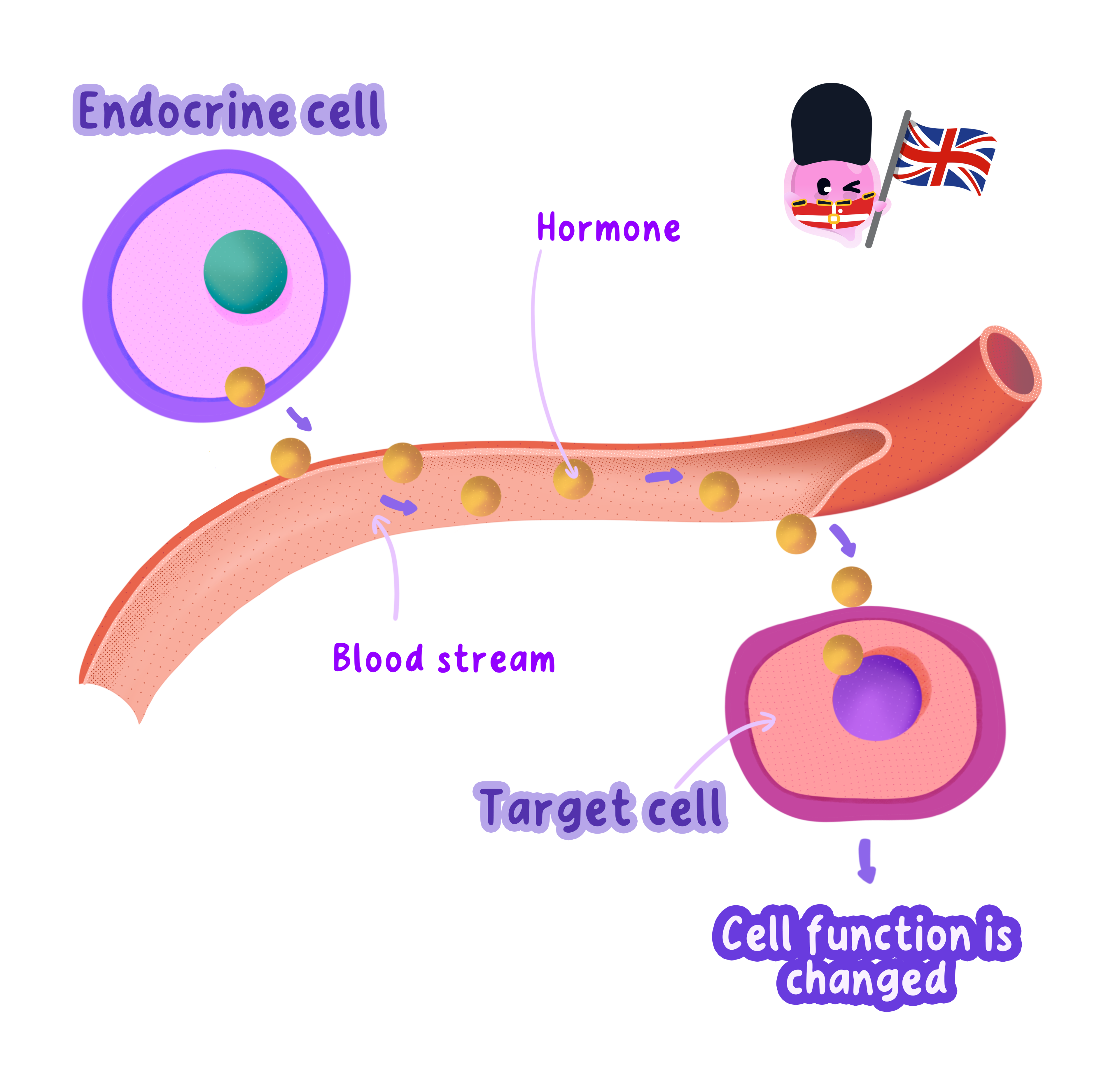
- A hormone is made inside an endocrine gland and passes into the blood plasma.
- The heart pumps that plasma through every organ, so the hormone is carried past cells throughout the body.
- Only cells carrying a receptor with a shape complementary to the hormone are able to bind it.
- Cells without the matching receptor are unaffected even though the hormone reaches them in the blood.
- The organ whose cells carry the matching receptors is the target organ for that hormone.
- Binding of the hormone to its receptor changes what the target cell does, for example by switching a chemical reaction on or off.
- Hormones are broken down slowly, mostly in the liver, so the response continues for a while after the gland stops secreting.
Example
Which organs respond
- A gland secretes a hormone, and the plasma carries it past the liver, the muscles, the brain and the skin.
- Only the liver cells and the muscle cells carry receptors with a shape complementary to that hormone.
- The brain cells and skin cells cannot bind the hormone, so nothing changes inside them.
- The liver and the muscles are therefore the target organs, even though every organ received the hormone.
Nervous and hormonal control
- Nervous coordination uses electrical impulses carried along neurones, while hormonal coordination uses chemicals carried in the blood.
- An impulse travels along a neurone far faster than blood carries a hormone, so nervous responses happen in a fraction of a second.
- A hormonal response takes seconds, hours or even years, because the hormone must first be secreted and then circulated.
- A neurone ends at one precise place, so a nervous response acts on a single muscle or gland.
- A hormone reaches every organ, so its effect can be spread across several organs at once.
- A nervous response stops quickly once the impulses stop, because the transmitter substance at the synapse is broken down.
- A hormonal response lasts longer because the hormone remains in the blood until it is broken down.
- Speed makes the nervous system suited to danger and reflexes, while duration makes the endocrine system suited to growth, development and pregnancy.
Example
Comparing response times
- A reflex withdrawal from a hot object takes roughly 0.02 s0.02\ \text{s}0.02 s from stimulus to muscle contraction.
- A hormonal response to the same stress takes roughly 20 s20\ \text{s}20 s to reach its full effect.
- The hormonal response is therefore 200.02=1000\dfrac{20}{0.02}=10000.0220=1000 times slower.
- The extra time is spent secreting the hormone and circulating it in the blood.
Common Mistake
- Do not write that hormones travel along nerves, because they are carried dissolved in the blood plasma.
- Do not write that a hormone only reaches its target organ, because it reaches every organ and only the target organ has the receptors.
- Do not describe the endocrine system as fast, because a response measured in seconds is slow next to a nervous response.
The main endocrine glands
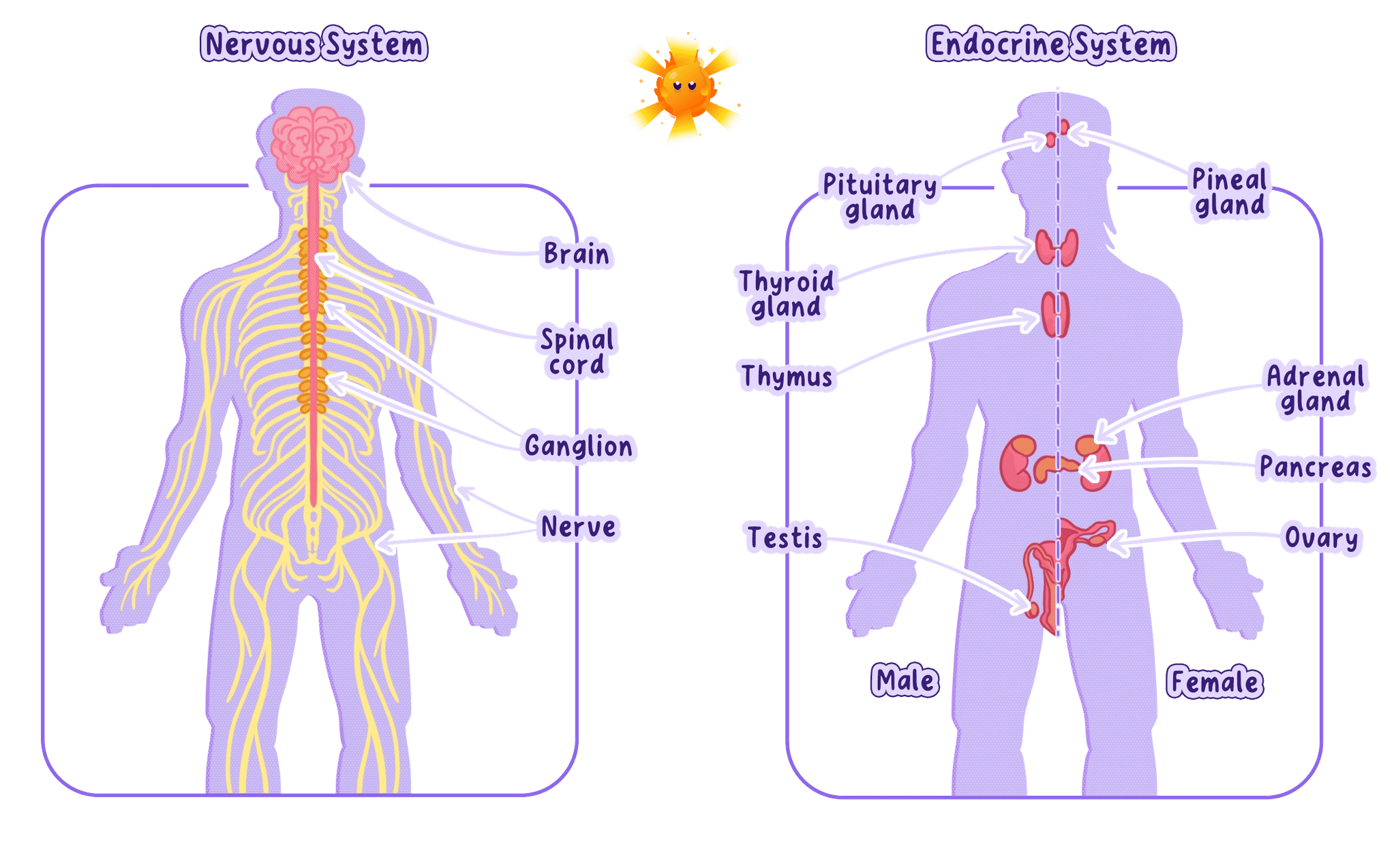
- The pituitary gland lies at the base of the brain and is known as the master gland.
- The thyroid gland in the neck secretes thyroxine, which sets the rate of the chemical reactions taking place in the body.
- The adrenal glands sit on top of the kidneys and secrete adrenaline when you are frightened or under stress.
- The pancreas secretes insulin and glucagon, which together control the concentration of glucose in the blood.
- The ovaries secrete oestrogen and progesterone, which control the changes of puberty and the menstrual cycle.
- The testes secrete testosterone, which controls sperm production and the changes of puberty.
- Every one of these glands works the same way, secreting its hormone into the blood rather than down a duct.
The pituitary as master gland
- The pituitary gland receives signals from the brain about conditions inside the body.
- It responds by secreting hormones of its own into the blood.
- Several of those hormones act on other endocrine glands rather than on ordinary body tissue.
- Pituitary hormones act on the thyroid gland, on the adrenal glands and on the ovaries or testes.
- Each of those glands then secretes its own hormone, so control passes along a chain of two glands.
- Because the first step in so many chains happens in the pituitary, it sets the output of much of the endocrine system.
Exam technique
Naming glands and hormones
- Name the gland and its hormone as two separate things, because the adrenal gland secretes adrenaline and there is no gland called adrenaline.
- Write that a gland secretes a hormone into the blood, since marks are given for naming the transport route.
- Answer a comparison question with both halves of every point, such as nervous responses being fast whereas hormonal responses are slow.
- Name the target organ as well as the hormone whenever a question asks what a hormone does.
Self review
- What is the difference between an endocrine gland and an exocrine gland?
- Explain why a hormone reaches every organ but changes only some of them.
- Give two ways in which a hormonal response differs from a nervous response.
- Name the gland that secretes thyroxine and the gland that secretes adrenaline.
- Why is the pituitary gland described as the master gland?
