Question 10
FA student uses a pond net to collect small animals from a pond.
The Figure shows four of the animals, A, B, C and D.
Figure
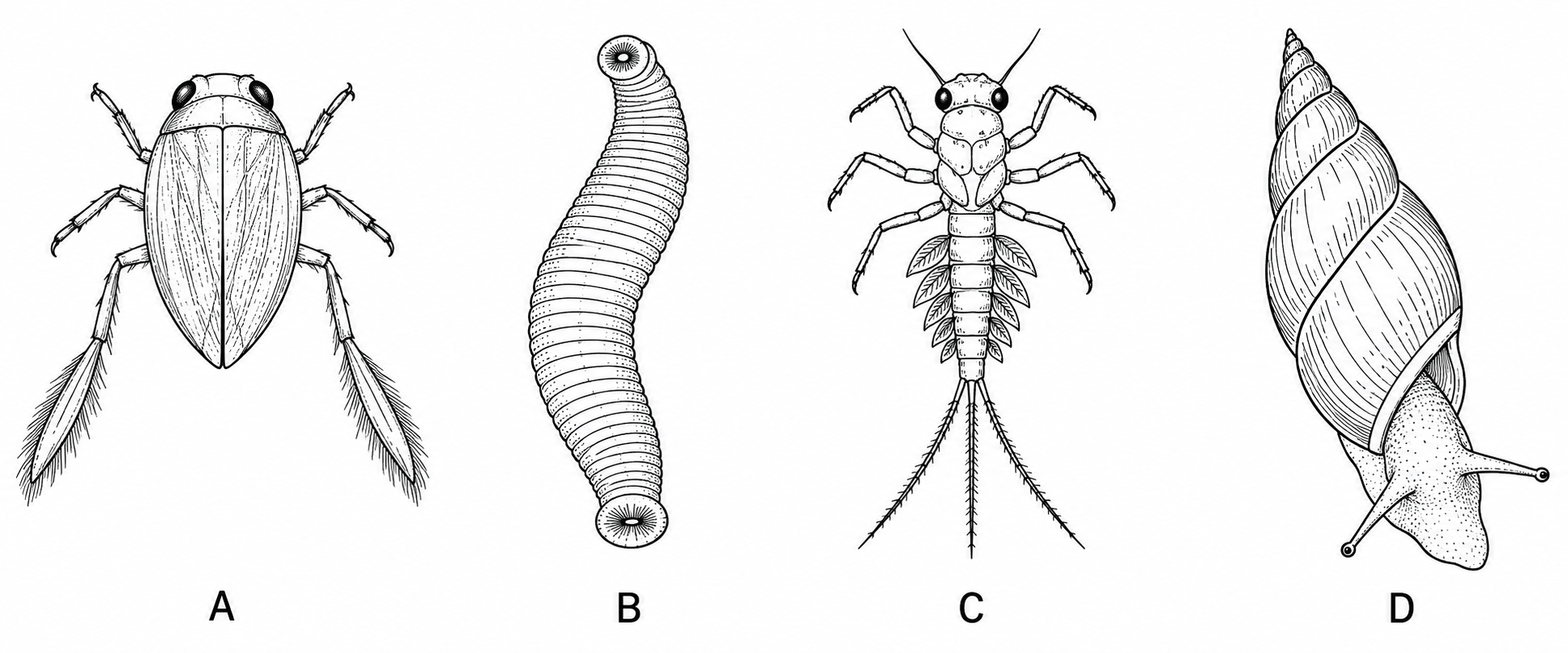 The student uses the key in the Table to identify the animals.
Table
| Step | Feature | Go to or name of animal |
|---|---|---|
| 1 | has legs | go to 2 |
| 1 | does not have legs | go to 3 |
| 2 | has three tails | mayfly nymph |
| 2 | does not have three tails | water boatman |
| 3 | has a shell | pond snail |
| 3 | does not have a shell | leech |
The student compares the animals in two ponds, P and Q.
The second Table shows the student's results.
Table
| Animal | Number found in pond P | Number found in pond Q |
|---|---|---|
| leech | 2 | 6 |
| mayfly nymph | 0 | 8 |
| pond snail | 54 | 7 |
| water boatman | 4 | 9 |
| Total | 60 | 30 |
a.[2]
Use the key to identify animal A and animal C.
b.[3]
Describe how the student should collect her samples so that the results from the two ponds can be compared fairly.
c.[2]
The student says:
'Pond P has a higher biodiversity than pond Q because more animals were found in pond P.'
Use the second Table to explain why the student is wrong.
6.1 Monitoring and maintaining the environment Questions
109 exam-style questions on OCR GCSE Biology 6.1 Monitoring and maintaining the environment, covering 6.1.1 Field investigation of distribution and abundance, 6.1.2 Human interactions and biodiversity, 6.1.3 Maintaining biodiversity, and 6.1.4 Environmental change and distribution of organisms. Each one has a worked solution and a mark scheme showing where the marks go.