3.3.1 Importance of a constant internal environment
Homeostasis keeps conditions suitable for metabolism
Homeostasis
The maintenance of a stable internal environment, keeping conditions such as temperature, blood glucose and water content within narrow limits around a set point.
- Homeostasis is the maintenance of a stable internal environment within narrow limits.
- The internal environment is the blood and tissue fluid surrounding body cells.
- Internal conditions change after eating, exercising and moving between hot and cold surroundings, so the body continually corrects deviations.
- Conditions fluctuate around a normal level rather than remaining completely constant.
Stable conditions maintain reaction rates
- Metabolic reactions are controlled by enzymes, whose activity depends on temperature and the chemical conditions around cells.
- Low temperatures reduce the kinetic energy of enzyme and substrate particles, so successful collisions occur less often and reactions slow down.
- High temperatures can change an enzyme's active site, so the enzyme becomes denatured and can no longer catalyse its reaction.
- A suitable blood glucose concentration provides cells with glucose for respiration without allowing the concentration to become dangerously high or low.
- If blood glucose falls too low, cells receive less glucose for respiration and cannot transfer energy at the required rate.
- A suitable water balance prevents excessive movement of water into or out of cells by osmosis.
- Dilute body fluids cause water to enter cells by osmosis, while concentrated body fluids cause water to leave cells.
- Large osmotic changes can make animal cells swell and burst or shrink, disrupting their normal reactions.
- When explaining why homeostasis is important, link the controlled condition to enzyme activity, the rate of metabolic reactions or normal cell function.
- State that conditions are kept within narrow limits, not at one fixed value.
Negative feedback reverses a change
Negative feedback
A control mechanism in which a change in a condition triggers a response that brings the condition back to normal.
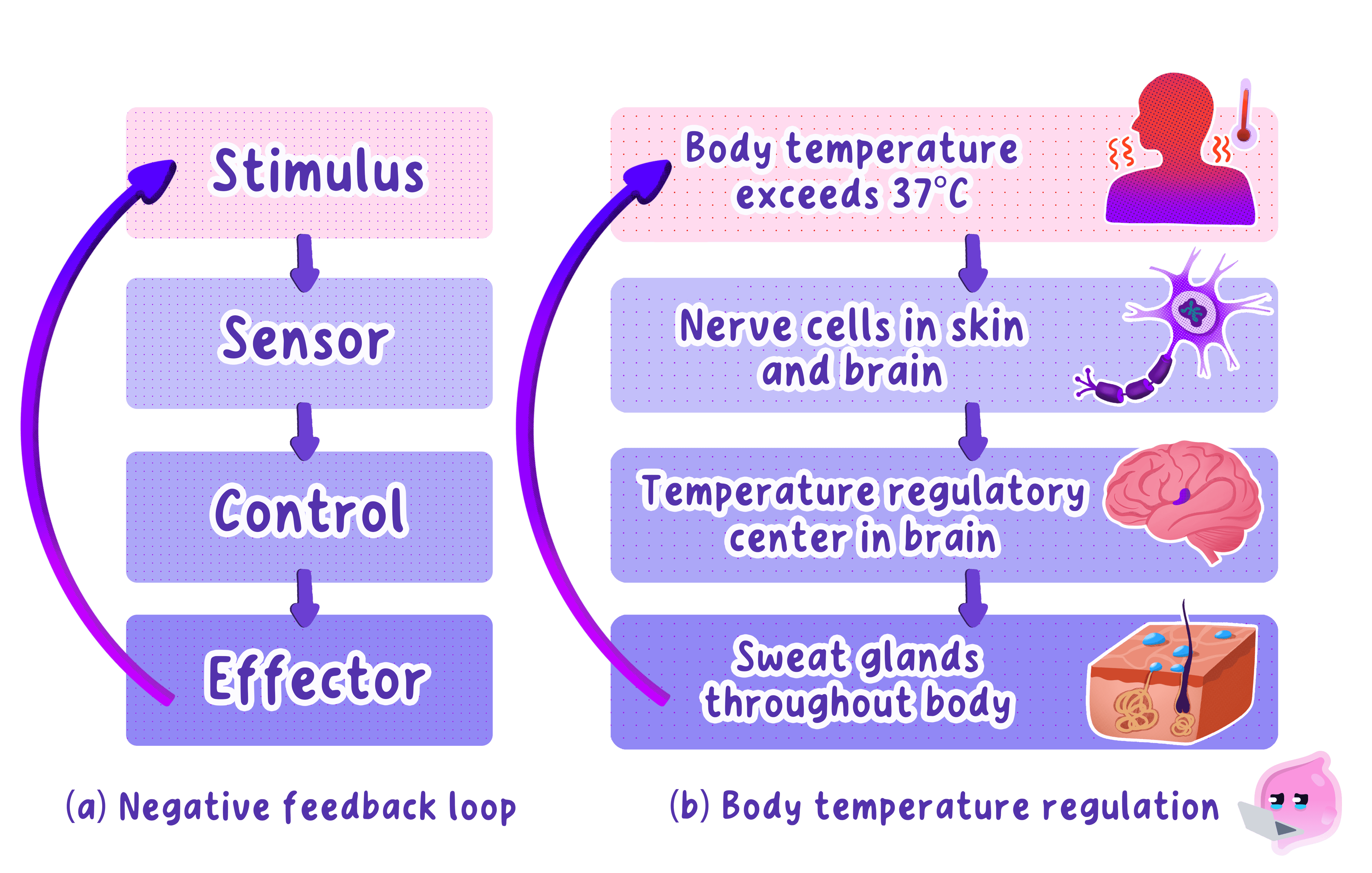
- A receptor detects a change in an internal condition and sends information to a coordination centre.
- The coordination centre compares the condition with its normal level and coordinates a response.
- An effector, such as a muscle or gland, produces the response.
- The response opposes the original change, so the condition returns towards its normal range and the response is reduced.
- The normal level is a set point, but the measured condition usually fluctuates slightly above and below it.
- The corrective response decreases once the deviation has been reduced, preventing a large change in the opposite direction.
- Nervous signals coordinate rapid responses, while hormones in the blood can coordinate slower and longer-lasting responses.
- change→receptor→coordination centre→effector→corrective response\text{change} \rightarrow \text{receptor} \rightarrow \text{coordination centre} \rightarrow \text{effector} \rightarrow \text{corrective response}change→receptor→coordination centre→effector→corrective response
- After a carbohydrate-rich meal, blood glucose rises above its normal range.
- The pancreas detects the rise and releases insulin, causing cells to remove glucose from the blood until the concentration returns towards normal.
Internal and external changes are controlled
- An external change, such as a fall in air temperature, can increase heat loss from the body.
- An internal change, such as increased respiration during exercise, can increase heat production inside the body.
- Eating a carbohydrate-rich meal raises blood glucose, while sweating heavily lowers the water content of the blood.
- Several control systems can operate together, so exercise can challenge temperature, blood glucose and water balance at the same time.
- Homeostatic responses counter these changes so cells continue to work under suitable conditions.
- What is homeostasis?
- Why do enzymes require internal conditions to stay within narrow limits?
- What sequence links a receptor to a corrective response?
- How does negative feedback restore a condition towards normal?
3.3.2 The skin and body temperature
The skin detects temperature and controls heat transfer
Thermoregulation
The control of body temperature, keeping it close to about 37 degrees Celsius so that enzymes work efficiently.
- Thermoregulation keeps core body temperature close to 37 ∘C37\,^\circ\text{C}37∘C so enzyme-controlled reactions proceed at suitable rates.
- Temperature receptors in the skin detect external temperature, while receptors in the brain monitor the temperature of the blood.
- The brain coordinates responses by effectors including sweat glands, skin blood vessels and skeletal muscles.
Hot conditions increase heat loss
Vasodilation
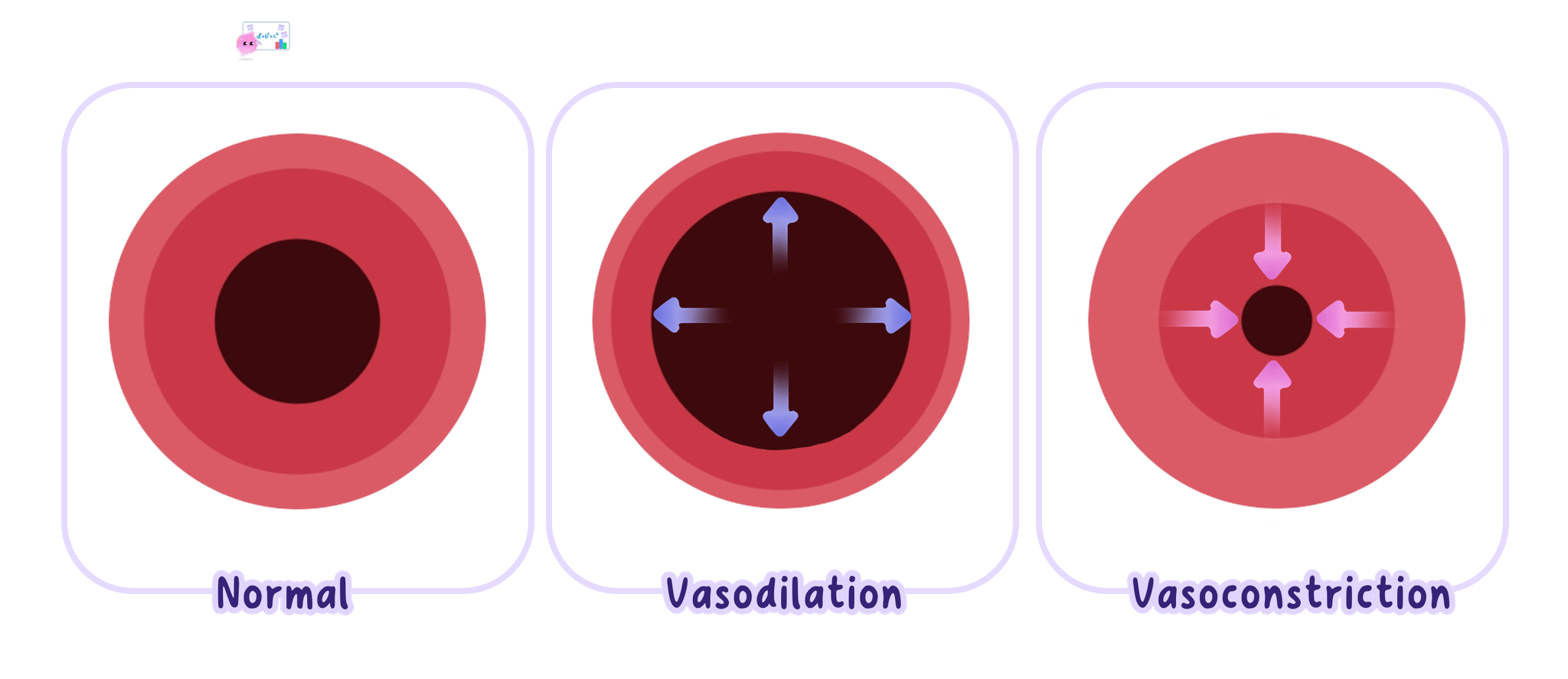
The widening of the blood vessels supplying the skin capillaries when the body is too hot, so more blood flows near the surface and more heat is lost.
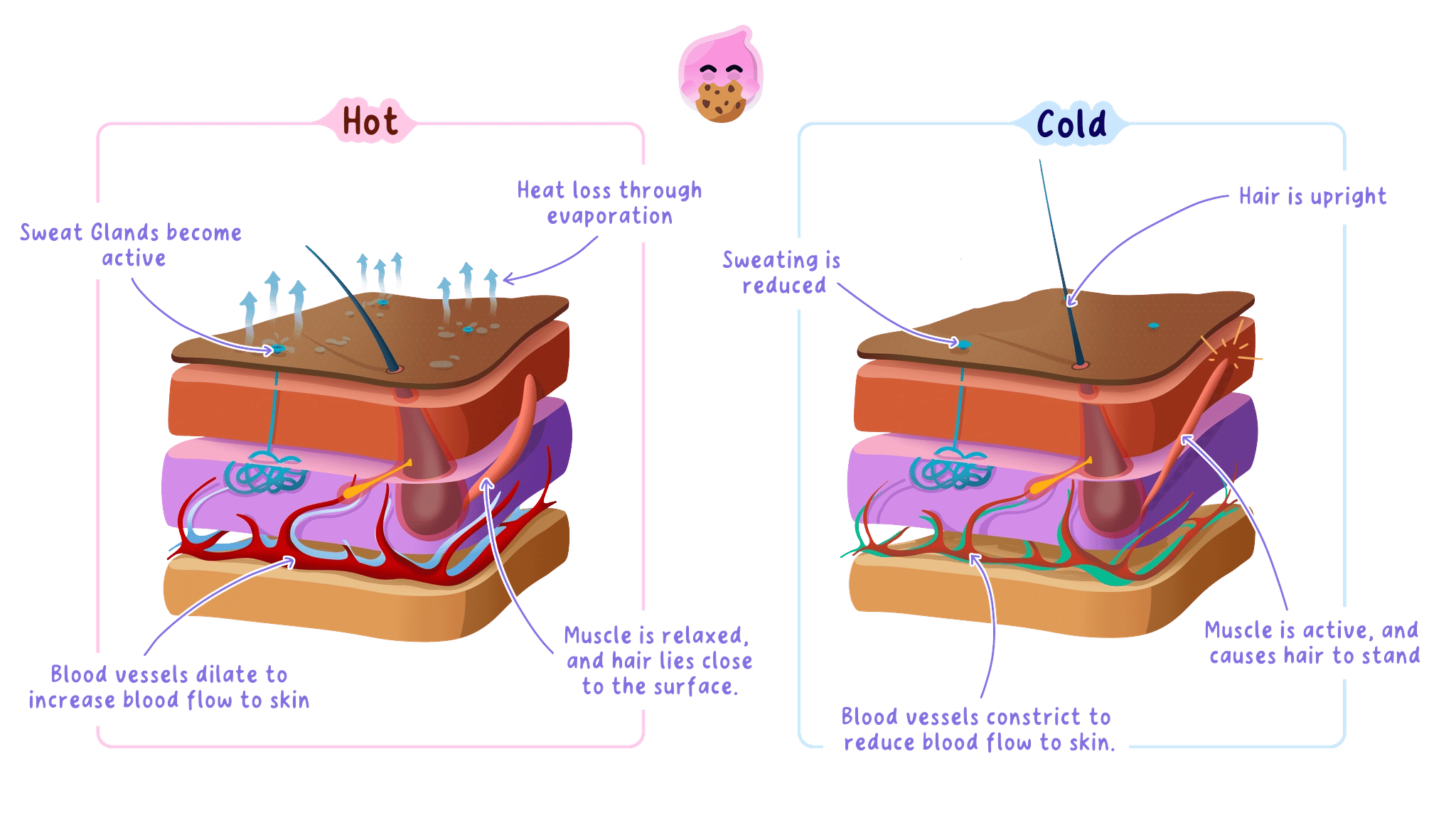
- When body temperature rises, sweat glands release more sweat onto the skin surface.
- The highest-energy water molecules escape as the sweat evaporates, transferring thermal energy from the skin to the surroundings.
- Evaporation therefore cools the skin and helps lower body temperature.
- Sweating is less effective in humid air because the air already contains more water vapour, so evaporation is slower.
- Prolonged sweating removes water and mineral ions from the body, increasing the risk of dehydration.
- The arterioles supplying surface capillaries widen during vasodilation, so more warm blood flows close to the skin surface.
- A larger transfer of thermal energy from the blood to the surroundings increases heat loss.
- Vasodilation changes the diameter of the arterioles rather than moving blood vessels closer to the surface.
- Hair erector muscles relax, so body hairs lie flat and trap less insulating air.
- Sweat cools the body only when it evaporates.
- Do not say that blood vessels move towards the surface during vasodilation, because the vessels widen and increase blood flow through existing surface capillaries.
Cold conditions conserve and generate heat
Vasoconstriction
The narrowing of the blood vessels supplying the skin capillaries when the body is too cold, so less blood flows near the surface and less heat is lost.
- When body temperature falls, the arterioles supplying surface capillaries narrow during vasoconstriction.
- Less warm blood flows near the skin surface, so less thermal energy is transferred to the surroundings.
- Vasoconstriction does not stop skin blood flow completely because skin cells still require oxygen and glucose.
- Sweat production decreases, reducing cooling by evaporation.
- Skeletal muscles contract rapidly during shivering, increasing respiration and the transfer of energy as heat.
- Shivering generates additional heat, while vasoconstriction reduces the rate at which heat is lost.
- Hair erector muscles contract, so hairs stand upright and trap an insulating layer of air.
- The insulating effect of raised hairs is small in humans because human body hair is sparse.
- The layer of fat beneath the skin also reduces heat transfer because fat is a poor thermal conductor.
- During vigorous exercise, respiration in muscles releases more heat and body temperature begins to rise.
- Sweating and vasodilation increase heat loss until temperature returns towards its normal range.
- For vasodilation, link wider vessels to more blood near the skin and then to more heat transfer.
- For shivering, link muscle contraction to increased respiration and then to greater heat production.
- Where are changes in external temperature detected?
- How does evaporation of sweat cool the body?
- How does vasodilation increase heat loss?
- How does vasoconstriction reduce heat loss?
- Why does shivering warm the body?
3.3.3 Insulin and blood sugar
Insulin lowers a raised blood glucose concentration
Blood glucose
The concentration of glucose (sugar) dissolved in the blood, which the body keeps within narrow limits so cells always have a supply for respiration.
- Blood glucose concentration is the amount of glucose dissolved in a given volume of blood.
- It rises after carbohydrate is digested and glucose is absorbed from the small intestine into the blood.
- The pancreas detects the rise and releases the hormone insulin into the bloodstream.
Insulin increases glucose removal from the blood
Insulin
A hormone that lowers blood glucose concentration; people with type 1 diabetes must be given insulin.
- Insulin causes body cells to take up more glucose from the blood.
- Cells use some of this glucose in respiration to transfer energy.
- Insulin also causes liver and muscle cells to convert excess glucose into glycogen for storage.
- glucose→insulinglycogen\text{glucose} \xrightarrow{\text{insulin}} \text{glycogen}glucoseinsulinglycogen
- Glycogen is suitable for storage because it is insoluble and does not draw water into cells by osmosis.
- Liver glycogen can later help restore blood glucose, while muscle glycogen supplies glucose for respiration in muscle cells.
- Removing glucose from the blood lowers its concentration towards the normal range.
- Insulin secretion changes continuously with blood glucose rather than being fully on or fully off.
- As the concentration returns towards normal, less insulin is released, completing the negative feedback response.
- Insulin is a hormone, not an enzyme.
- Do not state that insulin converts glucose into glycogen directly, because insulin causes liver and muscle cells to carry out the conversion.
Graphs show the effect of insulin
- On a graph of blood glucose against time, a meal is followed by a rise as glucose enters the blood.
- A later fall towards the starting range shows that glucose is being taken up and stored under the influence of insulin.
- The gradient shows the rate of change, so a steeper falling line represents a faster decrease in blood glucose.
- A curve that reaches a higher peak or remains raised for longer shows less effective removal of glucose from the blood.
- When comparing curves, use values from the axes and compare the height of the peak, the time taken to reach it and the time taken to return towards normal.
- If blood glucose rises from 4.5 mmol dm−34.5\,\text{mmol dm}^{-3}4.5mmol dm−3 to 7.5 mmol dm−37.5\,\text{mmol dm}^{-3}7.5mmol dm−3, the increase is 7.5−4.5=3.0 mmol dm−37.5-4.5=3.0\,\text{mmol dm}^{-3}7.5−4.5=3.0mmol dm−3.
- The subsequent fall is explained by insulin causing glucose uptake by cells and conversion of glucose to glycogen.
Write the chain in order: high blood glucose, pancreas, insulin, greater glucose uptake, glycogen formation, then blood glucose falls.
- Which organ detects a rise in blood glucose?
- What hormone is released when blood glucose is too high?
- How does insulin affect glucose uptake by cells?
- Where is glycogen stored?
- What pattern should a healthy blood glucose graph show after a meal?
3.3.4 Glucagon and blood sugar
Glucagon raises a low blood glucose concentration
Glucagon
A hormone released by the pancreas when blood glucose is too low; it makes the liver break down glycogen into glucose and release it into the blood.
- Blood glucose falls between meals and during prolonged exercise because cells remove glucose for respiration.
- The pancreas detects the low concentration and releases the hormone glucagon into the blood.
- Glucagon targets the liver and causes stored glycogen to be converted into glucose.
- glycogen→glucagonglucose\text{glycogen} \xrightarrow{\text{glucagon}} \text{glucose}glycogenglucagonglucose
- The liver releases this glucose into the blood, raising the concentration towards its normal range.
- As blood glucose returns towards normal, glucagon release decreases.
- During a long period without food, cells continue using glucose in respiration and blood glucose begins to fall.
- Glucagon causes the liver to mobilise its glycogen store, supplying glucose to the blood.
Insulin and glucagon act in opposite directions
Insulin
A hormone that lowers blood glucose concentration; people with type 1 diabetes must be given insulin.
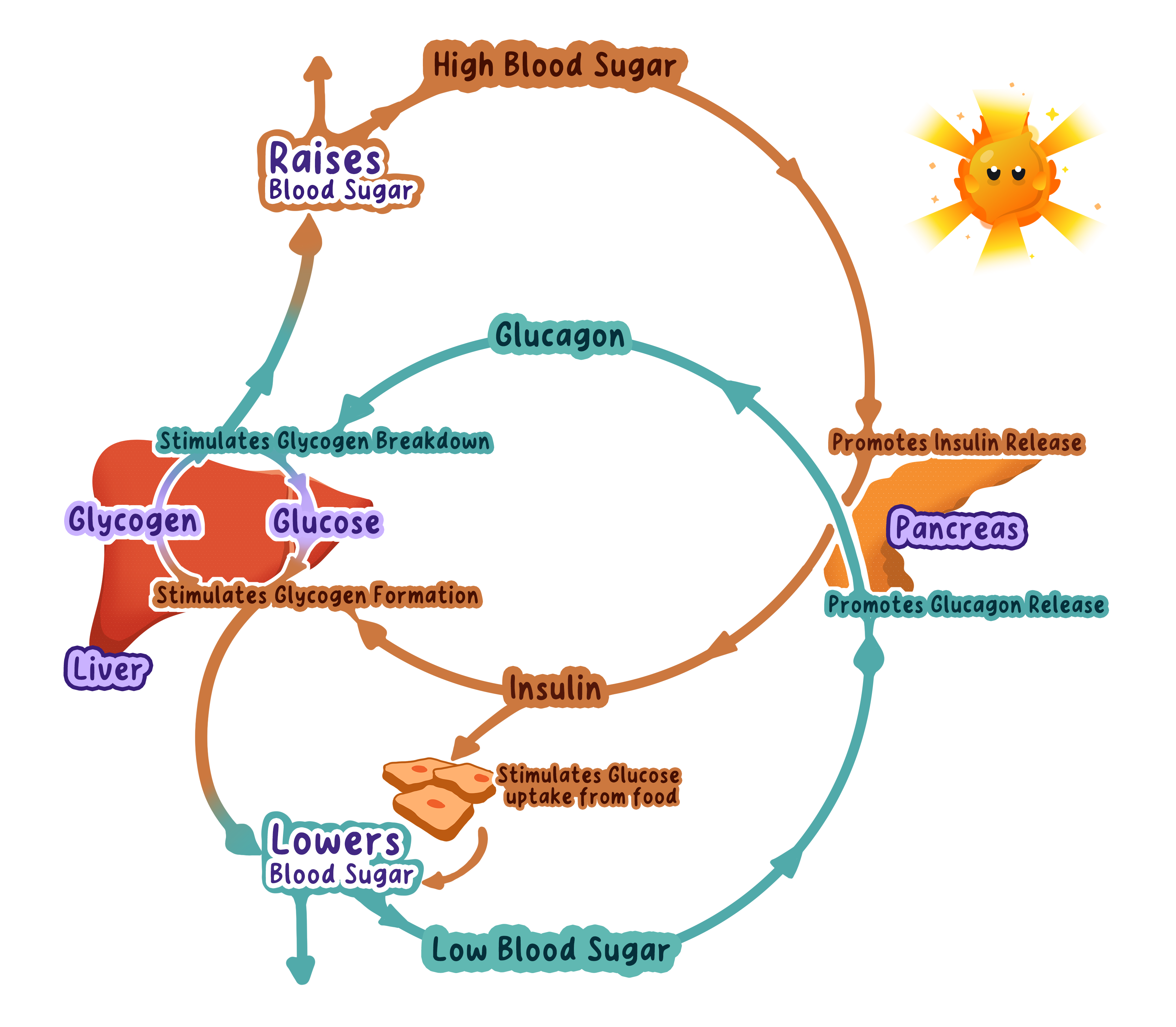
- When blood glucose is too high, insulin increases glucose uptake and glycogen formation, so blood glucose falls.
- When blood glucose is too low, glucagon increases glycogen breakdown and glucose release by the liver, so blood glucose rises.
- The two hormones are antagonistic because their effects oppose each other.
- After a meal, insulin secretion increases and glucagon secretion decreases, favouring glucose uptake and glycogen formation.
- Between meals, insulin secretion decreases and glucagon secretion increases, favouring glycogen breakdown and glucose release.
- The balance changes gradually, preventing large fluctuations as the body moves between fed and fasting conditions.
- Their interaction forms a negative feedback system that keeps blood glucose within narrow limits.
- Do not swap the hormones: insulin lowers blood glucose and glucagon raises it.
- Glucagon acts mainly on the liver, not on glycogen stores in every body cell.
Data questions require comparison and explanation
- A healthy blood glucose curve rises after a meal and then returns towards its normal range.
- A fall below the normal range stimulates glucagon release, so the curve rises again.
- The gradient shows the rate of change, while the peak and trough show the highest and lowest measured concentrations.
- If two people are compared, use equivalent time points and consider whether they began at different concentrations.
- When interpreting data, identify the change, quote comparative values where possible and link the change to the correct hormone and organ.
- A fall from 5.0 mmol dm−35.0\,\text{mmol dm}^{-3}5.0mmol dm−3 to 3.8 mmol dm−33.8\,\text{mmol dm}^{-3}3.8mmol dm−3 is a decrease of 1.2 mmol dm−31.2\,\text{mmol dm}^{-3}1.2mmol dm−3.
- The pancreas responds by releasing glucagon, which causes the liver to release glucose from glycogen.
For low blood glucose, write: pancreas detects the fall, glucagon is released, liver glycogen is converted to glucose, glucose enters the blood, and the concentration rises towards normal.
- When is glucagon released?
- Which organ responds to glucagon?
- What conversion does glucagon cause?
- Why are insulin and glucagon described as antagonistic?
- How does this hormonal interaction produce negative feedback?
3.3.5 Type 1 and type 2 diabetes
Type 1 and type 2 diabetes disrupt glucose control
Diabetes
A condition in which blood glucose concentration cannot be controlled properly and can rise dangerously high, either because too little insulin is made (type 1) or because the body's cells stop responding to insulin (type 2).
- Diabetes is a condition in which blood glucose concentration cannot be controlled effectively and may remain too high.
- Common signs include persistent thirst, frequent urination, tiredness and glucose in the urine.
- Long-term high blood glucose can damage blood vessels and organs, including the eyes, kidneys, nerves and heart.
Type 1 diabetes results from too little insulin
- In type 1 diabetes, the immune system destroys insulin-producing cells in the pancreas.
- The pancreas therefore produces little or no insulin, so body cells do not remove enough glucose from the blood after a meal.
- Blood glucose rises higher than normal and remains high for longer.
- When blood glucose is very high, the kidneys cannot reabsorb all the filtered glucose, so glucose remains in the urine.
- Glucose lowers the water potential of the urine, causing more water to remain in the urine and increasing urination.
- The resulting water loss produces thirst and can lead to dehydration.
- Cells may receive less usable glucose despite the high blood glucose concentration, contributing to tiredness and loss of body mass.
- Type 1 diabetes often develops in childhood or adolescence, although it can begin at any age.
- Type 1 diabetes is not caused by eating too much sugar.
- Its direct cause is the loss of insulin-producing cells, leading to insufficient insulin.
Type 1 treatment replaces insulin
Insulin
A hormone that lowers blood glucose concentration; people with type 1 diabetes must be given insulin.
- Insulin is supplied by injection or an insulin pump because insulin is a protein that would be digested if swallowed.
- Rapid-acting insulin can control the rise after meals, while longer-acting insulin provides background control between meals.
- The dose is adjusted using blood glucose measurements, carbohydrate intake and planned physical activity.
- Exercise increases glucose uptake by muscles, so the insulin dose or carbohydrate intake may need adjustment.
- Too little insulin allows blood glucose to remain high, while too much can lower it dangerously.
- Regular monitoring is required because food intake, illness, stress and exercise can change the insulin needed.
- A balanced diet and regular exercise help keep blood glucose within a safer range but do not cure type 1 diabetes.
Type 2 diabetes involves insulin resistance
- In type 2 diabetes, body cells respond less strongly to insulin, which is called insulin resistance.
- The pancreas may still produce insulin, especially early in the condition, but the response is insufficient to control blood glucose effectively.
- The pancreas may initially release more insulin to compensate for insulin resistance.
- Over time, insulin-producing cells may fail to meet the increased demand, so control becomes less effective.
- Risk increases with obesity, low physical activity, age and genetic factors, although a person can develop type 2 diabetes without being obese.
- Excess body fat, particularly around abdominal organs, is associated with increased insulin resistance.
- A family history increases risk, showing that inherited and lifestyle factors can interact.
- It usually develops gradually and is more common in adults, but it can occur in younger people.
Type 2 treatment improves glucose control
- A controlled diet can reduce large rises in blood glucose and support weight loss where needed.
- Dietary management controls the amount and timing of carbohydrate rather than removing all carbohydrate.
- Regular exercise increases glucose use by muscles and can improve the response of cells to insulin.
- Weight loss can reduce insulin resistance in some people, allowing their insulin to control blood glucose more effectively.
- Medicines may be used to improve insulin action, reduce glucose production by the liver or increase insulin release.
- Some people require insulin if other treatments no longer control blood glucose sufficiently.
- Repeated blood glucose measurements show whether the treatment is working and whether it needs adjustment.
- A person whose blood glucose rises sharply after a meal and remains high may have ineffective insulin control.
- Evidence that the pancreas still produces insulin but cells respond weakly supports type 2 diabetes rather than type 1 diabetes.
Comparisons must use matched points
- Both types cause poor control of blood glucose and can produce similar symptoms and long-term complications.
- Type 1 involves insufficient insulin production, whereas type 2 involves reduced cellular response to insulin.
- Type 1 is treated by replacing insulin, whereas type 2 is first managed with diet, exercise and appropriate medicines, with insulin used in some cases.
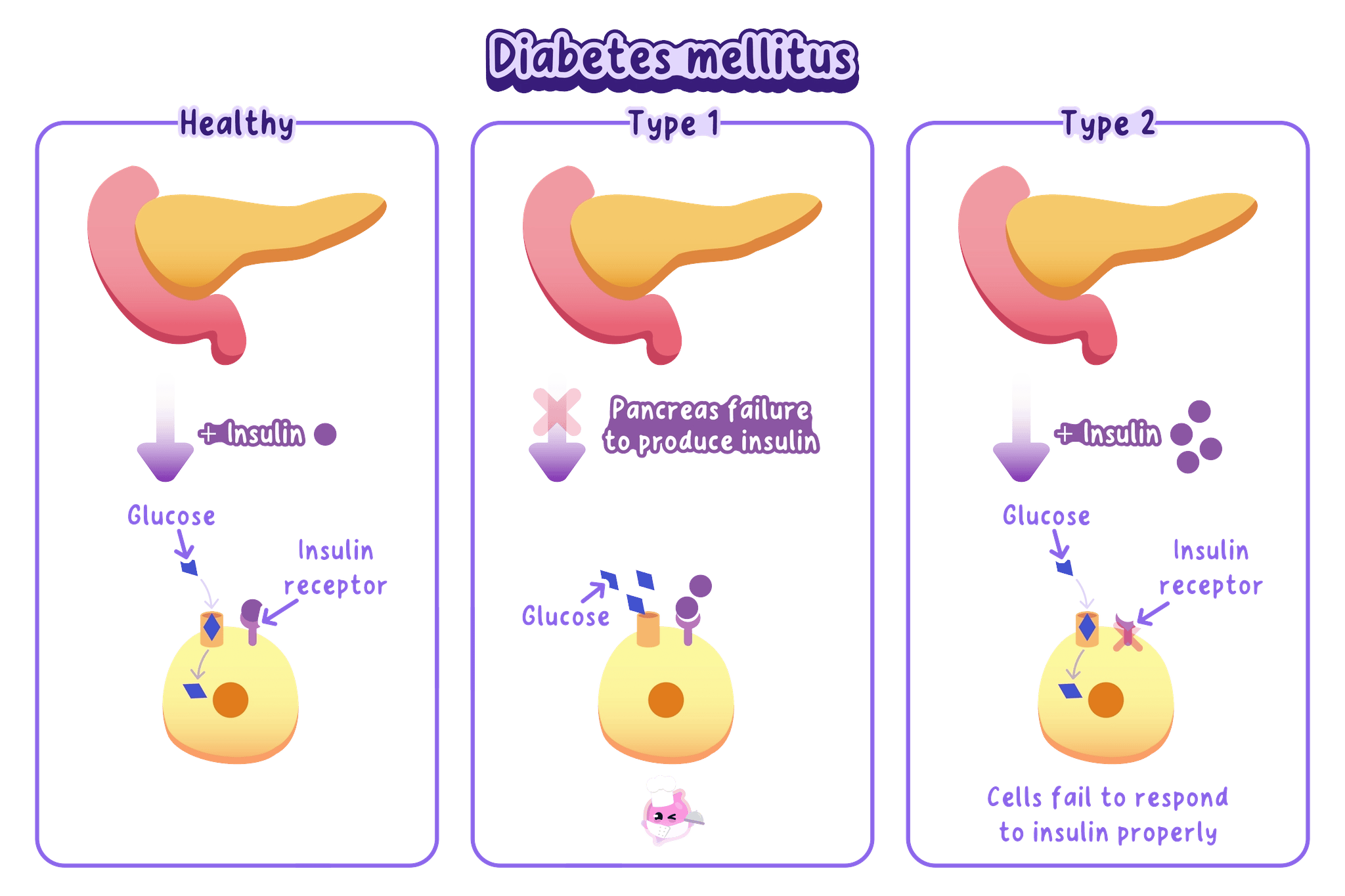
- Compare the two types using the same categories: cause, insulin production or response, typical development and treatment.
- Avoid absolute claims such as type 2 diabetes is always caused by obesity or is never treated with insulin.
- What causes type 1 diabetes?
- What is insulin resistance?
- How is type 1 diabetes treated?
- How can diet and exercise help manage type 2 diabetes?
- State one similarity and one difference between the two types.
3.3.6 Osmotic changes in body fluids
Water potential determines the direction of osmosis
Water potential
A measure of how free the water molecules in a solution are to move, which is highest in pure water and falls as more solute is dissolved.
- Water potential describes the tendency of water molecules to move from one region to another.
- A dilute solution has a higher water potential because it contains more free water molecules relative to dissolved solute.
- A concentrated solution has a lower water potential because dissolved solute reduces the proportion of free water molecules.
- Adding water raises water potential, while adding dissolved salts or sugars lowers water potential.
- No numerical calculation of water potential is required here, but the direction of water movement must be predicted correctly.
Osmosis changes animal cell volume
Osmosis
Osmosis is the net movement of water molecules from a dilute solution to a concentrated solution through a partially permeable membrane.
- Osmosis is the net movement of water molecules from higher water potential to lower water potential through a partially permeable membrane.
- The cell-surface membrane is partially permeable because water can cross it more readily than many dissolved substances.
- Water moves in both directions, but the net movement is towards the side with lower water potential.
- The movement continues until the water potentials become equal or another force prevents further net movement.
- Do not describe osmosis as the movement of a solution or solute particles.
- Osmosis is the net movement of water molecules through a partially permeable membrane.
Dilute body fluid can cause cell lysis
- If the body fluid outside an animal cell has a higher water potential than the cytoplasm, water enters the cell by osmosis.
- The cytoplasm increases in volume and pushes the cell-surface membrane outwards.
- Animal cells have no rigid cell wall, so a sufficiently large water gain can stretch the membrane until the cell bursts.
- Bursting caused by water entry is called lysis.
- Red blood cells placed in a very dilute solution are commonly used to illustrate this response.
- A red blood cell placed in pure water has cytoplasm with a lower water potential than its surroundings.
- Water enters by osmosis, the cell swells and it may lyse.
Concentrated body fluid causes cells to shrink
- If the body fluid outside a cell has a lower water potential than the cytoplasm, water leaves the cell by osmosis.
- The cytoplasm loses volume and the cell-surface membrane becomes wrinkled as the cell shrinks.
- A shrunken animal cell cannot function normally because its internal concentrations and membrane shape have changed.
- Red blood cells become crenated when they lose water in a concentrated solution.
- Build the explanation in order: compare water potentials, state the direction of net water movement, name osmosis, then give the effect on cell volume.
- Use higher and lower water potential rather than saying that water moves from a strong solution to a weak solution.
Equal water potentials prevent net change
- If the body fluid and cytoplasm have equal water potentials, water still crosses the membrane in both directions.
- The rates of movement are equal, so there is no net movement of water.
- The cell therefore keeps approximately the same volume and shape.
- Maintaining the water potential of body fluids within narrow limits protects cells from lysis and excessive shrinking.
- What is water potential?
- In which direction does water move by osmosis?
- Why can an animal cell lyse in a dilute solution?
- Why does an animal cell shrink in a concentrated solution?
- What happens when water potentials are equal?
3.3.7 Kidneys and water balance
Kidneys control how much water leaves in urine
Osmoregulation
The control of the water and solute (ion) balance of the body, keeping the water content of the blood within narrow limits.
- Osmoregulation keeps the water and dissolved ion content of the blood within narrow limits.
- Water enters the body in drinks, food and metabolic reactions such as aerobic respiration.
- Water leaves in urine, sweat, faeces and exhaled air.
- The kidneys provide adjustable water loss because they can change both the volume and concentration of urine.
- Sweating and water vapour in exhaled air also remove water, but these losses cannot be adjusted precisely to maintain water balance.
Blood is filtered and useful substances are recovered
- Blood enters each kidney through the renal artery and leaves through the renal vein.
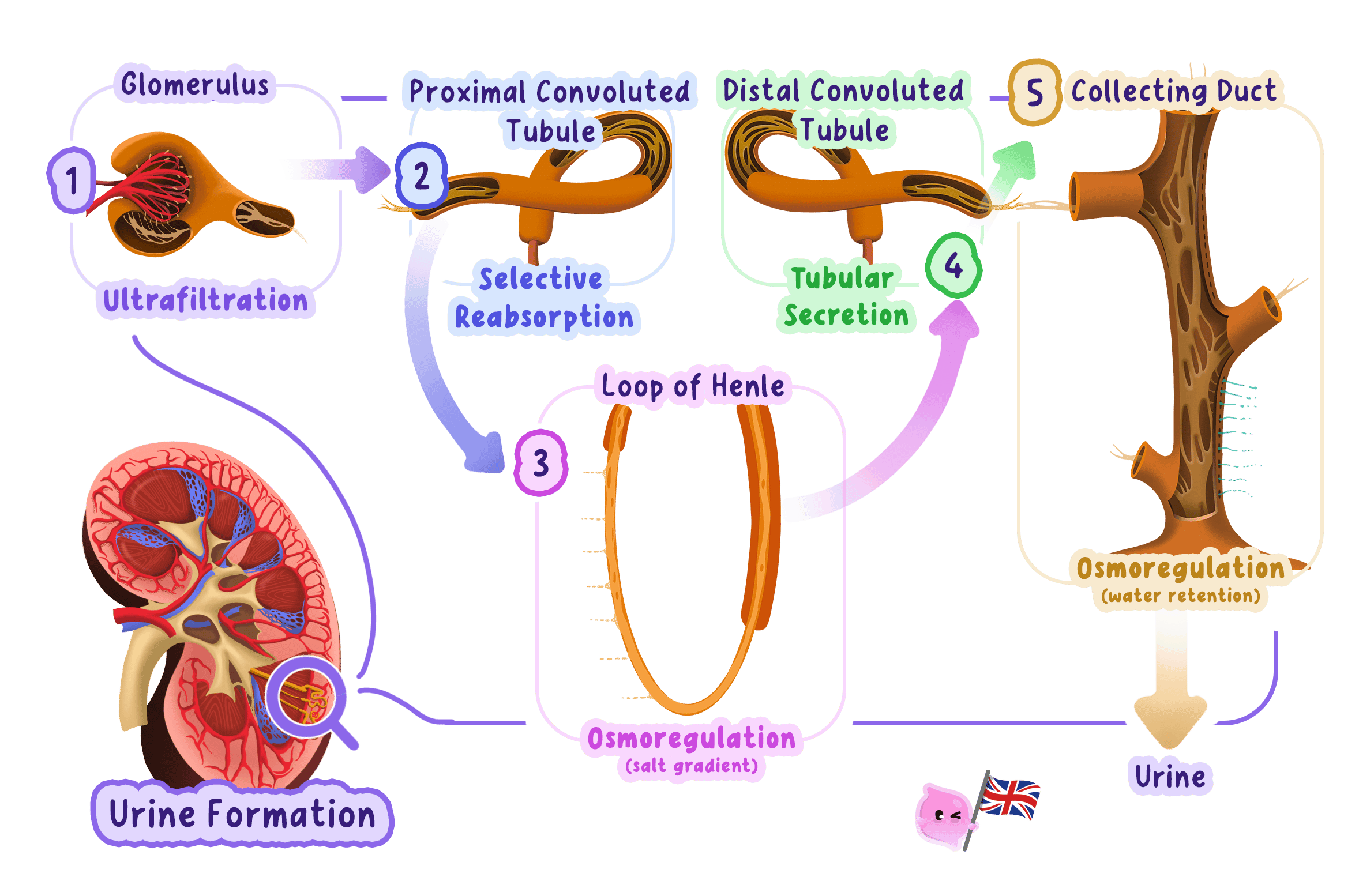
- Small molecules are filtered from the blood into kidney tubules, including water, glucose, ions and urea.
- Blood cells and large plasma proteins remain in the blood because they are too large to pass through the filtration barrier.
- Useful substances are reabsorbed from the tubules into the blood.
- All glucose is normally reabsorbed, together with the ions and water needed by the body.
- Urea, excess ions and excess water remain in the tubule fluid and form urine.
- The kidneys do not remove all water or all mineral ions from the blood.
- They vary the amounts excreted so the blood retains the water and ions the body needs.
Water shortage produces concentrated urine
- When the body is short of water, the kidneys reabsorb a larger proportion of the water from the tubule fluid.
- Less water remains to carry the dissolved urea and ions out of the body.
- The resulting urine has a small volume and a high concentration.
- This response reduces water loss but cannot prevent some water from being excreted because waste substances must still be removed.
- Dark urine can indicate concentration, although urine colour alone is not an exact measurement of hydration.
- After heavy sweating without drinking, water loss lowers the water content of the blood.
- The kidneys conserve water by producing a smaller volume of more concentrated urine.
Excess water produces dilute urine
- After a large water intake, the kidneys reabsorb a smaller proportion of the water from the tubule fluid.
- More water remains in the tubules and is excreted.
- The resulting urine has a large volume and a low concentration.
- Removing the excess water returns the water content of the blood towards its normal range.
- The concentration of urea in the urine changes with water content even if the amount of urea produced has not changed.
Urine data reveal kidney responses
- A water-conserving response is shown by lower urine volume and higher urine concentration.
- A water-removing response is shown by higher urine volume and lower urine concentration.
- When comparing results, use the same time interval because a volume collected over two hours cannot be compared directly with a volume collected over one hour.
- If urine production rate is required, calculate urine production rate=urine volumetime\text{urine production rate}=\dfrac{\text{urine volume}}{\text{time}}urine production rate=timeurine volume.
Link a water-balance answer through three stages: the body gains or loses water, the kidneys change water reabsorption, and urine changes in volume and concentration.
- What is osmoregulation?
- How do the kidneys respond to water shortage?
- What urine is produced after excess water intake?
- Why must some water still leave during dehydration?
- How is urine production rate calculated?
3.3.8 Structure of the kidney and tubule
The kidney contains an outer cortex and inner medulla
Nephron
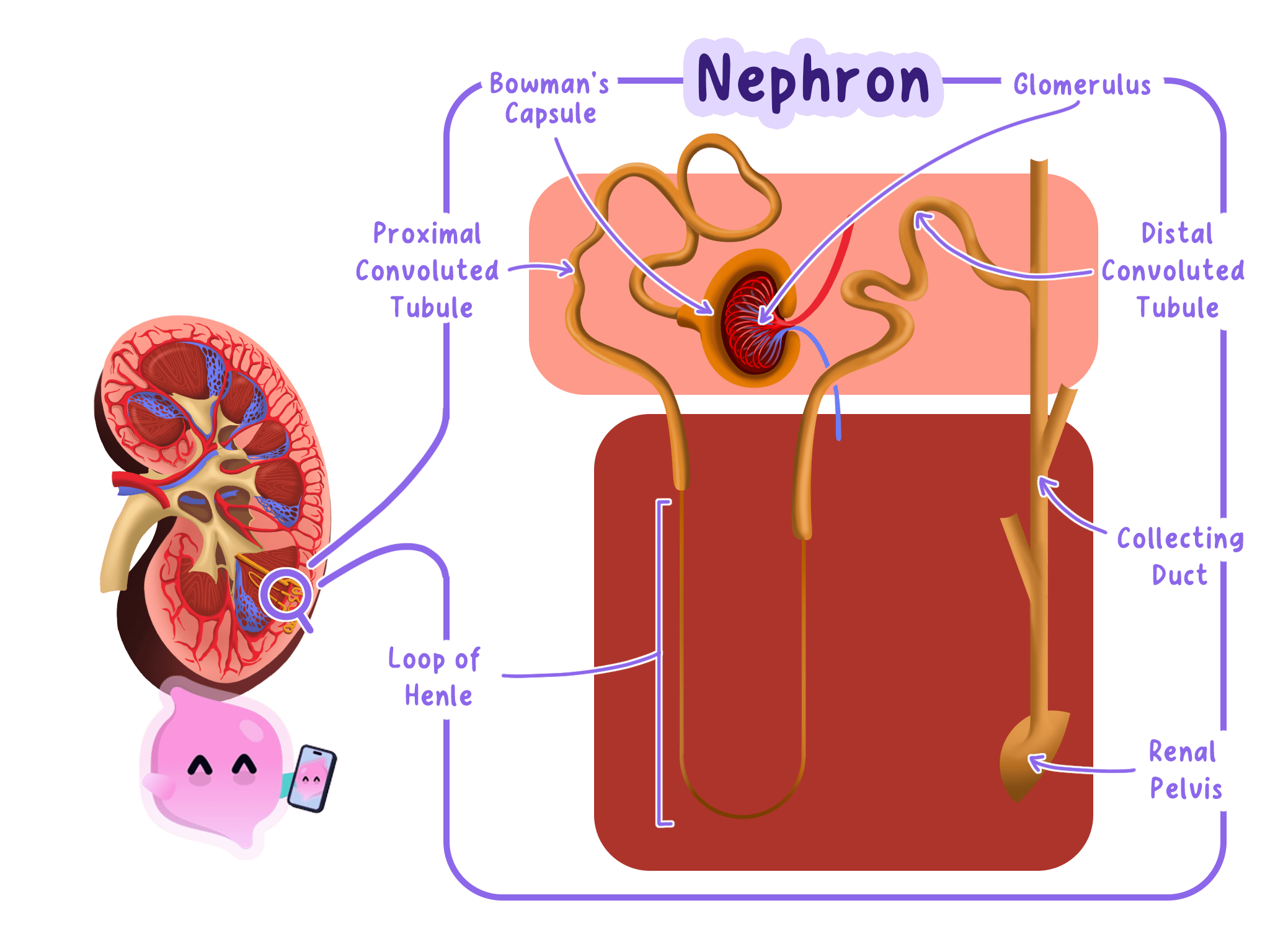
The tiny tubule that is the functional (filtering) unit of the kidney, where urine is made by ultrafiltration and selective reabsorption. Each kidney has about a million of them.
- Each kidney is supplied with blood by a renal artery and drained by a renal vein.
- The cortex is the outer region and contains the Bowman's capsules and convoluted parts of many nephrons.
- The medulla is the inner region and contains loops of Henlé and collecting ducts.
- The central renal pelvis collects urine before it passes into the ureter.
- The ureter carries urine from the kidney to the bladder, and the urethra carries urine from the bladder out of the body.
A nephron is the kidney tubule
Nephron
The tiny tubule that is the functional (filtering) unit of the kidney, where urine is made by ultrafiltration and selective reabsorption. Each kidney has about a million of them.
- A nephron is the microscopic filtering unit of a kidney.
- Each nephron begins with a cup-shaped Bowman's capsule surrounding a knot of capillaries called the glomerulus.
- The tubule then forms the proximal convoluted tubule, which is a tightly coiled section in the cortex.
- It continues as the loop of Henlé, which descends into the medulla and returns towards the cortex.
- The tubule joins a collecting duct, which passes through the medulla towards the renal pelvis.
- Many nephrons empty into the same collecting duct.
Bowman’s capsule receives the filtrate
Glomerulus
A tight knot of capillaries at the start of a nephron, inside the Bowman's capsule, where the blood is filtered under high pressure during ultrafiltration.
- The glomerulus receives blood through an afferent arteriole and drains through an efferent arteriole.
- Its capillary walls and the wall of Bowman's capsule form a filtration barrier.
- High pressure forces water and small dissolved molecules into Bowman's capsule.
- Blood cells and large plasma proteins remain inside the capillaries.
- The fluid entering the nephron is called the filtrate.
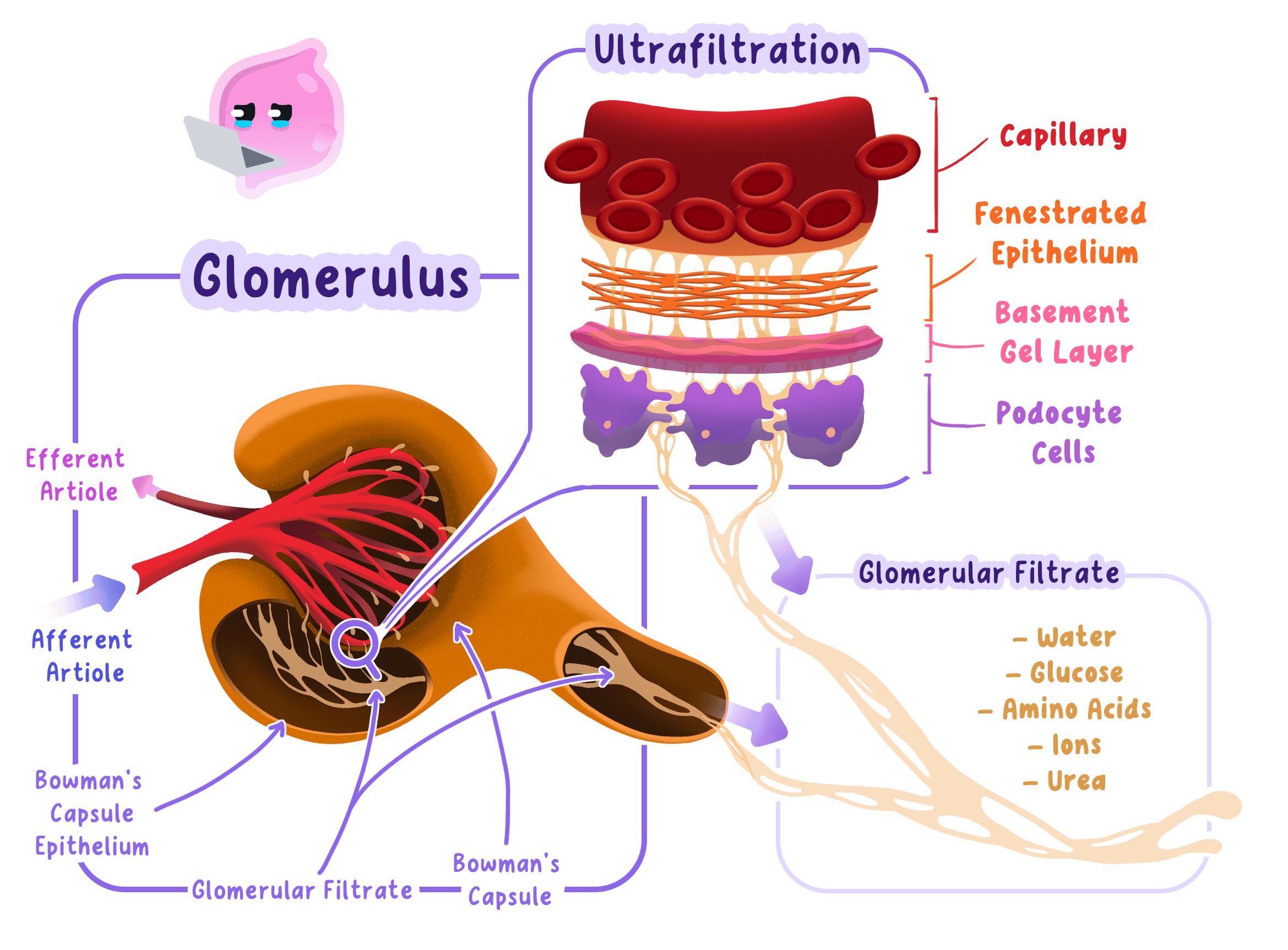
- Do not label the glomerulus as part of the tubule.
- The glomerulus is a capillary network enclosed by Bowman’s capsule.
Tubule regions have distinct positions
- The proximal convoluted tubule lies mainly in the cortex and is closely surrounded by capillaries.
- The loop of Henlé extends into the medulla before turning back towards the cortex.
- The collecting duct runs through the medulla and carries tubule fluid towards the renal pelvis.
- Blood capillaries run alongside the tubule, allowing substances and water to move between the filtrate and blood.
- Knowing the order of the regions helps trace the route taken by filtrate through the nephron.
- Bowman’s capsule→proximal convoluted tubule→loop of Henleˊ→collecting duct\text{Bowman's capsule} \rightarrow \text{proximal convoluted tubule} \rightarrow \text{loop of Henlé} \rightarrow \text{collecting duct}Bowman’s capsule→proximal convoluted tubule→loop of Henleˊ→collecting duct
On a nephron diagram, use shape and position: the cup is Bowman’s capsule, the first coil is the proximal convoluted tubule, the long hairpin is the loop of Henlé and the straighter tube is the collecting duct.
- Which kidney region contains Bowman’s capsules?
- What structures form the start of a nephron?
- What is the order of the named tubule regions?
- Which nephron region extends into the medulla?
- Where does the collecting duct carry the tubule fluid?
3.3.9 ADH and kidney tubule permeability
ADH changes kidney tubule permeability
ADH
Antidiuretic hormone: a hormone released from the pituitary gland that makes the kidney tubules and collecting duct more permeable to water, so more water is reabsorbed into the blood.
- ADH is antidiuretic hormone, a hormone that reduces water loss in urine.
- It is produced in the hypothalamus and released into the blood by the pituitary gland.
- ADH travels in the blood to the kidneys.
- Its target cells are in the later kidney tubules and collecting ducts.
More ADH increases water reabsorption
- ADH makes the walls of the kidney tubules and collecting ducts more permeable to water.
- More water therefore moves by osmosis from the tubule fluid into the surrounding tissue and then into the blood.
- Less water remains in the tubule fluid, so a smaller volume of more concentrated urine is produced.
- The reabsorbed water raises the water content of the blood towards normal.
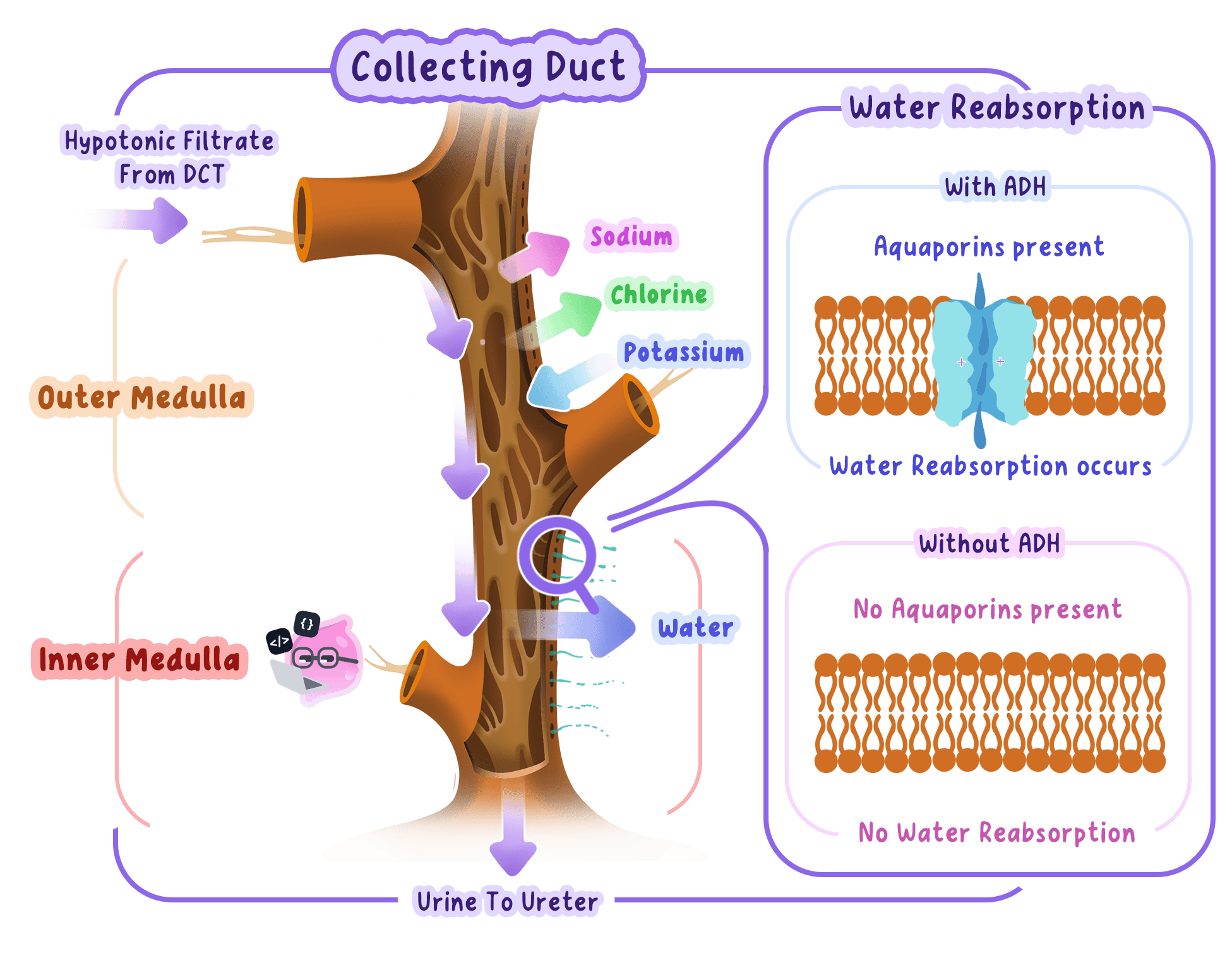
- ADH is carried to the kidneys in the blood and changes permeability.
- ADH does not travel down the kidney tubule and does not add water directly to the blood.
Less ADH reduces water reabsorption
- When less ADH is released, the tubule and collecting duct walls become less permeable to water.
- Less water leaves the tubule fluid by osmosis.
- More water remains in the tubule fluid, producing a larger volume of more dilute urine.
- Excreting the extra water lowers the water content of the blood towards normal.
- After drinking a large volume of water, less ADH is released.
- Kidney tubules become less permeable, less water is reabsorbed and a large volume of dilute urine is produced.
Negative feedback controls ADH release
Osmoregulatory centre
The region of the brain that monitors the water content of the blood and controls the amount of ADH released to keep it within narrow limits.
- The osmoregulatory centre in the hypothalamus monitors the water potential of the blood.
- When blood water potential falls, more ADH is released from the pituitary gland.
- More water is reabsorbed by the kidneys, raising blood water potential towards the normal level.
- As the normal level is restored, the stimulus for ADH release decreases, so less ADH is released.
- When blood water potential rises above normal, less ADH is released and more water is excreted.
- This response is negative feedback because it reverses the original change.
- For dehydration, link lower blood water potential to more ADH, greater tubule permeability, more water reabsorption and concentrated urine.
- For excess water, reverse every link in the chain.
- Where is ADH produced and released?
- How does ADH change kidney tubule permeability?
- What urine is produced when ADH concentration is high?
- What happens when less ADH is released?
- Why is ADH control a negative feedback system?
3.3.10 Responses to temperature and osmotic challenges
Heat and water challenges activate linked responses
Negative feedback
A control mechanism in which a change in a condition triggers a response that brings the condition back to normal.
- A challenge can disturb body temperature and water balance at the same time.
- Homeostatic systems use negative feedback to oppose each disturbance and return conditions towards their normal ranges.
- The response depends on the direction and size of the change rather than on a single fixed action.
- Temperature control changes heat production and heat loss, while osmoregulation changes thirst, ADH release and kidney water reabsorption.
Heavy sweating causes cooling and dehydration
- In hot conditions or during exercise, sweat secretion increases and evaporation transfers thermal energy away from the skin.
- Sweating removes water from the body, so blood volume falls and the water potential of the blood decreases.
- The osmoregulatory centre detects the lower blood water potential.
- The pituitary releases more ADH, making kidney tubules and collecting ducts more permeable to water.
- More water is reabsorbed into the blood, so a smaller volume of concentrated urine is produced.
- The thirst centre stimulates drinking, replacing water that cannot be recovered by the kidneys.
- If dehydration becomes severe, reduced sweating limits further water loss but also reduces evaporative cooling, increasing the risk of overheating.
- A runner on a hot day loses both heat and water through sweat.
- Vasodilation and sweating control temperature, while thirst and increased ADH reduce the fall in body water.
Excess water intake increases water excretion
- Drinking a large volume of water raises the water potential of the blood and dilutes its dissolved substances.
- The osmoregulatory centre detects the rise in water potential.
- Less ADH is released, so the kidney tubules and collecting ducts become less permeable to water.
- Less water is reabsorbed into the blood and more remains in the tubule fluid.
- A large volume of dilute urine is produced, removing the excess water.
- As blood water potential returns towards normal, ADH release returns towards its usual level.
High salt intake draws water from cells
- Eating a salty meal increases the concentration of dissolved ions in the blood and lowers blood water potential.
- Water moves from body cells into the blood by osmosis, so cells may lose water and shrink.
- The lower blood water potential stimulates thirst and increases ADH release.
- Drinking adds water to the blood and helps dilute the excess salt.
- Increased ADH causes more water reabsorption, producing a smaller volume of concentrated urine.
- The kidneys also excrete excess ions, but water is required to carry them out in urine.
- Once water potential returns towards normal, thirst and ADH release decrease.
- Do not say that salt directly removes water from the body.
- A high salt concentration lowers water potential, so water moves out of cells by osmosis and the body responds by conserving and seeking water.
Extended answers must connect both systems
- A complete response to a combined challenge identifies the initial change, the receptor or control centre, the effectors and the effect on the controlled condition.
- For heat, name sweating, vasodilation or shivering and explain how each changes heat transfer or production.
- For water balance, name thirst, ADH, kidney tubule permeability, water reabsorption and urine concentration.
- Finish by showing how the response returns temperature or water potential towards the normal range.
- When a scenario includes both heat and water loss, write two linked chains rather than blending the mechanisms together.
- Sweating explains cooling, while ADH and kidney responses explain water conservation.
- How can heavy sweating disturb two controlled conditions?
- Why does dehydration increase ADH release?
- What kidney response follows excess water intake?
- Why does a salty meal make cells lose water?
- How do thirst and the kidneys work together after dehydration?
